

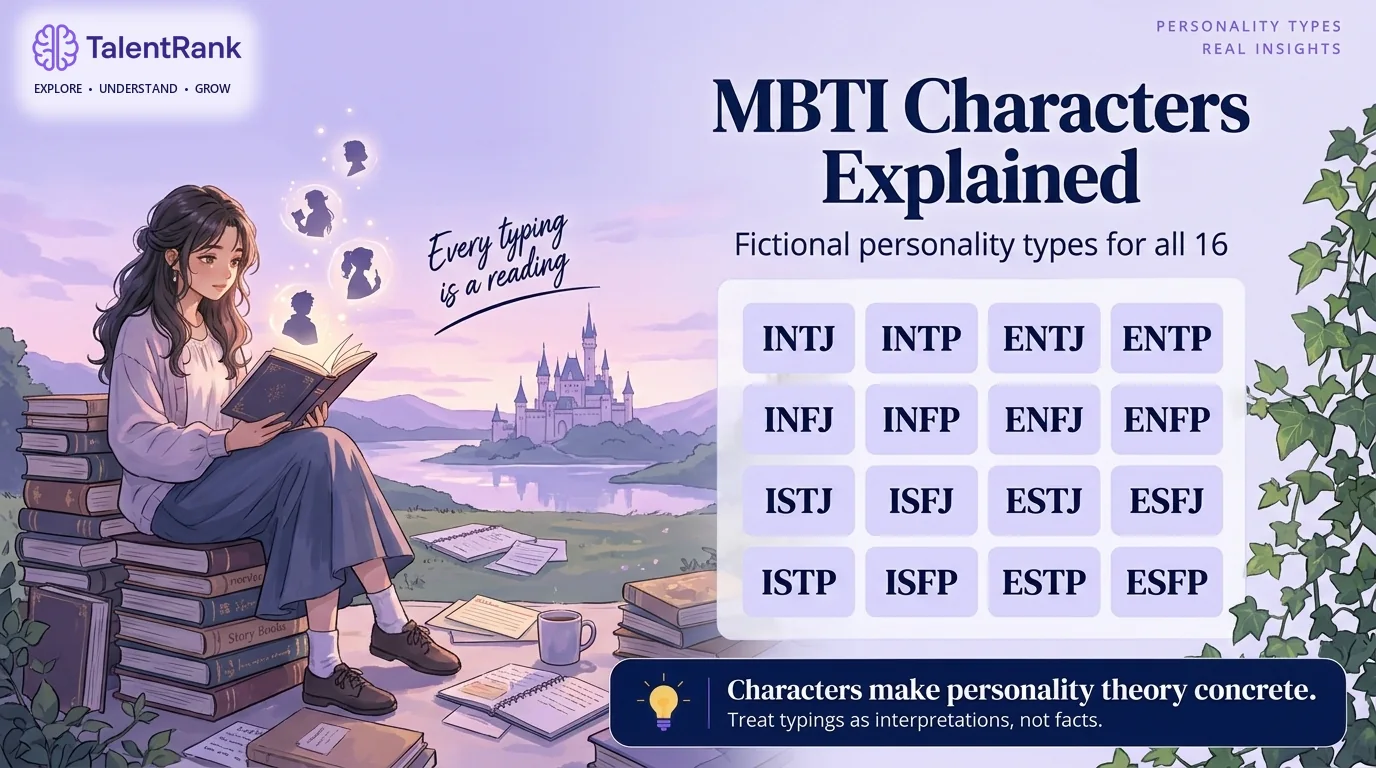
MBTI characters are fictional characters that fans, writers, and personality communities have typed using the Myers-Briggs framework. Luffy gets typed ESFP, Hermione gets argued between ESTJ and ISTJ, L from Death Note is a go-to INTP, and Samwise Gamgee shows up on nearly every ISFJ list. Typing characters is a popular way to explore personality theory, because a well-written story shows someone's choices in detail over time.
There's a catch, though. No fictional character has ever taken an MBTI assessment. Every typing is an interpretation, and serious fans disagree all the time. This guide explains how character typing works, lists commonly cited examples for all 16 types, and shows you how to judge a typing for yourself.
How Characters Get Typed
The MBTI describes four pairs of preferences: Extraversion or Introversion, Sensing or Intuition, Thinking or Feeling, and Judging or Perceiving. The Myers-Briggs Foundation's descriptions focus on where attention goes, how people take in information, how they decide, and how they approach structure.
When fans type a character, they're looking for evidence of those preferences in the story:
Where the character's energy goes: toward people and action, or inward.
What kind of information they trust: concrete facts and experience, or patterns and possibilities.
How they make big decisions: by logic and results, or by values and people.
How they handle plans: pushing for structure, or keeping options open.
The strongest typings look at repeated choices across the whole story, especially under pressure. The weakest ones rely on a single trait, like "quiet" or "smart", which many types can share.
MBTI Characters for All 16 Types
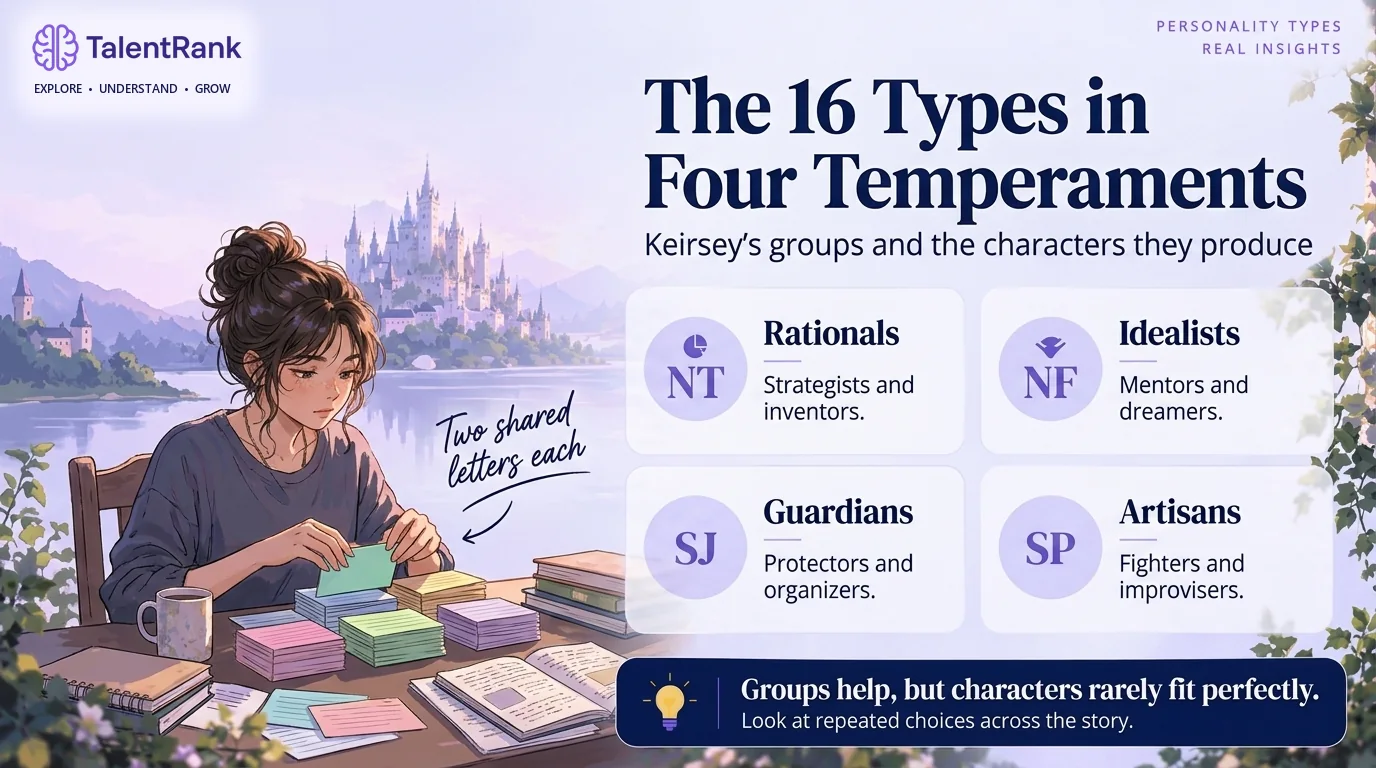
The examples below are commonly cited typings. They're interpretations, not official results. Where TalentRank has a full guide for a type, it's linked in the table. The types are grouped using the four temperaments described by psychologist David Keirsey: Rationals, Idealists, Guardians, and Artisans. (Keirsey) Each group shares two middle letters.
Rationals (NT Types)
Type | Commonly typed examples | Full guide |
INTJ | Lelouch Lamperouge, Light Yagami, Beth Harmon | |
INTP | L Lawliet, Senku Ishigami, Shikamaru Nara | |
ENTJ | Erwin Smith, Roy Mustang, Tywin Lannister | |
ENTP | Tony Stark, Jack Sparrow (debated with ESTP) | No full guide yet |
NT characters are usually the strategists, inventors, and schemers. They're driven by competence and ideas, which is why so many anime masterminds end up typed INTJ or INTP.
Idealists (NF Types)
Type | Commonly typed examples | Full guide |
INFJ | Armin Arlert, Itachi Uchiha, Remus Lupin | |
INFP | Frodo Baggins, Mob (Mob Psycho 100) | |
ENFJ | Mufasa, Moana, Elle Woods | |
ENFP | Anne Shirley, Jo March, Rapunzel, Aang |
NF characters are often the heart of their stories: mentors, dreamers, and people fighting for what they believe in.
Guardians (SJ Types)
Type | Commonly typed examples | Full guide |
ISTJ | Kento Nanami, Ned Stark, Raymond Holt | |
ISFJ | Samwise Gamgee, Neville Longbottom, Hinata Hyuga | |
ESTJ | Tenya Iida, Erza Scarlet, Dwight Schrute | |
ESFJ | Monica Geller, Molly Weasley, Ochaco Uraraka |
SJ characters keep their worlds running: the dutiful, the loyal, the organizers, and sometimes the rule-bound villains.
Artisans (SP Types)
Type | Commonly typed examples | Full guide |
ISTP | Levi Ackerman, Arya Stark, Katniss Everdeen | No full guide yet |
ISFP | Zuko, Eleven, Eren Yeager | |
ESTP | Han Solo, Katsuki Bakugo, Inosuke Hashibira | |
ESFP | Monkey D. Luffy, Shoyo Hinata, Peter Quill |
SP characters live in the moment: fighters, adventurers, and improvisers who act first and figure out the rest later.
Why Fans Disagree About Character Types
The same character can end up with three or four different typings. Some common reasons:
Adaptations differ. A character in a novel may think out loud on the page, while the film version shows only actions.
Writers aren't writing to a type. Characters change to fit the plot, which can create inconsistent evidence.
Stereotypes creep in. "Smart and cold" gets typed INTJ, "bubbly" gets typed ENFP, even when the character's decisions point elsewhere.
Growth arcs change behavior. A shy character in season one may be confident by season four.
Fans project. People often type favorite characters as their own type.
That's why debated cases like Hermione Granger (ESTJ or ISTJ), Naruto (ESFP or ENFP), and Leslie Knope (ESFJ or ENFJ) are useful. They show where the framework's categories blur.
Common Mistakes When Typing Characters
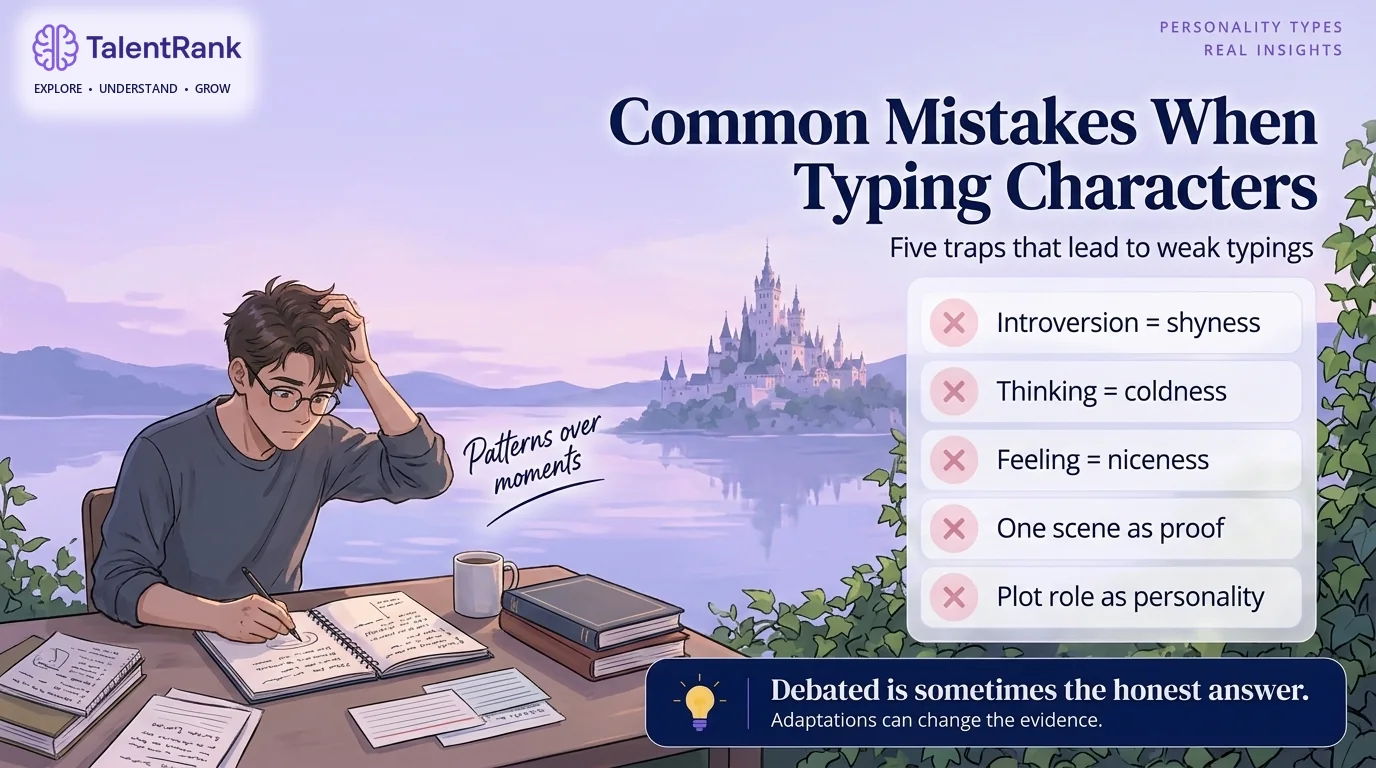
Treating introversion as shyness. Introversion is about where energy goes, not social skill.
Treating Thinking as coldness. Thinking characters can be warm; they just decide by logic.
Treating Feeling as niceness. Feeling characters can be harsh when their values are threatened.
Using one iconic scene as proof. Patterns across the story matter more than a single moment.
Confusing plot role with personality. The mentor isn't always INFJ, and the villain isn't always INTJ.
How to Type a Character Yourself
Watch or read the whole arc, not just highlights.
List the character's biggest decisions and what drove each one.
Ask how they take in information: concrete details, or patterns and possibilities?
Check how they handle plans and surprises.
Compare against the two or three most likely types, and note the evidence for each.
Hold your answer loosely. If the evidence is split, "debated" is an honest result.
MBTI, 16Personalities, and the Big Five
You'll often see characters labeled with a fifth letter, like "INFJ-T". That suffix comes from 16Personalities, which adds an Identity scale (Assertive or Turbulent) and builds its model on Big Five research rather than Myers-Briggs theory. (16Personalities) It's a different system from the official MBTI.
The Big Five traits, openness, conscientiousness, extraversion, agreeableness, and neuroticism, are widely used in personality research. They describe traits on a spectrum instead of sorting people into types. (Our comparison of the Big Five and MBTI explains the difference.)
Explore Your Own Personality Traits
Typing characters is a fun way to learn the framework, and it often leads people to wonder where they fit. The TalentRank assessment measures your Big Five personality traits and takes about 12 to 15 minutes. It won't assign you an MBTI type or match you to a character, but it gives you a clearer, research-based picture of your own tendencies. Take the TalentRank assessment.
Frequently Asked Questions About MBTI Characters
What are MBTI characters?
MBTI characters are fictional characters that fans and writers have typed using the Myers-Briggs framework. These typings are interpretations based on a character's choices and behavior, not official test results.
Which MBTI type is most common among anime characters?
There's no reliable count. Fan communities often type anime protagonists as ESFP, ENFP, or ISFP, and masterminds as INTJ or INTP, but those patterns partly reflect stereotypes and story roles.
Can fictional characters really have an MBTI type?
Not officially. Characters can't take an assessment, and writers rarely create them with a type in mind. Typing them is a way to discuss personality, not a scientific finding.
Why do characters have different types on different sites?
Fans weigh evidence differently, adaptations vary, and stereotypes influence typing. Debated characters often sit between two closely related types.
What does the -A or -T after a character's type mean?
It comes from 16Personalities, not the official MBTI. It refers to an Identity scale (Assertive or Turbulent) that stories rarely show clearly.
How do I find my own type?
Character typing can spark ideas, but it's not a substitute for a real assessment. A trait-based measure like the Big Five gives a more detailed picture than a character comparison.
The Takeaway
MBTI characters make personality theory feel concrete. Luffy, Samwise, L, and Hermione are easier to discuss than abstract definitions. Use typings as a starting point for conversation, look for consistent evidence across a story, and remember that the most interesting characters, like the most interesting people, rarely fit perfectly into four letters.