

Han Solo, Katsuki Bakugo, Inosuke Hashibira, Dean Winchester, Thor, and Scarlett O'Hara are some of the fictional characters most often typed as ESTP. They're the ones who act first, read a situation fast, take risks others won't, and usually talk their way out of the trouble they talked their way into.
These typings are interpretations. No fictional character has taken an MBTI assessment, and fans often disagree. This guide explains why each character gets read as ESTP, where the case is weaker, and how to judge an ESTP typing for yourself.
Quick List of ESTP Characters
The confidence labels below reflect how strong the case is in this article's reading. They aren't test scores.
Character | Work | Medium | Interpretation | Why it's plausible |
Han Solo | Star Wars | Film | Stronger case | Risk-taker, improvises, trusts his own skill over plans |
Katsuki Bakugo | My Hero Academia | Anime/manga | Stronger case | Competitive, direct, sharp tactical reading in fights |
Inosuke Hashibira | Demon Slayer | Anime/manga | Stronger case | Charges in headfirst, physical, instinct-driven |
Dean Winchester | Supernatural | TV | Stronger case | Action-oriented, blunt, practical under pressure |
Scarlett O'Hara | Gone with the Wind | Novel/film | Stronger case | Pragmatic, bold, focused on survival and results |
Thor | Marvel films | Film | Plausible | Brash, physical, learns through consequences |
Gaston | Beauty and the Beast (1991) | Animated film | Plausible | Physical confidence, crowd-driven, impulsive |
Jack Sparrow | Pirates of the Caribbean | Film | Debated | Often typed ESTP or ENTP |
What Makes a Character Seem ESTP?
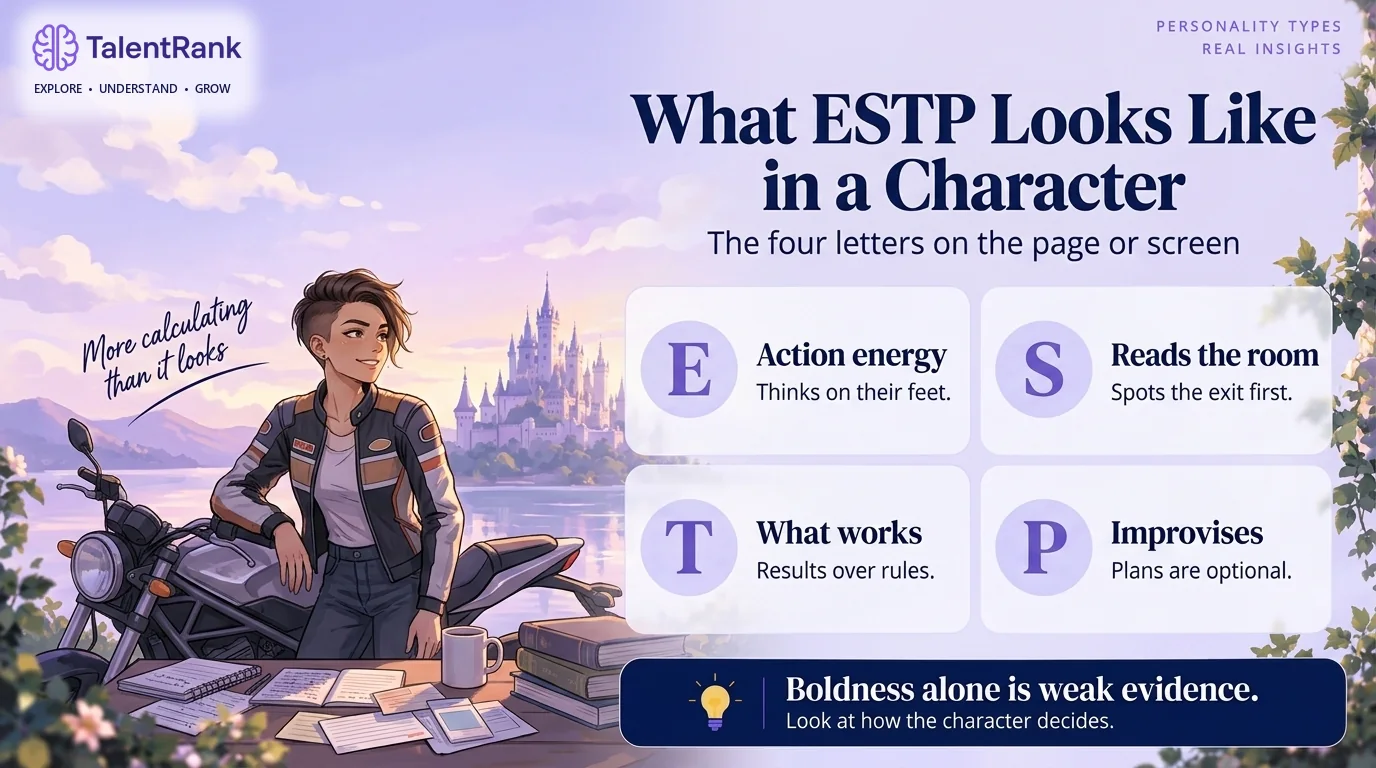
ESTP stands for Extraversion, Sensing, Thinking, and Perceiving. The official MBTI preference descriptions are more specific than the "reckless adrenaline junkie" stereotype, and each letter is easy to misread in fiction.
Extraversion Means Energy From Action and People
Extraversion describes where attention and energy go: outward, toward people and activity. ESTP characters tend to think on their feet and in conversation, and they get restless when things go quiet. (See TalentRank's E vs. I guide.)
Sensing Means Reading the Room Fast
Sensing is a preference for concrete, immediate information. In ESTP characters, it often shows up as sharp situational awareness: spotting the exit, sizing up an opponent, noticing who's bluffing. (More in our sensing vs. intuition guide.)
Thinking Means Deciding on What Works
Thinking means decisions are weighed by logic and results. ESTP characters are usually pragmatic: they do what gets the job done, even if it bends a rule or hurts a feeling.
Perceiving Means Improvising
Perceiving is a preference for keeping options open. ESTP characters rarely follow a plan to the letter. They adapt as things change, which makes them dangerous in a fight and frustrating in a meeting.
ESTP Anime Characters
Katsuki Bakugo, My Hero Academia
Bakugo is loud, aggressive, and intensely competitive, especially with Izuku Midoriya. Behind the temper is a fighter who reads opponents quickly and adapts his explosive quirk on the fly. His blunt, results-focused way of speaking and his hunger to win support an ESTP reading. His growth, learning to work with others and to acknowledge Midoriya, shows the type isn't frozen.
Inosuke Hashibira, Demon Slayer
Raised by boars and wearing a boar's head as a mask, Inosuke fights with two jagged swords and charges in without hesitation. He relies on his heightened sense of touch to track enemies, which fits the Sensing emphasis on direct, physical information. His competitiveness and impulsiveness make him one of the clearest ESTP examples in recent anime.
ESTP Characters in Movies and TV
Han Solo, Star Wars
Han is a smuggler who trusts his ship, his blaster, and his own reflexes more than anyone's plan. "Never tell me the odds" sums up his approach: he flies the Millennium Falcon into an asteroid field because it's the move that works right now. His return at the Battle of Yavin shows that his pragmatism has a loyal core.
Dean Winchester, Supernatural
Dean is a hunter who solves problems with action, his car, and a shotgun. He's blunt, practical, and quick to read a dangerous situation. His fierce protectiveness of his brother Sam adds emotional depth, but his default mode is to do something rather than talk about it.
Thor, Marvel Films
In his first film, Thor is brash and impulsive enough to launch an attack on Jotunheim, which gets him banished. He learns through consequences rather than advice, which fits the ESTP pattern of learning by doing. Later films soften him with humor and loss, but the core physical, in-the-moment approach remains.
Gaston, Beauty and the Beast (1991)
Gaston is Disney's ESTP gone wrong: physically confident, crowd-pleasing, and completely driven by what he wants in the moment. He's a useful reminder that fiction often uses ESTP traits for villains as well as heroes.
Jack Sparrow, Pirates of the Caribbean (Debated)
Jack improvises his way out of almost every situation, which supports ESTP. But his schemes often depend on long cons and unusual ideas, which leads many fans to type him ENTP instead. He's a good test case for the Sensing versus Intuition question.
ESTP Characters in Books
Scarlett O'Hara, Gone with the Wind
Scarlett is bold, pragmatic, and determined to survive. When war and poverty threaten Tara, she does whatever works, from marrying for money to running a business herself, which shocked her society. Her famous line, "Tomorrow is another day", reflects a focus on what can be done next rather than on dwelling.
How to Evaluate Whether a Character Fits ESTP
Boldness and risk-taking alone are weak evidence. Plenty of characters are reckless. A stronger case looks for patterns:
Situational awareness: does the character read people and surroundings quickly?
Pragmatic decisions: do they choose what works over what's proper?
Learning by doing: do they grow through experience rather than reflection?
Improvisation under pressure: do they adapt when plans fall apart?
Consistency across versions: does the reading hold in the book, film, and show?
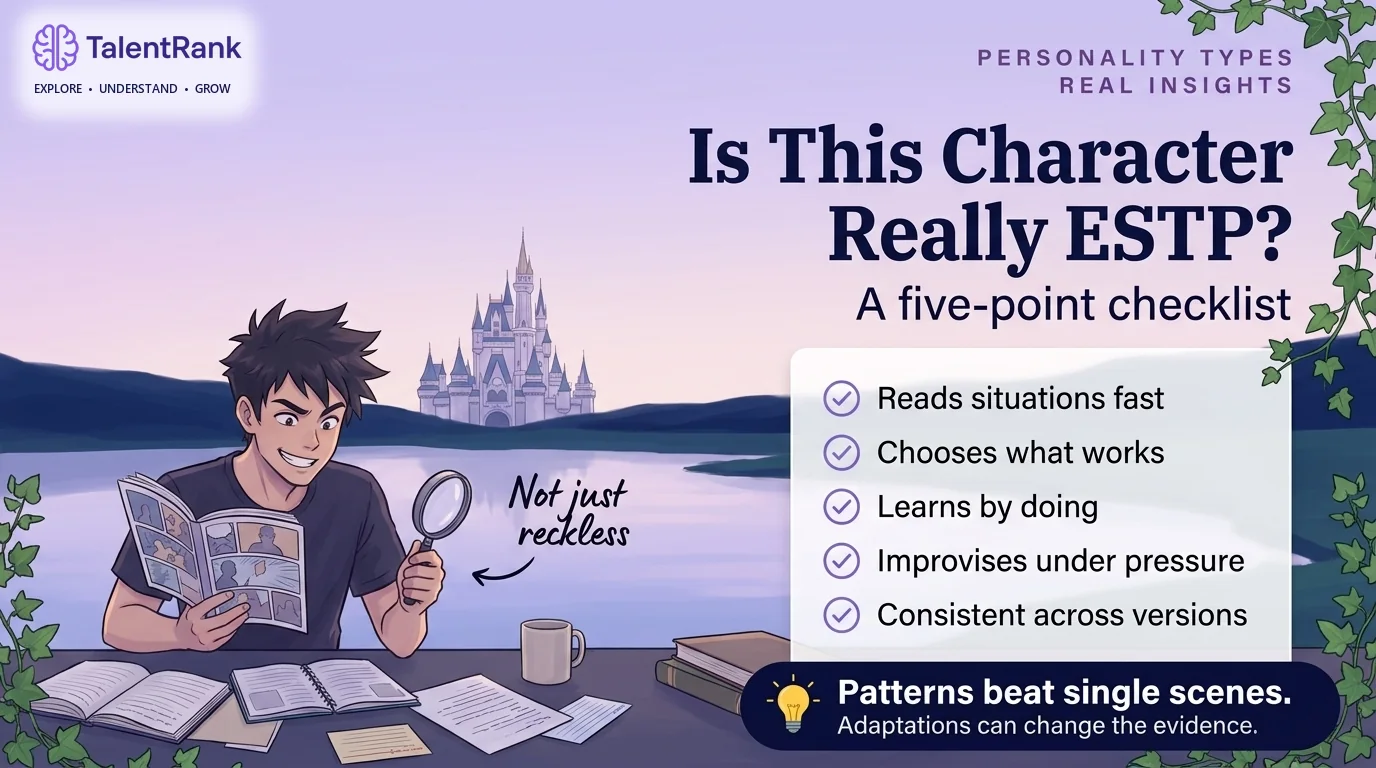
If a character fits several of these, an ESTP reading is plausible. If they're only "reckless and cocky", the case is thin.
ESTP or Another Type?
ISTP characters share the practical, physical approach but are more reserved and independent.
ESFP characters share the action and spontaneity but decide more by feelings and people. See our ESFP characters guide for comparison.
ENTP characters share the improvisation and wit but lean on ideas and long-range schemes rather than immediate action.
ENTJ characters share the confidence but plan much further ahead. Our ENTJ characters guide covers them.
ESTP-T Characters and What Fiction Can Show
The -A and -T suffixes come from 16Personalities, which adds a fifth scale called Identity and builds its model on Big Five research. (16Personalities) They aren't part of the official MBTI. A story rarely offers enough consistent evidence to judge that trait in a character.
Explore Your Own Personality Traits
Typing characters can be a fun way to think about your own patterns. The TalentRank assessment goes further by measuring your Big Five personality traits, such as extraversion, openness, and conscientiousness. It takes about 12 to 15 minutes and won't confirm an MBTI type, but it gives you a more detailed picture of how you tend to think and act. Take the TalentRank assessment.
Frequently Asked Questions About ESTP Characters
What fictional characters are ESTP?
Characters commonly typed as ESTP include Han Solo, Katsuki Bakugo, Inosuke Hashibira, Dean Winchester, Thor, Scarlett O'Hara, and Gaston. These are interpretations, not official typings.
Who are some ESTP anime characters?
Katsuki Bakugo from My Hero Academia and Inosuke Hashibira from Demon Slayer are two of the strongest examples.
Is Jack Sparrow ESTP or ENTP?
Both are argued. The ESTP reading emphasizes his improvisation in the moment; the ENTP reading emphasizes his elaborate schemes and unconventional ideas.
Are ESTP characters always reckless?
No. Fiction often plays up recklessness, but characters like Han Solo and Scarlett O'Hara show that ESTP boldness usually comes with sharp practical judgment.
Can ESTP characters be villains?
Yes. Gaston is a classic example of ESTP traits used for a villain: confidence and impulsiveness without concern for others.
The Takeaway
ESTP characters tend to act fast, read situations well, and trust what works over what's expected. Han Solo, Bakugo, Inosuke, and Scarlett O'Hara all show that pattern. Treat every typing as an interpretation, look for consistent evidence across the story, and remember that bold characters are often more calculating than they look.