

Monkey D. Luffy, Shoyo Hinata, Anna from Frozen, Peter Quill, Joey Tribbiani, and Andy Dwyer are some of the fictional characters most often typed as ESFP. What links them is how they take in the world and make choices. They respond to what's happening right now, they read people quickly, and they act on what feels right rather than on a long-range plan.
Keep in mind that these are interpretations. No fictional character has taken an MBTI assessment, and fan communities often disagree. The goal here is to show why each typing makes sense, where it's shaky, and how to judge an ESFP character for yourself.
Quick List of ESFP Characters
The confidence labels below reflect how strong the case is in this article's reading. They aren't test scores.
Character | Work | Medium | Interpretation | Why it's plausible |
Monkey D. Luffy | One Piece | Anime/manga | Stronger case | Acts in the moment, fierce loyalty, instinct over planning |
Shoyo Hinata | Haikyuu!! | Anime/manga | Stronger case | Physical, reactive, driven by the thrill of the game |
Peter Quill | Guardians of the Galaxy | Film | Stronger case | Improvises under pressure, uses charm and music to cope |
Joey Tribbiani | Friends | TV | Stronger case | Lives for food, fun, and friends; warm, present-focused |
Andy Dwyer | Parks and Recreation | TV | Stronger case | Enthusiastic, spontaneous, big-hearted |
Anna | Frozen | Animated film | Plausible | Impulsive, affectionate, acts on feeling |
Lydia Bennet | Pride and Prejudice | Novel | Plausible | Pleasure-seeking, social, careless of consequences |
Naruto Uzumaki | Naruto | Anime/manga | Debated | Often typed ESFP or ENFP |
Rachel Green | Friends | TV | Debated | Often typed ESFP or ESFJ |
What Makes a Character Seem ESFP?
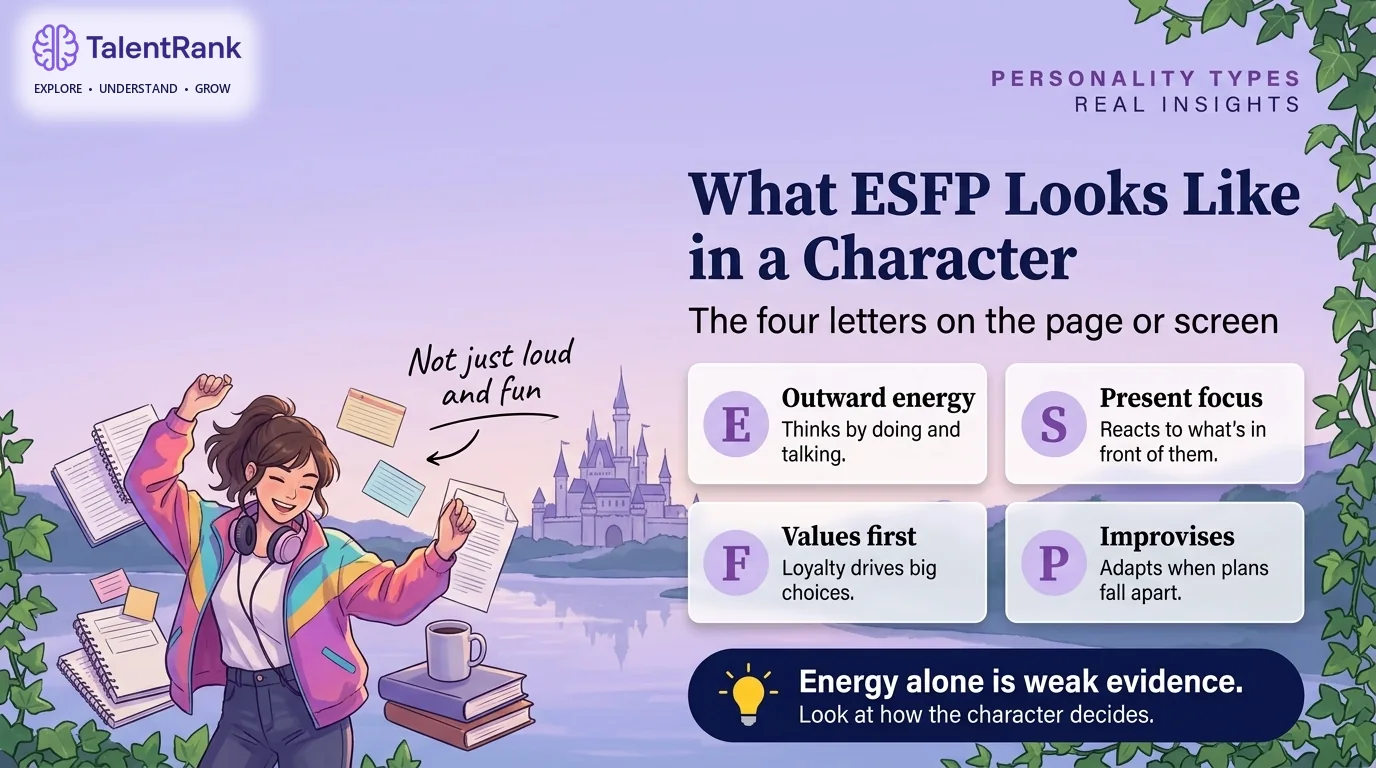
ESFP stands for Extraversion, Sensing, Feeling, and Perceiving. The official MBTI preference descriptions are more specific than the stereotypes, and each letter is easy to misread in fiction.
Extraversion Isn't the Same as Being Loud
Extraversion describes where someone directs attention and draws energy: the outer world of people and activity. A character can be noisy for comedic reasons without being extraverted in this sense. Look for characters who think by doing and talking, and who get restless when cut off from people. (TalentRank's E vs. I guide covers the difference.)
Sensing Means Grounded in the Present
Sensing is a preference for concrete, immediate information: what's happening, what you can see, touch, and act on. ESFP characters tend to notice physical details, react quickly, and trust experience over theory. That doesn't make them shallow. It means they solve problems with what's in front of them. (More in our sensing vs. intuition guide.)
Feeling Isn't Just Being Nice
Feeling means decisions are weighed by their effect on people and values. ESFP characters often have a strong personal code, even if they rarely explain it. Luffy doesn't calculate whether saving a friend is worth the risk. He just goes.
Perceiving Means Flexible, Not Lazy
Perceiving is a preference for keeping options open and adapting as things unfold. ESFP characters usually improvise instead of planning. The key question is whether that flexibility shows up consistently when the stakes rise.
ESFP Anime Characters
Monkey D. Luffy, One Piece
Luffy wants to become King of the Pirates, but he rarely plans how. He decides by instinct, fights for friends without hesitation, and gets distracted by food, adventure, and anything new. His loyalty is the strongest piece of evidence: his choices are driven by people he cares about, not by strategy. The Sensing case rests on how directly he reacts to what's in front of him rather than to abstract possibilities.
Shoyo Hinata, Haikyuu!!
Hinata is short for a volleyball spiker, and he compensates with speed, jumping, and sheer enthusiasm. He learns physically, by doing, and he's energized by the crowd and the rush of a point. His quick attack with Kageyama depends on reacting in the moment rather than reading the play in advance. Some fans type him ENFP, but his focus on concrete physical skill supports Sensing.
Naruto Uzumaki, Naruto (Debated)
Naruto is often typed ESFP for his impulsiveness, his need for attention, and his tendency to charge into fights. Others argue for ENFP, pointing to his dream of becoming Hokage and his talent for seeing potential in people others have written off. Both readings are defensible, which makes him a useful test case rather than a clean example.
ESFP Characters in Movies and TV
Peter Quill, Guardians of the Galaxy
Quill improvises constantly. His most famous moment, challenging Ronan to a dance-off to buy his team time, is pure in-the-moment thinking. He uses music, humor, and charm to handle stress, and his attachment to his mother's mixtape shows how much his feelings drive him.
Joey Tribbiani, Friends
Joey loves food, acting, and his friends, roughly in that order. He's warm, generous, and entirely focused on the present. He struggles with abstract ideas but cares deeply about his friends. He's also a good reminder that fiction exaggerates: the show plays his traits for laughs, which isn't the same as showing what ESFPs are really like.
Andy Dwyer, Parks and Recreation
Andy throws himself into whatever grabs him: his band, a shoeshine stand, becoming Johnny Karate on a kids' show. He's affectionate, spontaneous, and easily delighted. His growth over the series, from aimless to more responsible, shows that ESFP characters can mature without losing their energy.
Anna, Frozen
Anna gets engaged to Hans the day she meets him and heads into a snowstorm to find Elsa without much of a plan. She's affectionate, brave, and led by her feelings. Her final choice to save Elsa instead of herself is a Feeling decision in the clearest sense.
Rachel Green, Friends (Debated)
Rachel starts the series by running out of her own wedding, which feels spontaneous and ESFP-like. But her attention to social harmony, her fashion career, and her concern with how others see her lead some fans to type her ESFJ.
ESFP Characters in Books
Lydia Bennet, Pride and Prejudice
Lydia, the youngest Bennet sister, lives for balls, officers, and excitement. Her elopement with Wickham shows the risky side of a present-focused, pleasure-seeking character with no one to rein her in. She's a reminder that fiction often uses ESFP traits for cautionary tales, too.
How to Evaluate Whether a Character Fits ESFP
Energy and humor alone are weak evidence. A stronger case looks at patterns across the story:
Present-focused decisions. Does the character react to what's in front of them more than to long-range plans?
Concrete skills. Do they solve problems physically or practically rather than theoretically?
Values-driven choices. When it matters, do they choose based on people and loyalty?
Improvisation under pressure. Do they adapt on the fly when plans fall apart?
Consistency across adaptations. Does the reading hold up in the book, show, and film versions?
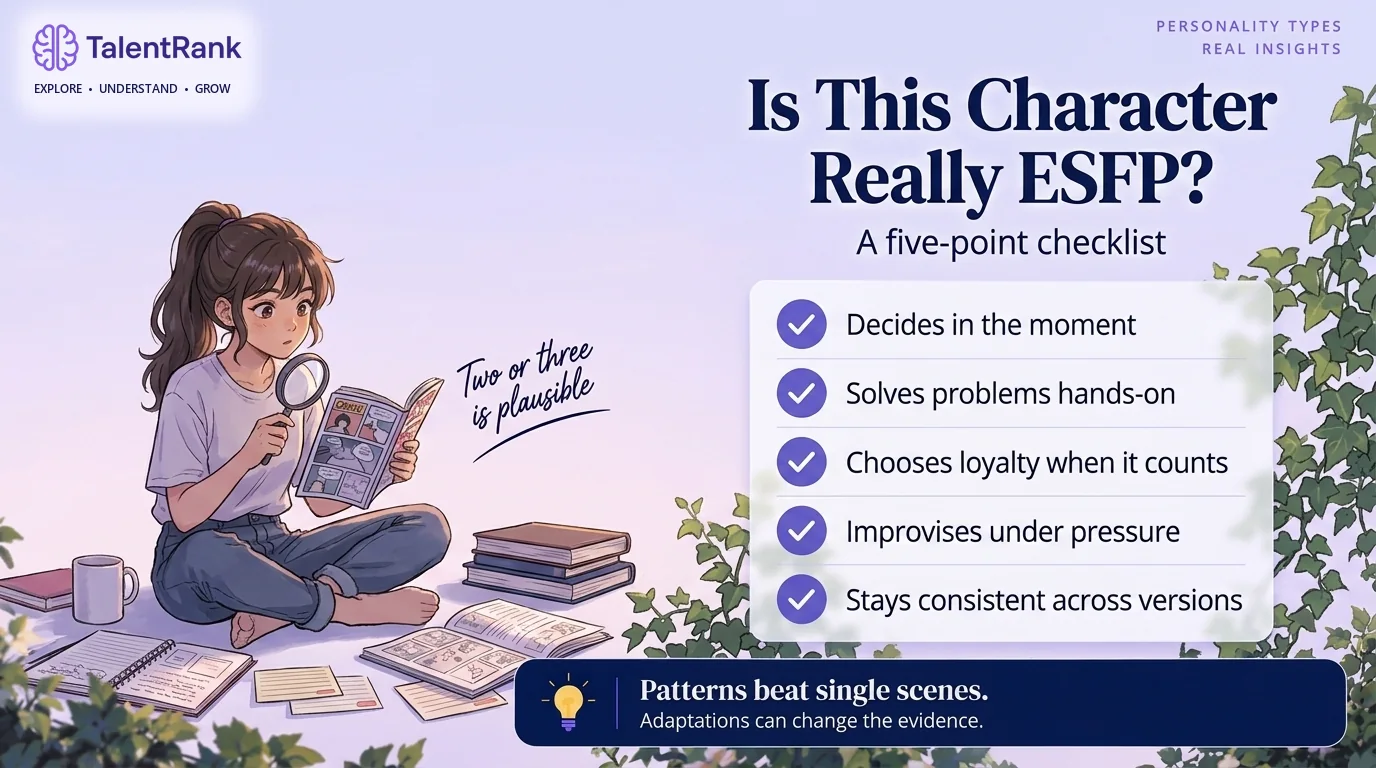
If a character fits two or three of these, the typing is plausible. If they fit only the "fun and loud" stereotype, it's probably a weak case.
ESFP or Another Type?
ESTP characters share the action and spontaneity, but decide more by logic and tactics. Jack Sparrow, a schemer who improvises his way out of trouble, is more often typed ESTP or ENTP.
ENFP characters share the warmth and enthusiasm, but focus more on possibilities and ideas. See our ENFP characters guide for comparison.
ISFP characters share the Sensing and Feeling, but are quieter and more private. Our ISFP characters guide covers them.
ESFP-T Characters and Why Fiction Can't Settle It
The -A and -T suffixes come from 16Personalities, which adds a fifth scale called Identity and bases its model on Big Five research. (16Personalities) They're not part of the official MBTI. Fans sometimes label characters who worry more or doubt themselves as "ESFP-T", but a story rarely gives enough consistent evidence to judge a trait like that.
Explore Your Own Personality Traits
Typing characters is fun, and it can help you think about your own patterns. But four letters are a rough summary. The TalentRank assessment measures your Big Five personality traits, like extraversion, openness, and conscientiousness, and takes about 12 to 15 minutes. It won't confirm an MBTI type. It gives you a more detailed picture of your own tendencies. Take the TalentRank assessment. For more on the type itself, see our ESFP personality type guide.
Frequently Asked Questions About ESFP Characters
What fictional characters are ESFP?
Characters commonly typed as ESFP include Monkey D. Luffy, Shoyo Hinata, Peter Quill, Joey Tribbiani, Andy Dwyer, Anna from Frozen, and Lydia Bennet. These are interpretations, not official typings.
Who are some ESFP anime characters?
Monkey D. Luffy from One Piece and Shoyo Hinata from Haikyuu!! are two of the strongest examples. Naruto Uzumaki is often typed ESFP, though ENFP is also a common reading.
Is Naruto ESFP or ENFP?
Both are argued. The ESFP case rests on his impulsiveness and physical approach; the ENFP case rests on his dream of becoming Hokage and his ability to see potential in others.
Are ESFP characters always the comic relief?
No. Fiction often uses ESFP traits for humor, but characters like Anna and Andy Dwyer show real growth, loyalty, and emotional depth.
What is an ESFP-T character?
The -T (Turbulent) label comes from 16Personalities, not the official MBTI. It's rarely possible to judge from a story alone.
The Takeaway
ESFP characters tend to live in the moment, act on loyalty and feeling, and handle problems with whatever's in front of them. Luffy, Hinata, Peter Quill, and Joey all show that pattern in different ways. Treat every typing as an interpretation, look for consistent evidence across the story, and remember that real people are always more complicated than four letters.