

The best ESFP careers usually keep you moving, put you in front of people, and show results right away. Nursing, dental hygiene, emergency medicine, flight attending, event planning, public relations, sales, film and TV production, coaching, fitness training, and hair and beauty work all come up often. They reward energy, warmth, and quick reactions.
That's a pattern, not a rule. The Myers-Briggs Company says preferences "do not indicate skill or ability" and warns against using the assessment to select people for jobs. (The Myers-Briggs Company) An ESFP can be a careful accountant or a patient researcher. Type describes what tends to feel natural.
This guide lists thirteen careers ESFPs often explore, with 2025 pay and 2025–35 growth figures from the U.S. Bureau of Labor Statistics. It also tackles a problem most ESFP lists skip: several of the most fun-sounding jobs pay modestly, so it helps to know which versions of that work pay more.
What ESFPs Tend to Want From Work
ESFP stands for Extraversion, Sensing, Feeling, and Perceiving. You probably get energy from people, live in the moment, care about how others feel, and like to keep plans flexible. (Our ESFP personality type guide covers the traits in more detail.)
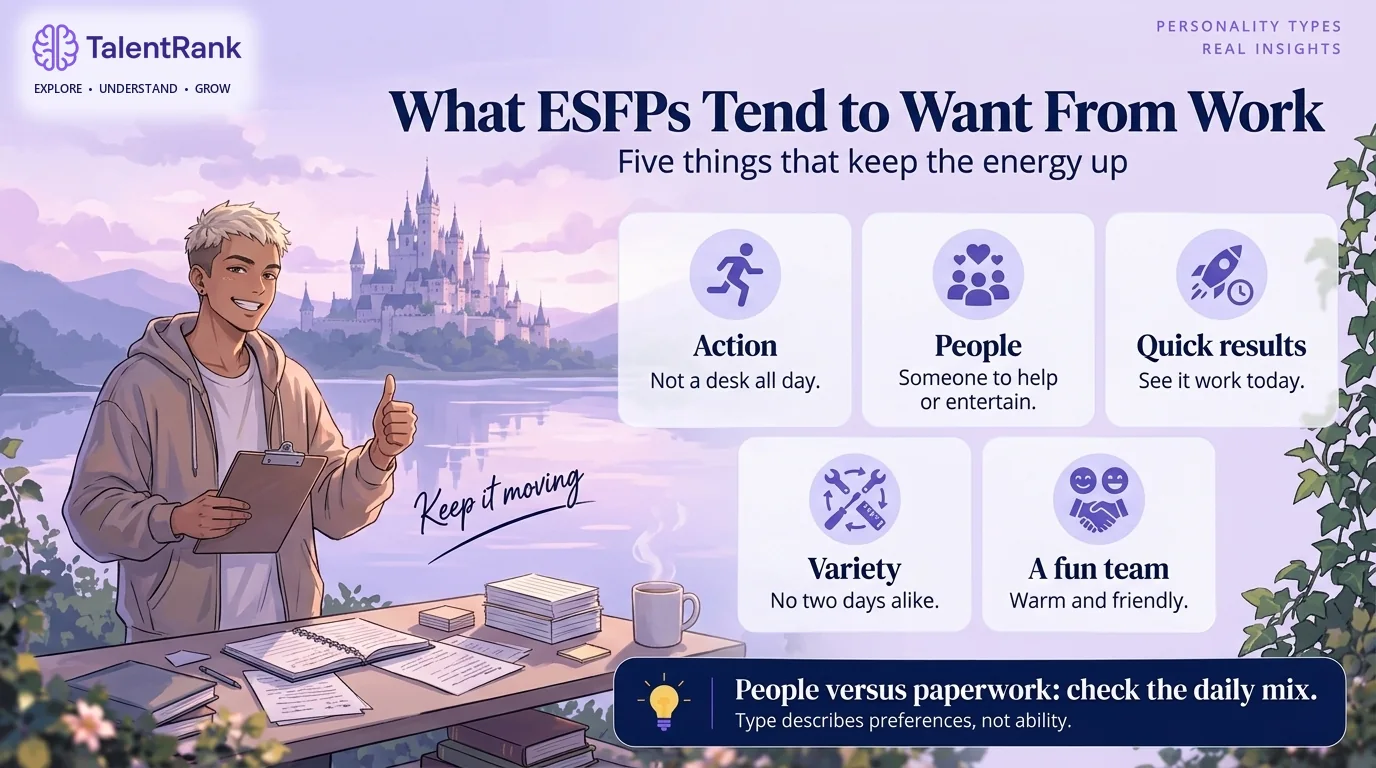
At work, that often means you want:
Action, not a desk all day.
People to talk to, help, or entertain.
Quick, visible results.
Variety from one day to the next.
A fun, friendly team.
The flip side of that energy is that long, abstract projects can feel like a slog. That's not a flaw. It just means the structure of a job matters as much as the field. Two jobs in the same industry can feel completely different depending on how much of the day is spent with people versus paperwork.
Best ESFP Careers to Explore
These careers reward energy, people skills, and hands-on action. Figures come from the Bureau of Labor Statistics Occupational Outlook Handbook: median pay in May 2025 and projected employment change from 2025 to 2035.
Career | 2025 median pay | Projected growth, 2025–35 | Typical entry education |
Dental hygienist | $98,100 | 8% | Associate's degree |
Registered nurse | $97,550 | 6% | Nursing degree or diploma plus license |
Producer or director | $90,360 | 4% | Bachelor's degree plus experience |
Wholesale or manufacturing sales representative | $76,460 | 0% | High school diploma for many roles |
Public relations specialist | $74,750 | 2% | Bachelor's degree |
Flight attendant | $63,580 | 9% | High school diploma plus airline training |
Event planner | $61,160 | 6% | Bachelor's degree |
Paramedic | $60,600 | 6% | Postsecondary certificate |
Real estate sales agent | $52,830 | 2% | High school diploma plus license |
Coach or scout | $47,320 | 6% | Bachelor's degree |
Fitness trainer or instructor | $47,160 | 7% | High school diploma plus certification |
Recreation worker | $36,560 | 4% | High school diploma |
Barber, hairstylist, or cosmetologist | $35,880 | 7% | Postsecondary certificate plus license |
Source: BLS Occupational Outlook Handbook, pages updated August 2026. The paramedic pay figure is for paramedics specifically; growth covers EMTs and paramedics together.
Healthcare With Energy
Registered nurses and dental hygienists spend their days with people and see results right away. Both pay close to $98,000, and dental hygiene needs only an associate's degree. EMTs and paramedics work fast, on their feet, in real emergencies. Paramedics earned a median of $60,600, well above EMTs at $44,470.
Travel, Events, and Hospitality
Flight attendants get travel, variety, and a new group of people on every flight, with 9% projected growth. Event planners run the show behind weddings, conferences, and launches. Recreation workers lead activities at camps and parks, though pay is modest.
Sales and Media
Wholesale and manufacturing sales representatives spend their days building relationships with buyers, and reps selling technical or scientific products earned a median of $104,920. Real estate agents show homes and negotiate deals, usually on commission. Public relations specialists and producers and directors work in fast-moving media environments.
Fitness, Sports, and Beauty
Fitness trainers and coaches motivate people and see progress week to week. Barbers, hairstylists, and cosmetologists get creativity and conversation all day, and the field is projected to grow 7%.
Fun Jobs vs. Well-Paid Jobs: How to Get Both
Several classic ESFP careers pay modestly. Hairstylists and cosmetologists earned a median of $35,880 in 2025, recreation workers $36,560, and actors are usually paid by the gig, with a median of $29.05 an hour and flat projected employment.
The good news is that many of these fields have a higher-paying version that keeps the energy:
EMT to paramedic: $44,470 to $60,600 median.
Non-technical sales to technical sales: $72,080 to $104,920 median.
Fitness trainer to physical therapist assistant: an associate's degree, a $68,380 median, and 23% projected growth.
Salon stylist to salon owner or educator, where income depends on clients and business skills.
Performer to producer, director, or event planner, which trade some stage time for steadier pay.
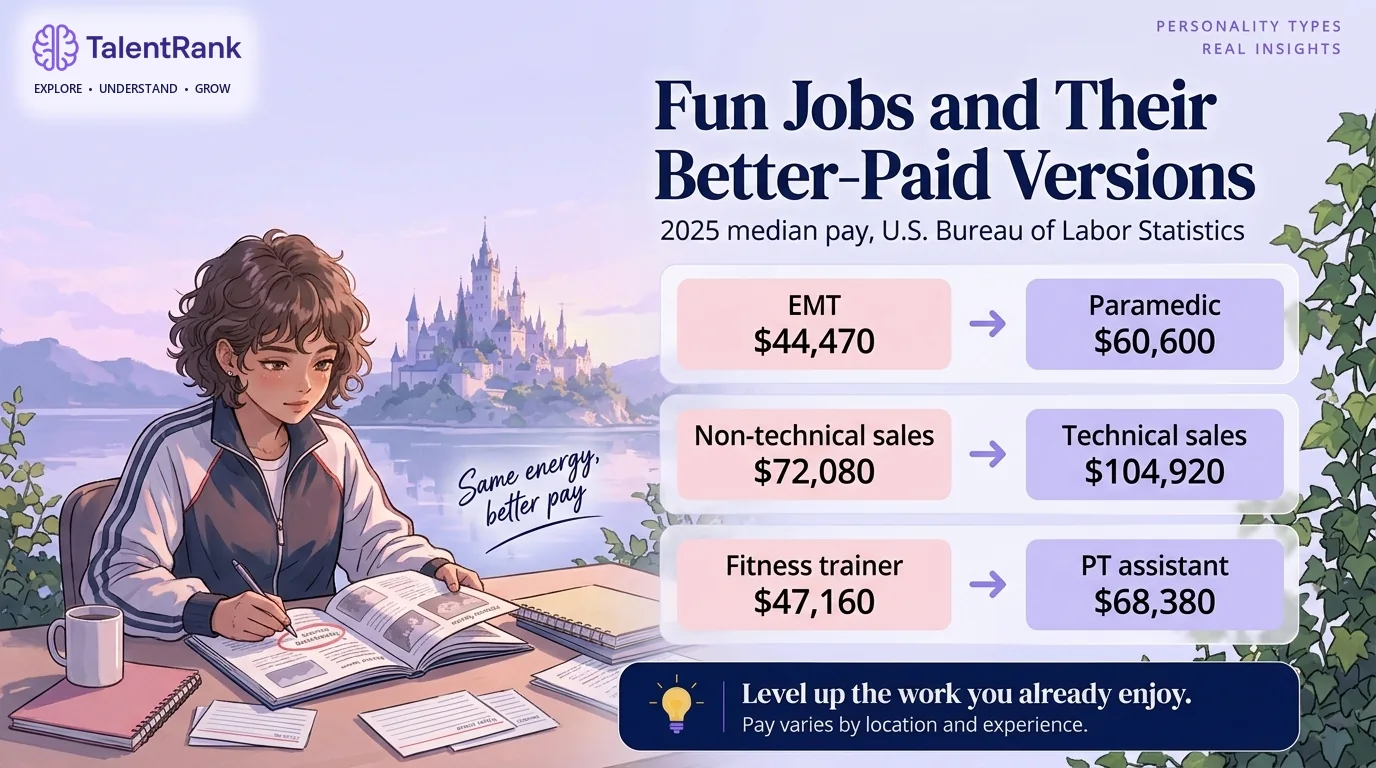
Hypothetical example: an ESFP starts as an EMT because she loves the adrenaline. After two years, she completes paramedic training. Same fast-paced work, same teammates, noticeably higher median pay, and more responsibility on every call.
ESFP Careers That Don't Require a Four-Year Degree
Many ESFP-friendly jobs start without a bachelor's degree:
Dental hygienist: associate's degree, $98,100 median.
Registered nurse: associate's degree routes are available.
Flight attendant: high school diploma plus airline training, $63,580 median.
Paramedic: postsecondary certificate, $60,600 median.
Non-technical sales representative: high school diploma, $72,080 median.
Real estate agent: high school diploma plus a license.
Fitness trainer: high school diploma plus certification.
Check licensing and training requirements in your state, especially in healthcare and real estate.
ESFP-T Careers: Does Turbulent Change Anything?
The -A (Assertive) and -T (Turbulent) suffixes come from 16Personalities, not the official MBTI. 16Personalities adds a fifth scale it calls Identity and builds its model on Big Five research. (16Personalities)
There's no separate list of ESFP-T careers. The same options apply. If the Turbulent label fits, commission-heavy roles with constant public rejection may feel harder at first, so it's worth testing them before committing.
ESFP Jobs to Avoid (or Conditions to Watch)
Most "ESFP jobs to avoid" lists name accountants, engineers, and researchers, based on the idea that ESFPs can't sit still. That's a stereotype. Accounting, engineering, and research all include client-facing and team-heavy roles.
The conditions that tend to drain ESFPs are more useful to know:
Long hours alone at a desk.
Abstract work with no visible result for months.
Rigid routines that never change.
Cold, quiet, or overly formal cultures.
Heavy paperwork with little human contact.
How to Choose Among ESFP Careers
Pick three careers from this guide.
Read the daily tasks for each on O*NET OnLine. Look at how much of the day is people versus paperwork.
Shadow someone for a shift, or volunteer at an event, clinic, or gym.
Ask what the pay looks like after five years, not just at the start.
Compare training time and cost against the pay and outlook above.
If you want a second framework, the Holland Code groups careers by interests, and the four temperaments offer another view of how you tend to work.
Beyond the ESFP Label
Two ESFPs can differ a lot. One is highly organized and steady under pressure. Another thrives on spontaneity. Trait measures pick up those differences. Extraversion, for instance, shapes how much people contact you'll enjoy. (Our guide to high extraversion covers what that can mean at work.)
The TalentRank assessment measures your Big Five personality traits and takes about 12 to 15 minutes. It won't confirm an MBTI type or choose a career for you. It can show where you land on traits like extraversion, conscientiousness, and openness, which are useful when weighing the options above. Take the TalentRank assessment and use it as one input.
Frequently Asked Questions About ESFP Careers
What are the best careers for an ESFP?
ESFPs often enjoy nursing, dental hygiene, emergency medicine, flight attending, event planning, sales, PR, media production, coaching, fitness training, and beauty work. Skills and the specific workplace matter as much as type.
What jobs should ESFPs avoid?
No job is off-limits because of type. It's more useful to avoid conditions that drain ESFPs, like long solo desk work, abstract projects with no visible result, and rigid routines.
What ESFP jobs pay well?
In this guide, dental hygienists had the highest 2025 median at $98,100, followed by registered nurses at $97,550 and producers and directors at $90,360, according to BLS. Technical sales reps earned a median of $104,920.
Can an ESFP succeed in an office job?
Yes. Office roles with lots of client contact, like sales, account management, HR, or events, can suit ESFPs well.
Is there a difference between ESFP-A and ESFP-T careers?
No. The A/T suffix comes from 16Personalities, not the official MBTI, and the same careers apply to both.
Are ESFPs good in healthcare?
They can be. Nursing, dental hygiene, and paramedic work combine people contact, action, and visible results, and several of these roles are growing.
Final Takeaway
ESFP careers tend to share a theme: energy, people, and results you can see today. Healthcare, travel, events, sales, and fitness all offer that. Some of the most fun jobs pay modestly, so look for the higher-paying version of the work you enjoy, and pick a workplace that keeps you on your feet.