

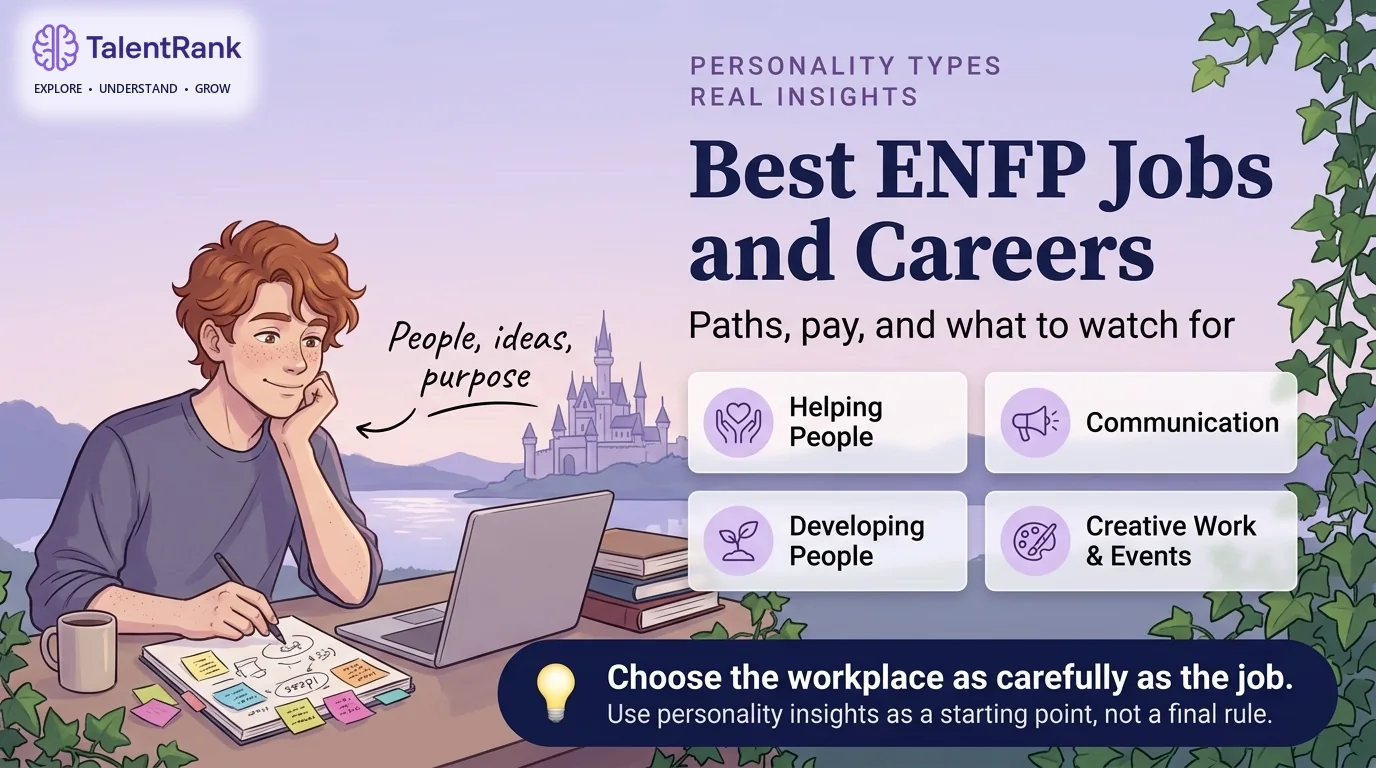
Good ENFP jobs tend to mix people, ideas, and a reason to care. Counseling, psychology, social work, public relations, marketing, fundraising, writing, training, teaching, event planning, and digital design all come up again and again, because they reward curiosity and give you a steady supply of new people and problems.
A type can't pick a career for you, though. MBTI results describe preferences, and the Myers-Briggs Company says plainly that preferences "do not indicate skill or ability" and that the assessment shouldn't be used to place people in jobs. (The Myers-Briggs Company) Some ENFPs are accountants. Some are software engineers. They're not doing it wrong.
This guide covers the careers ENFPs most often explore, with 2025 pay and 2025–35 growth figures from the U.S. Bureau of Labor Statistics. It also covers options without a four-year degree, what "ENFP-T" means for your job search, the work conditions worth checking before you accept an offer, and a way to narrow down a long list of interests.
What ENFPs Tend to Need From Work
ENFP stands for Extraversion, Intuition, Feeling, and Perceiving. In plain terms: you get energy from people, you notice possibilities before details, you weigh decisions by their effect on people and values, and you like to keep options open. (Our explainers on extraversion vs. introversion and judging vs. perceiving go deeper on the individual letters.)
At work, that combination usually translates into a handful of needs:
Variety. The same task every day for a year gets old fast.
People. Not constant meetings, but real contact with clients, students, colleagues, or an audience.
Meaning. It helps to believe the work matters to someone.
Room for ideas. A place where a new approach gets a hearing.
Structure you don't have to build alone. Deadlines, a good project manager, or a teammate who loves checklists.
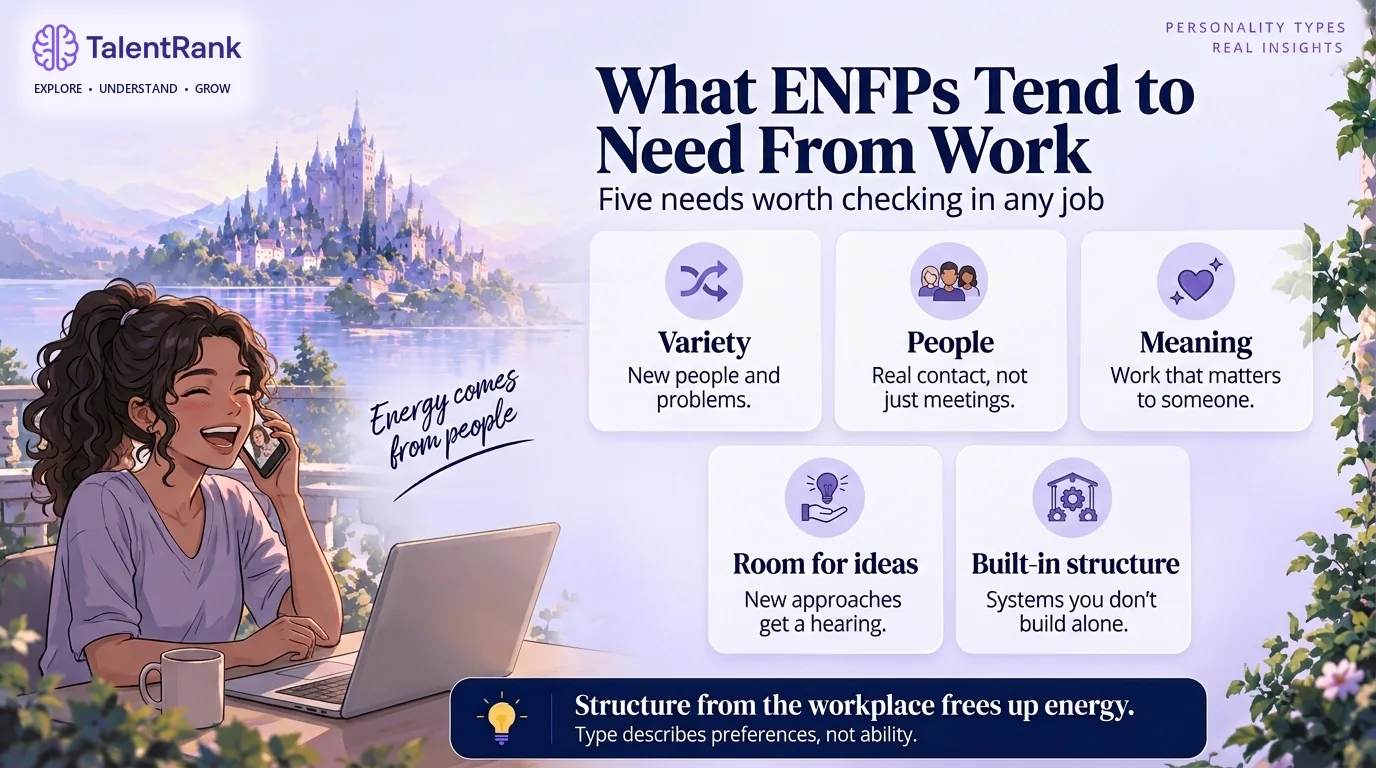
That last point surprises people. ENFPs are often described as disorganized. A fairer reading is that many ENFPs do their best work when the structure comes from the environment, so their energy can go into the parts they're good at. Picking a workplace with clear processes isn't a weakness. It's a smart design choice.
Best ENFP Jobs to Explore
These careers reward the needs above. Figures are from the Bureau of Labor Statistics Occupational Outlook Handbook: median pay in May 2025 and projected employment change from 2025 to 2035.
Career | 2025 median pay | Projected growth, 2025–35 | Typical entry education |
Advertising, promotions, and marketing manager | $165,780 | 6% | Bachelor's degree plus experience |
Web and digital interface designer | $104,000 | 5% | Bachelor's degree |
Psychologist | $99,110 | 6% | Master's or doctoral degree |
Writer or author | $76,910 | 0% | Bachelor's degree |
Human resources specialist | $75,940 | 6% | Bachelor's degree |
Public relations specialist | $74,750 | 2% | Bachelor's degree |
Fundraiser | $72,550 | 6% | Bachelor's degree |
High school teacher | $72,040 | 0% | Bachelor's degree |
Training and development specialist | $69,280 | 11% | Bachelor's degree |
School or career counselor | $64,330 | 3% | Master's degree |
Social worker | $61,780 | 6% | Bachelor's or master's in social work |
Event planner | $61,160 | 6% | Bachelor's degree |
Source: BLS Occupational Outlook Handbook, pages updated August 2026. Growth of 0% means little or no change in the number of jobs, though openings still appear as people retire or switch careers.
Helping and Guiding People
School and career counselors, psychologists, and social workers spend their days helping people see options they couldn't see alone. That fits the ENFP habit of spotting potential in others.
These roles also carry heavy emotional loads. Psychologists add years of training on top. If you absorb other people's moods easily, ask working counselors how they keep the job from following them home.
Communication and Persuasion
Public relations specialists, fundraisers, and marketing managers all sell an idea to an audience. Fundraising in particular combines relationship building with a cause, which is a strong match for many ENFPs.
Marketing management pays the most on this list, but it's rarely a first job. BLS lists work experience in a related occupation as a typical requirement, so expect a few years as a coordinator, specialist, or analyst first.
Writers and authors get to chase whatever interests them. The field is also flat, with no projected growth, and income can be uneven. Many ENFP writers pair writing with content strategy, communications, or teaching.
Developing People
Human resources specialists and training and development specialists help organizations hire people and keep them. Training is the fastest-growing role in this guide at 11%, and it suits ENFPs who like teaching but don't want a classroom.
High school teachers get variety every period and a direct view of their impact. The tradeoff is a fixed schedule and large classes, and BLS projects no net growth.
Creative Work and Events
Web and digital interface designers solve problems for real users, which blends creativity with empathy. Event planners juggle clients, vendors, and last-minute changes. Some ENFPs love that pace. Others find the logistics draining, so it's worth shadowing someone during a big event before committing.
Can ENFPs Work in Tech or Engineering?
Yes. Some career sites list software engineering and other engineering fields as jobs ENFPs should avoid, usually without citing any data. Personality type doesn't measure aptitude, and tech is broader than heads-down coding.
Roles like user experience research, product design, developer relations, technical training, and solutions consulting combine technical knowledge with a lot of human contact. If you enjoy technology and people, those hybrid roles are worth a close look. An ENFP who likes coding can also simply be a developer. Plenty of engineering teams value the person who asks what users actually need.
ENFP Jobs That Don't Require a Four-Year Degree
Several people-centered jobs start with a high school diploma plus training:
Fitness trainers and instructors earned a median of $47,160 in 2025, with 7% projected growth. Many employers prefer a certification.
Flight attendants earned a median of $63,580, with 9% projected growth, after airline training.
Real estate sales agents earned a median of $52,830. They need a state license, and income is usually commission-based, so the first year can be lean.
Sales, customer success, recruiting coordination, and hospitality management are also common entry points that can grow into higher-paying roles. Check local job postings, since requirements differ by employer and region.
ENFP-T Jobs: Does Turbulent Change the List?
No. The -A (Assertive) and -T (Turbulent) suffixes come from 16Personalities, which adds a fifth scale it calls Identity. Its model is built on Big Five research, not on Myers-Briggs theory. (16Personalities)
The same careers apply to ENFP-A and ENFP-T. What the Turbulent label might hint at is sensitivity to criticism or a tendency to second-guess. If that sounds like you, look for managers who give frequent, specific feedback, and be cautious about roles judged mainly on public metrics, like commission-only sales, until you know how you handle that pressure.
ENFP Jobs to Avoid (or Conditions to Check First)
Most "ENFP jobs to avoid" lists name accountants, engineers, bank tellers, and police officers. The assumption is that ENFPs can't handle detail or routine. That's a stereotype, not a finding.
The better question is what kind of workplace wears ENFPs down. Common culprits:
Isolated, repetitive work with no human contact for days at a time.
Micromanagement that leaves no room to try a better approach.
A mission you don't believe in. Values conflicts tend to hit ENFPs hard.
Rigid rules with no explanation and no way to question them.
Long projects with no feedback until the very end.
Hypothetical example: two ENFPs take jobs as marketing coordinators. One joins a small nonprofit where she writes campaigns, meets donors, and sees results within weeks. The other joins a large company where she spends most of her week updating spreadsheets for a campaign she never sees launch. Same title. Very different fit.
How to Narrow Down Too Many Career Ideas
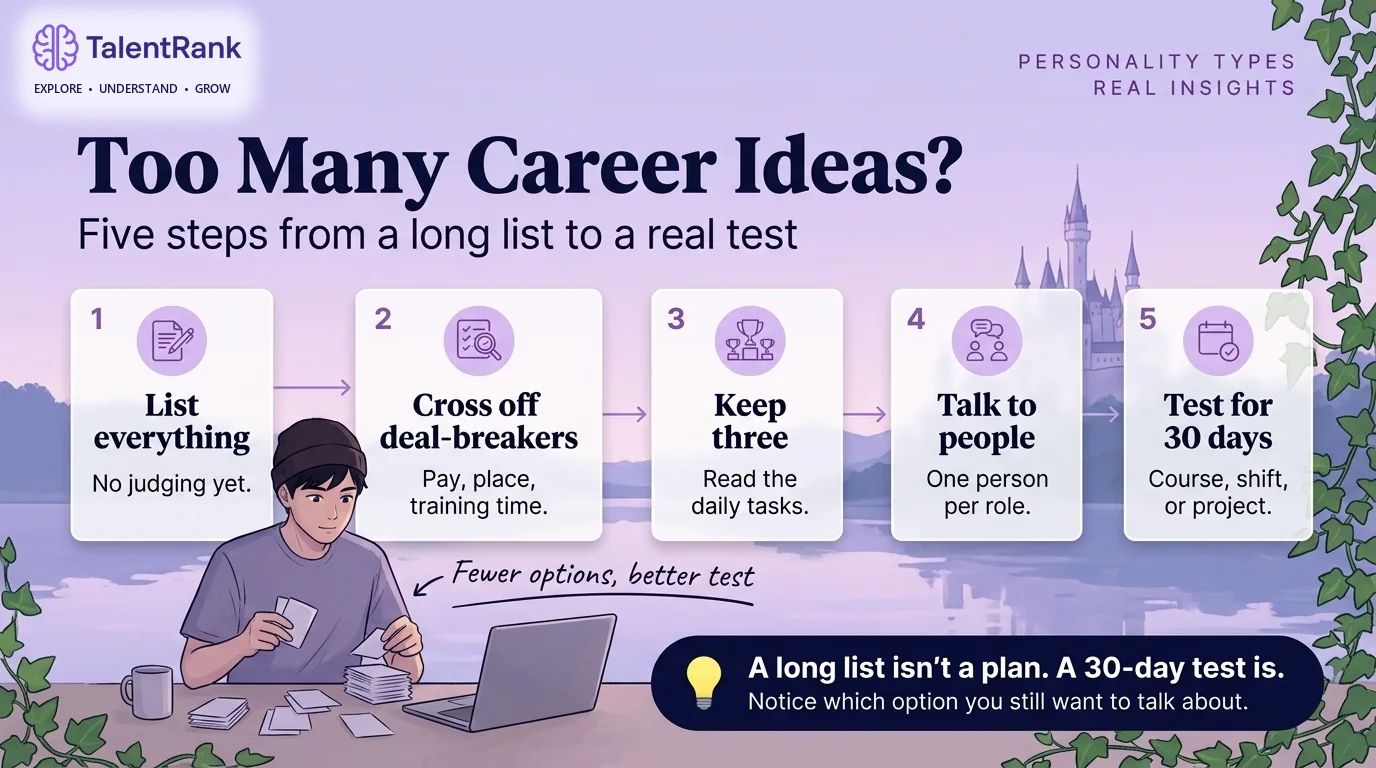
Many ENFPs don't struggle to find interesting careers. They struggle to stop finding them. A list of fifteen fascinating options isn't a plan. Try this instead:
Write down every career idea you have, without judging it.
Cross off anything that conflicts with your non-negotiables: pay floor, location, training time you can afford. Our guide to work values can help you define those.
Keep the top three. Look each up on O*NET OnLine and read the actual daily tasks.
Talk to one person in each role. Ask what they'd warn a newcomer about.
Run a 30-day experiment: a short course, a volunteer shift, or a freelance project. Notice which one you still want to talk about at the end.
If you want a framework beyond personality type, the Holland Code groups careers by interest themes, and a career interest test can add another angle.
Looking Past the Four Letters
Two ENFPs can differ a lot. One is highly organized and calm under pressure. Another thrives on deadlines and worries more. Four letters can't show that, but trait measures can. (Here's how the Big Five compares with MBTI.)
The TalentRank assessment measures your Big Five personality traits and takes about 12 to 15 minutes. It won't confirm an MBTI type or hand you a job title. It can show where you fall on traits like extraversion, conscientiousness, and openness, which are useful when you're comparing careers like the ones above. Take the TalentRank assessment and use the results as one input among several.
Frequently Asked Questions About ENFP Jobs
What are the best jobs for an ENFP?
Jobs that combine people, ideas, and meaning tend to suit ENFPs: counseling, psychology, social work, public relations, marketing, fundraising, writing, training, teaching, event planning, and digital design. Which one fits depends on your skills and the specific workplace.
What jobs should ENFPs avoid?
No job is off-limits because of personality type. It's more useful to avoid conditions that tend to drain ENFPs, such as isolated repetitive work, micromanagement, a mission you don't believe in, and long projects without feedback.
Can an ENFP be successful in a structured job?
Yes. Many ENFPs work well in structured roles, especially when the structure is clear and the work still involves people or new problems. A good system can free up energy for the parts of the job you enjoy.
What ENFP jobs pay well?
In this guide, marketing managers had the highest 2025 median pay at $165,780, followed by web and digital interface designers at $104,000 and psychologists at $99,110, according to BLS. Pay varies a lot by location and experience.
Are ENFP-T jobs different from ENFP-A jobs?
No. The A/T distinction comes from 16Personalities, not the official MBTI, and the same careers apply. The Turbulent label may matter more for the kind of feedback and pressure you prefer.
Is teaching a good job for an ENFP?
It can be. Teaching offers variety, human connection, and visible impact. It also means grading and classroom management, so try substitute teaching, tutoring, or training before committing to a credential.
Final Takeaway
ENFPs often do their best work around people, new ideas, and a purpose they believe in. Counseling, communications, training, teaching, design, and events all offer that, and so can tech roles with a human side. Don't let a type chart rule anything out. Pick three options, test them in the real world, and choose the workplace as carefully as the job.