



J vs P MBTI: Judging and Perceiving Explained
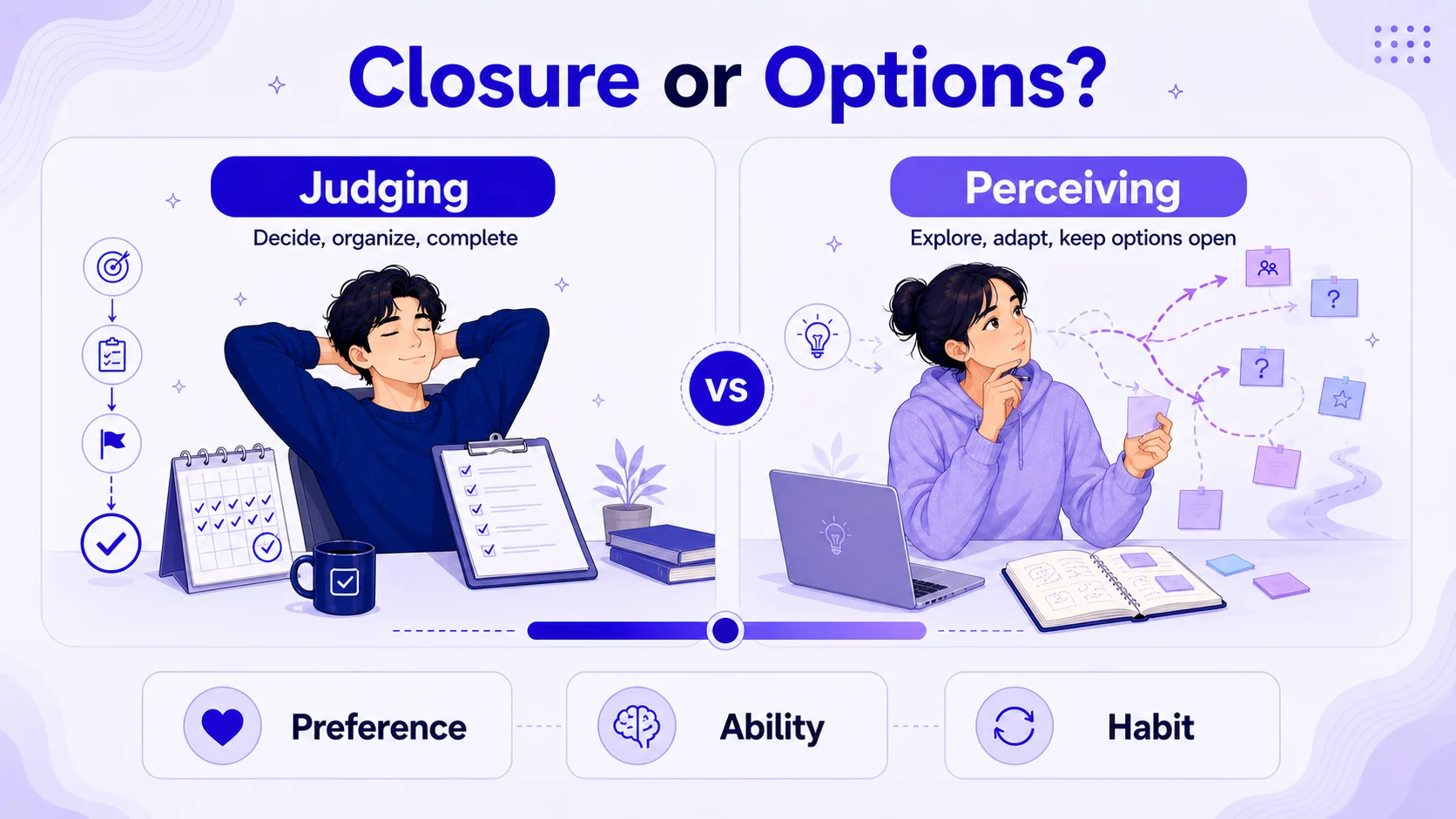
The J vs P MBTI preference describes how you generally approach structure, decisions, plans, and possibilities in the outside world. People who prefer Judging often feel comfortable when plans are settled and decisions are made, while people who prefer Perceiving usually want flexibility and room to respond as circumstances change.
However, J does not mean judgmental, and P does not mean more perceptive or observant. An organized person is not automatically a J, and someone who occasionally procrastinates is not necessarily a P. The most useful way to understand this preference is to examine the patterns behind your behavior - not one isolated habit.
In the Myers-Briggs framework:
J means Judging: A preference for structure, decisions, closure, and an organized approach to the external world.
P means Perceiving: A preference for flexibility, exploration, adaptability, and keeping options available in the external world.
The terms describe preferred approaches rather than fixed abilities. A Judging type can be spontaneous, while a Perceiving type can use calendars, meet deadlines, and maintain an organized workspace.
If you are wondering what the letters mean in Myers Briggs, the first three letters describe where you direct energy, how you gather information, and how you make decisions. The final J or P describes which kind of mental process you tend to show most clearly to the outside world.
J vs P MBTI Differences at a Glance
Situation | Judging preference | Perceiving preference |
Planning | Likes a clear plan early | Prefers an adjustable direction |
Decisions | Often feels relief after deciding | May want more information before committing |
Deadlines | Usually prefers steady progress | May work in flexible or intense bursts |
Change | Wants time to reorganize | Often responds quickly to new options |
Travel | May prepare an itinerary | May leave room for discovery |
Tasks | Enjoys completion and closure | Enjoys exploration and improvisation |
These are tendencies, not rules. Training, culture, anxiety, work requirements, and personal responsibilities can all influence visible behavior.
Judging Does Not Mean Judgmental
Judging is one of the most frequently misunderstood MBTI terms. It does not mean that someone is critical, morally superior, or constantly judging other people. In this framework, Judging refers to a preference for using a decision-making process - Thinking or Feeling - in the external world. That often appears as organization, defined expectations, scheduled action, and a desire to resolve open questions.
A J type can be accepting and open-minded. A P type can also be highly critical. How judgmental someone becomes depends on many factors that cannot be determined from the final letter of an MBTI result.
Perceiving Does Not Mean More Observant
Perceiving does not automatically mean that someone has stronger perception or pays more attention to details. It refers to presenting an information-gathering process - Sensing or Intuition - to the outside world. Perceiving types often engage by exploring, noticing new information, testing possibilities, or adapting their direction. This openness can support creativity and responsiveness, but under stress it can also lead to excessive option-seeking or difficulty committing.
How a Judging Preference Approaches the Outer World
People with a Judging preference generally like life to feel intentional and manageable. They may create schedules, define responsibilities, establish priorities, and make decisions before the last possible moment. Completing a decision often produces relief.
Establishing clear goals
Creating dependable routines
Tracking responsibilities
Anticipating deadlines
Turning decisions into action
Giving a group structure and direction
The same preference can produce blind spots. A J type may decide before all useful information is available, interpret a changed plan as irresponsibility, or become frustrated when other people continue exploring. A healthy Judging preference uses structure as a tool; it does not treat the original plan as more important than reality.
How a Perceiving Preference Approaches the Outer World
People with a Perceiving preference generally want space to observe what develops. They may begin with a direction rather than a detailed plan and adjust their approach as new information becomes available. Keeping options open can feel energizing, while finalizing too early may feel limiting.
Responding to changing conditions
Spotting unexpected opportunities
Improvising when plans fail
Exploring multiple solutions
Remaining curious during uncertainty
Helping a group consider alternatives
This preference also has possible blind spots. A P type may delay a necessary decision, underestimate completion time, or keep changing direction after others depend on the agreed plan. A healthy Perceiving preference preserves flexibility without avoiding responsibility.
The Cognitive-Function Rule Behind the Final Letter
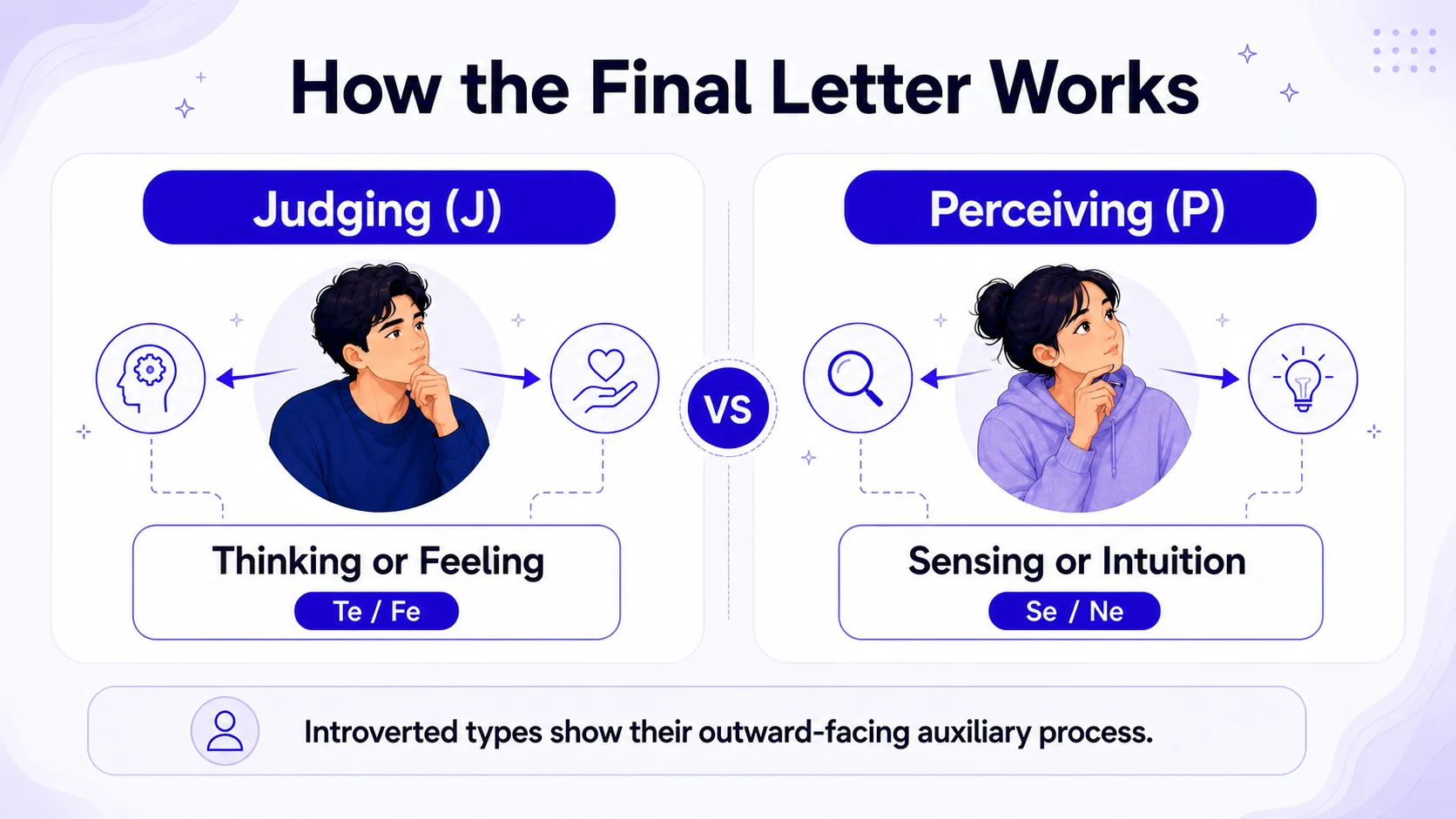
The final MBTI letter is more complicated than organized versus spontaneous. It indicates whether a person shows a Judging process or a Perceiving process most directly to the external world. Judging functions are Thinking and Feeling; Perceiving functions are Sensing and Intuition.
For an extraverted J type, the dominant function is usually an outwardly directed Judging function. For an extraverted P type, the dominant function is usually an outwardly directed Perceiving function. Introverted types create additional confusion: an INFP ends in P because it presents Extraverted Intuition outwardly, while an INFJ ends in J because it presents Extraverted Feeling outwardly.
J vs P in Six Real-Life Situations
Starting a Work Project
A J preference may define the objective, assign responsibilities, and create milestones. A P preference may gather ideas, explore the problem, and test approaches. A balanced team agrees on an exploration period and a decision point.
Responding to a Changed Deadline
A J type may first reorganize connected commitments. A P type may adapt quickly and reconsider the options. The best response combines rapid adaptation with an updated agreement everyone can see.
Planning a Trip
A J traveler may reserve early and prepare an itinerary. A P traveler may secure essentials but leave time open for discovery. A useful compromise protects high-risk arrangements while leaving selected periods unscheduled.
Organizing Home Life
A J preference may enjoy designated places and recurring routines. A P preference may organize according to convenience or an informal system. The real question is whether the system reliably supports its users.
Making a Group Decision
The J protects progress; the P protects possibility. Conflict begins when exploration is seen as avoidance or closure as control. A clear decision deadline gives both processes a legitimate role.
Responding to an Unexpected Opportunity
A J may compare the opportunity with existing obligations before accepting. A P may investigate first and determine details later. A strong decision considers both disruption and opportunity value.
Can a Judger Procrastinate and a Perceiver Plan?
Yes. This is one of the most important points in any MBTI P vs J comparison. A J type may procrastinate because of perfectionism, fear of failure, unclear expectations, exhaustion, or low interest. A P type may become an excellent planner because a job requires it or because planning protects time for exploration.
Preference: Which approach feels most natural?
Ability: Which behaviors can you perform effectively?
Habit: Which behaviors have you learned through repetition or necessity?
Can You Be Both J and P?
Everyone uses both Judging and Perceiving processes. A close test score does not necessarily prove that you are precisely half J and half P. It may indicate that answers vary by context, the preference is not strongly expressed, or the questionnaire is not consistently separating learned behavior from natural inclination.
Did you answer based on work behavior or private life?
Did recent stress affect your responses?
Did you select an idealized answer?
Do your responsibilities require learned behavior?
Were the questions too broad?
Are You J or P? A Pattern-Based Self-Check
Does making a decision produce relief, or do I wonder whether I closed my options too early?
When plans change, do I first rebuild the plan or explore new possibilities?
Do I define tasks before beginning, or understand them by interacting with them?
Do deadlines help me execute an existing plan or generate energy to discover my approach?
In a group, do I focus on reaching a decision or keeping discussion open?
Is structure naturally comforting, or mainly a system I learned?
The Closure-Options Test
A Judging preference often experiences an unresolved decision as mental weight. Selecting a direction reduces that weight. A Perceiving preference may experience premature closure as lost possibility. Keeping a decision open can feel responsible because additional information might improve the outcome.
J vs P at Work
J types often appreciate defined responsibilities, confirmed deadlines, early decisions, visible progress, and clear completion. P types often appreciate autonomy, experimentation, adjustable methods, new information, and variety. Problems arise when preference is mistaken for professionalism.
A practical J-P collaboration system includes a defined final deadline, a limited exploration window, an agreed decision point, clear responsibilities, a process for requesting changes, and enough flexibility inside fixed outcomes.
J vs P in Relationships
J and P types can form successful relationships. Compatibility depends more on communication, values, maturity, and mutual respect than on sharing the same final letter. Tension often involves how early plans are confirmed, when household tasks are completed, how often plans can change, and how long decisions remain open.
A J partner may interpret flexibility as lack of commitment; a P partner may interpret planning as control. Instead of deciding which style is correct, partners can agree which plans must be confirmed, where spontaneity is welcome, and how much notice is needed before changing a commitment.
J vs P Is Not the Same as Conscientiousness
The J/P preference should not be treated as another name for the Big Five trait of Conscientiousness. Conscientiousness is measured as a continuous trait associated with organization, dependability, self-discipline, and goal-directed behavior. MBTI J/P belongs to a different model. A P type can score highly in Conscientiousness, and a J type can struggle with consistency.
What J and P Cannot Tell You
Whether you are intelligent or emotionally mature
Whether you will meet every deadline
Whether you are creative or a good leader
Whether you are compatible with a partner
Whether you have a mental-health or attention-related condition
Whether you can develop opposite-preference skills
The letters should not be used to make hiring decisions or restrict education or career choices. Personality frameworks can begin a useful conversation, but they cannot replace evidence about actual behavior and ability.
A More Scientific Way to Use Your Result
The official Myers-Briggs preference overview presents results as preferences rather than measures of skill or character. Independent research has raised concerns about reliability, categorical scoring, and whether personality is better represented as continuous traits. A responsible approach is to treat your result as a hypothesis: compare both descriptions, observe recurring low-pressure patterns, ask trusted people for examples, separate learned behavior from natural comfort, and keep the label only if it improves reflection or communication.
Frequently Asked Questions
What does J mean in MBTI?
J means Judging: a preference for showing a decision-oriented process to the external world, often through structure, settled plans, and closure.
What does P mean in MBTI?
P means Perceiving: a preference for showing an information-gathering process outwardly, often through flexibility, exploration, and open options.
Does J mean judgmental?
No. Judging is a technical MBTI term and does not mean morally judgmental.
Can a P personality be organized?
Yes. A P type can be highly organized, punctual, and dependable.
Can a J personality procrastinate?
Yes. Perfectionism, stress, uncertainty, exhaustion, and low motivation can cause any type to procrastinate.
Why does my test switch between J and P?
Context, stress, recent experiences, learned habits, unclear questions, or test reliability may change the result.
Can someone be 50% J and 50% P?
People use both approaches and a test can produce a close score, but the percentage is not an exact measurement of personality.
Can a P become a J?
People can strengthen planning and flexibility skills. New behavior does not necessarily mean the underlying preference permanently changed.
Are J and P types compatible?
Yes. Clear communication about plans, responsibilities, deadlines, and changes matters more than the final letter.
Is the J vs P distinction scientifically valid?
It can support reflection, but the MBTI has been criticized for reliability and categorical scoring. It is not a diagnosis.
The Bottom Line
The most useful way to understand J vs P MBTI is as a difference between seeking closure and preserving options in the outside world - not as a contest between organized and disorganized people. Judging types often use structure to move life forward, while Perceiving types often use flexibility to remain responsive to what emerges. Both approaches offer valuable strengths, both can create blind spots, and everyone can develop skills associated with the opposite preference. Your best-fit letter is the one that explains your recurring motivation across different situations, not the one that matches a stereotype or a single online test score.