



T vs F MBTI: How Thinking and Feeling Really Differ
The simplest T vs F MBTI difference is the kind of criteria you naturally trust when making a decision. A Thinking preference tends to begin with consistency, accuracy, and effectiveness. A Feeling preference tends to begin with values, relationships, and human impact. Both approaches can use evidence, logic, empathy, and emotion.
That distinction matters because Thinking and Feeling are often misrepresented as intelligence versus emotion. They are not measures of how smart, kind, sensitive, or rational you are. This guide explains how the two preferences work, why your result may switch, and how to identify your natural pattern through real decisions instead of stereotypes.
In MBTI terminology, T stands for Thinking and F stands for Feeling. They form one of the framework's four preference pairs and describe how a person tends to evaluate information before reaching a judgment.
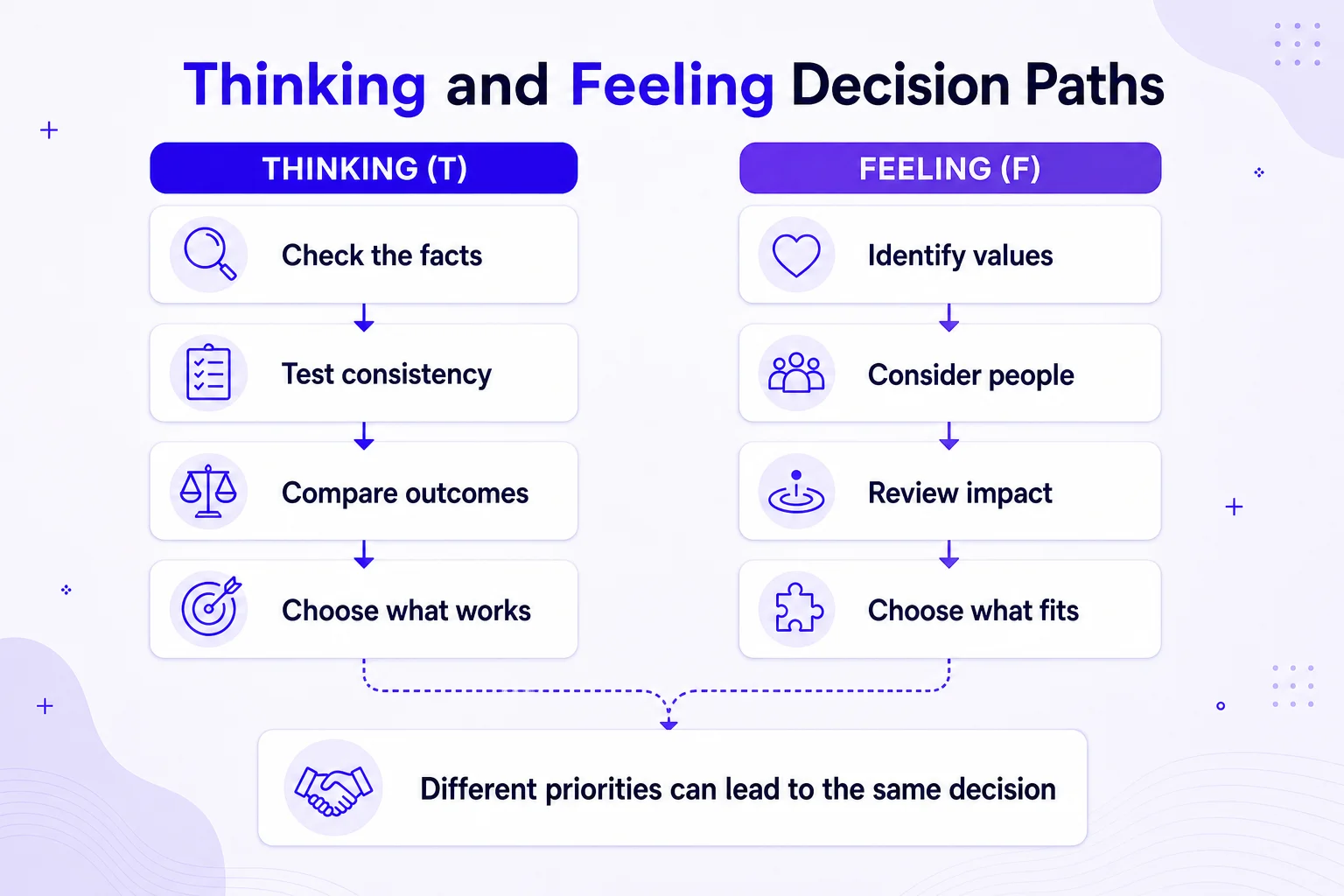
Thinking preference: gives greater initial weight to logical consistency, objective standards, cause and effect, and whether a solution works.
Feeling preference: gives greater initial weight to personal or shared values, individual circumstances, relationships, and the effects a decision may have on people.
Thinking and Feeling describe preferred evaluation criteria. They do not measure intelligence or emotional capacity. Every person thinks and feels. The preference indicates which process may feel more natural or trustworthy, especially when competing priorities make a decision difficult.
T vs F MBTI Differences at a Glance
Decision area | Thinking preference | Feeling preference |
Starting question | What is accurate, consistent, or effective? | What aligns with important values and respects the people involved? |
Fairness | Applying a consistent standard | Considering needs, context, and human consequences |
Feedback | Identifying the problem and correction directly | Considering how the message will be received and acted upon |
Conflict | Clarifying facts, principles, and solutions | Understanding perspectives and restoring connection |
Common strength | Detached analysis and consistency | Values awareness and interpersonal judgment |
Possible blind spot | Underweighting stakeholder effects | Underweighting impersonal standards or difficult tradeoffs |
Under stress | May become blunt or overly corrective | May personalize disagreement or avoid necessary friction |
These are tendencies rather than fixed behaviors. Experience, culture, responsibilities, and the importance of a relationship can change how either preference appears.
Thinking and Feeling Are Decision Preferences, Not Abilities
A Thinking preference does not mean someone thinks more or thinks better. A Feeling preference does not mean someone experiences more emotion or possesses greater empathy. The official Myers-Briggs explanation separates these terms from their ordinary meanings: people who prefer Thinking can feel, and people who prefer Feeling can think.
This is why behavior alone can mislead you. A Thinking type might comfort a distressed colleague because doing so is humane and necessary for the team. A Feeling type might deliver firm criticism because honesty and accountability are important values. The visible action does not reveal which consideration carried the most weight internally.
How a Thinking Preference Reaches a Decision
A Thinking preference commonly creates distance from the immediate situation so the problem can be examined against a principle or standard. The person may compare evidence, test for contradictions, and ask whether the same reasoning would remain valid in another case.
Imagine two employees requesting the same exception to a deadline. A manager using a Thinking-first approach may review policy, compare the circumstances, and decide whether granting either exception would create a consistent standard. The manager can still care deeply about both employees. The deciding consideration is whether the rule and its application remain defensible.
Potential strengths
Identifying contradictions and weak assumptions
Applying standards consistently
Giving direct, actionable feedback
Making difficult tradeoffs when every option has a cost
Potential blind spots
Treating measurable effects as the only effects that matter
Offering solutions before people feel understood
Assuming directness will be interpreted as intended
Using consistency when an important contextual difference deserves attention
How a Feeling Preference Reaches a Decision
A Feeling preference commonly evaluates what a choice supports, protects, or communicates about the people involved. The person may consider personal values, shared expectations, individual circumstances, and whether the outcome preserves dignity or trust.
Using the same deadline example, a Feeling-first manager may ask why each employee needs the exception, how the decision will affect the team, and which response best reflects the organization's values. That manager can still review policy and evidence carefully. The deciding consideration gives substantial weight to the human meaning of applying the rule.
Recognizing stakeholder needs that are easy to overlook
Understanding how decisions affect trust and cooperation
Adapting communication to the person and situation
Identifying value conflicts behind an apparent practical problem
Avoiding necessary disagreement to preserve short-term harmony
Applying standards inconsistently because every case feels unique
Interpreting impersonal criticism as a relationship judgment
Giving immediate comfort more weight than a difficult long-term consequence
Why the Final Decision Alone Cannot Reveal T or F
Two people can reach the same answer through different reasoning. Suppose a company must remove a product feature that creates accessibility problems.
Thinking route: The feature fails a usability standard, exposes users to preventable difficulty, and creates an inconsistent product experience. Removing it is the most defensible solution.
Feeling route: Keeping the feature would disregard the needs and dignity of affected users. Removing it better represents the company's stated commitment to inclusion.
The decision is identical. The criterion that made it compelling differs. Examine your recurring rationale rather than counting stereotypically logical or caring actions.
Can You Be Both a Thinker and a Feeler?
Yes. Every psychologically healthy person uses both thinking and feeling. The T or F preference does not remove the other side of your personality. It describes which criteria you are more likely to trust first when a difficult decision forces competing priorities.
A person can also have a relatively weak preference. If you regularly integrate impersonal standards and human considerations without consistently favoring one, tests may place you near the midpoint. That does not mean your personality is invalid or incomplete.
Can a Thinker Be Emotional and a Feeler Be Logical?
An emotional person can prefer Thinking, and a highly analytical person can prefer Feeling. Emotional intensity and decision preference are separate characteristics. A Thinker may experience powerful emotions but avoid treating those emotions as sufficient evidence. A Feeler may analyze an issue carefully while refusing to ignore the values or people affected by the answer.
An emotional Thinker
Imagine a manager who feels personally upset about an employee's repeated mistake. The manager acknowledges that reaction but checks written policy, previous cases, and measurable impact before deciding what to do. Strong emotion is present, but impersonal criteria lead the decision.
A logical Feeler
Another manager may analyze the same evidence and conclude that a coaching plan will protect fairness, team trust, and the employee's opportunity to improve. The decision is logical, but values and human consequences receive significant weight.
If Ethics Can Be Logical, What Actually Separates T and F?
Ethical reasoning can involve logic. A Thinking preference can build a consistent moral rule and apply it impartially. A Feeling preference can examine evidence and reject a choice that produces unacceptable human consequences.
The more useful question is not, 'Did this person choose the ethical option?' It is, 'Which consideration made that option feel most defensible?' One person may emphasize the consistency of the rule; another may emphasize whether the rule honors the values and people involved.
Same decision, different reason
Thinking route: This exception is justified because equivalent circumstances should receive equivalent treatment.
Feeling route: This exception is justified because applying the rule mechanically would violate its purpose and harm the people it should serve.
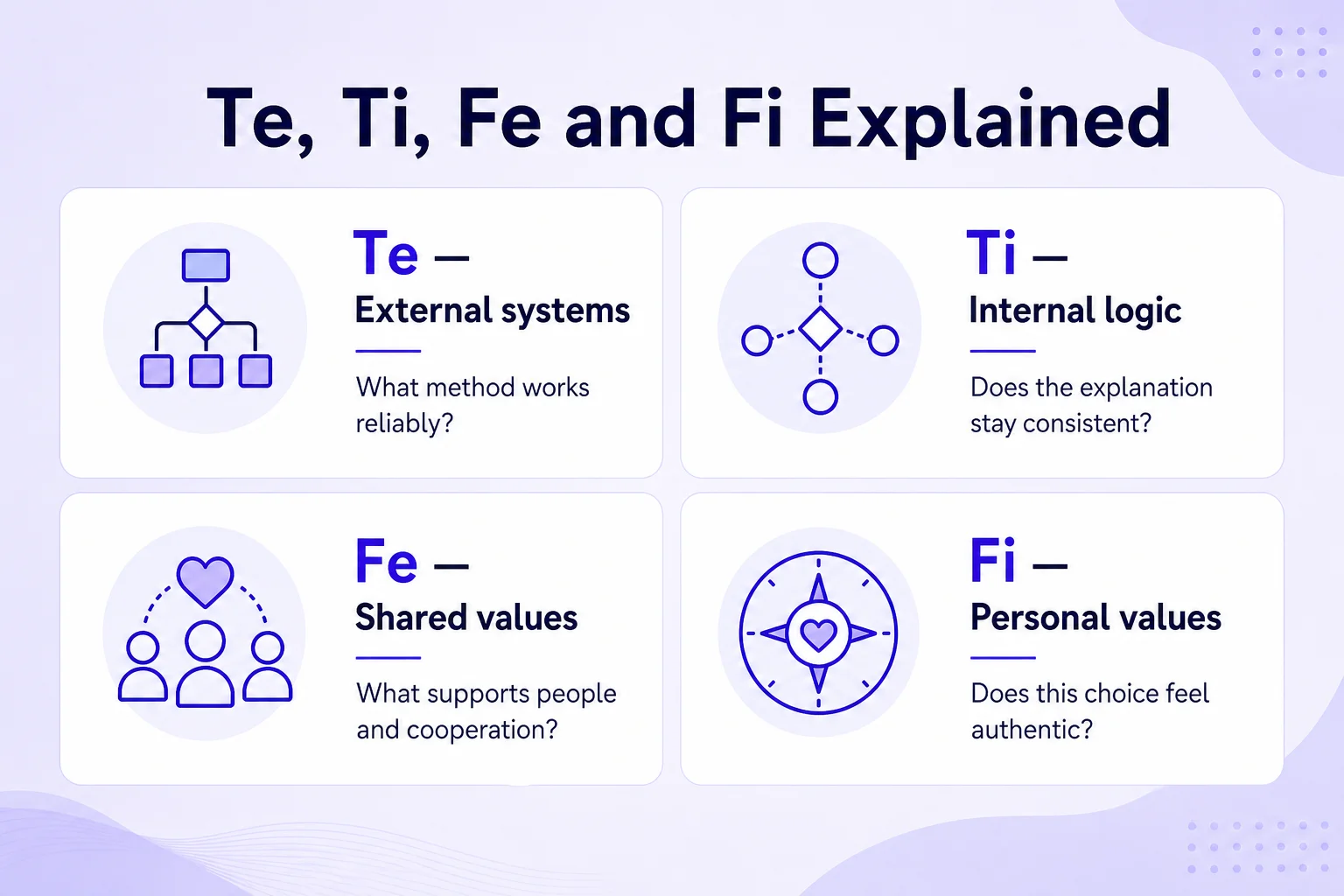
Te, Ti, Fe and Fi Without the Jargon
Some MBTI discussions divide Thinking and Feeling into introverted and extraverted cognitive functions. These concepts can provide richer language for reflection, but they should not be treated as independently verified measurements of mental machinery.
Function | Plain-language emphasis | Illustrative question |
Te | External organization, standards, and execution | What method will produce a reliable result? |
Ti | Internal logical precision and consistency | Does this explanation make sense without contradiction? |
Fe | Shared values and interpersonal coordination | What response will support people and cooperation? |
Fi | Personal values and internal moral alignment | Does this choice remain true to what I believe? |
These distinctions explain why two Thinking types or two Feeling types may look different. They also show why head versus heart is too simplistic.
T vs F in Six Real-Life Situations
1. Giving feedback
A Thinking preference may start by naming the error and required correction. A Feeling preference may first consider how to preserve trust so the correction can be heard. Effective feedback usually needs both clarity and delivery awareness.
2. Resolving workplace conflict
A Thinking-first response may define disputed facts, responsibilities, and an acceptable outcome. A Feeling-first response may explore unmet expectations and relationship damage. A durable solution may require both an operational agreement and interpersonal repair.
3. Choosing between job offers
A Thinking preference may compare salary, progression, responsibilities, and risk. A Feeling preference may emphasize purpose, cultural alignment, and effects on important relationships. Neither list is complete by itself.
4. Supporting a distressed friend
A Thinking preference may offer a plan because solving the problem seems helpful. A Feeling preference may offer validation because being understood seems necessary before action. Asking whether the person wants comfort, questions, or solutions prevents assumptions.
5. Enforcing a policy
A Thinking preference may emphasize consistency and precedent. A Feeling preference may examine whether individual circumstances justify an exception. Responsible decisions consider both the reliability of the rule and the consequences of applying it.
6. Making a group decision
A Thinking preference may ask which proposal best meets agreed requirements. A Feeling preference may notice whether the process excludes an important stakeholder. Strong teams examine both outcomes and people.
Are You T or F? A Pattern-Based Self-Check
Use these questions as prompts, not as a substitute for a properly administered assessment. Answer according to recurring behavior across situations rather than the person you believe you should be.
When two valid priorities conflict, do you first seek a consistent rule or identify the values and people most affected?
When giving criticism, do you naturally refine the accuracy of the message or its likely interpersonal effect first?
Does unfairness usually mean inconsistent treatment, neglected individual context, or both?
During conflict, are you more disturbed by faulty reasoning or by violated values and damaged trust?
When someone brings you a problem, do you instinctively offer a solution or establish emotional understanding?
Which compromise is harder to accept: an inefficient outcome or an outcome that conflicts with important human values?
One answer cannot type you. Look for the criterion that repeatedly receives greater weight when both options matter.
Why Personality Tests May Switch You Between T and F
Results can change when your preference is close to the midpoint, questions use vague wording, or you answer according to a particular role instead of your natural pattern. Mood, recent experiences, and the situation you imagine may also influence a self-report result.
Write down three difficult decisions from the past year.
Record the first concern that came to mind in each case.
Separate your private reasoning from the behavior other people saw.
Notice whether consistency and effectiveness or values and human impact repeatedly received greater weight.
Treat a near-even result as a weak preference rather than a failure to have a personality.
Personality results are best treated as hypotheses for reflection, not verdicts that must be defended.
T vs F at Work: Strengths, Blind Spots and Collaboration
Thinking and Feeling preferences can complement one another when neither style is treated as automatically superior. Thinking-first colleagues may strengthen standards, analysis, and direct problem-solving. Feeling-first colleagues may identify stakeholder effects, cultural risks, and communication needs that determine whether a technically correct solution succeeds.
When communicating with a Thinking preference
State the issue clearly and separate facts from assumptions.
Explain the reasoning behind your preferred solution.
Describe interpersonal effects as relevant decision information.
Do not assume direct criticism means personal rejection.
When communicating with a Feeling preference
Acknowledge the people affected before proposing a solution.
Explain how the recommendation supports shared values.
Avoid presenting efficiency as the only legitimate concern.
Do not assume concern for harmony means an inability to handle facts.
What T and F Cannot Tell You About Career Fit
A T or F preference cannot tell you how intelligent, emotionally skilled, or professionally capable you are. It cannot identify one correct career, predict job performance, or determine whether you can lead, negotiate, create, analyze, or care for others.
Personality: typical patterns in behavior and response
Interests: activities and subjects that attract you
Abilities: tasks you can learn or perform effectively
Work values: conditions and outcomes you need from work
Experience and constraints: qualifications, health, finances, location, and opportunity
TalentRank measures Big Five personality traits and selected cognitive abilities. It is not an official MBTI assessment, T/F test, emotional-intelligence test, interest inventory, or work-values assessment. Its results should support exploration rather than define your identity or choose a career for you.
A More Scientific Way to Use Personality Results
MBTI can provide accessible language for discussing preferences, while the Big Five measures personality on continuous trait dimensions and has a stronger role in contemporary personality research. Use each framework only for questions it can reasonably address.
Treat categories as descriptions, not fixed biological divisions.
Compare results with recurring real-world evidence.
Avoid using type to excuse harmful behavior or restrict development.
Use job-relevant evidence rather than personality labels for hiring decisions.
Consider continuous traits when degree and scientific measurement matter.
Frequently Asked Questions
What does T mean in MBTI?
T stands for Thinking. It describes a preference for evaluating decisions through logical consistency, impersonal criteria, accuracy, and effectiveness. It does not mean the person lacks emotions.
What does F mean in MBTI?
F stands for Feeling. It describes a preference for evaluating choices through values, relationships, and human impact. It does not mean the person is irrational or incapable of analytical thinking.
Can I be both T and F in MBTI?
You use both processes. MBTI reports the side you tend to prefer when important decision criteria conflict. A close result may indicate a relatively weak or context-sensitive preference.
Can an emotional person be a Thinking type?
Yes. Emotional intensity and the criteria used to make decisions are different characteristics.
Can a Feeling type be highly logical?
Yes. Feeling types can analyze evidence and reason carefully while giving meaningful weight to values and effects on people.
Why does my personality test alternate between T and F?
Your preference may be near the midpoint, questions may be ambiguous, or you may answer according to different roles and situations.
Are Thinkers more intelligent than Feelers?
No. T and F describe preferred evaluation styles, not intelligence, reasoning ability, or competence.
Do Thinking and Feeling types get along?
Yes. Compatibility depends on communication, maturity, shared values, and circumstances, not one MBTI letter.
Should T or F determine my career?
No. Career decisions should also consider abilities, interests, values, experience, opportunities, and broader personality traits.
Sources
The Myers-Briggs Foundation, MBTI Preferences: https://www.myersbriggs.org/my-mbti-personality-type/the-mbti-preferences/
The Myers-Briggs Company, MBTI Facts: https://www.themyersbriggs.com/en-us/support/mbti-facts
McCrae and Costa (1989), Reinterpreting the Myers-Briggs Type Indicator from the perspective of the Five-Factor Model: https://doi.org/10.1111/j.1467-6494.1989.tb00759.x
The Bottom Line
The real Thinking versus Feeling distinction is not logic against emotion. It is a difference in the criteria people tend to trust when evaluating choices. Thinkers can be emotional, Feelers can be analytical, and both can reach ethical and effective decisions. Use your result to notice recurring patterns, improve communication, and ask better questions - not to rank people, predict careers, or force your personality into a stereotype.