

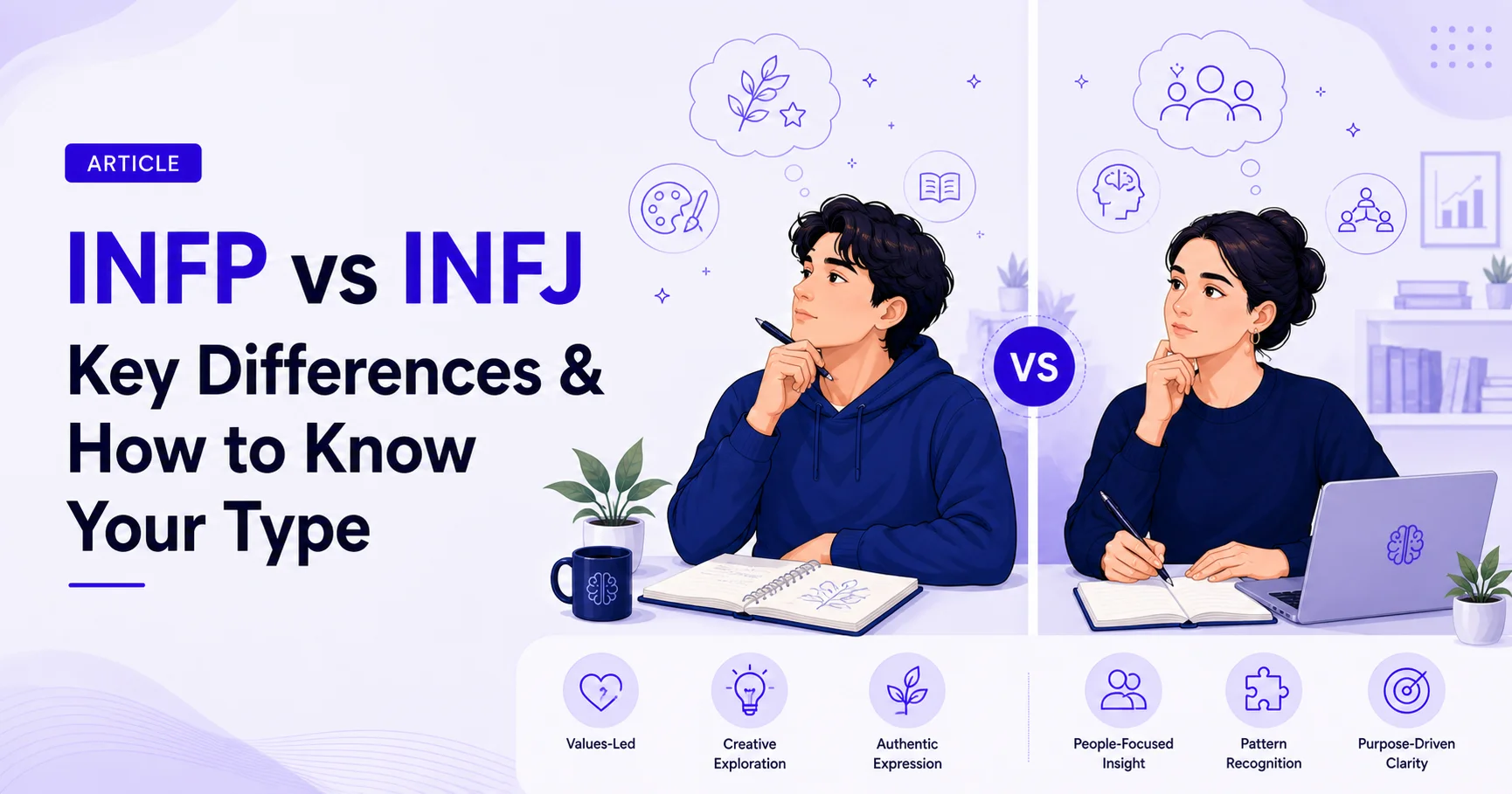
INFP vs INFJ: Key Differences and How to Know Your Type
INFP and INFJ can look remarkably similar: both are introverted, intuitive, feeling-oriented, and often drawn to meaningful work. The key difference is not whether one is more emotional or organized. It is the mental process each type tends to trust first. INFP theory begins with personal values and explores possibilities; INFJ theory begins with an underlying pattern or insight and then considers its effect on people.
This guide compares INFP vs INFJ through cognitive functions, decisions, empathy, conflict, careers, relationships, and stress. Use it as a reflection tool rather than a diagnosis. Four-letter personality models describe preferences, not ability, character, or mental health.
The shortest answer is that INFP is commonly described as values-first and possibility-expanding, while INFJ is commonly described as insight-first and people-attuned. An INFP may ask, “Does this feel true to who I am?” An INFJ may ask, “What pattern is unfolding, and how will it affect everyone involved?”
The letters can be misleading. INFP has a P in its code but leads with an internal judging process, Introverted Feeling. INFJ has a J in its code but leads with an internal perceiving process, Introverted Intuition. That is why surface habits alone do not reliably separate them.
Why INFP and INFJ Are So Easy to Confuse
Both types may prefer depth over small talk, care about authenticity, notice symbolism, need private recovery time, and seek purpose in relationships and work. Either may be creative, empathetic, quiet, idealistic, or organized. Context, maturity, culture, occupation, and learned skills can blur the outward differences.
Online tests also force continuous preferences into categories. A close score, mood, wording, or different test model can move a result from P to J. Instead of comparing stereotypes such as “messy versus organized,” examine repeated motivations and information-processing patterns.
Cognitive Functions: The Difference Behind the Four Letters
In type theory, cognitive functions describe preferred ways of evaluating information and making sense of experience. The proposed stacks are completely different: INFP uses Fi-Ne-Si-Te, while INFJ uses Ni-Fe-Ti-Se. These are theoretical constructs, not clinical measurements.
The INFP Function Pattern: Fi-Ne-Si-Te
Introverted Feeling (Fi) evaluates choices against personal values and inner congruence. Extraverted Intuition (Ne) generates alternatives and connections. Introverted Sensing (Si) compares the present with detailed personal experience. Extraverted Thinking (Te) seeks workable structure and measurable execution, often becoming more visible when a decision must finally be implemented.
The INFJ Function Pattern: Ni-Fe-Ti-Se
Introverted Intuition (Ni) compresses many signals into a central interpretation or future direction. Extraverted Feeling (Fe) tracks interpersonal needs and shared values. Introverted Thinking (Ti) refines internal logic. Extraverted Sensing (Se) attends to immediate sensory reality, although it may receive less attention until the environment demands it.
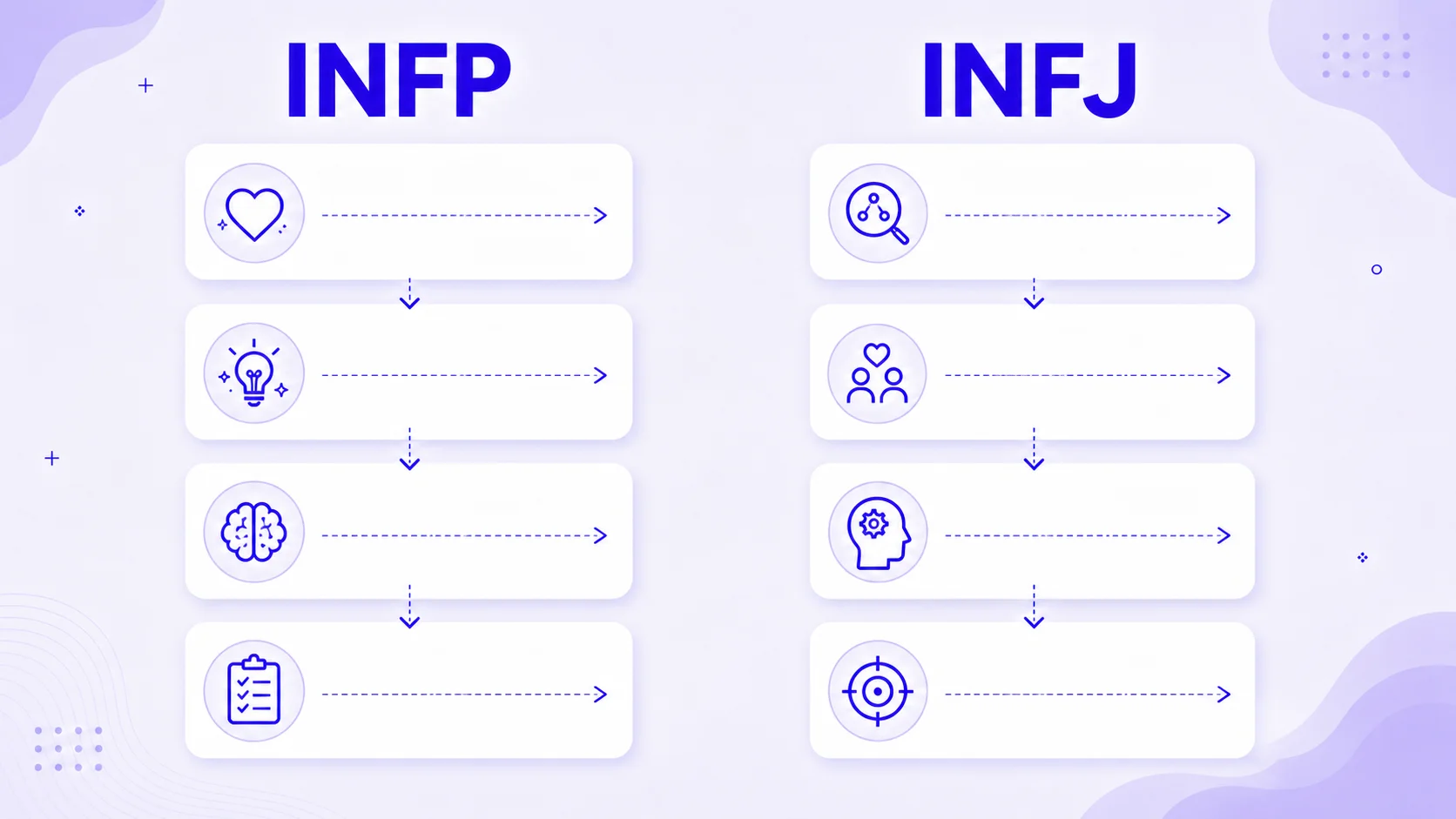
INFP Fi-Ne-Si-Te and INFJ Ni-Fe-Ti-Se cognitive function pathways compared
INFP vs INFJ at a Glance
Area | INFP tendency | INFJ tendency |
First filter | Personal values and authenticity | Underlying pattern and likely outcome |
Possibilities | Keeps several options open | Converges toward one central insight |
Empathy | Relates through personal emotional understanding | Tracks and responds to the emotional atmosphere |
Conflict | Protects values and avoids inauthentic compromise | Seeks relational clarity and a coherent resolution |
Planning | Flexible until a choice feels right | Often prefers a directional plan |
Communication | Explains personal meaning and context | May begin with the conclusion or big picture |
Real-Life Situations That Reveal Your Natural Pattern
Making a Difficult Personal Decision
An INFP may test each option against identity, conscience, and what feels internally honest, while continuing to imagine alternatives. An INFJ may wait until separate observations form a clear direction, then consider how the decision will affect the people involved. Either type can use logic; the distinction is the starting point, not the final result.
Responding to Someone Else’s Strong Emotions
An INFP may connect by locating a related feeling inside and honoring the other person’s individuality. An INFJ may quickly notice the emotional atmosphere and adjust tone, pacing, or words to stabilize the interaction. Neither approach guarantees better empathy, and people of either type can misunderstand others.
Planning Ahead and Handling Change
INFPs may prefer room to revise a plan as new possibilities emerge. INFJs may feel calmer when a future direction is coherent, even if details remain flexible. A highly conscientious INFP can be very scheduled, while an adaptable INFJ can look spontaneous, so look beneath the habit to the reason for it.
Explaining a Position During Disagreement
An INFP may emphasize the principle being protected and resist language that feels false. An INFJ may frame the issue around the wider pattern, relationship, or long-term consequence. Under pressure, both may become unusually blunt or withdraw to process privately.
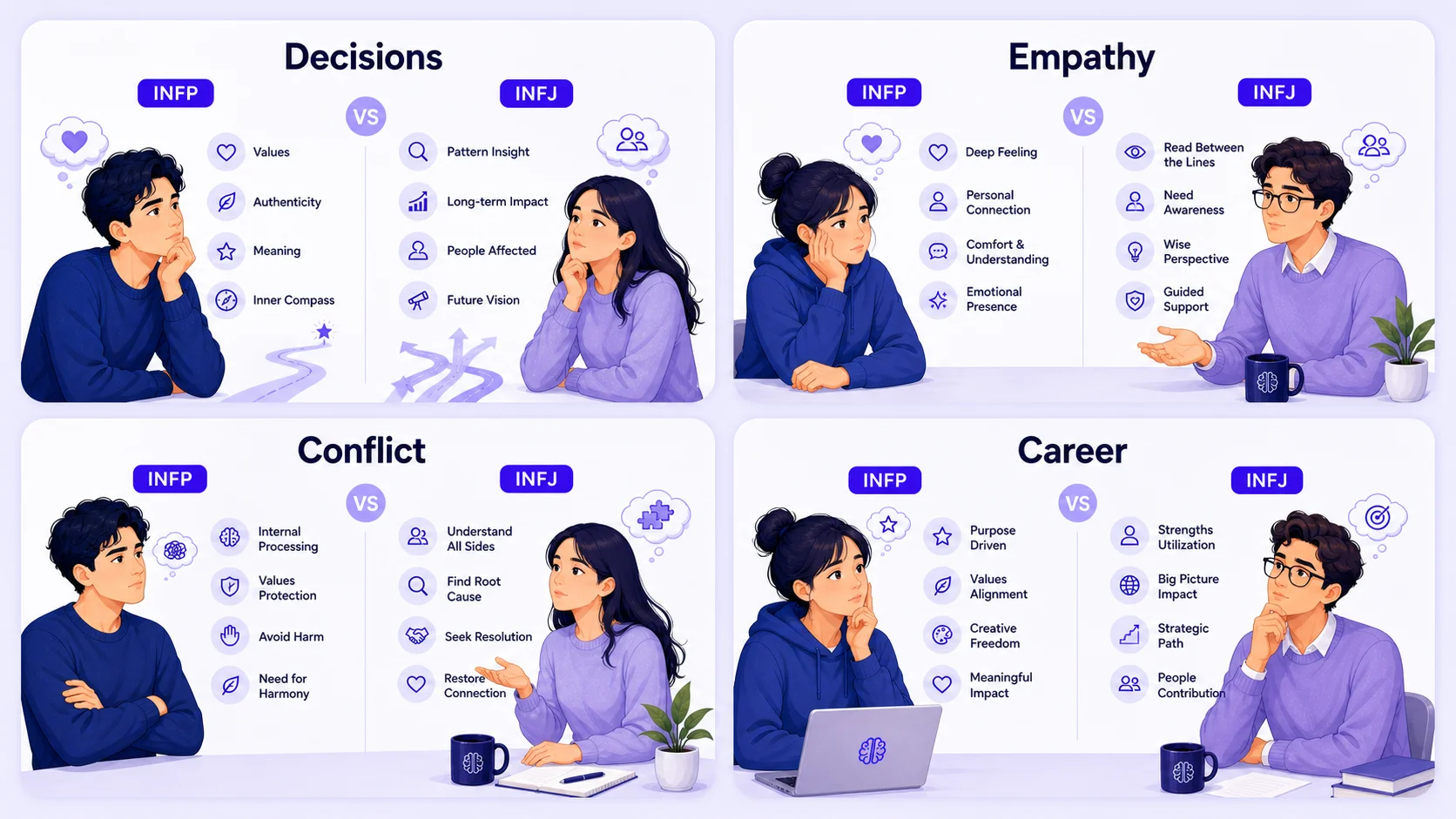
INFP and INFJ differences in decisions empathy conflict and career situations
Why Personality Tests May Alternate Between INFJ and INFP
Your Judging-Perceiving score may be close to the midpoint.
Different websites may use different personality models while displaying similar four-letter labels.
You may answer according to work expectations instead of your default private pattern.
Stress, current responsibilities, and learned skills can change visible behavior.
Broad questions about organization or empathy cannot reliably identify cognitive functions.
A changing result does not mean your personality is fake. It means the instrument, context, or category boundary may not be stable enough to support a confident label.
How to Tell Whether You Are INFJ or INFP: A Step-by-Step Self-Check
Start with your default mental process, not your hobbies, clothing, or job title.
Review ordinary weeks rather than your best day or a period of extreme stress.
Ask whether decisions begin with inner value alignment or a converging interpretation of events.
Notice whether possibilities naturally multiply or gradually narrow toward one likely meaning.
Compare patterns across relationships, work, learning, and private reflection.
Treat a type result as a hypothesis and keep examples that support and contradict it.
If neither pattern consistently fits, you do not need to force a conclusion. A continuous trait framework such as the Big Five may describe your individual profile more precisely than a category.
INFP vs INFJ in Relationships
Both may want depth, loyalty, and emotional safety. INFPs often need room to preserve individual values and process feelings without pressure. INFJs often need clarity about the relationship’s direction and mutual emotional expectations. Healthy communication matters more than type compatibility: state needs directly, verify assumptions, and avoid treating a four-letter code as permission to mind-read.
INFP vs INFJ Careers and Work Style
Type should not prescribe a career. Skills, interests, values, cognitive ability, opportunity, and work environment matter more. Still, an INFP may be energized by autonomy, creative interpretation, and values-aligned contribution. An INFJ may enjoy synthesizing complex information into a purposeful direction and supporting development or coordination.
Either type can succeed in writing, design, counseling, research, education, technology, health, business, or leadership. The useful question is not “Which job belongs to my type?” but “Which tasks, environment, and mission consistently bring out my best work?”
Frequently Asked Questions
Are INFJ and INFP very similar?
They can appear similar because both share I, N, and F preferences. Type theory nevertheless assigns them different function patterns, so their internal reasoning may differ even when behavior overlaps.
Which is rarer, INFJ or INFP?
Published frequency estimates vary by population and method, but INFJ is commonly reported as less frequent than INFP in traditional U.S. MBTI distributions. Rarity does not indicate quality or ability.
Can someone be both INFP and INFJ?
A categorical test assigns one result, but real people can show behaviors associated with both descriptions. Close preference scores and measurement limits can make either label feel incomplete.
Are INFP and INFJ compatible?
They can be, but communication, values, maturity, boundaries, and shared goals predict relationship quality better than matching type codes.
What is the easiest way to spot INFP vs INFJ?
Compare repeated decision and attention patterns: personal value alignment plus expanding options is more consistent with INFP theory; converging insight plus interpersonal calibration is more consistent with INFJ theory.
Why do I keep testing as both?
Close scores, different models, changing context, and broad behavioral questions can alternate the result. Review long-term patterns instead of relying on one quiz.
The Bottom Line
The clearest INFP vs INFJ distinction is not artistic versus analytical, emotional versus logical, or messy versus organized. It is the proposed order of mental preferences: INFP theory emphasizes inner values and expanding possibilities; INFJ theory emphasizes converging insight and interpersonal awareness. Use that distinction to ask better questions about yourself, but keep the label modest. Personality is broader than any four letters.
For a more individualized view, take TalentRank’s personality assessment and compare your continuous trait results with your real-world work preferences: https://www.talentrank.io/assessment-lander
Sources
The Myers-Briggs Company, Type Dynamics: https://www.myersbriggs.org/unique-features-of-myers-briggs/type-dynamics-overview/
The Myers-Briggs Company, MBTI basics: https://www.myersbriggs.org/my-mbti-personality-type/the-16-mbti-personality-types/
McCrae and Costa on MBTI and five-factor traits: https://doi.org/10.1111/j.1467-6494.1989.tb00759.x
TalentRank, Big Five vs MBTI: https://www.talentrank.io/blog/big-five-vs-mbti-which-personality-framework-should-you-actually-trust
TalentRank, MBTI compatibility guide: https://www.talentrank.io/blog/how-to-check-mbti-compatibility