

ENFP Characters in Fiction Anime Movies and TV
ENFP characters are usually the imaginative people in a story who follow their own values: the ones who chase possibilities, connect ideas quickly, question dull rules, and act from a strong inner sense of what matters. In fiction, ENFP typing is always an interpretation, not an official assessment, because characters cannot take a personality test or confirm their own long-term preferences.
That is why this guide does not treat every cheerful, funny, or chaotic character as ENFP. Instead, it looks at repeated choices, emotional motives, adaptability, pressure moments, and the strongest alternative typing. Some readings fit the story more clearly than others. The examples below explain where the evidence is strong and where it leaves room for another type.
Which characters are commonly typed ENFP
Commonly typed ENFP characters include Anne Shirley, Jo March, Rapunzel, Aang, Naruto Uzumaki, Ariel, Lorelai Gilmore, Phoebe Buffay, Kaori Miyazono, and selected versions of Peter Parker. Anne, Jo, Rapunzel, and Aang are useful starting points. Peter Parker needs a closer look at the specific adaptation.
ENFP fictional characters can feel very different from each other. Some are poetic and idealistic, some are impulsive and funny, some are emotionally intense, and some become complicated or unhealthy under pressure. What connects them is not constant happiness. It is a pattern of seeing possibilities, acting from personal meaning, and improvising their way through conflict.
ENFP characters at a glance
Version matters. A character may change across books, seasons, reboots, films, comics, games, and adaptations. Use this table as a starting point. Strong and moderate describe the strength of the interpretation in this guide, not an official result or a measured level of fan agreement. Debated means another type also has a plausible case.
Character | Work or version | Medium | Evidence for the ENFP reading | Strong alternative | Reading strength |
Anne Shirley | Anne of Green Gables novel | Book | Imaginative, expressive, future-focused, guided by personal meaning | INFP | Strong |
Jo March | Little Women novel | Book | Independent, idealistic, restless, creatively driven | ENTP or INFP | Strong |
Rapunzel | Tangled (2010) | Disney film | Curious, optimistic, adaptable, values-led in her growth | ESFP | Strong |
Aang | Avatar original animated series | Western animation | Possibility-seeking, playful, compassionate, resistant to rigid duty | ENFJ for some readers | Strong to moderate |
Naruto Uzumaki | Naruto and Naruto Shippuden | Anime | Hopeful, people-focused, persistent, driven by possibility and bonds | ESFP or ENFJ | Moderate |
Kaori Miyazono | Your Lie in April | Anime | Inspires change, resists emotional confinement, acts from personal conviction | ENFJ | Moderate |
Ariel | The Little Mermaid (1989) | Disney film | Drawn to new worlds, personal longing, risk-taking, identity exploration | ESFP | Moderate |
Lorelai Gilmore | Gilmore Girls | TV | Quick associative humor, independence, warmth, flexible problem-solving | ENTP or ESFP | Moderate |
Phoebe Buffay | Friends | TV | Unconventional values, spontaneous imagination, emotional openness | INFP or ENTP | Moderate |
Peter Parker | Spider-Man: Homecoming (2017) | Film | Imagines a larger role, seeks connection, improvises while learning | INTP, ISFP, or ENFJ depending on version | Debated |
Anna | Frozen (2013) | Disney film | Warm, hopeful, bond-seeking, impulsive, possibility-oriented | ESFP | Debated |
Harley Quinn | Birds of Prey (2020) | Film | Improvisation and changing loyalties in this portrayal | ESFP or ENTP | Debated |
A strong fictional typing should survive more than one scene, one quote, or one fan database vote. It should make sense across the character's recurring decisions.
What does ENFP mean in a fictional character?
For a closer look at the four preferences, see E vs I in MBTI, S vs N in MBTI, T vs F in MBTI, and J vs P in MBTI.
In a fictional character, ENFP usually means the character is energized by possibility, motivated by personal values, expressive in relationships, and flexible in action. The label works best when it describes a repeated pattern, not a costume, joke style, romantic arc, or one dramatic choice.
ENFP stands for Extraversion, Intuition, Feeling, and Perceiving. The letters point to broad preferences. "E" often appears as outward engagement with people or the world. "N" appears as interest in meanings, patterns, futures, and what could be. "F" appears as choices shaped by values and personal impact. "P" appears as adaptability and openness to new information. The Myers & Briggs Foundation overview explains these four preference pairs.
Fiction makes this harder because characters are designed for plot. A character may behave differently across books, seasons, reboots, translations, or fan interpretations. Check which version you are reading, and consider whether another type also fits.
What evidence makes an ENFP character convincing?
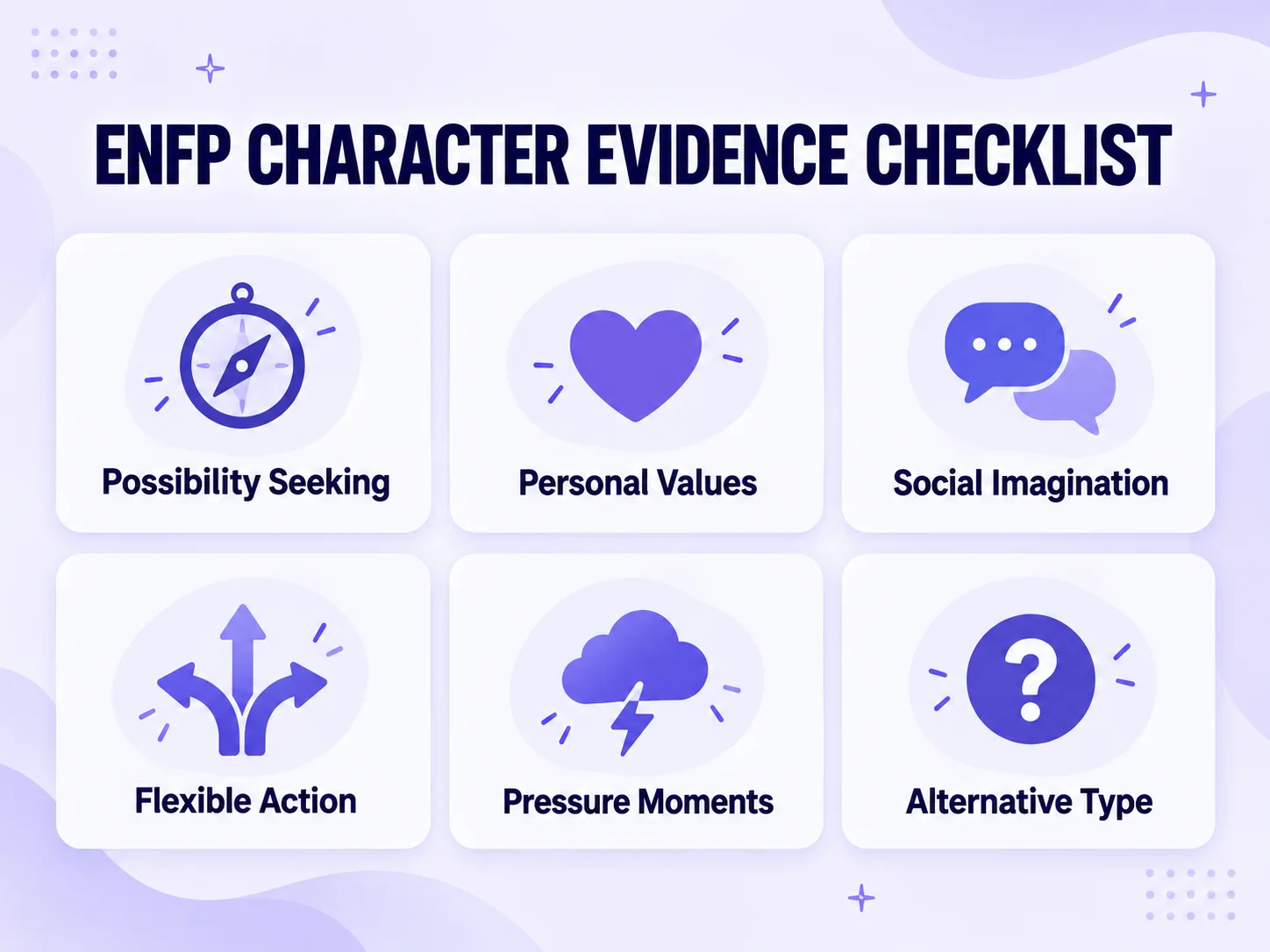
A convincing ENFP character repeatedly pursues possibilities, follows personal values, reads people imaginatively, and adapts plans quickly. Being loud, funny, rebellious, dreamy, or chaotic is not enough by itself. Use these six checks to look beyond a first impression.
● Look for repeated possibility-seeking, not one exciting scene.
● Check whether personal values shape important choices.
● Separate social imagination from simple popularity.
● Notice flexible action, plan changes, and improvisation.
● Test the typing under pressure, not only in happy scenes.
● Name the strongest alternative type before deciding confidence.
Compare an early choice with a difficult decision later in the story. If the same motive appears in both, you have a stronger basis for the typing.
Possibility seeking beyond immediate excitement
ENFP characters often move toward what could happen next. They are drawn to new worlds, new identities, new friendships, new creative paths, or new ways to solve an old problem. The key is possibility, not just thrill-seeking.
This is why Rapunzel feels stronger as an ENFP example than a character who is only impulsive. Her curiosity is connected to meaning, freedom, discovery, and a larger picture of who she might become.
Personal values that shape repeated choices
For a nearby values-first comparison, see the INFP Characters guide.
The "F" in ENFP should show up as more than sweetness. It often appears as a personal code: loyalty, authenticity, compassion, artistic truth, freedom, or a need to protect someone's dignity.
Jo March is a useful example because her choices are not only energetic. She is trying to live honestly, create on her own terms, and resist a life that feels too small for her inner values.
Social imagination without social perfection
Many ENFP characters are good at imagining what people might become. They see potential in friends, strangers, rivals, and sometimes even people who have given up on themselves.
That does not make them socially perfect. ENFP characters can interrupt, avoid hard details, misread a situation, or push too hard. A realistic typing allows warmth and messiness to exist together.
Flexible action and changing plans
ENFP characters often improvise. They may start with one idea, discover something more interesting, and change direction. That flexibility can be creative, but it can also create conflict when others need structure.
Lorelai Gilmore is a good screen example of flexible verbal and practical energy. Her mind jumps quickly, but her best moments also show care, loyalty, and independence rather than random chaos.
Follow-through, growth, and behavior under pressure
Look beyond the bright opening scenes. Notice what happens when the character is hurt, pressured, disappointed, or forced to choose.
An ENFP character may still follow through if the goal has personal meaning. Anne Shirley keeps returning to imagination and feeling, but she also grows into responsibility when her values require it.
Why quirky, bubbly, or rebellious is weak evidence
Quirky style is not a personality type. Bubbly energy is not proof. Rebellion can come from many motivations. A character can be loud and still not be ENFP, or quiet and still show an ENFP pattern.
The better question is: what keeps repeating? If the answer is possibility, personal meaning, flexible exploration, and values-led connection, an ENFP reading becomes more persuasive.
The strongest ENFP fictional character examples
The strongest ENFP fictional character examples combine recognizable personality patterns with enough story evidence to explain the typing. Anne Shirley, Jo March, Rapunzel, and Aang are strong starting points because their choices repeatedly show imagination, values, openness, and a drive toward possibility.
Anne Shirley from Anne of Green Gables
Anne Shirley in the original Anne of Green Gables novel is one of the clearest literary examples of an ENFP reading. She turns ordinary places into imaginative worlds, responds intensely to beauty, and wants life to feel meaningful rather than merely acceptable.
Her ENFP pattern is not just talkativeness. It is the way she uses imagination to survive, connect, dream, and grow. She even renames the places around her, turning Barry's pond into the Lake of Shining Waters. That habit makes her imagination visible in everyday life, as the original novel shows.
The strongest alternative is INFP, especially in readings that focus on Anne's inner world. The ENFP case becomes stronger when her outward energy, social spark, and constant engagement with people and places are emphasized.
Rapunzel from Tangled
Rapunzel in the 2010 animated film Tangled is a strong Disney ENFP character because her curiosity is more than impulse. She wants to understand the world, test the story she has been told, and discover what her longing means.
Her choices show adaptability, optimism, and courage. Her wish to see the floating lanterns gives her curiosity a clear goal, while leaving the tower forces her to question what she has been told. Disney's character profile also emphasizes her curiosity and willingness to enter an unfamiliar world. Those qualities support the ENFP interpretation; Disney does not assign her an MBTI type there.
ESFP is the best alternative for some readers because Rapunzel is physically expressive and present-moment engaged. The ENFP reading is stronger when her symbolic longing, future imagination, and identity search are treated as central.
Aang from Avatar: The Last Airbender
Aang in the original Avatar: The Last Airbender animated series is a strong ENFP candidate. His case comes from his playful openness, compassion, creative avoidance of rigid expectations, and desire to imagine another way through conflict. The series belongs in the Western animation category used in this guide.
His story repeatedly places freedom, mercy, friendship, and possibility against duty and fear. In the final confrontation with Ozai, Aang uses energybending to take away Ozai's bending rather than kill him. That resolution supports an ENFP reading because he keeps looking for an answer he can accept without abandoning his beliefs.
Some readers may argue ENFJ because of Aang's social responsibility and harmonizing role. The ENFP reading is most convincing when his improvisation, open-ended imagination, and resistance to fixed scripts are central.
Jo March from Little Women
Jo March in Louisa May Alcott's novel is often read as ENFP because she is independent, expressive, creative, restless, and deeply protective of her personal freedom. Her ambition is not only achievement. It is a need to live and create honestly.
Jo's strongest ENFP evidence appears in her imaginative writing, resistance to social restriction, intense loyalty, and willingness to remake her path when a ready-made life does not fit. Her loyalty also has a practical side: in chapter 15 of Little Women, she sells her hair to help fund her mother's journey to her sick father. The choice shows how quickly she acts when someone she loves needs help.
ENTP and INFP are the main alternatives. ENTP can fit Jo's argumentative edge, while INFP can fit her personal conviction. ENFP remains persuasive when her outward momentum, warmth, and creative possibility-seeking are emphasized.
ENFP anime characters
ENFP anime character examples include Kaori Miyazono, Chika Fujiwara, Naruto Uzumaki, Usagi Tsukino, and Jiraiya. Luffy is a more disputed example, with ENFP, ESFP, and ENFJ interpretations worth comparing.
The entries here refer to the anime adaptations. Aang appears under Western animation, while manga versions and later story arcs may call for a separate reading.
Kaori Miyazono from Your Lie in April
Kaori is commonly read as ENFP because she pushes against emotional and artistic confinement. She inspires change by refusing to treat life as something that must stay small, quiet, or predictable.
Her response to a failed performance gives that idea substance. After she and Kosei are disqualified, Kaori does not blame him; she later encourages him to enter a piano competition. The official episode 5 synopsis describes both choices. An ENFP reading sees her attention returning to what Kosei could still become, even after a setback.
ENFJ is a fair alternative because Kaori has a strong influence on others. The ENFP reading works when her personal spontaneity and inner conviction drive the interpretation.
Chika Fujiwara from Kaguya-sama: Love Is War
Chika is often typed ENFP because she brings playful disruption, social imagination, quick shifts, and unpredictable energy into structured situations. She is frequently the character who turns a rigid plan into something strange, funny, or unexpectedly revealing.
The caution is that comedy characters can be exaggerated by design. Her ENFP case is strongest when her repeated improvisation and people-reading are considered together, not when she is typed only because she is silly.
Naruto Uzumaki from Naruto
Naruto is a moderate ENFP example because his story is full of future hope, emotional conviction, relationship repair, and refusal to accept that people are locked into one fate.
His optimism becomes especially clear in his confrontation with Nagato during Naruto Shippuden. He listens to Nagato's account of suffering and still commits to finding peace, carrying forward Jiraiya's hope. The official story recap describes this exchange. It supports an ENFP interpretation because Naruto keeps believing that another future is possible when the person in front of him has stopped believing it.
ESFP and ENFJ are reasonable alternatives. ESFP captures some of his direct, action-heavy style. ENFJ captures his later leadership and influence. ENFP fits best when his possibility-driven defiance is emphasized.
Usagi Tsukino from Sailor Moon
Usagi is often read as ENFP because she leads with heart, connection, hope, and emotional openness. She is not the most disciplined or strategic character at first, but her strength grows from compassion and belief in people.
Her ENFP case is strongest when the focus is on her values-led growth, adaptability, and ability to keep imagining a better outcome even when she is frightened or unprepared.
Jiraiya from Naruto Shippuden
Jiraiya can be read as ENFP in the way he blends humor, curiosity, idealism, mentorship, and a belief in future possibility. Behind his comic surface is a recurring investment in people and in the idea that the world can still change.
He is also a good reminder that ENFP characters are not always young, naive, or purely bubbly. A mature ENFP reading can include regret, wisdom, contradiction, and a long view of hope.
Is Luffy ENFP ESFP or ENFJ
Luffy is debated because his desire for freedom and emotional loyalty can support an ENFP reading. ESFP deserves equal attention: his quick responses to immediate situations can be read as a stronger interest in direct experience than in exploring ideas. An ENFJ interpretation puts more weight on how he gathers people and inspires loyalty.
A Reddit discussion comparing ENFP and ESFP asks this question directly. A big dream or a loyal crew cannot decide the type on its own. Luffy belongs here as a comparison case, with the explanation mattering more than the label. For a close comparison, see the ENFJ Characters guide.
ENFP cartoon and Western animation characters
Aang, Mabel Pines, and Finn are useful Western animation examples because they show playful possibility, emotional sincerity, improvisation, and growth shaped by their values. Their stories also leave room for fear, mistakes, and responsibility.
Aang is one of the strongest Western animation examples for ENFP, especially when his avoidance of rigid destiny is read alongside his compassion and creative problem-solving.
His playful manner coexists with a difficult responsibility: protecting others while staying true to his beliefs. That tension gives his ENFP reading more depth than his humor alone.
Mabel Pines from Gravity Falls
Mabel Pines is often read as ENFP because she is imaginative, expressive, relationship-centered, and constantly open to odd possibilities. Her emotional world is loud, but it is also sincere.
The best case for Mabel is her mixture of creativity, social warmth, and values-led loyalty. The caution is that her cartoon exaggeration can make any typing feel larger than life.
Finn from Adventure Time
Finn can be interpreted as ENFP because he grows through adventure, idealism, emotional exploration, and a desire to do good even when he does not fully understand himself yet.
His type is not settled for every reader. Still, his movement from simple hero energy into more reflective, values-based growth makes him a useful moderate example.
ENFP Disney characters
Disney characters often typed as ENFP include Rapunzel, Ariel, and the Genie, with Anna from Frozen treated as a debated case. These entries refer to the original animated films.
Rapunzel earns the strongest Disney spot because her arc is driven by possibility and identity. She wants more than an exciting day outside. She wants to know whether the world she has imagined is real and whether she belongs in it.
Her flexibility, optimism, creativity, and values-led courage make the ENFP reading persuasive.
Ariel from The Little Mermaid
Ariel is commonly read as ENFP because she is fascinated by another world and pulled by longing, imagination, and identity. She does not merely collect human objects. She attaches meaning to them.
ESFP is a strong alternative because Ariel is impulsive and sensory-curious. ENFP fits best when her future-oriented idealism and symbolic imagination are given more weight.
The Genie from Aladdin
The Genie can be read as ENFP because he is imaginative, expressive, improvising, relationship-oriented, and deeply invested in freedom. His comic flexibility is matched by a personal longing to be more than a role.
Because he is a magical comic figure, the typing should stay moderate. The evidence is strongest when his creativity and values around freedom are read together.
Is Anna from Frozen ENFP or ESFP?
Anna is debated. The ENFP reading focuses on her hope, relational idealism, openness, and belief in emotional possibility. The ESFP reading focuses on her direct action, present-moment expressiveness, and fast response to what is right in front of her.
Anna's warmth and hope support one reading; her immediate, practical responses support the other. Both need to be weighed before calling her a definite ENFP.
ENFP movie and TV characters
ENFP movie and TV characters often stand out through fast association, emotional openness, flexible problem-solving, and a refusal to live inside a script that feels false. Lorelai Gilmore, Phoebe Buffay, Jake Peralta, Michael Scott, and some Peter Parker versions can all be discussed with attention to the particular adaptation.
Lorelai Gilmore from Gilmore Girls
Lorelai is a moderate ENFP example because her humor moves quickly, her life choices are independence-driven, and her relationships are full of warmth, improvisation, and personal conviction.
She can look ENTP because of her verbal speed and playful argument style. The ENFP reading is stronger when her emotional loyalty and values-led independence are treated as central.
Phoebe Buffay from Friends
Phoebe is often read as ENFP because she is unconventional, spontaneous, imaginative, and guided by a personal code that does not always match the rules around her.
The risk is typing her only as "weird." Her better ENFP evidence is that she often follows meaning, personal ethics, and emotional connection in her own unusual way.
Jake Peralta from Brooklyn Nine-Nine
Jake can be read as ENFP when the focus is on his playful imagination, people orientation, improvisation, and gradual growth into responsibility. He uses jokes and unusual ideas to connect with colleagues and approach cases.
ESFP and ENTP are also possible readings, depending on which parts of his humor, action style, and reasoning the reader emphasizes.
Michael Scott from The Office
Michael Scott is a flawed and often unhealthy example, not a model of the type. He can be interpreted as ENFP because he chases belonging, reinvents situations, acts from emotional need, and resists sterile workplace rules.
His poor judgment is not "because of ENFP." It is a character flaw in a comedy, and type should never be treated as a moral explanation.
Which version of Peter Parker can be read as ENFP?
Peter Parker changes by writer, actor, era, and continuity. Tom Holland's Peter in Spider-Man: Homecoming (2017) is one possible ENFP interpretation: he imagines a larger role for himself, seeks connection, and improvises as he learns to be a hero. His excitement about joining the Avengers is also part of Marvel's film synopsis. This is a reading of the fictional character, not the actor.
Other versions may fit INTP, ISFP, or another type better. The Homecoming reading should not be carried over automatically to another film or comic run.
ENFP book and literary characters
Book characters can be especially useful for ENFP typing because novels often show motivation, inner conflict, and repeated choices more clearly than short screen scenes. Anne Shirley, Jo March, Pippi Longstocking, and Elizabeth Bennet all invite ENFP discussion, though not all are equally settled.
Anne's imagination, emotional intensity, values, and outward engagement make her one of the strongest literary ENFP examples. Her growth adds another reason: near the end of Anne of Green Gables, she gives up her immediate plan to attend college and chooses to stay with Marilla and teach. She finds a new way forward without losing her ambition.
Jo's ENFP case rests on creative independence, restless possibility, personal values, and refusal to accept a narrow role. She has enough complexity that INFP and ENTP readings can also make sense, but ENFP remains a strong reading.
Pippi Longstocking
Pippi is often read as ENFP because she is imaginative, unconventional, playful, independent, and resistant to rules that feel arbitrary. Her story energy is possibility-led rather than orderly or tradition-bound.
Because Pippi is also a highly stylized children's character, the typing should stay light and interpretive rather than overly technical.
Elizabeth Bennet from Pride and Prejudice
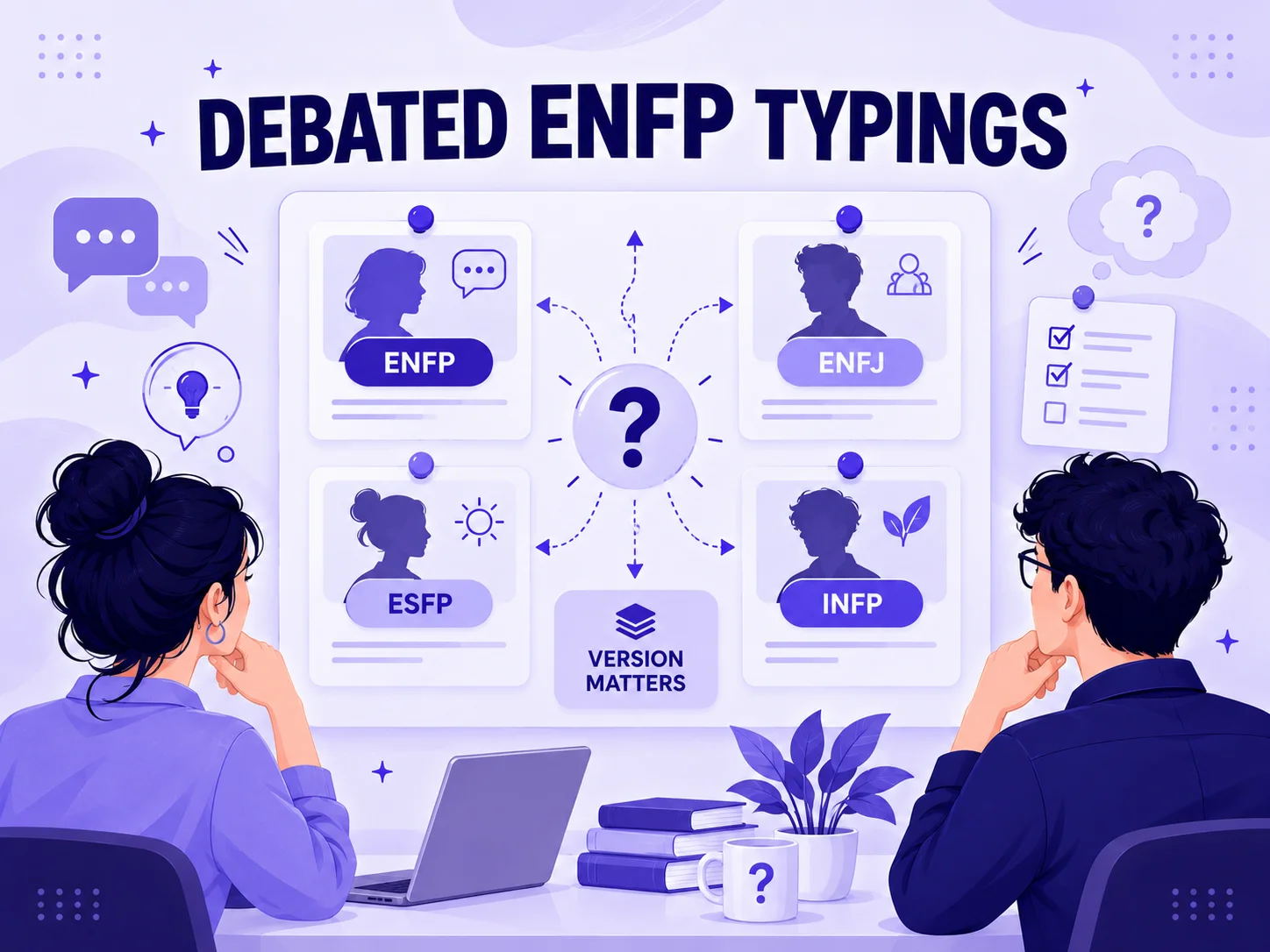
Elizabeth Bennet is debated. ENFP readers may point to her wit, independence, strong personal judgments, and refusal to accept social expectations blindly.
Others see ENTP, ENFJ, or another type depending on how her social perception and reasoning are interpreted. She is best used as a discussion example, not a settled ENFP entry.
ENFP characters in games and comics
Games and comics need extra caution because character continuity can change across writers, timelines, player choices, and adaptations. A character may feel ENFP in one run and very different in another.
For that reason, game and comic examples need a specific continuity. Compare the character's recurring dialogue and decisions within that version. In a game with branching choices, also separate actions written into the story from choices made by the player.
Harley Quinn shows why that matters. Her portrayal in a particular comic run, animated series, game, or film needs its own evidence. The Birds of Prey example discussed below applies to that film; it does not settle the type of every DC version.
Realistic ENFP representation beyond the bubbly stereotype
Realistic ENFP representation includes more than cheerful chaos. An ENFP character can be thoughtful, strategic in bursts, wounded, mature, male, female, introverted-looking at times, or morally complicated. The type is about patterns of possibility and values, not a single mood or aesthetic.
Intelligent and mature ENFP characters
Mature ENFP characters often become better at choosing which possibilities deserve follow-through. They may still brainstorm, joke, and resist stale rules, but they learn to connect imagination with responsibility.
Jiraiya, Jo March, Anne Shirley as she grows, and Lorelai Gilmore in her more grounded moments can all help show that ENFP does not mean childish or unserious.
Well-written male and female ENFP characters
ENFP lists can lean heavily on Disney girls, which makes the type feel narrower than it is. Aang, Naruto, Jiraiya, and the Genie offer male examples alongside Jo, Anne, Rapunzel, Lorelai, Phoebe, and Kaori.
Together, these characters show how similar preferences can appear through different ages, genres, cultures, and story roles.
Unhealthy, flawed, villain, and non-hero ENFP characters
Flawed or non-hero characters can be discussed as ENFP only with careful boundaries. A personality type does not cause violence, trauma, addiction, selfishness, or poor judgment. If a complicated character is included, focus on fictional decision patterns, not diagnosis or moral labels.
Harley Quinn in selected DC versions
Harley Quinn is highly version-dependent. In Birds of Prey (2020), her unexpected alliance with Huntress, Black Canary, and Renee Montoya provides one specific portrayal to examine. Her improvisation and changing loyalties can support an ENFP interpretation, but the film's action and comedy also leave room for other readings.
Other versions may fit ESFP, ENTP, or another type better. Because the character changes across comics, animation, games, and films, she should never be listed as a universal, settled ENFP.
Obito Uchiha from Naruto
Obito is a debated example because his story involves grief, manipulation, and destructive choices. His early hopes and later decisions need to be considered together, rather than treating one stage of his story as his entire personality.
An ENFP reading may focus on distorted idealism, emotional intensity, and a broken relationship to possibility. That does not mean ENFP causes harmful behavior. It only means some readers interpret his fictional pattern that way.
Other debated morally complicated examples
Some characters are included in ENFP lists because they are chaotic, funny, or rule-breaking. That is not enough. A morally complicated character should only be included when the story shows values, possibility, adaptation, and repeated motivation.
When the story does not support that pattern, keep the ENFP label tentative. Being unpredictable or rebellious is too little evidence on its own.
Why do people disagree about ENFP character typings?
People disagree about ENFP character typings because fictional characters are written by authors, not assessed through stable personality tests. Different adaptations, arcs, translations, genres, and fan expectations can emphasize different traits. ENFP can also overlap on the surface with ESFP, ENFJ, ENTP, and INFP, especially when evidence is thin.
Debated character | ENFP argument | Strong alternative | Why the debate exists |
Anna from Frozen | Hopeful, relational, open, possibility-oriented | ESFP | Her direct action and present-moment energy are also strong |
Luffy from One Piece | Freedom-seeking, loyal, possibility-driven | ESFP or ENFJ | Immediate action supports ESFP; group influence supports ENFJ |
Peter Parker in Homecoming | Idealistic, improvising, emotionally responsive in some versions | INTP, ISFP, ENFJ | The character changes heavily by writer and adaptation |
Harley Quinn in Birds of Prey | Reinvention, improvisation, emotional intensity in selected versions | ESFP, ENTP | Continuity changes and sensitive story material affect interpretation |
Elizabeth Bennet | Independent, witty, values-led, socially perceptive | ENTP, ENFJ | Readers weigh wit, judgment, and social insight differently |
Disagreement can make the comparison useful. One reader may give more weight to a character's ideals, while another focuses on how they act from moment to moment. Specific scenes make those differences easier to judge.
How to evaluate an ENFP character yourself
To evaluate an ENFP character yourself, start with the exact version, then look for repeated choices. Ask what the character moves toward, what values shape their decisions, how they respond under pressure, and which alternative type would explain the same evidence better.
Question | What to look for |
Which version are you typing? | Book, film, series season, reboot, comic run, game route, or specific adaptation |
What possibility keeps attracting them? | New future, new identity, new relationship, new idea, new world, or new moral option |
Which values shape their choices? | Freedom, authenticity, compassion, loyalty, creativity, justice, or personal meaning |
How do they act under pressure? | Improvisation, avoidance, values-led courage, emotional intensity, or scattered follow-through |
What is the strongest counterexample? | A scene or arc that points away from ENFP |
Which type is the strongest alternative? | ESFP, ENFJ, ENTP, INFP, or another plausible reading |
What confidence level fits? | Strong, moderate, debated, or weak |
If the evidence is mostly "funny," "weird," "rebellious," or "popular," the typing is weak. If the evidence shows repeated possibility-seeking and values-led adaptation across the story, the ENFP reading is much stronger.
ENFP-A and ENFP-T characters: what can fiction actually show?
ENFP-A and ENFP-T come from 16Personalities' Identity scale. A means Assertive and T means Turbulent. These suffixes are not part of the four-letter MBTI preference code. For fictional characters, they remain informal interpretations rather than assessment results.
In that framework, ENFP-T describes greater self-doubt and sensitivity to stress, while ENFP-A describes greater confidence and steadiness. If you are looking for ENFP-T characters, pay attention to self-questioning and responses to setbacks. For ENFP-A characters, look for a more assured response across several situations. A confident scene or an anxious episode cannot establish either label.
A/T labels should not replace the main question: does the character repeatedly show an ENFP pattern in the story? They also do not tell you whether a character is kind, intelligent, mature, or well written.
Frequently ask Questions
Why do I not relate to popular ENFP characters
A character list cannot represent every person with the same type. A Reddit discussion about ENFP portrayals raises this frustration with endlessly cheerful, dreamy characters. You may recognize Anne's imagination or Jo's independence without sharing Rapunzel's manner. Look for familiar motives and choices, rather than expecting the whole character to resemble you.
Which ENFP characters feel mature and realistic
Anne as she grows into responsibility, Jiraiya as a mentor, and Lorelai in her more grounded moments are useful examples from this guide. A Reddit question about mature ENFP characters asks for this kind of representation. Maturity shows in how a character handles consequences, keeps commitments, and learns from mistakes.
Does relating to an ENFP character mean I am ENFP
No. You can relate to a character because of a shared goal, experience, sense of humor, or relationship. Those connections may help you reflect on yourself, but they cannot establish your personality type. Notice your own recurring preferences across everyday situations, rather than relying on which fictional character you like most.
What ENFP characters have in common
The best ENFP characters are not just the loudest, funniest, or most chaotic people in a story. Their choices repeatedly point toward possibility, personal values, imaginative connection, and flexible growth. Anne's changing ambitions, Rapunzel's curiosity, and Naruto's hope express that pattern in different ways. Start with the version you know, look at what the character actually does, and leave room for a better explanation. If these examples feel familiar, you can explore your own personality preferences through TalentRank's free personality test.