

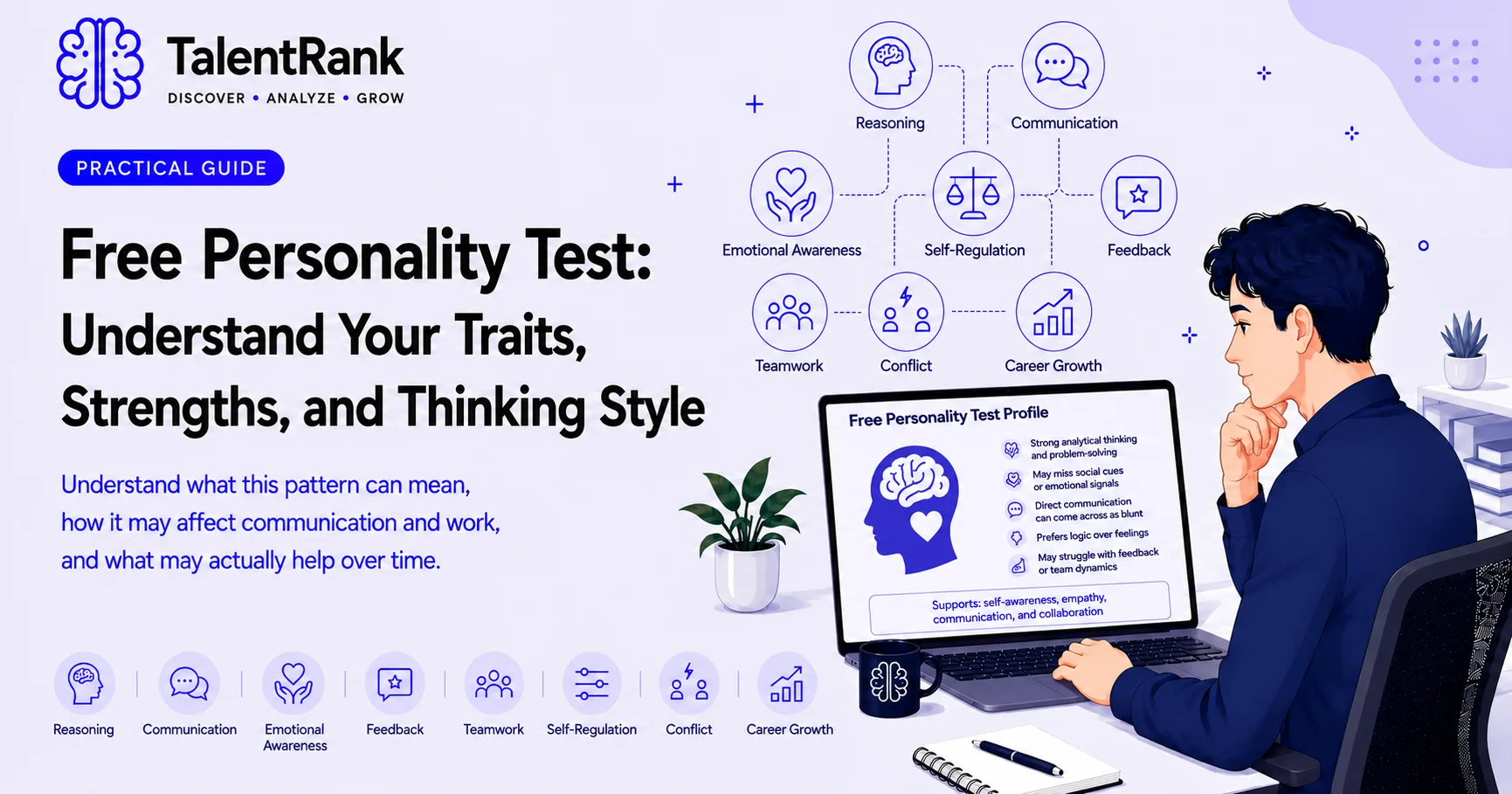
A free personality test can help you explore patterns in how you think, respond to situations, interact with other people, and approach work or everyday decisions. A well-designed assessment can turn those patterns into a structured personality profile, giving you useful language for self-reflection without reducing your personality to a single label.
But not every personality test online measures the same thing or has the same level of evidence behind it. Some use established trait frameworks, while others are designed mainly for entertainment. The key is knowing what an assessment measures, how to interpret its results, and what those results cannot tell you. This guide explains the Big Five personality model, test accuracy, personality and cognitive assessment, career use, and what to look for before trusting an online test.
What Can a Free Personality Test Actually Tell You?
A personality test can help describe broad tendencies in how you typically behave, feel, and respond. Depending on the assessment, your results may highlight patterns such as sociability, organization, curiosity, cooperation, or emotional sensitivity. These are tendencies rather than fixed rules about who you are.
That distinction matters because a personality score is not a diagnosis, a prediction of your future, or a complete description of you.
A useful assessment may help you:
identify recurring behavioral tendencies;
find language for strengths and potential growth areas;
reflect on how you approach relationships and teamwork;
consider the environments in which you prefer to work;
compare different aspects of your personality without forcing them into a single type.
It cannot tell you with certainty which career you should choose, whether a relationship will succeed, or how you will behave in every situation. It also should not be used as a medical or mental-health evaluation.
Think of a personality profile as a structured starting point for reflection, not a verdict.
How Online Personality Assessments Work
Most online personality assessments ask you to respond to statements about your typical thoughts, feelings, preferences, or behavior. Your responses are then scored according to the framework used by the assessment.
The quality of that process matters more than whether the test happens to be free.
Self-Report Questions
Many personality assessments use self-report items. You may be asked how strongly you agree with statements about being organized, sociable, curious, cooperative, or easily stressed.
There is no benefit to trying to choose the answer that seems more impressive. If an assessment is intended to describe your usual tendencies, answering according to the person you think you should be can make the profile less useful.
Trait Scores Instead of Fixed Labels
Some assessments sort people into categories or personality “types.” Trait-based assessments work differently.
Instead of saying that you either are or are not a particular type, a dimensional model can show where your responses fall along several continua. That matters because two people can both be relatively introverted, for example, while still differing substantially in conscientiousness, openness, or agreeableness.
Why Honest Answers Matter
Context can affect how people answer. You may think about yourself differently at work than you do with close friends, and some questions may feel difficult when your behavior varies by situation.
A practical approach is to answer based on how you generally behave rather than focusing on an unusual day or trying to create an ideal profile.
What Is the Big Five Personality Model?
The Big Five is a widely researched framework that organizes personality characteristics into five broad trait dimensions: Openness to Experience, Conscientiousness, Extraversion, Agreeableness, and Neuroticism. The initials form the common acronym OCEAN. Importantly, these dimensions are continua rather than five separate personality types. Research literature has examined the model's structure, measurement, and relationship with a range of behaviors and outcomes.
Trait | In simple terms | A relatively higher score may reflect | A relatively lower score may reflect |
Openness | Interest in ideas, novelty, and experiences | Curiosity, imagination, preference for variety | Preference for familiarity, practicality, or established approaches |
Conscientiousness | Organization and goal-directed behavior | Planning, persistence, orderliness | Flexibility, spontaneity, less preference for structure |
Extraversion | Engagement with social activity and stimulation | Sociability, assertiveness, energy | Reserved behavior, preference for lower-stimulation settings |
Agreeableness | Interpersonal cooperation and concern for others | Compassion, cooperation, trust | Greater skepticism, competitiveness, or directness |
Neuroticism | Tendency toward negative emotional reactivity | Greater sensitivity to stress or negative emotion | Greater emotional stability and lower reactivity |
None of these columns should be read as “good” versus “bad.” A trait can be useful or challenging depending on its level, the situation, and what a person is trying to accomplish.
For example, lower Extraversion does not mean someone lacks social skills. A more reserved person may simply prefer smaller groups, more independent work, or less social stimulation. Likewise, high Extraversion does not automatically make someone a better leader.
As summarized in John and Srivastava's Big Five taxonomy review, the Big Five became influential in personality research partly because it provides a common taxonomy for describing broad individual differences rather than forcing everyone into a small number of mutually exclusive personality categories.
How Accurate Are Free Personality Tests?
A personality test is not accurate simply because it is paid, and it is not inaccurate simply because it is free. A better evaluation looks at the assessment itself: what it measures, how consistently it measures it, whether evidence supports the intended interpretation of its scores, and whether its claims match the available evidence.
Two concepts are particularly useful when evaluating assessments: reliability and validity.
Reliability concerns the consistency of measurement. Validity concerns whether evidence supports the interpretations and uses being made from assessment scores. They are related, but they are not interchangeable, and neither can responsibly be reduced to a marketing claim such as “92% accurate” without explaining exactly what that percentage represents.
Your responses matter, too. Rushing through questions, answering according to an idealized version of yourself, misunderstanding items, or responding randomly can reduce the usefulness of the resulting profile.
This also creates an important distinction when comparing personality tests online:
Evidence supporting a personality framework does not automatically validate every questionnaire that uses that framework.
The Big Five has a substantial research literature. That fact alone does not establish the reliability or validity of every website's particular Big Five test.
If accuracy is your main concern, look beyond the label on the test and examine its methodology, evidence, intended use, and limitations.
How to Choose a Trustworthy Online Personality Assessment
A trustworthy online personality assessment should make it reasonably clear what it measures and avoid promising more than its results can support. You do not need to be a psychometrician to spot basic signs of transparency.
Before relying on a test, ask:
Does it identify the framework it uses? A test should explain whether it is based on the Big Five, a type model, another framework, or a proprietary approach.
Does it explain what the scores mean? Results should provide more than flattering descriptions or vague statements that could apply to almost anyone.
Are research claims supported? Look for sources when a site makes claims about reliability, validity, prediction, or psychological research.
Does it distinguish framework evidence from test-specific evidence? Research on the Big Five is not automatically research on a particular company's questionnaire.
Are limitations acknowledged? Be cautious when a test claims it can reveal your ideal career, perfect partner, future success, or complete personality.
Can you understand how your information is handled? Check the site's privacy information before providing personal data.
Is the purpose appropriate? A self-discovery assessment should not present itself as a substitute for a clinical evaluation.
A professional-looking results page is not evidence by itself. Transparency about what an assessment can and cannot do is a stronger trust signal than dramatic claims about precision.
Personality Tests vs. Cognitive Assessments: What’s the Difference?
Personality and cognitive assessments answer different kinds of questions. Personality assessments generally examine characteristic patterns and tendencies, often through self-report questions. Cognitive assessments use performance-based tasks to examine aspects of reasoning or other cognitive abilities. The two sources of information can complement each other, but they should not be treated as interchangeable.
Personality assessment | Cognitive assessment | |
Main focus | Characteristic tendencies and patterns | Performance on reasoning or other cognitive tasks |
Common format | Self-report questions | Problems or performance-based questions |
Typical output | Trait profile | Ability/performance-related scores |
Possible career use | Reflecting on work style and preferences | Additional information about reasoning-related performance |
Medical diagnosis | No | No |
The International Cognitive Ability Resource (ICAR) was developed as a public-domain resource for cognitive ability measurement. Its initial research examined several types of performance items, including letter-and-number series, matrix reasoning, three-dimensional rotation, and verbal reasoning.
That research supports discussion of ICAR itself. It does not mean that any assessment containing ICAR-inspired or ICAR-informed questions automatically inherits the validation evidence of the original instrument.
TalentRank approaches these areas together by using the Big Five personality framework alongside ICAR-informed cognitive questions. The purpose is to provide different kinds of information within a broader assessment experience rather than pretending that a personality score and a cognitive score measure the same construct.
Can a Free Personality Test Help With Career Decisions?
A personality test can be useful for career exploration when you treat the results as one source of information rather than a prescription. Personality research has found relationships between some Big Five traits and aspects of work performance, but those relationships vary by trait, occupation, and outcome. A personality profile cannot determine your ideal career by itself.
Consider someone who scores relatively high on Extraversion. It would be tempting to conclude, “You should work in sales.”
That is too simplistic.
A better use of the result is to ask questions:
Do you enjoy frequent interaction during the workday?
Do you prefer collaborative or independent tasks?
How important is social stimulation in your ideal work environment?
Do you enjoy persuading or presenting, or do you simply enjoy being around people?
What skills, interests, and values do you want to use at work?
Research on personality and job performance also illustrates why simple career matching is risky. A classic meta-analysis by Barrick and Mount found that Conscientiousness showed relatively consistent relationships with the job-performance criteria they examined across occupational groups, while relationships involving other Big Five dimensions varied depending on the occupation and criterion.
In other words, “high on trait X = career Y” is not a responsible interpretation.
For meaningful career exploration, combine personality information with your interests, skills, values, education, experience, practical constraints, and the opportunities available to you. Cognitive assessment may provide another piece of information, but it still does not replace the broader career decision-making process.
How to Get More Useful Results From a Personality Test
The way you approach an online personality assessment can affect how useful the results feel afterward. You do not need to manipulate your answers to produce a “better” personality.
Instead:
Answer for your typical behavior. Think about recurring patterns rather than one exceptional situation.
Avoid answering as your ideal self. Choosing what sounds desirable defeats the purpose of self-reflection.
Do not treat one score as your identity. Look at the overall pattern across traits.
Pay attention to context. Your behavior may differ across work, family, friendships, and unfamiliar situations.
Use surprising results as questions, not facts. Ask why a result feels inaccurate or unexpected instead of immediately accepting or rejecting it.
Avoid making high-stakes decisions from one test. A personality profile is one data point, not a complete decision system.
For example, imagine that your Conscientiousness score is lower than you expected. Rather than concluding, “I am an unorganized person,” look at the pattern more carefully. Perhaps you dislike rigid schedules but reliably meet deadlines. Maybe you are organized at work but spontaneous in your personal life. Those distinctions can be more useful than the label alone.
Big Five vs. Personality Types: Why the Results Look Different
Big Five assessments and personality-type tests can feel very different because they organize information differently. The Big Five measures broad traits along continua, while type-based systems typically group patterns into categories. As a result, a trait profile can preserve more information about where you fall between two extremes instead of requiring a single type label.
That does not mean a personality type can never be useful for self-reflection. Type systems can provide memorable language for discussing preferences and interpersonal differences. The important question is what you expect the assessment to do.
If you are specifically interested in four-letter personality types, TalentRank's guide to the free Myers-Briggs test explains the difference between the official MBTI and free MBTI-style alternatives. You can also explore the four personality types guide for a broader look at simpler type-based approaches.
If your priority is understanding personality through broad, continuous trait dimensions, a Big Five assessment is the more relevant format.
What TalentRank’s Free Assessment Measures
TalentRank combines a Big Five-based personality assessment with ICAR-informed cognitive questions and provides a personalized report. These components are intended to offer different perspectives rather than compressing everything about a person into a single personality label.
The personality component focuses on broad Big Five traits. The cognitive component introduces performance-based questions informed by cognitive-assessment research. Keeping those components conceptually separate is important: personality tendencies and cognitive performance are not the same thing.
TalentRank describes its approach as research-informed. That wording should not be interpreted to mean that the complete TalentRank assessment has been independently clinically validated or that research on the Big Five or ICAR automatically validates TalentRank's specific implementation.
The assessment is designed for informational self-understanding and exploration. It is not a medical, psychiatric, or mental-health diagnostic tool.
If you want to examine assessment quality in more depth before taking a test, read TalentRank's guide to what makes a personality test accurate. You can also review TalentRank's Privacy Policy to understand how the service describes its handling of information.
Take the Free TalentRank Assessment
If you want to move from reading about personality to exploring your own results, you can take the free TalentRank assessment. It combines Big Five-based personality questions with ICAR-informed cognitive questions and a personalized report so you can examine different aspects of your profile in one experience.
Treat the results as a starting point for asking better questions about yourself, not as a final definition of who you are.
Frequently Asked Questions About Free Personality Tests
Are free personality tests accurate?
Some free personality tests can be useful, but price alone tells you very little about assessment quality. Look at the framework, methodology, evidence, scoring interpretation, limitations, and intended use. Research supporting a framework such as the Big Five does not automatically validate every free test based on it.
What is the Big Five personality test?
A Big Five personality test measures five broad dimensions: Openness to Experience, Conscientiousness, Extraversion, Agreeableness, and Neuroticism. Rather than assigning one fixed personality type, Big Five assessments generally represent people along continuous trait dimensions.
Can I take a personality test online for free?
Yes. Many websites provide free personality assessments, although their frameworks, question quality, reports, privacy practices, and supporting evidence vary. Check what a test measures and what is included in the free experience before relying on its results.
Can a personality test tell me what career to choose?
Not reliably by itself. Personality results can help you reflect on work preferences and behavioral tendencies, but career decisions also depend on interests, skills, values, education, experience, constraints, and available opportunities. Avoid tests that promise to identify your one “perfect” career from personality alone.
What is the difference between personality and cognitive assessment?
Personality assessments generally measure characteristic tendencies, often using self-report questions. Cognitive assessments use performance-based questions to examine aspects of reasoning or other cognitive abilities. They provide different kinds of information and should not be interpreted as interchangeable measures.
Can personality test results change over time?
Results can differ because of measurement factors, context, how questions are interpreted, and genuine changes in personality over time. A single score should therefore be treated as an estimate of your current trait pattern rather than an unchangeable identity.
Is an online personality test a psychological diagnosis?
No. A general online personality test should not be used to diagnose a mental-health or psychiatric condition. Personality traits describe patterns of individual differences; they are not, by themselves, clinical diagnoses.
A Better Way to Use a Free Personality Test
The most useful free personality test is not necessarily the one with the boldest accuracy claim or the most memorable label. Look for an assessment that clearly explains what it measures, uses an appropriate framework, supports research claims with evidence, acknowledges limitations, and gives you results you can interpret responsibly. Whether you are exploring your personality out of curiosity or thinking about work and personal development, use the results to generate better questions rather than final answers, and combine them with what you already know from your experience, goals, skills, and real-world context.