

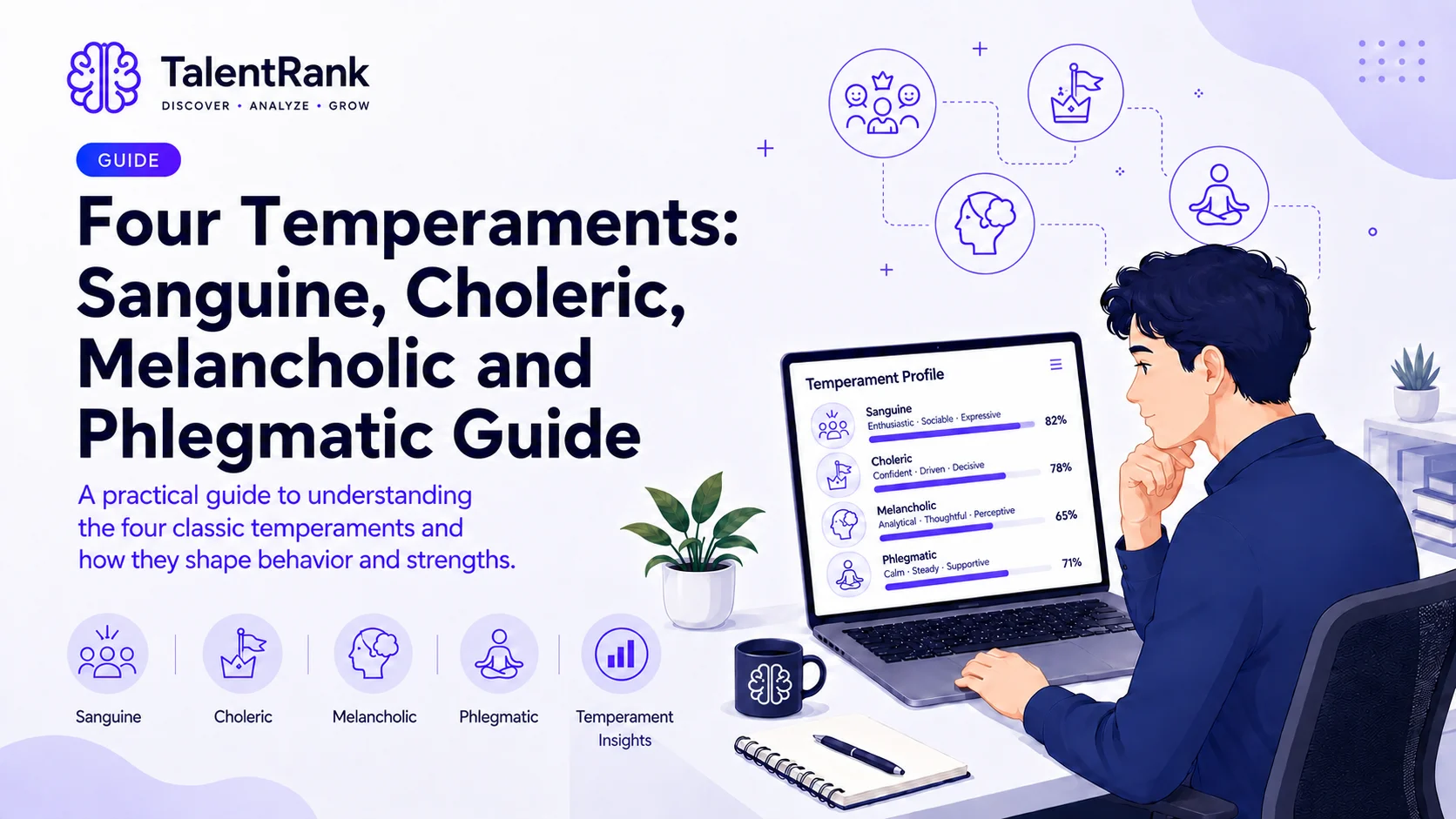

The Four Temperaments are broad historical categories rather than fixed identities.
Search for a “4 types of personality test,” and you may find several different answers. Some pages mean the Four Temperaments Sanguine, Choleric, Melancholic and Phlegmatic. Others mean DISC, Type A/B/C/D, or the four preference pairs used to create the 16 Myers-Briggs personality types.
This guide focuses first on the Four Temperaments because it is one of the most familiar four-category models. It also explains how the framework differs from DISC, MBTI, the Big Five and cognitive testing, helping you choose a test that matches what you actually want to learn.
Direct answer The four traditional temperament types are Sanguine, Choleric, Melancholic and Phlegmatic. They provide simple language for discussing broad behavioral tendencies, but they are historical categories rather than a modern diagnostic system. Most people recognize themselves in more than one type, and a continuous trait assessment can provide a more detailed profile.
What Does “4 Types of Personality Test” Actually Mean?
The phrase does not refer to one universally accepted assessment. It most often means the Four Temperaments, but it may also describe DISC’s four behavioral styles, Type A/B/C/D patterns or, less accurately, MBTI’s four preference pairs. The Big Five differs because it measures five traits by degree instead of assigning one of four labels.
Framework | Typical result | Common purpose | Key limitation |
|---|---|---|---|
Four Temperaments | Sanguine, Choleric, Melancholic or Phlegmatic | Simple self-reflection | Four historical categories cannot represent every trait combination |
DISC | Four behavioral styles and possible blends | Communication and workplace development | It does not measure every part of personality |
Type A/B/C/D | Four broad behavior patterns | General behavior discussion | Definitions and evidence vary across sources |
MBTI | Four preference pairs combined into 16 types | Preference-based self-reflection | Categories can hide differences in degree |
Big Five | Five continuous trait scores | Detailed personality description | The result is less memorable than one simple type label |
The Four Temperaments Model
The Four Temperaments model divides personality into four broad patterns traditionally called Sanguine, Choleric, Melancholic and Phlegmatic. Modern quizzes usually use these names as shorthand for differences in social energy, decisiveness, careful analysis and calm support.
The model is easy to remember because every pattern has a name and recognizable story. Its simplicity is also its main limitation: four categories cannot represent every combination of personality, motivation, experience and context.
The Four DISC Behavioral Styles
DISC is a separate behavioral framework. Everything DiSC® uses Dominance, Influence, Steadiness and Conscientiousness, while publishers such as Truity use Drive, Influence, Support and Clarity. People may also be described as blends rather than pure styles. Review the official Everything DiSC model.
(everythingdisc.com)
Although DISC and the Four Temperaments both begin with four broad styles, their histories, terminology and intended uses differ. A Choleric description is therefore not automatically equivalent to a Dominance or Drive result, even when parts of the descriptions appear similar.
Type A, B, C and D Personalities
Type A and Type B developed from a separate behavior-and-health research tradition. Later sources introduced additional Type C and Type D labels, but definitions vary and the four labels do not form one universally standardized personality assessment.
Popular explanations often describe Type A as competitive or time-conscious and Type B as more relaxed. Treat broader Type A/B/C/D comparisons cautiously because different publishers may define the categories differently or use them for different purposes.
Why MBTI Has Four Preference Pairs but 16 Types
The Myers-Briggs Type Indicator® uses four preference pairs: Extraversion or Introversion, Sensing or Intuition, Thinking or Feeling, and Judging or Perceiving. Those preferences combine into 16 possible types, so MBTI has four dimensions rather than four final personality types. Review the official 16 MBTI types.
(myersbriggs.org)
Learn how official MBTI assessments differ from free MBTI-style personality tests.
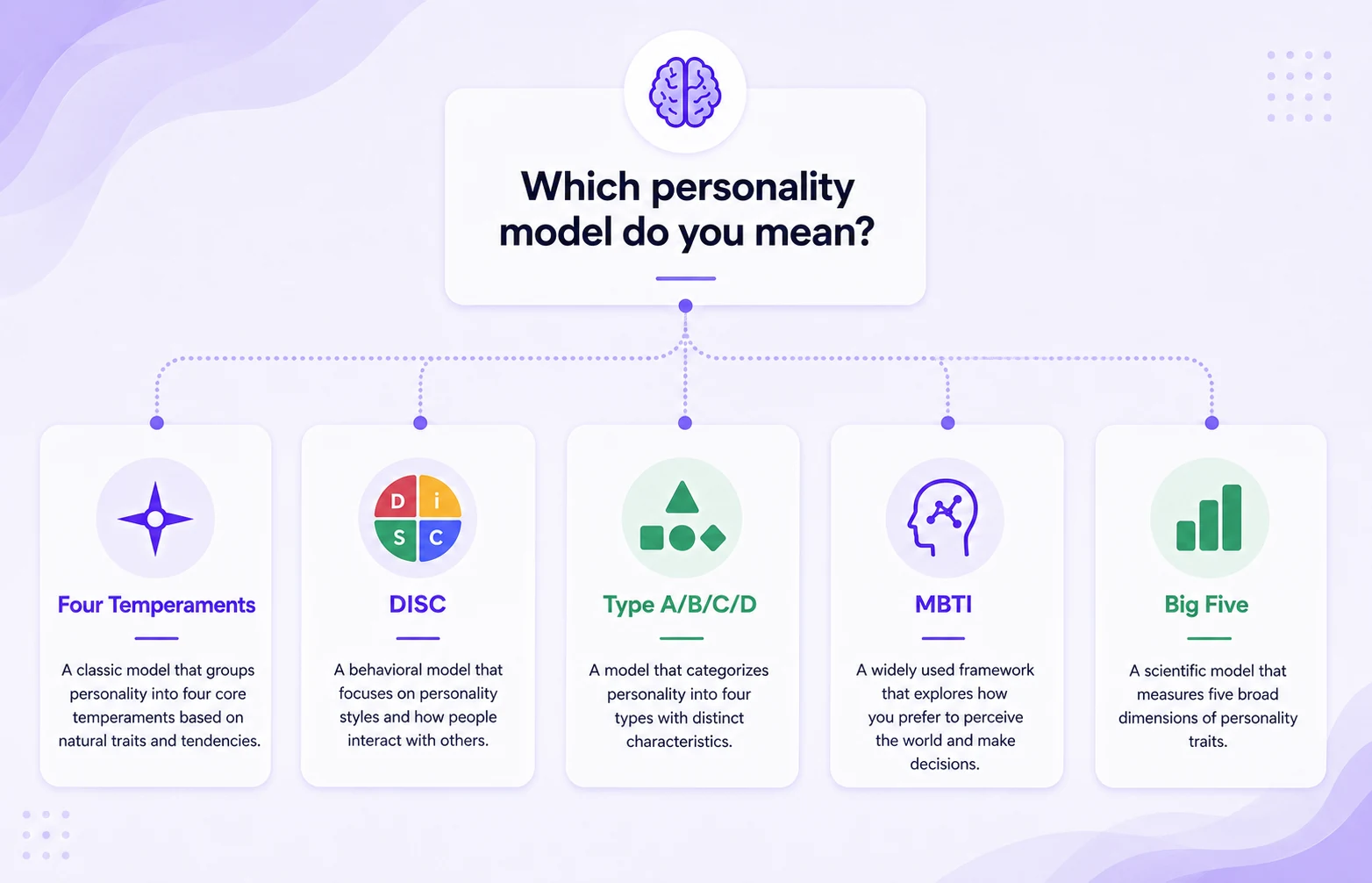
Several personality frameworks use four categories or dimensions, but they do not produce equivalent results.
Where Did the Four Temperaments Come From?
The Four Temperaments developed from ancient Greek and Roman ideas about health and behavior. Hippocratic medicine was associated with four bodily humors, and Galen later linked those humors with temperament classifications. The humors were blood, yellow bile, black bile and phlegm. Read a scholarly review of Galen’s humors and temperament.
(PMC)
Blood was associated with the Sanguine temperament.
Yellow bile was associated with the Choleric temperament.
Black bile was associated with the Melancholic temperament.
Phlegm was associated with the Phlegmatic temperament.
Modern medicine does not accept bodily-fluid imbalances as an explanation of personality. The names survived because they provide memorable archetypes not because the ancient medical theory remains valid.
You can use the four labels as prompts for self-reflection while recognizing that they are not a modern medical, clinical or psychometric diagnosis.
What Are the Four Temperament Personality Types?
The four traditional types are Sanguine, Choleric, Melancholic and Phlegmatic. Popular modern interpretations associate them with an energetic social style, a direct action-oriented style, a careful analytical style and a calm supportive style. These are broad tendencies rather than permanent identities.
Temperament | Common style | Possible strength | Possible blind spot | Growth prompt |
|---|---|---|---|---|
Sanguine | Social, energetic and adaptable | Enthusiasm | Inconsistent follow-through | Finish one priority before beginning another |
Choleric | Direct, driven and decisive | Quick action | Impatience | Ask for another viewpoint before deciding |
Melancholic | Analytical, careful and reflective | Precision | Overthinking | Define what “good enough” means in advance |
Phlegmatic | Calm, patient and supportive | Stability | Conflict avoidance | State one preference before seeking agreement |

Most people recognize a mixture of tendencies rather than one pure temperament.
Sanguine Personality: Social, Energetic and Adaptable
A Sanguine-leaning person may gain energy from conversation, variety and shared activity. They may think aloud, build rapport quickly and bring visible enthusiasm to a group.
Possible strengths
Starting conversations easily
Creating excitement around an idea
Adapting to changing social situations
Helping other people feel included
Generating energy during group work
Possible blind spots
Losing interest after the exciting beginning
Acting before considering practical details
Overcommitting
Interrupting during lively discussions
Avoiding repetitive follow-through
At work, a Sanguine-leaning person may enjoy collaboration, presentations, brainstorming and varied activities. This does not mean they cannot succeed in quiet or structured work. It suggests that variety and interaction may help sustain their attention.
In relationships, they may express interest openly and enjoy shared experiences. Under stress, they might seek distraction, talk rapidly through a problem or move toward a new idea before resolving the current one.
Everyday example During a group project, the Sanguine-leaning teammate creates energy, gets people talking and proposes several possibilities. When the work reaches detailed documentation, their attention may begin to drift. Growth experiment Before starting something new, write down the final three actions required to complete the current task.
Choleric Personality: Direct, Driven and Decisive
A Choleric-leaning person may focus on results, speed and forward movement. They may make decisions confidently, take responsibility quickly and become frustrated when progress feels unnecessarily slow.
Possible strengths
Making decisions under pressure
Setting clear priorities
Taking ownership
Challenging inefficient processes
Keeping attention on results
Possible blind spots
Moving before other people understand the plan
Treating disagreement as obstruction
Underestimating relationship concerns
Becoming impatient with slower decision-makers
Taking too much control
At work, this person may prefer autonomy, measurable goals and enough authority to act. They may be comfortable leading, but effective leadership also depends on listening, judgment, expertise and the ability to adjust to other people.
In relationships, they may show care through problem-solving and practical action. Under stress, they might become more controlling, blunt or focused on winning the immediate disagreement.
Everyday example A deadline moves forward unexpectedly. The Choleric-leaning teammate divides the work and selects a plan, helping the group act quickly. They may need to pause long enough to hear concerns that could improve the decision. Growth experiment Before announcing a decision, ask one person, “What am I missing?”
Melancholic Personality: Analytical, Careful and Reflective
The historical term “Melancholic” is often misunderstood as simply meaning sad. In modern Four Temperaments descriptions, it usually refers more broadly to careful analysis, sensitivity to detail, high standards and reflection.
Possible strengths
Detecting errors and inconsistencies
Preparing thoroughly
Considering long-term consequences
Producing careful work
Taking commitments seriously
Possible blind spots
Continuing analysis after enough information is available
Setting standards that are difficult to meet
Focusing more on flaws than progress
Hesitating when uncertainty remains
Taking criticism deeply
At work, a Melancholic-leaning person may appreciate clear expectations, preparation time and opportunities to build expertise. They may enjoy detailed work, but a temperament label cannot determine which career they should pursue.
In relationships, they may value loyalty, depth and thoughtful communication. Under stress, they may withdraw, replay mistakes or try to remove every uncertainty before acting.
Everyday example Before a presentation, the Melancholic-leaning teammate checks the data, notices inconsistent figures and prevents an embarrassing mistake. They may also spend too long refining details the audience will never notice. Growth experiment Decide in advance what “good enough to submit” means and stop when those criteria are met.
Phlegmatic Personality: Calm, Patient and Supportive
A Phlegmatic-leaning person may prefer steadiness, cooperation and a manageable pace. They may listen carefully, remain calm during tension and help groups maintain stable relationships.
Possible strengths
Listening without escalating conflict
Creating consistency
Supporting cooperation
Remaining patient
Considering several viewpoints
Possible blind spots
Delaying a necessary disagreement
Allowing other people to set every priority
Staying in an unsatisfying situation because change feels disruptive
Hiding preferences
Waiting too long to make a decision
At work, a Phlegmatic-leaning person may appreciate predictable expectations, respectful teams and sufficient time to adjust to major changes. Calmness should not be confused with a lack of ambition; motivation can be expressed quietly.
In relationships, they may be dependable and considerate. Under stress, they might withdraw, minimize the problem or agree outwardly while remaining uncomfortable.
Everyday example Two colleagues disagree sharply. The Phlegmatic-leaning teammate slows the discussion and helps each person feel heard. They may need to state their own position instead of remaining the permanent mediator. Growth experiment Express one preference before asking what everyone else wants.
How Might the Four Temperaments Respond in Everyday Situations?
These examples show possible tendencies rather than fixed predictions. The same person may respond differently according to experience, culture, role, mood and the importance of the situation.
Situation | Sanguine tendency | Choleric tendency | Melancholic tendency | Phlegmatic tendency |
|---|---|---|---|---|
Joining a new group | Starts conversations and creates energy | Looks for the group’s goal or direction | Observes carefully before participating | Waits for a comfortable opening |
Facing a tight deadline | Generates ideas and rallies the group | Chooses a plan and sets priorities | Checks requirements and possible errors | Creates a steady pace and reduces tension |
Receiving criticism | May respond openly and move on quickly | May challenge the feedback directly | May analyze the criticism deeply | May remain calm but avoid discussing discomfort |
Making a decision | Talks through possibilities | Decides quickly and moves forward | Collects information before deciding | Looks for a stable and agreeable option |
Managing conflict | May use humor or conversation to reduce tension | Addresses the issue directly | Examines causes and details | Tries to restore cooperation |
Handling sudden change | May enjoy the novelty | Takes control of the response | Checks possible consequences | Seeks a gradual transition |
Which of the Four Personality Types Sounds Most Like You?
Compare your usual behavior across several situations rather than selecting the description you find most flattering. Think about repeated patterns, especially when you are comfortable, rushed, disappointed or required to work with other people.
Five Questions for Comparing Your Natural Tendencies
When you enter an unfamiliar social setting, what happens first? Do you begin conversations, assess the room, focus on a goal or wait for a comfortable opening?
How do you make a time-sensitive decision? Do you act quickly, talk it through, collect more information or seek agreement?
What do you do during disagreement? Do you debate directly, lighten the atmosphere, examine the details or try to restore calm?
How do you approach a complex task? Do you start with energy, define the result, build a detailed plan or create a steady routine?
How do you respond when plans change suddenly? Do you become interested, take control, worry about overlooked consequences or try to reduce disruption?
No single answer proves your temperament. Look for a repeated pattern across situations, relationships and time.
Why Your Mood and Situation Can Affect Your Answers
Self-report answers may shift according to the setting you imagine, recent experiences and how you feel while answering. Research has found that expressions of personality traits can vary across situations, even when broader individual differences remain meaningful. Review research on personality traits across situations.
(PMC)
Answer according to what you usually do rather than what you did on your best day, worst day or in one unusual environment.
Why You May Recognize Yourself in Several Types
You might be enthusiastic in familiar groups but cautious around strangers. You may be decisive at work and conflict-avoidant at home. You may enjoy detailed planning while adapting quickly when plans change.
Those combinations are normal. A four-category model compresses many characteristics into a few memorable labels, so overlap should be expected.
Can You Have a Primary and Secondary Temperament?
Yes. Many people use primary and secondary temperament labels to describe themselves, although these combinations are informal interpretations rather than universally validated psychological scores. Behavior also changes across settings, so a secondary pattern may appear more strongly at work, in close relationships or under pressure.
Sanguine–Choleric Example
A Sanguine–Choleric person may appear energetic, persuasive, competitive and willing to act. They might enjoy leading through enthusiasm rather than formal authority.
Combined strengths: Energy, confidence, persuasion and initiative
Possible tension: Impatience, overcommitment or incomplete follow-through
Growth suggestion: Choose fewer priorities and request feedback before acting
Melancholic–Phlegmatic Example
A Melancholic–Phlegmatic person may appear thoughtful, calm, dependable and sensitive to other people’s needs. They might prepare carefully and prefer stable, respectful environments.
Combined strengths: Carefulness, patience, loyalty and consistency
Possible tension: Delayed decisions or avoidance of difficult conversations
Growth suggestion: Set a decision deadline and express concerns earlier
Mixed results do not mean an assessment failed. They may simply show that categories cannot capture degrees. A person can be moderately social, highly careful, somewhat assertive and very calm at the same time.
How Do Four-Type Personality Models Compare?
Four-type models simplify personality in different ways. The Four Temperaments provides historical archetypes, DISC focuses on behavioral styles, Type A/B/C/D describes broad patterns, and MBTI combines four preference pairs into 16 types. The Big Five instead provides separate scores across five continuous dimensions.
Framework | Result format | Best suited for | Main strength | Main limitation | Do not use alone for |
|---|---|---|---|---|---|
Four Temperaments | Four broad categories | Simple self-reflection | Memorable vocabulary | Historically based and broad | Diagnosis, hiring or career guarantees |
DISC | Four behavioral styles and blends | Communication and teamwork discussions | Practical workplace language | Does not cover every personality trait | Employee selection without other evidence |
Type A/B/C/D | Four broad behavior patterns | General behavior discussion | Simple labels | Definitions and evidence vary | Medical or psychological diagnosis |
MBTI | Sixteen types from four preference pairs | Preference-based reflection | Familiar type language | Categories can hide differences in degree | Recruitment or ability judgments |
Big Five | Five continuous trait scores | Detailed personality description | Captures degrees and mixed profiles | Does not explain every motive, story or context | Diagnosis or permanent judgments |
Four Temperaments Compared With DISC
Both frameworks begin with four broad styles, but they do not have an official one-to-one conversion. Sanguine may resemble parts of Influence, Choleric may resemble parts of Dominance or Drive, Melancholic may share language with Conscientiousness or Clarity, and Phlegmatic may resemble Steadiness or Support. These are loose similarities rather than equivalent scores.
Four Temperaments Compared With Type A, B, C and D
The Four Temperaments originated in ancient humoral theory. Type A and Type B developed within a much later behavior-and-health research tradition, with additional C and D labels appearing in later applications. The models use different histories and definitions, so statements such as “Choleric equals Type A” should be avoided.
Four Temperaments Compared With MBTI
The Four Temperaments produces four broad labels. MBTI combines preferences across four pairs to produce one of 16 types. Official Myers-Briggs guidance says the assessment describes preferences rather than skills or abilities and should not be used for recruitment or selection. Review official MBTI usage guidance.
(themyersbriggs.com)
Treat temperament-to-MBTI conversion charts cautiously. Apparent Sanguine qualities, for example, cannot establish all four MBTI preferences.
Compare Big Five versus MBTI in more detail.
Four Temperaments Compared With the Big Five
The Big Five organizes personality around Openness to Experience, Conscientiousness, Extraversion, Agreeableness and Neuroticism. Its defining advantage over a four-category typology is that it measures each dimension by degree, allowing moderate and mixed profiles to remain visible. Review the Five-Factor Model overview by McCrae and John.
(PubMed)
For example, a four-type quiz might label two people as Melancholic. A Big Five assessment could show that one is highly conscientious and emotionally stable, while the other is moderately conscientious and more emotionally reactive. The shared category hides that difference.
There is no dependable exact conversion from Sanguine, Choleric, Melancholic or Phlegmatic into five Big Five scores. Use a separate Big Five assessment when you need a more detailed trait profile.
Learn how the Big Five personality traits work.
Categories provide one broad label, while trait scales show separate degrees and mixed patterns.
Explore more than one label TalentRank presents its assessment as a Big Five-based personality profile combined with cognitive testing, not as a Four Temperaments test. Use it to explore a different and more detailed profile rather than to confirm a Sanguine, Choleric, Melancholic or Phlegmatic label. Start Free AssessmentReview assessment, report and data FAQs
TalentRank’s current FAQ says the full assessment can be completed without charge, a result summary is available free, and the complete personalized report is a one-time purchase. The FAQ should remain the source of truth after the site’s conflicting completion-time and accuracy claims are reconciled. (TalentRank)
Where Do Bird, IDRlabs and Truity Personality Tests Fit?
A bird personality test replaces abstract category names with memorable animal labels. IDRlabs, for example, publishes a model using Dove, Owl, Peacock and Eagle. It describes the model as a simplified typology rather than formal academic psychology. Review the IDRlabs bird personality typology.
(idrlabs.com)
IDRlabs and Truity are separate assessment publishers offering different personality frameworks. Truity uses Drive, Influence, Support and Clarity for its DISC interpretation, while Everything DiSC uses Dominance, Influence, Steadiness and Conscientiousness. Review Truity’s DISC description.
(Truity)
Do not select a test only because it contains four memorable labels. Check what it measures, how the questions and scoring work, whether limitations are explained, and what decision you plan to make from the result.
TalentRank should not imply affiliation with IDRlabs, Truity, the Myers-Briggs publishers or Everything DiSC unless a genuine partnership exists and is publicly disclosed.
How Accurate Is a Four-Types Personality Test?
A four-type quiz can help you notice broad patterns, but it cannot capture your complete personality or guarantee conclusions about careers, relationships, leadership or future success. Its usefulness depends on the questions, scoring method, supporting evidence, interpretation and purpose.
What Can a Four-Type Quiz Help You Notice?
Broad social and decision-making tendencies
Vocabulary for discussing behavioral differences
Possible strengths and related blind spots
How you may respond to pressure or change
Questions worth exploring in greater depth
A result can be useful without being a final truth. “I sometimes rush when I become excited” is an actionable observation. “I am Sanguine, so I cannot finish anything” is a rigid label.
What Can Four Broad Categories Not Measure?
How strongly you express each trait
Whether you fall near the middle of a dimension
Every mixed combination
How behavior changes by setting
Your values, interests, skills or life history
Cognitive ability
Mental-health diagnoses
Guaranteed career compatibility
Moral character or human potential
Helpful uses
Casual self-reflection
Learning simple personality vocabulary
Discussing possible communication differences
Identifying questions for further development
Do not use a four-type quiz alone for
Mental-health diagnosis
Clinical treatment
Rejecting a job applicant
Educational placement
Legal decisions
Career or relationship guarantees
Permanent judgments about ability or character
Is an IQ Test the Same as a Personality Test?
No. A personality assessment describes tendencies, preferences or trait patterns. An IQ or cognitive test assesses performance on particular reasoning tasks. The two results should remain separate because being outgoing, careful or emotionally steady is not the same as solving verbal, spatial or numerical problems.
Comparison point | Personality assessment | Cognitive or IQ assessment |
|---|---|---|
What it measures | Characteristic tendencies, preferences or traits | Performance on defined reasoning tasks |
Question type | Usually self-report statements or choices | Usually problems with correct and incorrect answers |
Typical result | Trait scores, preferences or type descriptions | Scores across particular reasoning abilities |
Main limitation | Does not measure intelligence or complete identity | Does not describe personality or total human potential |
Appropriate use | Self-reflection and personality description | Understanding performance on specified cognitive tasks |
TalentRank states that its cognitive component uses ICAR-16. Published descriptions of ICAR-16 identify four item areas: matrix reasoning, verbal reasoning, three-dimensional rotation and letter-number series. It is a brief public-domain cognitive measure and should not automatically be presented as equivalent to every professionally administered intelligence assessment. Review recent ICAR validation information.
(PMC)
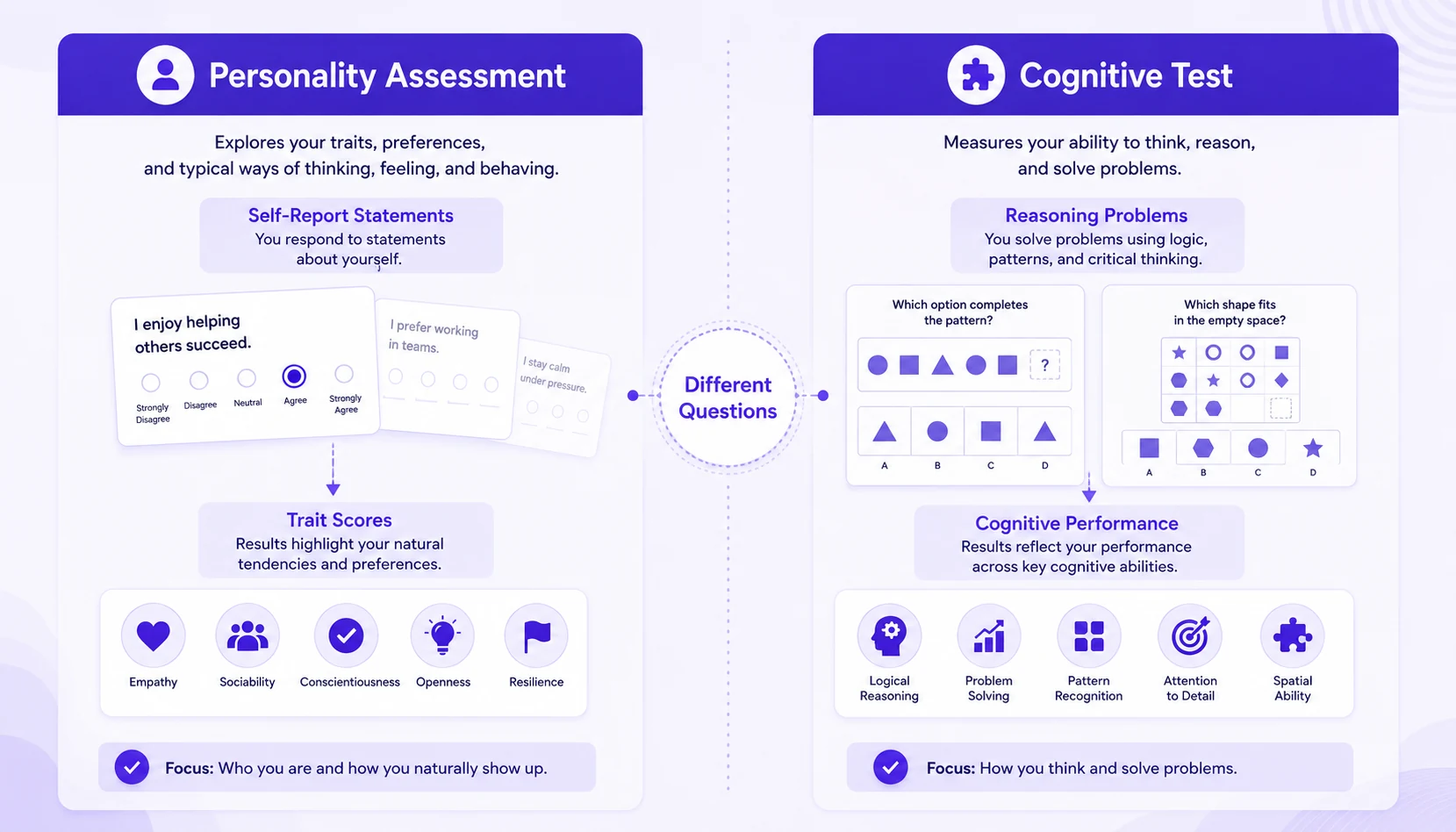
Personality and cognitive assessments answer different questions and should be interpreted separately.
Learn what an IQ or cognitive test measures.
Personality Quizzes Are Not Personality-Disorder Tests
An ordinary personality quiz cannot diagnose borderline, schizotypal, paranoid, avoidant or other personality disorders. It also cannot diagnose dissociative identity disorder, which was previously called multiple personality disorder. Review the American Psychiatric Association’s dissociative-disorder guidance.
(American Psychiatric Association)
Why Online Quizzes Cannot Diagnose a Mental-Health Condition
Clinical diagnosis involves more than matching yourself with a list of traits. A qualified professional considers symptoms, duration, severity, impairment, personal history, other possible explanations and the person’s circumstances. NIMH states that borderline personality disorder is diagnosed by a licensed mental-health professional after a thorough discussion of symptoms and personal and family history. Review NIMH diagnostic information.
(National Institute of Mental Health)
TalentRank’s assessment should therefore be described as a personality, cognitive and self-reflection product not a schizotypal, borderline, paranoid, avoidant or dissociative-disorder test.
When to Speak With a Qualified Mental-Health Professional
Consider speaking with a licensed professional when patterns of emotion, thinking, relationships or behavior cause significant distress, interfere with daily life, create safety concerns or remain difficult to manage. A personality-test result should not be used to confirm or dismiss those concerns.
Which Personality Test Should You Choose?
Choose according to the question you want answered rather than looking for one assessment that is best for every person and purpose.
Your goal | Suitable starting point | Important limitation |
|---|---|---|
Learn four memorable historical archetypes | Four Temperaments | Expect broad descriptions and overlap |
Discuss workplace communication | DISC-style assessment | Do not treat a style as a complete personality profile |
Explore familiar preference labels | MBTI-style assessment | Four preferences create 16 types rather than four final types |
Receive a continuous personality profile | Big Five assessment | Review the specific test’s methodology and limitations |
Explore reasoning performance | Separate cognitive assessment | A brief online measure is not automatically a clinical IQ evaluation |
Seek a mental-health diagnosis | Qualified clinical professional | An ordinary personality quiz is not diagnostic |
For a Fast and Memorable Introduction
Choose the Four Temperaments when you want simple language for discussing broad patterns. Keep the result flexible and expect to recognize yourself in more than one description.
For Workplace Communication and Team Discussions
A DISC-style assessment may be useful when the goal is to discuss communication, pace, priorities and collaboration. Do not use an informal style result as the sole basis for hiring, promotion or dismissal.
For Familiar Preference Labels
An MBTI-style framework may appeal when you want memorable language about preferences. Remember that its four preferences combine into 16 types and are not intended to measure skills or cognitive ability.
For a Detailed Personality Profile
Choose a documented Big Five assessment when you want separate scores across broad personality dimensions. Look for clear information about the instrument, scoring, comparison population and limitations.
Learn how to choose the most suitable personality test for your goal.
For Cognitive Strengths and Reasoning Skills
Choose a separate cognitive measure. Ask which abilities it assesses, how long it takes, how scores are interpreted and whether it is intended as a brief estimate or a formal professional evaluation.
How to Use Your Personality-Test Results Constructively
A personality result becomes useful when it helps you test a behavior not when it provides a permanent excuse.
Treat the result as a starting point, not an identity. Replace “I am this type” with “I recognize this tendency in some situations.”
Choose one useful observation. Select a specific pattern that can be observed in real behavior.
Run a small behavioral experiment. Change one habit for a week and observe the result.
Compare the result with real evidence. Ask whether people who know you would recognize the same pattern.
Revisit the result when context changes. New roles, relationships and environments may change how traits appear.
Four practical behavior experiments
Sanguine: Use a finish checklist before starting another task.
Choleric: Ask for one objection or alternative before deciding.
Melancholic: Set a deadline for analysis and define “good enough.”
Phlegmatic: State one preference before seeking group agreement.
Go Beyond Four Labels With a Detailed Trait Profile
Four categories can make personality easier to discuss, but they leave out intensity, mixed patterns and important differences between people who receive the same label. TalentRank describes its product as a Big Five-based personality profile combined with cognitive assessment and a personalized report, so it should be presented as a different kind of assessment not as a Four Temperaments result. (TalentRank)
Explore your personality beyond one type label Complete TalentRank’s personality and cognitive assessment and review a free summary of your results. The full personalized report is offered separately as a one-time purchase. Start Free AssessmentRead assessment and privacy FAQs
See an example report firstView Sample Report
Frequently Asked Questions About Four-Type Personality Tests
What are the four main temperament types?
The four traditional temperament types are Sanguine, Choleric, Melancholic and Phlegmatic. They are commonly described as energetic and social, direct and driven, careful and reflective, and calm and supportive. The categories came from an ancient theory and should now be used as broad reflection tools rather than medical explanations.
How can I tell which temperament fits me best?
Compare your repeated behavior across social situations, decisions, conflict, planning and unexpected change. Look for the pattern that appears most often instead of choosing the most flattering description. You may identify with a primary and secondary type, and different settings may bring out different tendencies.
Can one person have traits from all four types?
Yes. Four temperament labels simplify personality, so most people can recognize characteristics from several categories. Mixed traits do not mean you answered incorrectly. They mean one broad label cannot represent every aspect of how you behave across work, relationships, stress and unfamiliar situations.
Are Four Temperaments and DISC the same test?
No. The Four Temperaments uses Sanguine, Choleric, Melancholic and Phlegmatic labels rooted in an ancient theory. DISC uses four behavioral styles, commonly Dominance, Influence, Steadiness and Conscientiousness. Their descriptions may overlap, but the frameworks have different histories, terminology and intended applications.
Is a four-type test the same as MBTI?
No. MBTI uses four preference pairs that combine to create 16 personality types. A Four Temperaments test produces four broad historical categories. Both offer memorable labels, but their questions and results cannot be converted reliably through a simple one-to-one chart.
Is the Big Five more detailed than a type test?
Usually, yes. The Big Five provides separate continuous scores for Openness, Conscientiousness, Extraversion, Agreeableness and Neuroticism. Continuous scores can distinguish moderate from extreme tendencies and show mixed profiles that one category may hide. The quality of a specific test still depends on its instrument and methodology.
Is an IQ test a personality assessment?
No. Personality assessments describe characteristic tendencies, while IQ or cognitive assessments measure performance on reasoning tasks. The two can complement each other, but one cannot replace the other. A brief online cognitive measure should also be distinguished from a comprehensive professionally administered intelligence assessment.
Can an online personality quiz diagnose a disorder?
No. A temperament, Big Five, MBTI, DISC or entertainment quiz cannot diagnose a personality disorder or dissociative condition. Clinical assessment requires an appropriately qualified professional who can consider symptoms, history, impairment, context and alternative explanations. Use ordinary personality results for reflection, not self-diagnosis.
Explore more personality guides from TalentRank.
A Four-Type Result Is the Beginning, Not the Full Picture
The Four Temperaments can help you notice whether you tend to bring social energy, decisive action, careful analysis or calm support to a situation, but most people combine several tendencies and behave differently across contexts. Use the result to ask better questions rather than limit your identity, and choose a continuous Big Five assessment when you want a more detailed view of your traits alongside clearly separated cognitive insights.