

To check MBTI compatibility, first identify both people’s reported types, then compare how they prefer to direct energy, take in information, decide, and organize daily life. Use those differences to discuss communication, conflict, planning, and support. Treat any chart as a prompt for conversation, not a score or prediction.
This guide shows a practical way to apply the four MBTI preference pairs in romantic relationships, friendships, and workplaces. It also explains why maturity, values, trust, context, and behavior matter more than matching letters, and why a trait model such as the Big Five may be more suitable when measurement and research evidence are the priority.
What MBTI Compatibility Actually Means
MBTI compatibility describes how two people’s stated personality preferences may interact. It can help them name differences in energy, information gathering, decisions, and lifestyle. The official Myers-Briggs Foundation says there are no best or more successful type combinations; people with all, some, or none of the same preferences can get along well.
Area | Useful question |
|---|---|
Communication | Do we prefer quick discussion, quiet reflection, detail, or possibilities? |
Decisions | Do we lead with impersonal criteria, personal values, or a deliberate mix? |
Conflict | What helps each of us feel heard, and when do we need time to cool down? |
Planning | How much structure, notice, and flexibility does each person need? |
Support | What kind of encouragement feels helpful rather than intrusive? |
Use type responsibly A type preference is not an ability, character judgment, diagnosis, or fixed limit. Avoid statements such as “You are a Thinking type, so you do not care.” Ask about the person’s actual behavior instead. |
|---|
How to Check MBTI Compatibility Step by Step
Confirm both types without forcing a label. Use a legitimate assessment or a careful self-reflection process, and allow uncertainty if a result feels unclear.
Translate the four letters into preferences. Compare E–I, S–N, T–F, and J–P separately instead of treating the four-letter code as a single verdict.
Discuss everyday examples. Ask how each person recharges, processes information, makes decisions, handles plans, and reacts under stress.
Map likely strengths. Identify where similarity creates ease and where difference creates complementary perspectives.
Name friction points without blame. Turn vague complaints into specific situations, needs, and requests.
Compare values and goals. Talk about trust, boundaries, money, family, career, lifestyle, and future plans. These cannot be inferred from type.
Agree on one or two experiments. Try a communication or planning adjustment, observe the result, and revisit it together.
Use the chart as a recap, not a ruling. Real behavior over time is the most relevant evidence for the relationship.
The Four Preference Pairs
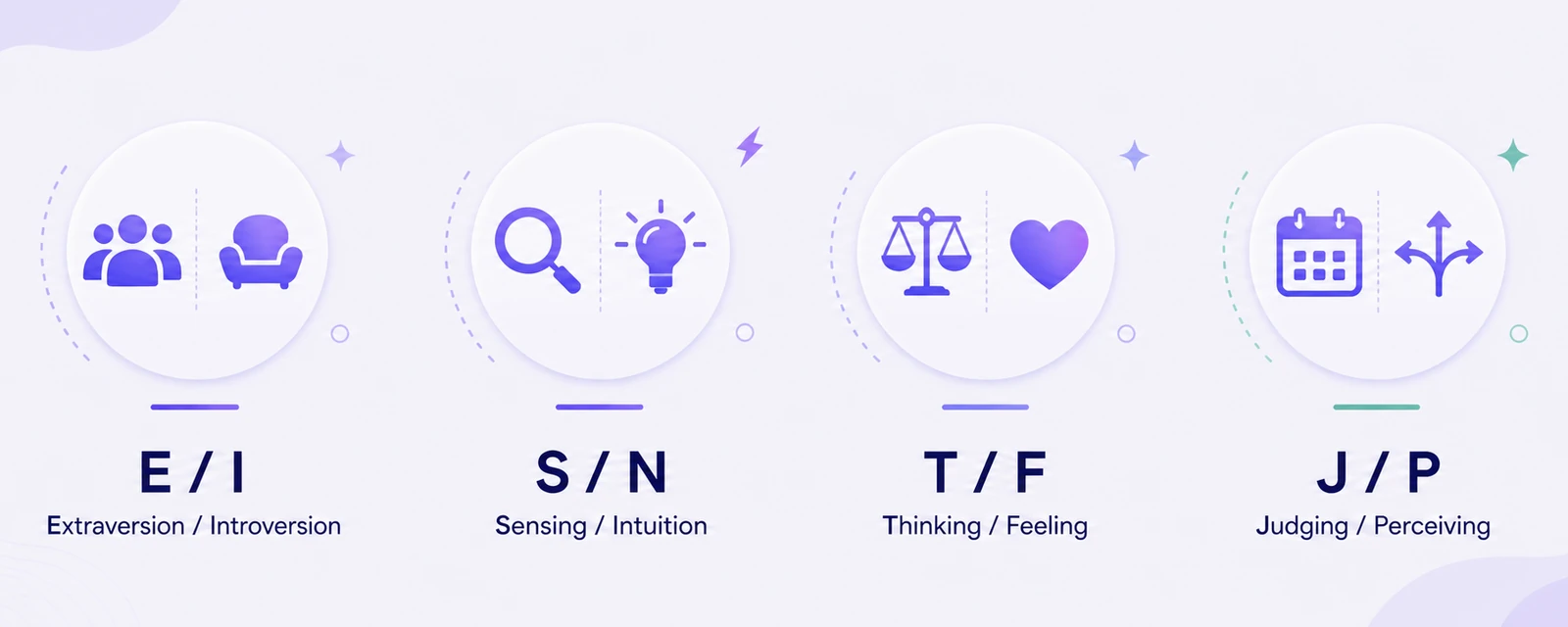
Compare each MBTI preference pair separately instead of treating a four-letter type as a compatibility score.
Preference pair | What it describes | Compatibility conversation |
|---|---|---|
Extraversion (E) / Introversion (I) | Where attention and energy are commonly directed | How much interaction and solo recovery time feels healthy? |
Sensing (S) / Intuition (N) | How information is noticed and interpreted | Do we need concrete detail, patterns, possibilities, or all three? |
Thinking (T) / Feeling (F) | What receives weight in decisions | How will we balance consistency, people, and values? |
Judging (J) / Perceiving (P) | How people approach structure and options | Which plans need commitment, and where can we stay flexible? |
MBTI Compatibility Chart Explained
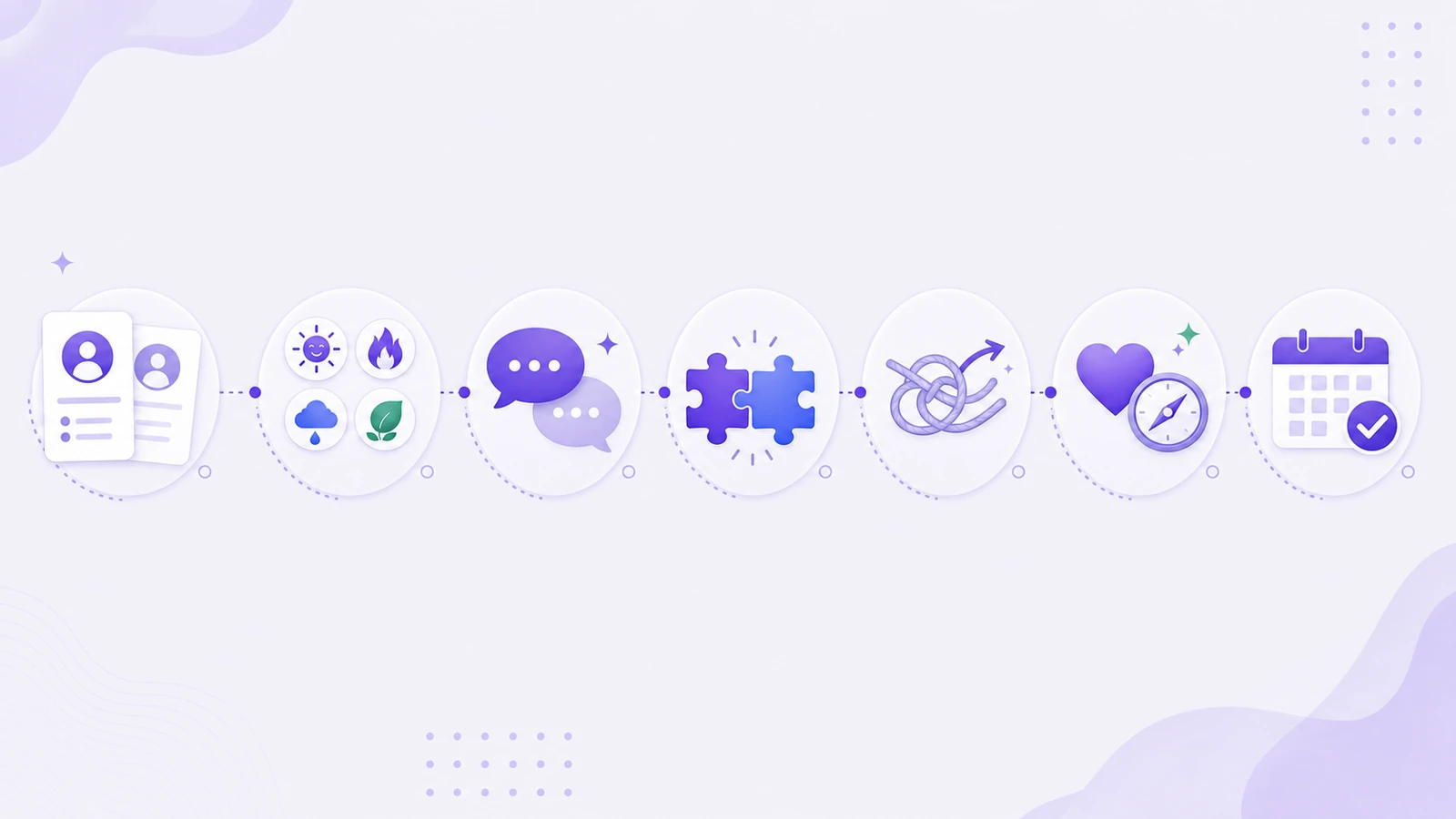
A practical conversation flow for checking compatibility without treating personality type as a prediction.
A responsible MBTI compatibility chart should summarize conversation needs rather than assign “perfect,” “average,” or “bad” matches. The matrix below works with any pair because it focuses on observable interaction patterns. Complete it together and add examples from real life.
Pattern | Possible advantage | Watch for | Helpful practice |
|---|---|---|---|
Many shared preferences | Fast mutual recognition and familiar rhythms | Shared blind spots or assumptions | Invite a different perspective before major decisions |
A mix of shared and different preferences | Familiarity plus complementary strengths | One style becoming the default | Rotate who leads planning, discussion, or review |
Many different preferences | Broader perspectives and learning | Translation fatigue or repeated misunderstanding | State needs explicitly and confirm what was heard |
Same type | Ease in some routines and language | Duplicated weaknesses; false sense of sameness | Discuss individual values and habits separately |
Opposite preferences | Complementary attention and methods | Polarization and stereotyping | Treat differences as options, not identities to defend |
A Practical Compatibility Scorecard
Rate each area from 1 (needs attention) to 5 (working well), then discuss one example behind the score. Do not total the numbers into a relationship verdict; use them to choose the next conversation.
Area | 1–5 | Evidence to discuss |
|---|---|---|
Listening and clarity | ____ | A recent conversation that went well or poorly |
Conflict repair | ____ | How you reconnect after disagreement |
Planning balance | ____ | A deadline, trip, project, or household task |
Emotional support | ____ | What each person needs during stress |
Values and boundaries | ____ | A decision where priorities mattered |
Growth and accountability | ____ | How feedback is given and received |
Personality Chart vs. MBTI Chart
Personality chart | MBTI chart |
|---|---|
A broad label for a visual that may represent traits, categories, behaviors, or another model. | A visual specifically organized around the 16 MBTI types or four preference pairs. |
May display continuous scores. | Often displays categories or type combinations. |
Its meaning depends on the assessment behind it. | It should explain preferences and interaction patterns, not guarantee outcomes. |
Romantic Compatibility
For couples, the most useful application is not asking whether the letters match. It is learning how each partner wants to communicate, receive support, make joint decisions, and recover after conflict. The Myers-Briggs Foundation presents type as a way to understand differences and explicitly notes that not every relationship problem is type related.
Questions for couples
When a disagreement begins, do you want to talk immediately or reflect first?
What does emotional support look like in observable behavior?
Which decisions need logic, personal values, or both?
How much advance planning helps each person feel secure?
Which differences are genuinely type-related, and which involve boundaries, habits, or unmet commitments?
Example: INTJ and ENFP
An INTJ may value private reflection, long-range structure, and concise problem-solving. An ENFP may value open exploration, energetic idea sharing, and flexibility. This pairing can benefit from vision and creativity, but the labels do not tell you whether either person listens well, keeps promises, respects boundaries, or shares the other’s goals. A practical agreement might be: explore freely first, then choose a deadline and next action together.
Situation | Unhelpful assumption | Better question |
|---|---|---|
One partner becomes quiet | “They do not care.” | Do you need time to process, and when can we return to this? |
Plans change | “They are unreliable.” | Which parts must stay fixed, and which can remain flexible? |
Advice feels cold | “They have no empathy.” | Do you want comfort, questions, or solutions right now? |
Friendship Compatibility
Friends do not need identical social energy or interests. Type language can help explain why one friend prefers frequent spontaneous contact while another values predictable plans and recovery time. Compatibility improves when both can request what they need without interpreting difference as rejection.
Agree on a realistic contact rhythm.
Make room for both familiar activities and novelty.
Ask before turning a conversation into debate or advice.
Repair missed expectations directly instead of attributing them to type.
Workplace Compatibility

Different personality preferences can support teamwork when expectations and communication are made explicit.
In teams, MBTI can provide neutral language for discussing work preferences, but it should not be used to screen candidates, assign capability, restrict promotion, or excuse poor behavior. Focus on role requirements and observed performance. Use preferences only to improve collaboration and offer multiple ways to contribute.
Team challenge | Practical response |
|---|---|
Fast talkers dominate meetings | Share the agenda early and collect written input before decisions. |
Detail and big-picture views clash | Separate the vision review from the implementation review. |
Logic and people impacts compete | Use decision criteria that include results, risks, and stakeholder effects. |
Planning styles differ | Define non-negotiable milestones and flexible execution space. |
Remote communication creates ambiguity | State channel, response time, owner, and decision status explicitly. |
Common MBTI Compatibility Mistakes
Mistake | Why it fails | Better approach |
|---|---|---|
Searching for a perfect match | No type pairing guarantees relationship quality. | Evaluate communication, values, behavior, and repair. |
Treating letters as destiny | Preferences do not dictate every action. | Ask for examples and notice context. |
Using stereotypes | Labels replace curiosity and can become insulting. | Describe the behavior and its impact. |
Ignoring maturity and skills | Self-regulation and communication can develop. | Discuss accountability and growth. |
Using type to hire or exclude | Type is not job competence or legal job qualification. | Use structured, job-relevant evidence. |
Confusing similarity with satisfaction | Recent couple research finds personality similarity itself is not robustly tied to satisfaction. | Focus on each partner’s traits, perceptions, and interaction quality. |
Does Science Support MBTI Compatibility?
Evidence does not justify using MBTI type pairings as a predictor of relationship success. Even the official Myers-Briggs relationship guidance says there are no best combinations. Research using the Big Five shows that personality traits and the way partners perceive one another can relate to relationship satisfaction, but similarity between partners appears to contribute little on its own. These findings support a cautious conclusion: personality can inform a conversation, but a matching chart cannot forecast an individual relationship.
Evidence boundary This article is educational and is not psychological, medical, hiring, or relationship counseling advice. If conflict involves safety, coercion, or abuse, a compatibility framework is not the appropriate tool; seek qualified support. |
|---|
Big Five vs. MBTI
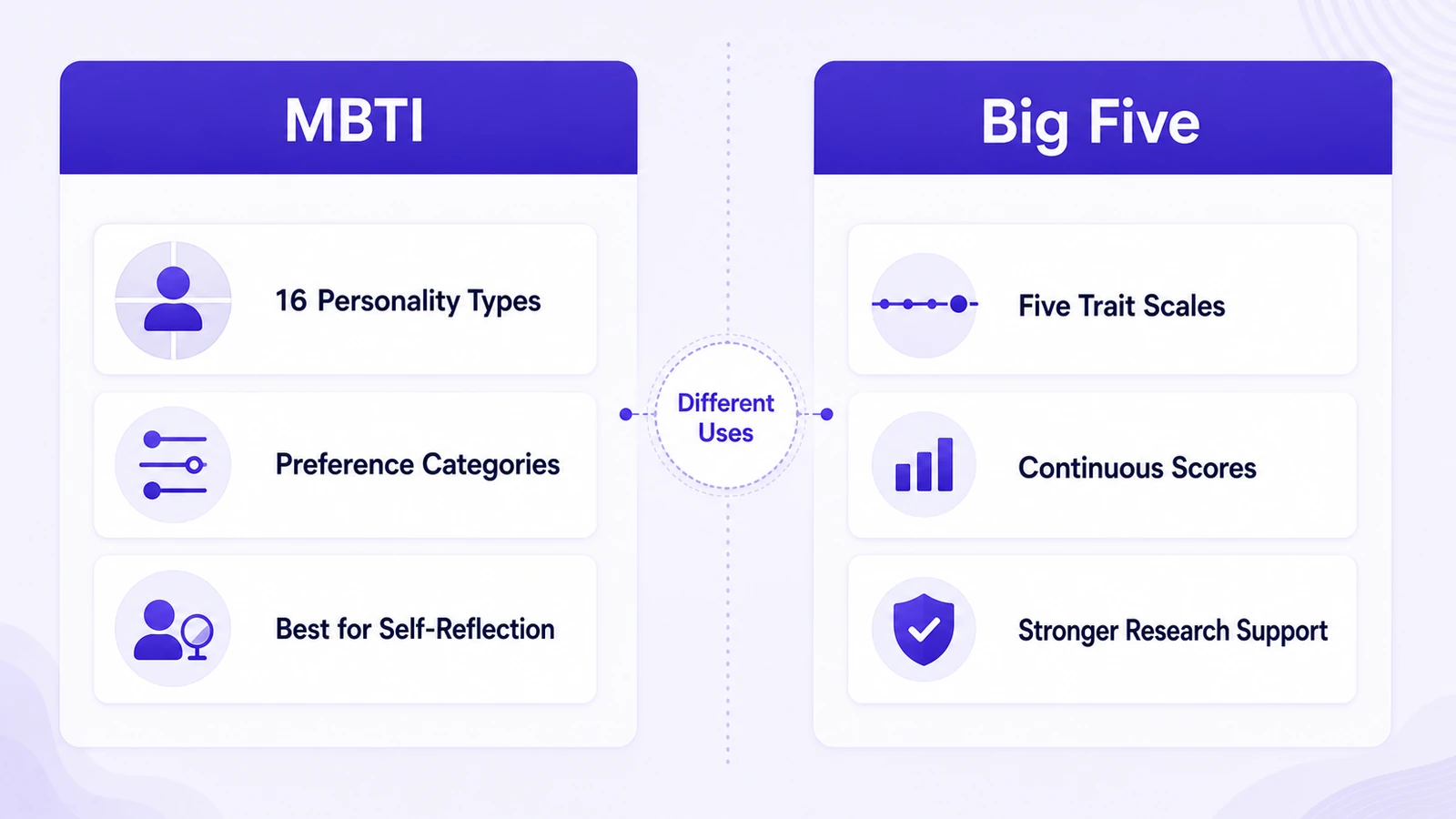
MBTI uses preference categories, while the Big Five measures traits on continuous scales.
Feature | MBTI | Big Five |
|---|---|---|
Output | A four-letter type based on preference pairs | Continuous scores on five broad traits |
Best fit | Accessible language for reflection and discussion | Research, measurement, and trait-level comparison |
Compatibility use | Conversation prompts about preferences | Traits and partner perceptions may be examined in relation to satisfaction |
Important limit | Type combinations do not predict success | Trait associations still do not determine an individual outcome |
Choose the framework based on the question. If two people want accessible language for discussing differences, MBTI may be engaging. If the goal is evidence-based trait measurement, the Big Five has a stronger research tradition. Neither model replaces direct assessment of respect, trust, safety, shared goals, and behavior.
Decision Checklist
We know both reported types and allow room for uncertainty.
We can describe each preference in plain language without stereotypes.
We have discussed communication, conflict, planning, and support with real examples.
We have compared values, boundaries, goals, and reliability separately from type.
We have chosen one practical adjustment and a time to review it.
We are not using a chart to justify harmful behavior or make a high-stakes decision.
Frequently Asked Questions
How do you check MBTI compatibility?
Identify both reported types, compare the four preference pairs, and discuss how those preferences show up in communication, decisions, conflict, planning, and support. Then compare values, goals, boundaries, and actual behavior. Use a chart to organize the discussion, not to calculate whether the relationship will succeed.
Which MBTI types are most compatible?
There is no universally best pairing. The Myers-Briggs Foundation states that people who share all, some, or none of their preferences can get along well. Similarity may create ease in some situations, while difference can provide balance. Maturity, respect, communication, and shared values matter more than matching letters.
Can opposite MBTI types work together?
Yes. Opposite preferences can create complementary perspectives, but they may also require clearer translation and negotiation. Success depends on whether both people can understand the difference, make specific requests, and share responsibility for adapting. “Opposite” does not mean incompatible, just as “same” does not guarantee ease.
Are MBTI compatibility charts accurate?
They can summarize common preference-based interaction patterns, but they cannot accurately predict an individual relationship. A useful chart should generate questions about communication and daily life. Be cautious of charts that assign fixed romantic scores, “soulmates,” or guaranteed bad matches without explaining evidence and limitations.
Does having the same MBTI type improve a relationship?
Not necessarily. The same type can produce familiar communication and routines, but it can also duplicate blind spots. Research using trait models suggests that partner similarity itself has little robust association with relationship satisfaction. Individual traits, perceptions, behavior, and the quality of interaction deserve more attention.
Should MBTI be used for hiring or team selection?
It should not be used as a shortcut for competence or to exclude candidates. In a workplace, type language may support voluntary development conversations, but hiring and promotion should rely on structured, job-relevant criteria and observed performance. Never infer ability, character, or legal suitability from a personality label.
What if my result changes?
Treat the result as a hypothesis for reflection. Answers can vary with interpretation, context, or uncertainty about a preference. Review the descriptions, consider real behavior across situations, and avoid forcing a label. Compatibility work remains useful when it focuses on concrete communication needs rather than a fixed code.
Is MBTI better than the Big Five?
They serve different purposes. MBTI offers accessible categories for discussing preferences. The Big Five measures traits on continuous scales and is more commonly used in personality research. For a casual compatibility conversation, MBTI may be easier to use; for evidence-focused measurement, the Big Five is generally the stronger choice.
Conclusion
The best way to check MBTI compatibility is to turn personality preferences into specific conversations about energy, information, decisions, planning, conflict, and support, then test those insights against real behavior. Do not search for a perfect pairing. A healthy relationship or team depends on respect, safety, shared expectations, reliability, and the willingness to repair misunderstandings. Used with those limits, MBTI can be a practical language for curiosity and communication rather than a verdict about who belongs together.
Sources and Further Reading
The Myers & Briggs Foundation. “Personality Type and Relationships.” https://www.myersbriggs.org/type-in-my-life/personality-type-and-relationships/
The Myers & Briggs Foundation. “All Types are Equally Valuable.” https://www.myersbriggs.org/my-mbti-personality-type/all-types-are-valuable/
O’Meara, M. S., & South, S. C. (2019). Big Five personality domains and relationship satisfaction: Direct effects and correlated change over time. Journal of Personality, 87(6), 1206–1220. https://doi.org/10.1111/jopy.12468
Schaffhuser, K., et al. (2016). Discrepancy in personality perceptions is related to relationship satisfaction. Journal of Personality, 84(5), 658–670. https://doi.org/10.1111/jopy.12189
Weidmann, R., et al. (2023). Trait and facet personality similarity and relationship and life satisfaction in romantic couples. Journal of Research in Personality. PubMed: https://pubmed.ncbi.nlm.nih.gov/37396145/