

You probably said yes to something this week that you wanted to say no to. And you probably did it so smoothly that the other person had no idea.
That's a highly agreeable person operating on autopilot. The high agreeableness personality is one of the most socially valuable trait profiles in the Big Five model, but it can also be costly. Scoring in the 70th to 99th percentile on agreeableness means you're wired for warmth, cooperation, and care. It also means you're at risk of underearning, overgiving, and swallowing your frustration until it curdles into resentment.
This is what that looks like, where it helps you, and what to do about the parts where it doesn't.
What High Agreeableness Feels Like
You probably feel other people's emotions almost as strongly as your own. Someone cries in a meeting and your chest tightens. A friend calls anxious about a job interview and you find yourself more invested in the outcome than they are. Your nervous system is highly attuned and this is how it processes the world.
You're the person people come to. For advice, and for the specific kind of presence that makes someone feel heard without being judged. That's rare. Most people are listening while preparing their next sentence.
Harmony matters to you in a way that feels almost physical. Conflict isn't just uncomfortable, it's disruptive in a way that lingers. You replay difficult conversations. You second-guess whether you were too direct. You smooth things over before they fully form into problems, sometimes before anyone else has even noticed there's tension. That instinct keeps your relationships functional and your environment calm. But it also means you absorb friction that isn't yours to absorb.
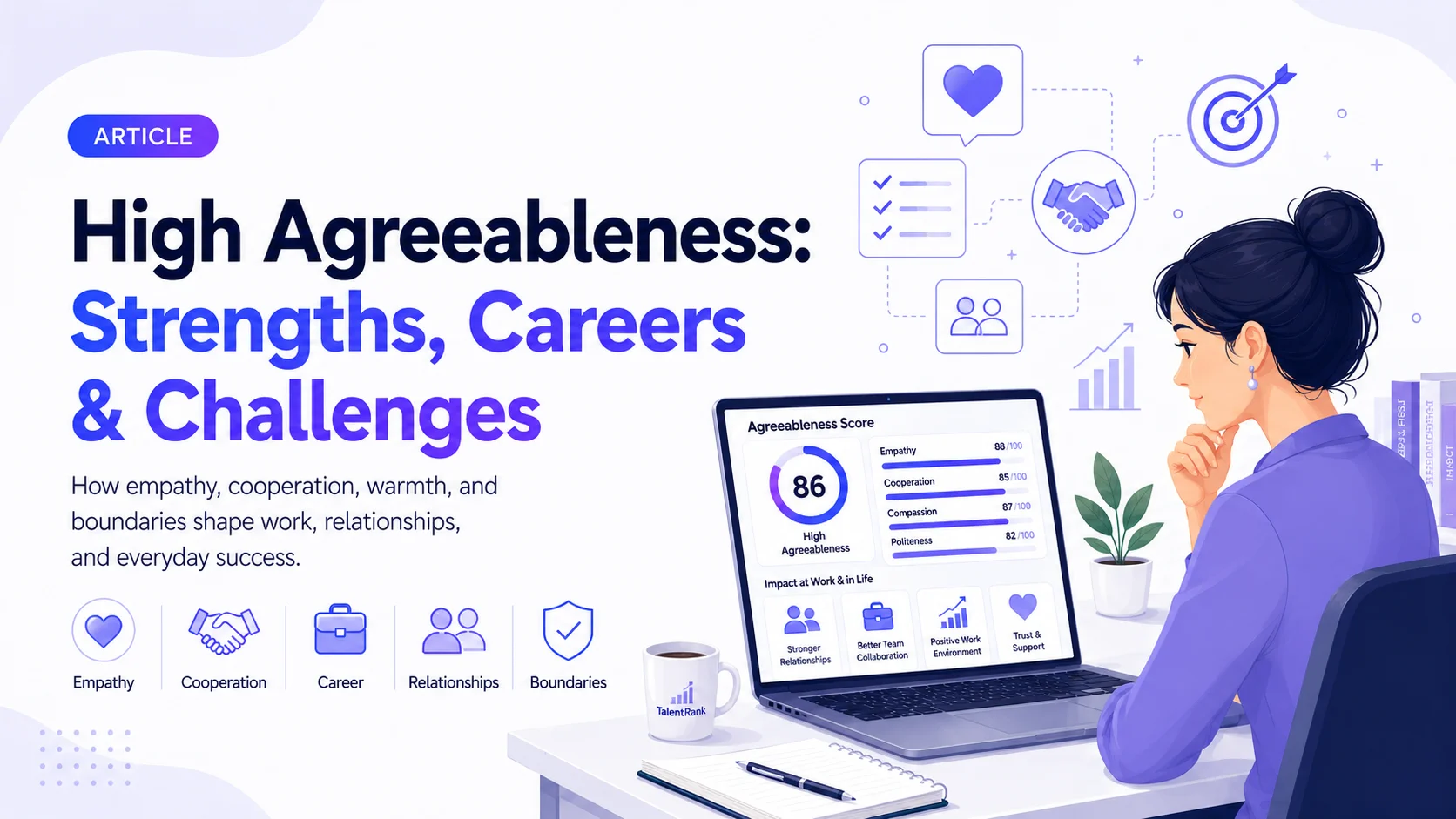
Colin DeYoung's model of agreeableness breaks it into two sub-components: Compassion and Politeness. High Compassion is the empathy side, the genuine interest in other people's emotional states, the impulse to care and connect. High Politeness is the behavioral side, the avoidance of confrontation, the tendency to defer, the reluctance to assert at the cost of social friction. Most highly agreeable people score high on both. And it's the combination that creates the pattern: deep care, combined with an almost reflexive resistance to direct conflict.
You give more than you take. Most of the time, that's something you value about yourself. But there's usually a quieter truth underneath it: sometimes you give because giving feels safer than asking, and asking feels dangerously close to imposing.
High Agreeableness at Work
The careers where highly agreeable people thrive are relatively obvious: nursing, counseling, teaching, social work, human resources, customer success, nonprofit leadership, ministry, veterinary work, occupational therapy. These roles require what you generate almost effortlessly: trust, warmth, and attunement to what another person needs.
Your strengths in a professional setting are real. You build team cohesion in ways that more dominant personalities can't replicate. You defuse conflict before it becomes structural. You generate customer satisfaction scores that managers can't explain, and you mentor well because mentoring requires patience and investment in someone else's development, which you do naturally.
But there are costs. Research published by Judge, Livingston, and Hurst in 2012 found a significant income penalty associated with high agreeableness, particularly for men, but present across genders. Agreeable workers earn less because they negotiate less aggressively, avoid advocating for themselves in moments that feel confrontational, and tend to undervalue their own contributions. You don't like asking for more than what feels "fair," and your sense of fair is often calibrated against others' comfort rather than your own market value.
Saying no is hard for you. Not impossible, but the internal cost is higher than it is for someone lower on agreeableness. Each no requires you to override a genuine instinct toward accommodation. Over time, this leads to overcommitment, a calendar full of other people's priorities, and a slow erosion of the space to do your best work.
Necessary confrontation is the other major professional vulnerability. There are moments in every career when a direct, uncomfortable conversation is the most productive move available. Performance issues that need to be named. Scope creep that needs to be stopped. A bad decision that needs to be challenged. Highly agreeable people often find these moments late, soften them past usefulness, or avoid them entirely and pay the price later.
From a personality type perspective, MBTI's feeling types, particularly INFJ, ISFJ, ENFJ, and INFP, consistently score high on agreeableness. If you identify with any of these types, the trait-level pattern is likely familiar.
High Agreeableness in Relationships
You are warm, present, and attuned in ways your partners, friends, and family depend on. You remember things. You notice when someone is off before they say anything. You make people feel cared for.
The risk is that you're so good at absorbing others' needs that your own can go unvoiced for years. Suppressing what you want in service of harmony works, right up until it doesn't. Resentment builds slowly in highly agreeable people. By the time it surfaces, it's usually disproportionate to whatever immediate event triggered it, because the immediate event is just the last instance of a pattern that's been running for a long time.
The people closest to you often don't know what you actually need. Not because you're mysterious, but because you've trained them not to ask by always being fine.
High Agreeableness Combined with Other Traits
High Agreeableness + High Neuroticism produces the anxious people-pleaser. The care is genuine, but it's amplified by worry. Saying no carries the threat of rejection. Making someone uncomfortable feels catastrophic. This combination benefits most from direct work on self-worth that isn't contingent on others' approval.
High Agreeableness + High Conscientiousness creates the reliable caregiver. Organized, dependable, and genuinely invested in others' wellbeing. This is a high-trust, high-value profile in both professional and personal contexts. The risk here isn't chaos, it's martyrdom. You'll meet every obligation except the ones you set for yourself.
High Agreeableness + Low Extraversion builds the quiet supporter. You don't seek the spotlight, don't need to be the one running the room. But the people close to you feel your warmth completely. The growth edge is making your needs visible in relationships where you've made yourself easy to overlook.
Common Challenges and Growth Areas
Boundaries are your number one growth area. Not because you don't know they exist, but because enforcing them requires tolerating someone else's momentary discomfort, which your nervous system is wired to prevent. A useful reframe: a boundary isn't a rejection. It's information. It tells the other person what a sustainable relationship with you actually looks like. Setting one early is kinder than withdrawing later.
Negotiation is where the income research becomes most concrete. Highly agreeable people leave money on the table. In salary negotiations, they accept the first offer or the first counter. In vendor negotiations, they feel guilty pressing. In performance reviews, they undersell contributions that feel like "just doing my job." The fix isn't becoming aggressive. It's developing a negotiation script you've rehearsed enough that delivering it doesn't feel like confrontation. Scripts work because they separate the discomfort of asking from the personal identity of being the one asking.
The income gap documented by Judge et al. is real, averaging several thousand dollars annually and compounding over a career. The strategies that close it are specific behaviors: anchoring high in salary discussions, using silence after making a request, framing self-advocacy in terms of value delivered rather than personal need. These can be learned. They don't require you to stop being agreeable. They require you to be agreeable and direct, which is harder but possible.
Seeking feedback from trusted peers or working with a coach who understands this trait profile can accelerate the growth process. TalentRank's [Blueprint report] maps your specific Big Five profile to the exact areas where targeted development will have the highest return.
FAQ
Is high agreeableness a weakness?
No. But it has a specific cost structure that low-agreeableness people don't face. Your strengths in cooperation, trust-building, and empathy are genuine and valuable. The weaknesses, undervaluing yourself, avoiding necessary conflict, difficulty negotiating, are real too. Awareness of the pattern is the prerequisite for addressing it.
Why do agreeable people earn less?
The short answer: they negotiate less. Judge, Livingston, and Hurst (2012) found that agreeable workers, especially men, earn meaningfully less than their less agreeable counterparts, not because of performance differences, but because of behavior in compensation discussions and self-advocacy moments. Agreeable people avoid the friction that higher pay requires.
What careers suit highly agreeable people?
Roles where interpersonal warmth is a core job function: healthcare, counseling, education, social work, HR, nonprofit leadership, customer success, and ministry. Where agreeable people struggle is in high-stakes negotiation roles or environments that reward aggressive self-promotion. The best career fit for a highly agreeable person isn't just a list of job titles. It's an environment where your cooperation and care are recognized as productive, not taken for granted.