

Every INFP fan list online covers a different slice of fiction. One site does anime. Another does Disney. A third mixes in forty real celebrities and calls one fictional character a bonus. If you have ever wanted a single, honest answer to "which characters are INFP," you have probably had to check three or four different pages to get it.
This guide covers commonly cited INFP characters across anime, movies, TV, books, Disney and animation, and games, explains what "INFP" actually means before naming a single character, and answers the questions fan communities keep debating: which typings are contested, whether any of these characters read as unhealthy examples of the type, and how the INFP-A/INFP-T split actually works. Every typing below is a widely shared community interpretation based on observable behavior, not an official classification from the work itself, and each section says plainly where agreement is strong and where it genuinely isn't.
|
Key Takeaways
"INFP characters" almost always means characters that fans and personality communities have typed based on behavior, not a classification confirmed by the creators of the work.
Frodo Baggins, Luke Skywalker, Belle, Mob, and Gaara appear across multiple independent personality sites, making them the closest thing to a fan consensus.
INFP-A and INFP-T are not part of the official Myers-Briggs framework. They were added by 16Personalities and map onto the Big Five trait of Neuroticism.
Characters get debated or mistyped because they never take an actual test; typings come from limited on-page or on-screen behavior that different viewers read differently.
TalentRank measures cognitive ability and Big Five personality, including Neuroticism. It does not offer an MBTI or INFP assessment.
What Does It Mean to Say a Character Is INFP?
INFP is one of the 16 personality types in the Myers-Briggs framework, described by the Myers-Briggs Foundation as driven by Introverted Feeling (Fi), the internal values-based function INFPs trust most, paired with Extraverted Intuition (Ne), which looks outward for possibility and meaning. The tertiary and inferior functions, Introverted Sensing and Extraverted Thinking, round out the stack but show up less often and less comfortably.
No fictional character has ever taken the actual Myers-Briggs Type Indicator. Every "INFP character" list, including this one, is an editorial interpretation built from observable behavior: what a character values, how they make decisions, and how they respond under pressure. Two thoughtful fans can watch the same scene and reasonably disagree. That is not a flaw in the exercise; it is simply what character typing is.
In practice, the clearest behavioral signal is not quietness or artistic interest, both of which get treated as INFP shorthand far too often. It is a character consistently deciding based on an internal sense of right and wrong even when it costs them something external, paired with an active, sometimes restless imagination about what could be rather than what is. A character who is simply shy, or simply creative, is not automatically INFP; a character who repeatedly chooses personal integrity over practical advantage, while also generating options and possibilities other characters don't consider, fits the pattern far more specifically.
This guide also does not include real people, only fictional characters. Several existing INFP lists mix in living celebrities and historical figures alongside one or two fictional examples, which answers a different question than the one this guide is built around.
A few common mistakes are worth naming directly, since they explain why so many fan-typed lists disagree with each other:
Treating any quiet or artistic character as automatically INFP, when quietness alone is consistent with several introverted types.
Confusing a character's circumstances with their temperament: a character forced into isolation by the plot is not the same as a character who is naturally reflective and idealistic by nature.
Typing a character from a single scene rather than their pattern across the whole story, which is exactly how the same character ends up confidently typed as two or three different things on different sites.
INFP Anime Characters
Anime produces an unusually large number of characters read as INFP, likely because the medium often centers quiet, idealistic protagonists who hold onto a personal code under pressure.
Mob, from Mob Psycho 100, is one of the most consistently cited examples across personality sites: gentle, values-driven, and reluctant to use his own power against others even when provoked. Gaara, from Naruto, is frequently typed as INFP in his post-redemption arc, when his early aggression gives way to a quiet, protective idealism. Alphonse Elric, from Fullmetal Alchemist, is commonly read the same way: sensitive, morally consistent, and more troubled by the cost of power than drawn to it. Shinji Ikari, from Neon Genesis Evangelion, appears across multiple sites as an INFP example of the type's introspective, conflict-avoidant side under extreme stress. Tamaki Amajiki, from My Hero Academia, is often cited for his anxious, deeply empathetic inner world paired with real conviction when it matters.
Atsushi Nakajima, from Bungo Stray Dogs, is another recurring example: a character defined less by confidence than by quiet persistence and an underlying sense of his own worthlessness that the story slowly pushes back against, which is part of why fan communities keep returning to him as a Turbulent-leaning INFP specifically. These typings cluster around a shared pattern: characters whose central conflict is internal and values-based rather than external and strategic, which is closer to what Introverted Feeling looks like on screen than any single visual trait such as being quiet or artistic.
INFP Characters in Movies and TV
Frodo Baggins, from The Lord of the Rings, is the single most frequently cited INFP character across every source checked for this guide. His selflessness, quiet endurance, and refusal to abandon his values even as the ring corrupts those around him is the example nearly every personality site converges on.
Luke Skywalker, from Star Wars, is commonly typed as INFP for his idealism and his refusal to give up on redeeming his father even when every practical argument points the other way. Jon Snow, from Game of Thrones, is frequently read as INFP for his introspective, duty-bound idealism, though some sites type him INFJ instead, a disagreement worth noting rather than hiding. Amélie Poulain, from Amélie, is often cited for her private, whimsical inner world and her quiet determination to improve strangers' lives without seeking credit. Uncle Iroh, from Avatar: The Last Airbender, is described by more than one personality community as a near-textbook INFP: a character whose gentleness and personal code of honor sit underneath a lifetime of loss, guiding people around him through example rather than authority.
INFP Characters in Books and Literature
Literature is where several personality sites and community Q&A threads independently converge on the same handful of names, separate from the film adaptations of those same stories. Anne Shirley, from Anne of Green Gables, is one of the most frequently cited literary INFPs: imaginative, values-driven, and unwilling to perform a version of herself that isn't genuine, even when it costs her socially.
Jane Eyre is commonly read the same way, for her quiet insistence on her own moral standards regardless of the social or financial pressure to compromise them. Atticus Finch, from To Kill a Mockingbird, appears on several lists for the same reason: a character whose actions are driven by an internal sense of right and wrong rather than by what is expedient or popular. Coraline Jones, from Coraline, is cited for her restless imagination and her refusal to accept a comfortable but false version of her world once she senses something is wrong with it.
Literary INFP typings tend to draw less argument than anime or film examples, likely because a novel usually has more direct access to a character's internal reasoning than a screen adaptation does. A reader sees Jane Eyre's actual internal justification for a decision; a viewer only sees the decision itself and has to infer the reasoning, which is part of why the same character can look more settled in print than on screen.
INFP Disney and Animated Characters
Belle, from Beauty and the Beast, appears on nearly every INFP Disney list checked for this guide: a reader and dreamer who values substance over appearance and holds firm to her own judgment even when the whole village disagrees. Pocahontas is commonly typed the same way, for her idealism and her willingness to act on her own values against practical pressure from both sides of a conflict.
Elsa, from Frozen, is frequently cited for her introspective, values-driven relationship with her own identity, and Aurora, from Sleeping Beauty, appears on several lists for her dreamy, inward-facing temperament. Outside the Disney catalog, Charlie Brown and Daria Morgendorffer are two of the most commonly cited animated INFPs: Charlie Brown for his persistent idealism despite constant setbacks, and Daria for a quieter, more guarded version of the same values-first temperament. As with the anime and film examples above, these are fan and site typings, not confirmed classifications from the studios that created the characters.
INFP Video Game and Other Fictional Characters
Video-game character typing is a smaller, less consolidated corner of the INFP conversation than anime or film. Where it does show up, the recurring pattern is a healer, artist, or visionary archetype: a character whose driving motivation is protecting or expressing a personal value system rather than winning or dominating. Games with strong branching narratives and internal-monologue-driven protagonists, the kind built around slow emotional arcs rather than pure mechanics, tend to generate more of this discussion than action- or competition-first titles, simply because they give writers more room to show a character's internal values in the first place.
Readers exploring this angle should treat any specific video-game character typing they find elsewhere with the same caution as every other example here: a community read, not a confirmed fact. It is also worth noting that player-created or player-controlled protagonists are typed less consistently than fixed characters, since players project different decision-making styles onto the same nominal character depending on how they chose to play.
INFP-A vs INFP-T: Do These Characters Split by Subtype?
INFP-A (Assertive) and INFP-T (Turbulent) are not part of the official Myers-Briggs Type Indicator. The distinction was added by 16Personalities as a fifth dimension, and it maps closely onto the Big Five trait of Neuroticism rather than onto anything in the original four-letter MBTI framework.
Question | INFP-A (Assertive) | INFP-T (Turbulent) |
Baseline confidence | Generally self-trusting, less prone to second-guessing | More self-critical, more likely to replay past decisions |
Response to setbacks | Recovers steadily | More reactive, more likely to dwell |
Fictional examples often cited | Characters shown as calm under pressure despite doubt | Characters shown as visibly anxious or self-doubting under the same pressure |
Mob, from the anime section above, is frequently cited as leaning Turbulent, given how openly the character struggles with self-worth beneath his calm surface. Belle is more often read as Assertive, given how steadily she holds her judgment against outside pressure. As with every typing in this guide, these are community reads rather than settled facts.
This distinction matters more than it might first appear, because two characters can share the same four-letter type and still look very different on screen if one is written as Assertive and the other as Turbulent. That is also why relying on the four-letter type alone to predict how a character will react to failure or criticism can be misleading; the -A/-T layer, however unofficial, is often doing more of the emotional work in a given scene than the base type itself.
Are Any of These Characters Considered Unhealthy or Dark INFPs?
Yes, in the sense that any personality type can be portrayed at its healthier or less healthy extreme, and INFP is no exception. A less healthy INFP-coded character in fiction is typically shown withdrawing from real relationships into an internal fantasy, avoiding conflict past the point of self-protection, or clinging so tightly to personal ideals that they stop adapting to real feedback from people around them. Whether a specific character reads as an "unhealthy INFP" is itself a matter of interpretation, and reasonable fans disagree on individual cases.
This pattern shows up most often in stories that are specifically about a character's arc from isolation toward connection, since a writer needs to show the unhealthy starting point before the character can grow past it. It is worth separating two things fans sometimes merge: a character being written as troubled, and a character being an inaccurate example of the type. A withdrawn, self-doubting INFP-coded character early in a story is not evidence against the typing; it is often exactly the arc the writer intended.
Why Do Some Characters Get Debated or Mistyped as INFP?
Fictional characters never sit for an actual personality assessment, so every typing is built from a limited window: what the story chooses to show on the page or on screen. A character who is quiet by circumstance can look identical, from the outside, to a character who is quiet by temperament, and different viewers will reasonably weigh different scenes as decisive. This is exactly why the same character, such as Jon Snow above, often appears on both INFP and INFJ lists depending on which site you check, and why arguments about a character's "real" type can run for years in fan communities without resolving.
Shinji Ikari is another frequently contested example: some sites type him INFP for his introspective, values-conflicted inner monologue, while others type him INFJ or even INTP depending on which arc of Evangelion they weigh most heavily. A character written across a long series can also genuinely change on the page as the story develops, which adds a second layer of disagreement on top of simple differences in reader interpretation. Neither reading is more "correct" in any verifiable sense, because there is no actual test result to check either interpretation against.
Which of These Typings Actually Have the Widest Agreement?
Not every character on this page carries the same level of consensus, and it is worth being explicit about that instead of presenting every name with equal confidence. Comparing independent personality sites, fan databases, and community discussion threads directly, a small handful of characters showed up across nearly every source checked for this guide: Frodo Baggins, Belle, and Mob in particular were named independently by unrelated sites with no evidence of copying from one another.
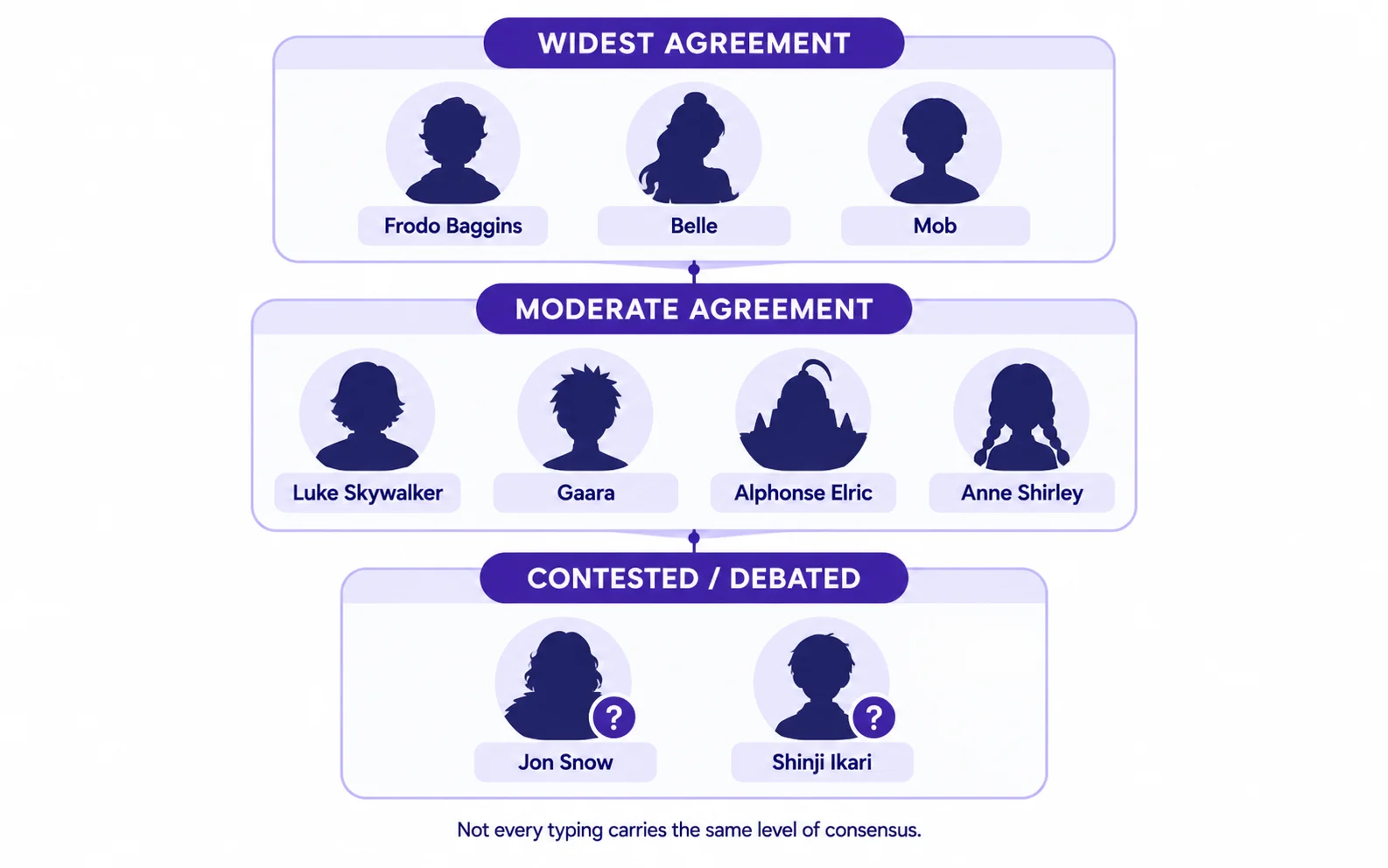
A second tier of characters appeared on multiple, but not most, sources: Luke Skywalker, Gaara, Alphonse Elric, and Anne Shirley fall here, cited often enough to be a fair representation but not quite at the same near-universal level as the first group. A third tier is genuinely contested, where different sites actively disagree, such as Jon Snow and Shinji Ikari, who each show up typed as more than one personality on different pages. Presenting all three tiers with the same level of certainty would misrepresent how settled these typings actually are, so this guide treats them differently on purpose.
This tiered approach is also a useful check on any single list you find elsewhere, including this one. If a site presents a contested character with total confidence and no acknowledgment that other sites disagree, that is a reasonable signal the list was built quickly rather than checked against independent sources.
How to Use This If You're Exploring Your Own Personality Type
Recognizing yourself in a fictional character can be a genuinely useful starting point for self-reflection, but it is worth remembering that a character is written to serve a story, not to pass a real assessment. If a specific character resonates with you, that recognition is more useful as a prompt to explore your own values and decision-making than as a substitute for finding out where you actually land.
For example, someone who relates strongly to Frodo's quiet endurance might notice they value loyalty and personal integrity highly, which is a useful thing to know about yourself regardless of which four letters you eventually land on. What a character resonance exercise cannot tell you is how you actually reason under pressure, how consistent your behavior is across different situations, or how you compare to a real, standardized population, which is exactly the gap a genuine assessment is built to close.
TalentRank does not offer an MBTI or INFP assessment. It measures cognitive ability and the Big Five personality traits, including Neuroticism, which the INFP-A/INFP-T distinction above is actually built on. For the deeper science-based comparison between the Big Five and MBTI-style frameworks, read TalentRank's guide to Big Five vs MBTI, or how to check MBTI compatibility if you already know your type and want to explore it further. If you want to see where you stand on the traits TalentRank actually measures, you can explore your own cognitive ability and Big Five personality.
Frequently Asked Questions
What are some well-known INFP characters?
Frequently cited examples include Frodo Baggins, Luke Skywalker, Belle, Mob, and Gaara. These are community and personality-site interpretations based on behavior, not confirmed classifications from the works that created them.
Is Frodo Baggins really an INFP?
Frodo is the most consistently cited INFP example across independent personality sites, largely for his selflessness and refusal to abandon his values under pressure. Like every typing in this guide, it is a widely shared interpretation, not an official classification.
Are INFP characters more common in anime or Western media?
Anime lists tend to name more INFP examples than Western film and TV lists, likely because anime frequently centers quiet, idealistic protagonists. This may reflect what gets written and typed rather than a real difference in how common the type is.
What is the most realistic INFP character in fiction?
There is no single agreed answer, and it is one of the most debated questions in personality fan communities. Realism tends to depend on whether a character is shown making decisions under real consequences, not just displaying surface traits like quietness or creativity.
Is Mob from Mob Psycho 100 considered a strong INFP example?
Yes, Mob is one of the most consistently cited INFP characters across independent personality sites, largely for his gentleness, strong internal values, and reluctance to use his power against others even under provocation.
Does TalentRank test for INFP or MBTI?
No. TalentRank measures cognitive ability and Big Five personality, including Neuroticism. It does not offer an MBTI, INFP, or any other Myers-Briggs-style assessment.
There is no official record anywhere of Frodo Baggins, Mob, or Belle taking a personality test, and there never will be. What these lists actually capture is something more useful than a fake certainty: a shared, debatable read on how idealism, quiet conviction, and value-driven decision-making show up in the characters people already know. The characters with the widest agreement, Frodo, Belle, and Mob among them, are worth treating as reasonably solid reference points; the contested ones, like Jon Snow and Shinji Ikari, are worth treating as exactly that, contested, rather than settled either way. Either way, use any typing here, including the ones fan communities agree on most, as a starting point for noticing your own patterns rather than a label to defend.