

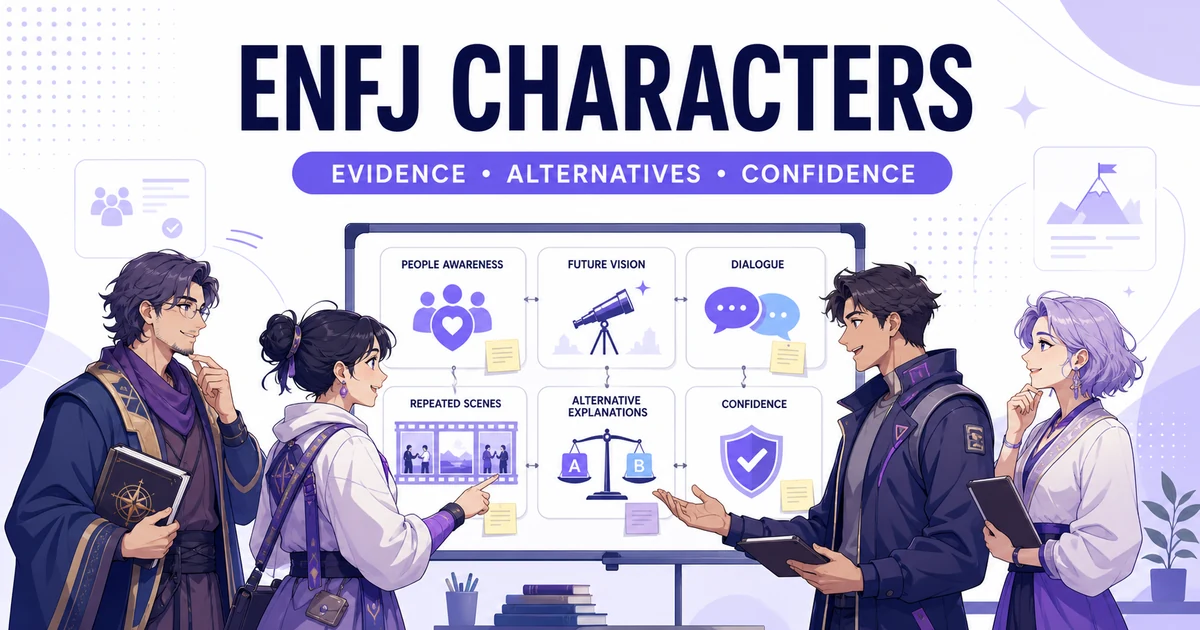
Fictional characters commonly interpreted as ENFJ include Mufasa, Moana, Morpheus, Elle Woods, Tanjiro Kamado, All Might, Emma Woodhouse, and Margaret Hale. They do not all look alike. What connects the stronger examples is a repeated effort to understand people, organize relationships, and move a group toward a meaningful future, not simply being friendly, dramatic, or popular.
These typings are interpretations, not official diagnoses. Most fictional characters were never assigned a Myers-Briggs type by their creators, and they cannot complete a personality assessment. This guide therefore treats each label as a case to examine. It identifies the version being discussed, looks for repeated behavior, considers a plausible alternative type, and keeps confidence modest when the evidence is incomplete or contested.
The Short Answer: Which Characters Are Commonly Read as ENFJ?
Mufasa, Moana, Morpheus, Elle Woods, Margaery Tyrell, Tanjiro Kamado, All Might, Jonathan Joestar, Emma Woodhouse, Margaret Hale, and Rosalind are frequently or plausibly read as ENFJ. Luffy is also popular on ENFJ lists, although ENFP and other interpretations remain credible. None of these labels should be treated as canon unless a verified creator or publisher says otherwise.
The most useful question is not, “Does this character act nice?” It is, “Across the story, does this character repeatedly read the social field, form a unifying direction, and help other people move toward it?” That standard still leaves room for disagreement, but it produces a stronger discussion than matching a character to four flattering adjectives.
ENFJ Character Examples at a Glance
Character | Work or version considered | Medium | Proposed ENFJ signals | Strongest alternative | Confidence |
Mufasa | The Lion King animated film | Movie | Values-led guidance, community responsibility, long-range mentorship | ESFJ | Moderate |
Moana | Moana animated film | Movie | Reads competing needs, restores shared direction, leads through persuasion | ENFP | Low–moderate |
Morpheus | The Matrix film | Movie | Organizes a group around a future vision and develops belief in others | INFJ | Moderate |
Elle Woods | Legally Blonde films | Movie | Social intelligence, advocacy, persuasion tied to a cause | ESFJ | Low–moderate |
Margaery Tyrell | Game of Thrones television version | Television | Public influence, relationship mapping, strategic care | ENTJ | Low |
Tanjiro Kamado | Demon Slayer anime | Anime | Compassion that shapes group conduct, moral persistence, encouragement | ISFJ | Low–moderate |
All Might | My Hero Academia anime | Anime | Public symbol, mentorship, collective reassurance, future successor | ESFJ | Moderate |
Jonathan Joestar | JoJo's Bizarre Adventure anime | Anime | Moral example, concern for others, inspiring conduct | ESFJ | Low |
Monkey D. Luffy | One Piece anime | Anime | Coalition building, loyalty, contagious vision | ENFP | Contested |
Emma Woodhouse | Jane Austen's Emma novel | Book | Social planning, relationship intervention, correction after harm | ESFJ | Low–moderate |
Margaret Hale | Elizabeth Gaskell's North and South novel | Book | Mediation across groups, moral direction, active relationship building | INFJ | Low–moderate |
Rosalind | Shakespeare's As You Like It play | Play | Reads relationships, tests motives, coordinates a social resolution | ENFP | Low–moderate |
Confidence here describes the strength of an editorial interpretation within the named version. It does not measure a character's mental health, realism, or value. A different adaptation can support a different reading because writers, actors, directors, and translators may emphasize different motives.
What Makes a Fictional Character Look ENFJ?
Kindness, popularity, enthusiasm, and inspirational speeches are weak evidence on their own. A stronger ENFJ interpretation looks for a repeated pattern of people-focused decisions, an organizing vision for the group, and action that brings relationships or shared values into alignment. The same behavior should also be tested against plausible ENFP, INFJ, ESFJ, or ENTJ explanations.
Weak evidence on its own | Stronger evidence to examine |
The character is friendly or popular | They repeatedly notice how choices affect several people and adjust their approach |
They deliver one inspiring speech | They sustain a shared direction across ordinary interactions, conflict, and setbacks |
They are emotional or caring | They turn social understanding into coordinated action while considering consequences |
They lead a group | Their leadership consistently develops people and aligns relationships with a meaningful future |
If you want a plain-language refresher on what ENFJ stands for, start with the four preference letters before comparing fictional behavior.
The official Myers-Briggs framework describes ENFJ through four preferences: Extraversion, Intuition, Feeling, and Judging. Preferences describe tendencies, not skills or fixed behavior. The framework also discusses type dynamics, but fictional analysis cannot reproduce a real best-fit process or validated assessment. For that reason, this article uses the theory as a vocabulary for interpretation rather than proof. Readers who want the framework's own wording can review the Myers-Briggs overview of the 16 types and its type dynamics overview.
People-Focused Decisions, Not Popularity Alone
An ENFJ reading becomes more convincing when a character pays attention to how decisions affect several people at once. The character may anticipate conflict, adjust communication, develop another person, or protect group cohesion. That is different from merely enjoying attention. A popular performer might be motivated by novelty, achievement, security, status, or personal expression instead.
Look for the starting point of a decision. Does the character first ask how people can move together toward a shared outcome? Does that concern appear during ordinary conversations as well as major speeches? Repeated low-stakes choices usually reveal more than a heroic climax designed to make any protagonist look inspiring.
People-focused criteria should not be reduced to being emotional or agreeable; the guide to Thinking and Feeling in MBTI explains the preference more carefully.
A Shared Vision That Becomes Group Action
Type enthusiasts often describe the ENFJ pattern as outward attention to people combined with an inward sense of direction. In story terms, that may appear as a mentor who recognizes potential, a diplomat who frames a common purpose, or an organizer who turns scattered individuals into a functioning team.
The distinction between concrete precedent and pattern-based direction becomes clearer in TalentRank's guide to Sensing and Intuition.
Vision alone is not enough. An INFJ interpretation may also emphasize a unifying insight, while an ENTJ interpretation may organize people efficiently around an objective. The proposed ENFJ distinction is that relational effects remain central: the character does not only design the destination but continually works through people to reach it.
Why One Dramatic Scene Is Not Enough
Stories exaggerate behavior. A shy character may deliver one rallying speech because the plot demands it. A cheerful hero may become controlling under extreme pressure. A villain may display extraordinary social insight without showing a stable preference for harmony or development.
A responsible reading samples several situations: calm conversations, conflict, disappointment, leadership, private reflection, and change over time. It also defines the canon. Book Emma, for example, should not automatically inherit every behavior added by a film adaptation. When the evidence is sparse or inconsistent, the confidence label should fall rather than the explanation becoming more certain.
ENFJ Characters in Movies and Television
Mufasa: Guiding a Community Through Values and Responsibility
Mufasa is a relatively strong mainstream example because his leadership is inseparable from teaching. In Disney's animated The Lion King, he explains responsibility as a relationship among the ruler, the land, and other living creatures. He is not merely powerful; he uses authority to prepare Simba for a role that must serve a wider community.
This supports an ENFJ interpretation built on values-led mentorship and long-range social responsibility. Psychology Junkie's fictional ENFJ analysis similarly emphasizes his big-picture guidance and duty to family and community. ESFJ remains a serious alternative because Mufasa also protects an established order, teaches inherited obligations, and grounds his lessons in the concrete continuity of the Pride Lands.
Moana: Turning Empathy Into Collective Direction
Moana repeatedly negotiates between competing needs: her father's fear, her island's survival, Maui's wounded pride, and her own developing sense of responsibility. Her leadership does not depend on formal authority. She listens, persuades, restores confidence, and keeps the larger mission visible when others withdraw.
That combination can fit an ENFJ reading, especially when empathy becomes coordinated action. Yet ENFP is plausible because Moana is also exploratory, identity-seeking, and willing to improvise beyond inherited limits. The point is not to force a verdict. It is to notice that “brave and caring” does not settle the underlying interpretation.
Morpheus: Inspiring Commitment to a Future Vision
Morpheus holds a clear interpretation of the future and organizes a community around it. His influence comes through belief, symbolism, mentorship, and an ability to make others see themselves as part of something larger. He develops Neo rather than treating him as a replaceable tool.
Those qualities support the people-plus-vision pattern associated with ENFJ. INFJ is the strongest alternative because Morpheus's conviction may begin with an inward, singular insight that he communicates selectively. The difference depends on whether readers see his relational leadership as the driver of his vision or as the outward expression of a private conclusion.
Elle Woods: Persuasion in Service of a Cause
Elle Woods succeeds partly because she understands social environments that others dismiss. She notices people, builds trust, communicates with unusual confidence, and eventually applies those abilities to advocacy rather than acceptance alone. Her warmth is active: it changes what groups believe is possible and who gets included.
An ENFJ interpretation therefore has more support than the stereotype “outgoing person who helps friends.” ESFJ remains plausible because Elle is attentive to presentation, concrete social knowledge, loyalty, and practical care. Her arc also shows why competence cannot be inferred from a type label; skills develop through effort, education, opportunity, and persistence.
Margaery Tyrell: Social Insight With a Strategic Edge
Spoiler note: This profile discusses Margaery's political strategy and public role in the television adaptation without detailing her final storyline.
The television version of Margaery Tyrell reads rooms quickly, adapts her public communication, and understands that power depends on relationships as much as formal rank. Her charitable image may include genuine care, political calculation, or both. That ambiguity makes her more useful than an idealized helper character.
ENFJ is one possible reading because she turns social understanding into a public vision and coordinated influence. ENTJ is equally plausible if her primary pattern is strategic control of institutions, alliances, and outcomes. Her profile should remain low-confidence because political roles reward precisely the behaviors typology enthusiasts may mistake for stable personality preferences.
ENFJ Anime Characters, and Why Some Typings Are Debated
Anime is a strong part of this search because long character arcs provide many situations to compare. It also creates special problems: adaptations may alter pacing or motivation, translations influence tone, and protagonists are written to inspire allies even when their proposed personality patterns differ.
Tanjiro Kamado: Compassion That Shapes the Group
Tanjiro's compassion does more than make him likable. He repeatedly recognizes suffering, steadies other people, and preserves a moral direction under pressure. His treatment of Nezuko and his capacity to see humanity in enemies shape how companions understand their own responsibilities. ComingSoon's anime list also highlights his optimism, selflessness, and protective care.
This can support ENFJ, although ISFJ is a credible alternative if his behavior is read primarily through devotion, duty, concrete protection, and remembered bonds. His central moral role may also amplify caring behavior beyond what type theory can explain.
All Might: Mentorship, Symbolism, and Public Responsibility
All Might is written as more than an individual hero. He becomes a public symbol whose presence reassures society, then turns his attention toward developing a successor. His energy is relational and performative in a purposeful sense: he understands that people respond not only to strength but to what a leader represents.
That makes an ENFJ interpretation plausible. His mentorship, public communication, and future-oriented responsibility form a consistent pattern. ESFJ remains possible because he strongly protects established social roles and expresses care through concrete service, teaching, and duty. His symbolic narrative function means confidence should stay moderate rather than absolute.
Jonathan Joestar: Moral Example and Relational Leadership
Jonathan Joestar is often discussed as a compassionate, principled hero who influences others through conduct rather than domination. He treats strength as a responsibility and maintains concern for other people even when conflict rewards cruelty. This moral example can look ENFJ because it gives companions a direction larger than individual victory.
ESFJ is a reasonable alternative: Jonathan's code is concrete, dutiful, and tied to honorable conduct. There is also limited evidence compared with characters written across many seasons. A low-confidence label is more honest than turning conventional heroism into proof of one personality type.
The Luffy Question: ENFJ, ENFP, or Another Reading?
Monkey D. Luffy appears on popular ENFJ anime lists because he inspires loyalty, forms alliances across social boundaries, and keeps a powerful shared direction in view. His crew members do not simply follow orders; they commit to a future made believable through his conviction.
The disagreement is equally important. ENFP can explain his spontaneity, openness, appetite for new possibilities, resistance to imposed structure, and ability to improvise. Some readers also interpret his direct sensory engagement through other types. Luffy is useful precisely because he demonstrates that coalition building and charisma do not produce one automatic answer.
Much of this disagreement turns on Judging and Perceiving: coordinated closure and follow-through can look different from open-ended exploration and improvisation.
ENFJ Characters in Books and Classic Stories
Literary examples allow a tighter canon boundary because the analysis can name one original text. The TypeAtlas literary analysis models this caution by comparing each proposed type with a competing interpretation and keeping confidence low or low–moderate.
Emma Woodhouse: Social Coordination or ESFJ Convention?
Spoiler note: This section refers to Emma's mistakes and later correction of her conduct.
In Jane Austen's Emma, Emma maps relationships, mentors Harriet, predicts social outcomes, and tries to improve other people's lives through matchmaking. Her errors matter. After causing harm, she revises both her judgment and her conduct, which shows that her social planning is not presented as effortless mind-reading.
ENFJ can explain the desire to coordinate a wider relationship system. ESFJ may explain her intense attention to local convention, familiar obligations, hospitality, and concrete social expectations. Her wealth and narrative position also give her unusual freedom to intervene, so role and personality remain difficult to separate.
Margaret Hale: Public Mediation or INFJ Conviction?
Elizabeth Gaskell's North and South repeatedly places Margaret between divided groups: family and community, workers and owners, South and industrial North. She learns through relationships, challenges assumptions, and sometimes turns private moral judgment into public intervention.
That mediation supports ENFJ, but INFJ remains strong if her actions are understood as the outward consequence of an inward moral synthesis. A careful interpretation should examine ordinary scenes as well as crisis moments. Public courage alone does not establish an extraverted preference.
Rosalind: Relational Resolution or ENFP Improvisation?
Rosalind in Shakespeare's As You Like It uses role play, conversation, and social testing to understand motives. She eventually coordinates revelations and relationships into a shared resolution. That outcome-directed attention to people can fit ENFJ.
Her improvisation, verbal experimentation, and delight in open possibilities strongly support ENFP as an alternative. Performance choices can move the portrayal further in either direction. A stage character is never only the text: actor, director, rhythm, and audience all influence what pattern viewers perceive.
Healthy, Complicated, and Unhealthy ENFJ Portrayals
No personality type determines morality. A character interpreted as ENFJ can be supportive, flawed, controlling, or harmful because morality depends on motives, choices, learning, circumstances, and writing, not four letters. Social awareness may help a mentor encourage growth, but it may also help a political operator influence a crowd.
Portrayal pattern | What the story may show | What type cannot prove |
Supportive | Listening, mentoring, coordinating help, building confidence | That every ENFJ is empathic or an effective leader |
Complicated | Overinvolvement, certainty about others' needs, pressure to maintain harmony | That controlling behavior is inevitable for the type |
Harmful | Deliberate manipulation, coercion, exploitation of trust | That violence, abuse, criminality, or mental illness comes from personality type |
The phrase “unhealthy ENFJ” can become a shortcut that explains nothing. If a character harms others, the article should describe the behavior and narrative context directly. It should not use typology as a diagnosis or excuse.
Why Do Websites Disagree About the Same Character?
Typing sites often evaluate different evidence. One may use a novel, another a film adaptation, and a third a handful of popular scenes. Some writers emphasize motives; others match visible traits. Fandom databases may aggregate votes without showing why a reader selected a type.
Disagreement also arises because several proposed patterns can produce similar behavior. An ENFJ and ESFJ reading may both emphasize care and coordination but differ on whether abstract direction or concrete precedent appears to lead. ENFJ and INFJ interpretations may share people awareness and long-range meaning while disagreeing about whether engagement or inward synthesis comes first.
Reddit discussions make this disagreement visible. Readers ask for interesting ENFJ characters, debate famous fictional examples, and question why ENFJ characters or celebrities seem uncommon. These discussions document audience uncertainty; they do not prove any typing.
Why ENFJ Protagonists Can Seem Surprisingly Uncommon
The popular “Protagonist” nickname can mislead readers into expecting every central hero to be ENFJ. It is a type label, not a rule about narrative roles. Many stories are driven by solitary discovery, improvisation, rebellion, tactical action, or internal conflict, so other proposed patterns may be easier for writers to foreground in a lead character.
Characters interpreted as ENFJ may also appear as mentors, diplomats, organizers, teachers, or team leaders because those roles make people-focused coordination visible. Reddit users have asked whether ENFJs are “actually protagonists” when so many examples appear to support or guide someone else. The better answer is that narrative role and personality label are separate questions.
Watch: One Video Interpretation of Fictional ENFJs
The video below presents another creator's list of fictional characters associated with ENFJ. It is included as a third-party interpretation, not evidence that every listed character has an official or settled type. Compare its choices with the method and alternatives in this guide.
Could This Character Be ENFJ? Use This Evidence Checklist
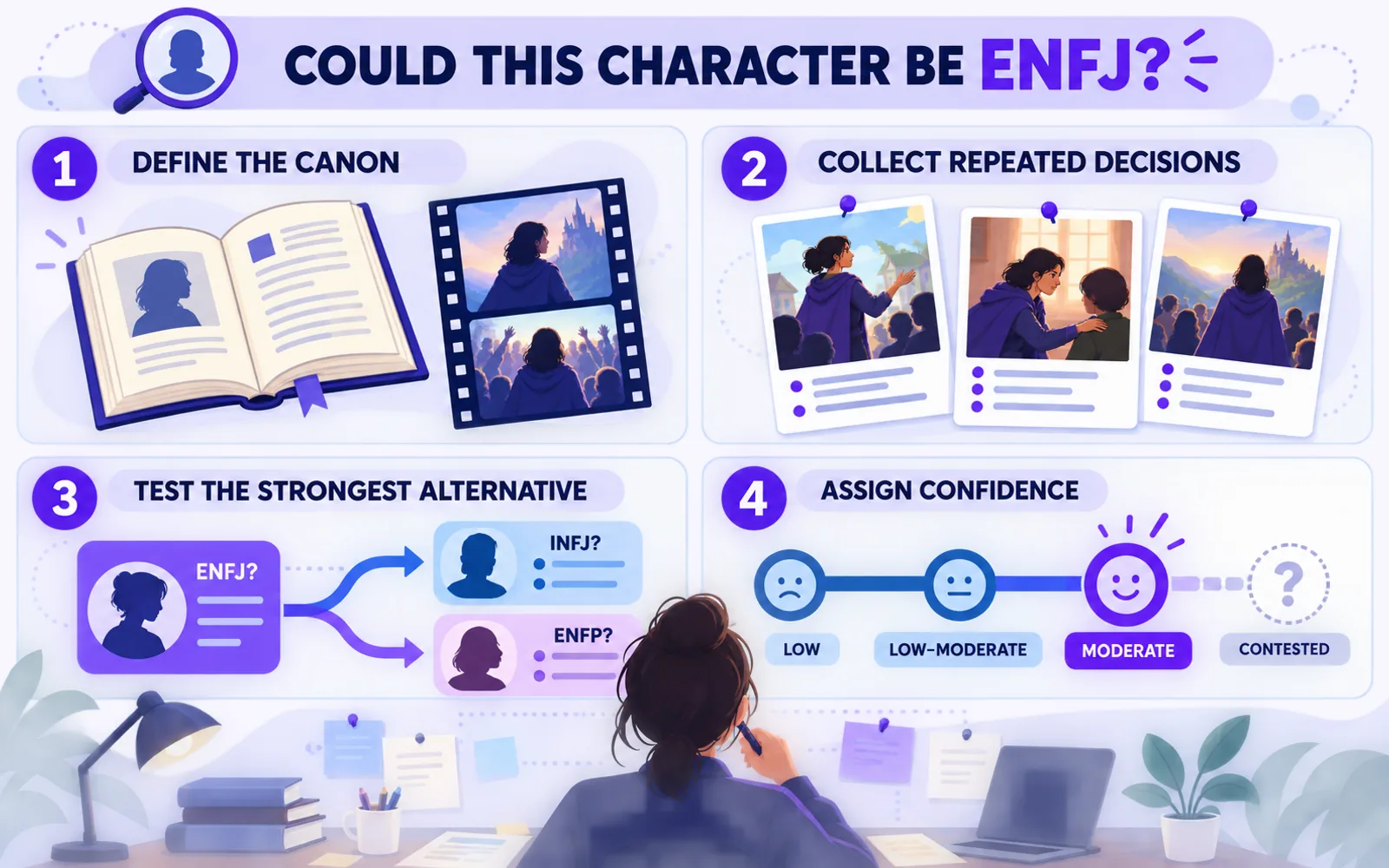
Use this four-step worksheet when a character is missing from the list or when two communities disagree. The goal is not to win a typing argument. It is to make the interpretation transparent enough that another reader can see the evidence, test an alternative, and reasonably reach a different conclusion.
Step 1: Define the Exact Version or Canon
Write down the precise work you are evaluating: novel, film, television season, anime adaptation, manga arc, game, or stage text. Do not combine every version automatically. Note whether the character's arc is complete and whether major spoilers are necessary.
Step 2: Collect Repeated Decisions, Not Adjectives
Record at least three scenes from different contexts. Include one ordinary interaction, one conflict, and one decision with consequences. Describe what the character notices first, what outcome they prioritize, and how they involve other people. Avoid entries such as “charismatic” or “nice” unless you explain the behavior underneath.
Step 3: Test the Strongest Alternative Type
Choose the best competing explanation rather than a random opposite. Ask whether concrete duty better explains the behavior than abstract direction, whether open exploration leads more than convergence, whether private synthesis comes before engagement, or whether task efficiency outweighs relational coordination.
Step 4: Assign a Confidence Level
Use moderate only when the pattern repeats across contexts and survives a serious alternative. Use low–moderate when one interpretation fits but key scenes support another. Use contested when adaptations, inconsistent writing, or equally strong alternatives prevent a stable conclusion. Avoid “confirmed” unless a verified official source actually confirms the label.
Copyable Worksheet
Character and exact version:
Is the character arc complete?
Repeated people-focused decisions:
Evidence of a shared future direction:
Behavior that contradicts the ENFJ reading:
Strongest alternative type:
Why the alternative may fit better:
Final confidence: low, low–moderate, moderate, or contested
After completing the worksheet, look for disconfirming evidence before choosing a label. That one habit makes the exercise more useful and less stereotyped.
Questions Readers Ask About ENFJ Characters
Are Fictional Character MBTI Types Official?
Usually not. Most online character typings are editorial interpretations or community votes. Fictional characters cannot complete an assessment, and creators rarely publish a verified MBTI result for them. Treat a label as official only when a trustworthy creator, publisher, or licensed source explicitly confirms it.
Who Is the Best Example of an ENFJ Character?
Mufasa and All Might are relatively clear mainstream examples because mentorship, public responsibility, and group-oriented direction recur across their roles. “Best” still depends on the version and the evidence standard. A well-supported low-confidence interpretation is more useful than a confident label based on one speech.
Are There ENFJ Villains?
A morally gray or villainous character can be interpreted as any personality type. Type does not determine ethics. Some readers type socially skilled manipulators as ENFJ, but manipulation alone is not evidence. The analysis still needs repeated people-focused organization, a future direction, alternatives, and a clear separation between personality theory and harmful conduct.
Which Female Characters Are Commonly Typed ENFJ?
Moana, Elle Woods, Margaery Tyrell, Emma Woodhouse, Margaret Hale, and Rosalind are among the female characters often or plausibly discussed through an ENFJ lens. Their evidence differs, and each has a strong alternative interpretation. They should not be reduced to one “caring female leader” stereotype.
Which Anime Characters Are Commonly Typed ENFJ?
Tanjiro Kamado, All Might, Jonathan Joestar, and Monkey D. Luffy frequently appear in discussions of ENFJ anime characters. Tanjiro and All Might offer clearer mentorship or group-care evidence. Luffy is more contested because ENFP and other interpretations explain much of his spontaneity and exploratory style.
Can Two People Reasonably Type the Same Character Differently?
Yes. Readers may choose different canon versions, interpret motives differently, or give more weight to different scenes. A useful disagreement identifies the evidence and strongest alternative instead of attacking the other reader. Fiction is incomplete by design, so some ambiguity cannot, and need not, be eliminated.
What Fictional Examples Can, and Cannot, Teach You About Personality
Fictional ENFJ interpretations can make abstract personality language easier to explore, especially when they show mentorship, group awareness, persuasion, overinvolvement, and conflicting motives in context. They cannot establish an official type, diagnose a person, predict morality, or choose a career. For real-person assessment, the Big Five vs MBTI comparison explains why a continuous trait profile can answer different questions from a four-letter category. Use the examples and worksheet to ask better questions about patterns, then keep the label modest: a character is a written construction, and a real person is always more complex than four letters.