

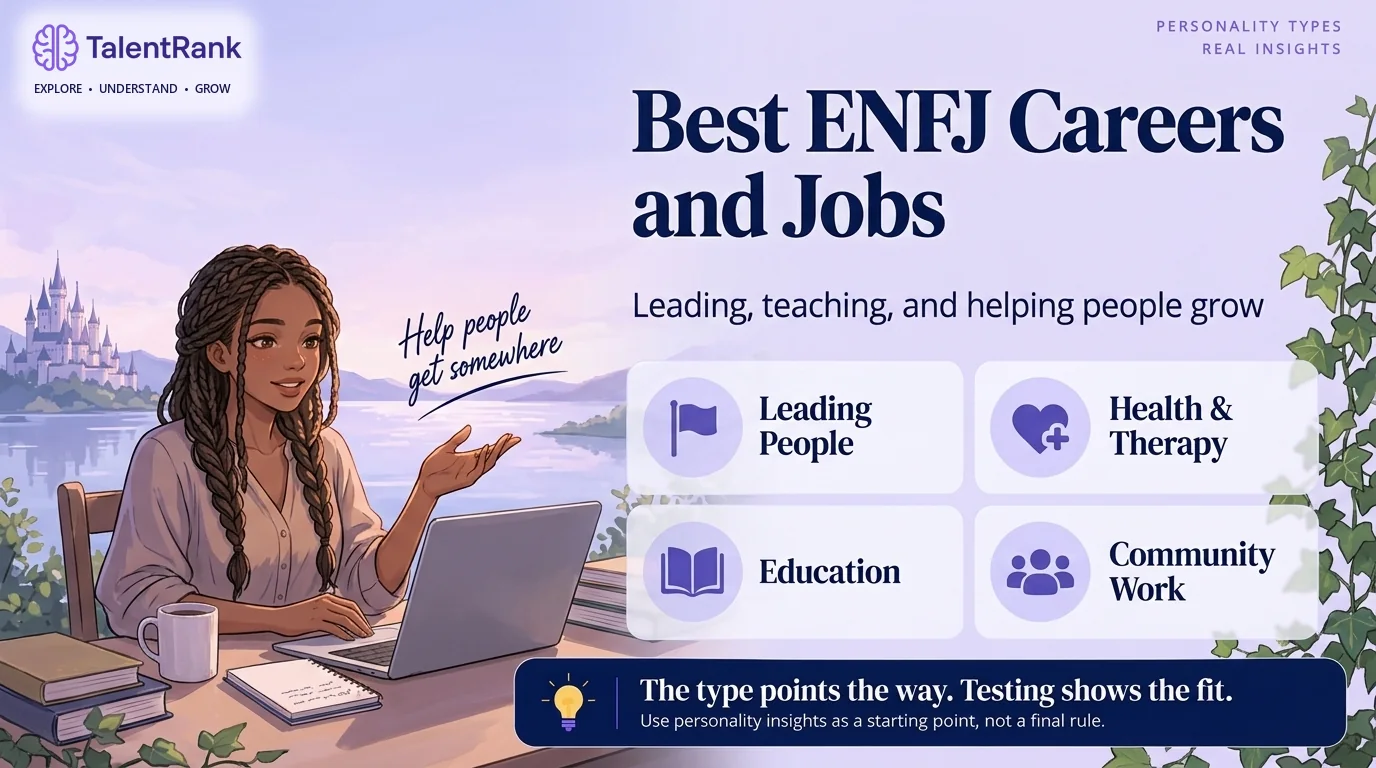
The best ENFJ careers usually put you in charge of helping other people get somewhere. Human resources, training and development, health services management, nonprofit leadership, school administration, counseling, occupational therapy, speech-language pathology, nursing, and public relations all fit that pattern. The common thread is organizing people toward a goal you believe in.
That's a pattern, not a prescription. The Myers-Briggs Company is clear that type preferences "do not indicate skill or ability" and that the assessment shouldn't be used to select people for jobs. (The Myers-Briggs Company) An ENFJ can be a good engineer or accountant. The label helps you notice where your energy tends to go.
Below you'll find twelve career paths with 2025 pay and 2025–35 growth figures from the U.S. Bureau of Labor Statistics, a look at leadership versus frontline roles, options that don't need a four-year degree, what "ENFJ-A" and "ENFJ-T" mean for your search, and the work conditions most likely to burn an ENFJ out.
What Draws ENFJs to Certain Kinds of Work
ENFJ stands for Extraversion, Intuition, Feeling, and Judging. Put simply, you tend to recharge around people, look at where things are heading, weigh decisions by their effect on others, and like a plan with a clear finish line. (Our pages on thinking vs. feeling and judging vs. perceiving cover those letters in more depth.)
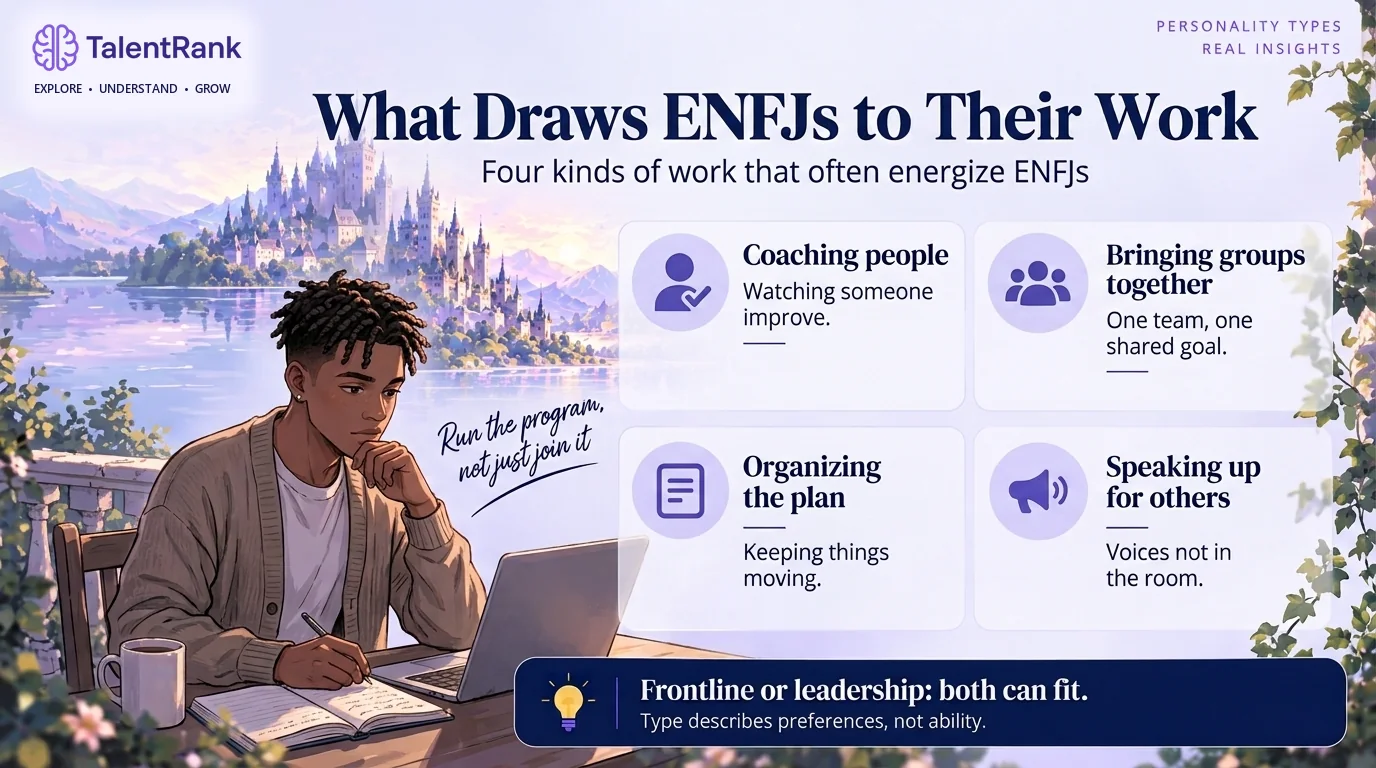
That J is what separates many ENFJs from their ENFP cousins. Both are drawn to people and meaning. ENFJs are more likely to want to run the program, not just take part in it. If that describes you, you'll probably enjoy work where you:
Coach or teach someone and watch them improve.
Bring a group together around a shared goal.
Organize the plan and keep it moving.
Speak up for people who aren't in the room.
Best ENFJ Careers to Explore
These careers reward those strengths. Figures come from the Bureau of Labor Statistics Occupational Outlook Handbook: median pay in May 2025 and projected change in employment from 2025 to 2035.
Career | 2025 median pay | Projected growth, 2025–35 | Typical path in |
Human resources manager | $149,280 | 6% | Bachelor's degree plus 5+ years' experience |
Public relations or fundraising manager | $136,470 | 6% | Bachelor's degree plus 5+ years' experience |
Training and development manager | $133,000 | 6% | Bachelor's degree plus 5+ years' experience |
Medical and health services manager | $123,860 | 24% | Bachelor's degree |
School principal | $105,870 | 0% | Master's degree plus teaching experience |
Occupational therapist | $100,330 | 15% | Master's degree plus license |
Speech-language pathologist | $97,870 | 17% | Master's degree plus license |
Registered nurse | $97,550 | 6% | Nursing degree or diploma plus license |
Social and community service manager | $80,390 | 7% | Bachelor's degree plus experience |
Instructional coordinator | $77,440 | 2% | Master's degree |
Human resources specialist | $75,940 | 6% | Bachelor's degree |
School or career counselor | $64,330 | 3% | Master's degree |
Source: BLS Occupational Outlook Handbook, pages updated August 2026. A 0% projection still means openings, mostly from retirements.
Leading and Developing People
Human resources managers and training and development managers shape how an organization hires and develops its people. Both pay well, and both usually require about five years of experience first. The typical route is to start as an HR specialist or trainer and move up.
These roles aren't all warmth. HR managers handle layoffs, disputes, and compliance. An ENFJ who hates delivering bad news should ask how much of the job involves it.
Health and Therapy
Occupational therapists and speech-language pathologists work one-on-one with clients over weeks or months, which gives you the long-term coaching arc many ENFJs enjoy. Both are growing much faster than average, at 15% and 17%.
Registered nurses combine care, teaching, and coordination, and there are several entry routes, including associate's degree programs. Medical and health services managers run the clinics and departments behind the care. BLS projects 24% growth for that role, the fastest in this guide.
Education
ENFJs are sometimes nicknamed "the teacher," and education offers a clear ladder. Many start in the classroom, then move into instructional coordinator or principal roles, which shift the focus from teaching students to developing teachers. School and career counselors work directly with students on their plans.
The catch: principal roles typically need a master's degree and years of teaching, and projected growth is flat. The long hours, including evening events, are part of the job.
Community and Communication
Social and community service managers run programs at nonprofits and agencies, from food banks to addiction services. They need less experience than most managers on this list, which makes the role a realistic mid-career goal. Public relations and fundraising managers persuade donors and the public to back a cause, which suits ENFJs who are good at rallying people.
Leader or Helper? Choosing Your Level
Many ENFJ careers split into two tracks. On one, you help people directly: the nurse, the therapist, the counselor, the trainer. On the other, you build the system that helps people: the health services manager, the principal, the HR director.
Neither is better. They feel different day to day. Frontline roles give you the direct human moments. Leadership roles give you reach, along with more meetings and harder personnel calls. If you're early in your career, it's normal to start in a frontline role and decide later whether you want to lead.
Hypothetical example: an ENFJ nurse loves patient teaching and becomes the informal mentor for new hires. A manager suggests she apply for a charge nurse role. Before saying yes, she shadows the current charge nurse for a week and finds out whether she enjoys scheduling and escalations as much as she enjoys teaching. That week is worth more than any type description.
ENFJ Jobs That Don't Require a Four-Year Degree
Several paths start without a bachelor's degree:
Community health workers help people get access to care and adopt healthier habits. They typically need a high school diploma plus on-the-job training, earned a median of $51,850 in 2025, and the field is projected to grow 13%.
Registered nursing can start with an associate's degree, as noted above, and many nurses finish a bachelor's later while working.
Fitness trainers and instructors need a high school diploma and, usually, a certification. The median was $47,160.
Customer success, recruiting coordination, and team lead roles in retail or hospitality are also common starting points for people who like leading others. Check local postings, since requirements vary.
ENFJ-A and ENFJ-T Careers: Is There a Difference?
The "-A" and "-T" endings come from 16Personalities, not the official MBTI. 16Personalities adds a fifth scale, called Identity, and builds its model on Big Five research. (16Personalities)
So there's no separate list of ENFJ-A careers. The careers above apply to both. The Assertive label may suggest someone more comfortable with high-pressure leadership. The Turbulent label may suggest someone who worries more about letting people down, which is worth planning for in roles where you're responsible for others' outcomes. Either way, it's a hint to explore, not a rule.
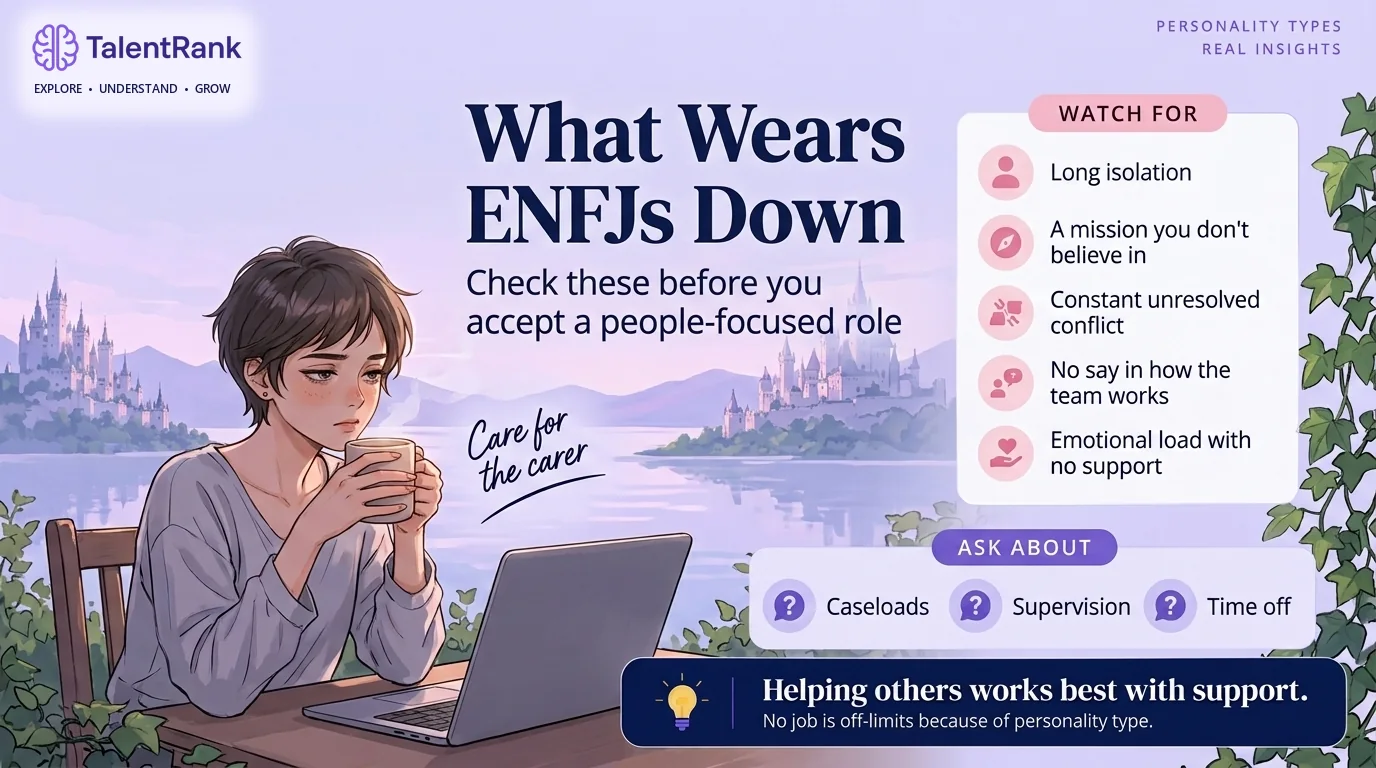
Conditions That Tend to Wear ENFJs Down
Rather than a list of "jobs to avoid," it's more useful to know which conditions tend to drain people with ENFJ preferences:
Isolation, with little contact with people for long stretches.
A mission you don't believe in, or leadership that says one thing and does another.
Constant conflict with no path to resolve it.
No say in how the team is organized.
Emotional load with no support. Helping roles can quietly absorb your evenings and weekends.
That last one matters. Many ENFJs find it hard to say no when someone needs help. In counseling, nursing, and HR, that trait is valuable, and it can also lead to exhaustion. Ask in interviews how the team handles caseloads, supervision, and time off.
How to Test an ENFJ Career Before You Commit
Pick three careers from this guide that genuinely interest you.
Read the daily tasks for each on O*NET OnLine, not just the description.
Talk to one person in each role about the hardest part of their week.
Get close to the work: volunteer, shadow, lead a small project, or take a short course.
Compare the training time and cost against the pay and outlook above.
If you want a second framework, the Holland Code groups careers by interest themes, and clarifying your work values can help you decide between frontline and leadership tracks.
Going Beyond the Type Label
Two ENFJs can look quite different at work. One is calm under pressure and highly organized. Another is just as caring but more anxious about conflict. Trait-based measures capture those differences better than four letters. (Our comparison of the Big Five and MBTI explains how.)
The TalentRank assessment measures your Big Five personality traits and takes about 12 to 15 minutes. It won't confirm an MBTI type or choose a career for you. It can show where you land on traits like agreeableness, extraversion, and emotional stability, which matter a lot in people-facing work. Take the TalentRank assessment and use it alongside what you learn from testing real options.
Frequently Asked Questions About ENFJ Careers
What is the best career for an ENFJ?
There isn't a single best one. ENFJs often do well in roles that involve developing, organizing, or advocating for people, such as HR, training, healthcare, education, counseling, and nonprofit leadership. Skills and workplace fit matter as much as type.
What jobs should ENFJs avoid?
No career is off-limits because of type. It's more useful to avoid conditions that drain ENFJs, like long isolation, a mission you don't believe in, constant unresolved conflict, and emotional load without support.
Are ENFJs good leaders?
Many are. ENFJs often bring a clear vision and genuine interest in how their team develops. Good leadership also takes comfort with hard decisions and difficult conversations, which anyone can develop with practice.
What ENFJ jobs pay the most?
In this guide, human resources managers had the highest 2025 median pay at $149,280, followed by public relations and fundraising managers at $136,470 and training and development managers at $133,000, according to BLS. Most of these roles require several years of experience first.
Is there a difference between ENFJ-A and ENFJ-T careers?
No. The A/T distinction comes from 16Personalities, not the official MBTI, and the same careers apply. It may be more relevant to how you handle pressure and responsibility for others.
Is nursing a good career for an ENFJ?
It can be. Nurses spend much of their day teaching patients and coordinating care, and there are several ways into the field. It's also physically and emotionally demanding, so shadowing a nurse or working as a nursing assistant first is a good test.
Final Takeaway
ENFJ careers tend to share one theme: helping people grow, directly or by running the system around them. Healthcare, education, HR, training, and nonprofit work all offer that. Decide whether you want the frontline or the leadership track, protect yourself from emotional overload, and test a few options before committing. The type points the way. The testing tells you whether it fits.