

You take a free test online, get three letters back, and then what? A Holland Code is meant to make career choices feel less like guesswork, but a code on its own does not tell you much. RIASEC, the framework behind it, has been used by career advisers for decades, and it is genuinely useful once you understand what it is actually measuring.
The confusion usually comes from treating a Holland Code as a personality result. It is not one. It describes what kind of work pulls you in, which is a different question from how you behave or what you are good at. This guide explains the six types, how a three-letter code is built, why the order of those letters changes the meaning, and the specific things your code cannot tell you.
Key Takeaways
A Holland Code summarises your work interests in three letters drawn from six types: Realistic, Investigative, Artistic, Social, Enterprising, Conventional.
RIASEC and Holland Code refer to the same framework.
Interests are not personality traits, and the two can point in different directions.
The order of your letters matters. SAE and ASE describe different people.
TalentRank measures personality and cognitive ability, not career interests.
What Is a Holland Code?
A Holland Code is a three-letter summary of your strongest career interests, drawn from psychologist John L. Holland's six types: Realistic, Investigative, Artistic, Social, Enterprising and Conventional. It describes the kind of work and environment you are drawn to, not your personality, your ability, or the job you should take.
The framework treats interests as something worth measuring in their own right. The reasoning is straightforward. People tend to do better and stay longer in environments that match what they enjoy, and most of us are poor at describing that match without a structure to work from. A code gives you that structure.
It is used well beyond the original research. The US government's O*NET system organises its occupational interest data using the same six categories, which is why so many free career tools produce results in this format.
What Does RIASEC Stand For?
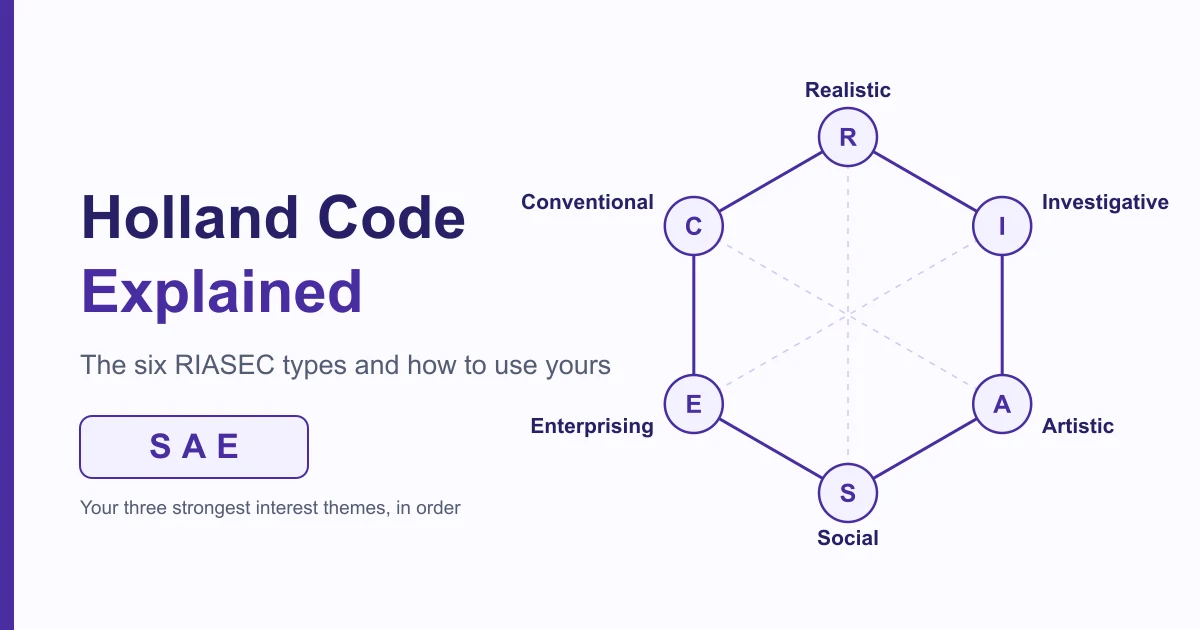
RIASEC stands for Realistic, Investigative, Artistic, Social, Enterprising and Conventional, the six interest types in Holland's model. RIASEC and Holland Code describe the same framework. Most people are not one pure type; a code combines the two or three themes that describe you most strongly.
Type | What drives it | Example activities | Fields it tends toward |
Realistic | Working with tangible things and seeing a physical result | Building, repairing, operating equipment, working outdoors | Trades, engineering, agriculture, logistics |
Investigative | Understanding why something works the way it does | Analysing, researching, testing ideas, solving abstract problems | Science, data, medicine, research |
Artistic | Creating something that did not exist before | Designing, writing, composing, performing | Design, media, writing, performing arts |
Social | Helping people develop or resolve something | Teaching, advising, supporting, facilitating | Education, healthcare, counselling, social work |
Enterprising | Influencing outcomes and people | Persuading, leading, negotiating, selling | Business, sales, law, management |
Conventional | Bringing order to information and process | Organising, tracking, verifying, systematising | Finance, administration, operations, compliance |
R: Realistic
Realistic interests centre on concrete, hands-on work. You are drawn to problems where the result is visible and the feedback is immediate: something is fixed, or it is not. This shows up in the trades and engineering, but also in laboratory work, logistics and anywhere the job involves physical systems.
One caution. A high Realistic score is not a statement about your intelligence or ambition, and it does not mean office work will make you miserable.
I: Investigative
Investigative interests are about understanding. You want to know the mechanism, not just the outcome. People with strong Investigative themes tend to enjoy working through ambiguous problems and are often comfortable spending a long time on a question before reaching an answer.
One caution. Enjoying analysis is not the same as being good at it. Interest and ability are separate things, which is the distinction this whole framework rests on.
A: Artistic
Artistic interests involve making something original. That covers the obvious creative fields, but it also covers anyone who would rather design a new process than run an existing one well.
One caution. Artistic interests do not require you to be extroverted, expressive, or willing to perform. Plenty of people with strong Artistic themes do their best work alone and quietly.
S: Social
Social interests centre on people developing, learning or recovering. The reward is someone else's progress. This appears in teaching, healthcare and counselling, and equally in training, coaching and team leadership roles.
One caution. A Social theme is about the purpose of the work, not about how sociable you are. Wanting to help people and wanting to be around people constantly are different things.
E: Enterprising
Enterprising interests are about influence and momentum. You want to move things forward, convince people, and take responsibility for an outcome. This covers sales and management, and also entrepreneurship and advocacy.
One caution. Enterprising is not a synonym for ambitious or extroverted. It describes the type of work you are drawn to, not how driven you are.
C: Conventional
Conventional interests involve making systems reliable. You are drawn to accuracy, structure and processes that work the same way every time. Finance, operations, compliance and data administration all sit here.
One caution. This is the type most often described dismissively, which is a mistake. Wanting things to be correct and orderly is a genuine interest, not a lack of imagination.
How Your Three-Letter Code Is Built
An interest inventory asks how much you would like to do a range of work activities. Your answers produce a score for each of the six types, and your code is usually the three highest scoring themes, written in order.
Two or three letters is standard because almost nobody is a single pure type. A one-letter description would throw away most of the useful information, and using all six would leave you with nothing to prioritise.
Why the Order of Your Three Letters Matters
Yes, the order matters. The first letter is your strongest interest theme and carries the most weight. SAE and ASE contain the same three themes but describe different people, because the leading theme shapes what the person seeks first. Read your code in order, not as an unordered set.
Someone with SAE leads with Social. They are looking for work centred on other people's development, and they want room to be creative and to influence direction inside that. Someone with ASE leads with Artistic. They are looking for creative work first, and the social and enterprising themes describe how they prefer to do it.
Illustrative example: a nearly flat profile. Imagine someone whose top three scores come out within a point or two of each other. Reading a first letter here would be false precision, because a small difference in how they answered a handful of questions could reorder the whole code. The useful move is to stop treating it as a ranking and look at what those three themes share. If Social, Artistic and Enterprising all score similarly, the common thread might be work that involves shaping how other people experience something. That is a more honest read than forcing a leading letter the data does not support.
Holland's Hexagon: How the Six Types Relate to Each Other
The six types are conventionally arranged around a hexagon in the order the acronym gives: Realistic, Investigative, Artistic, Social, Enterprising, Conventional. The arrangement is not decorative. Types sitting next to each other on the hexagon are more closely related than types sitting opposite each other.
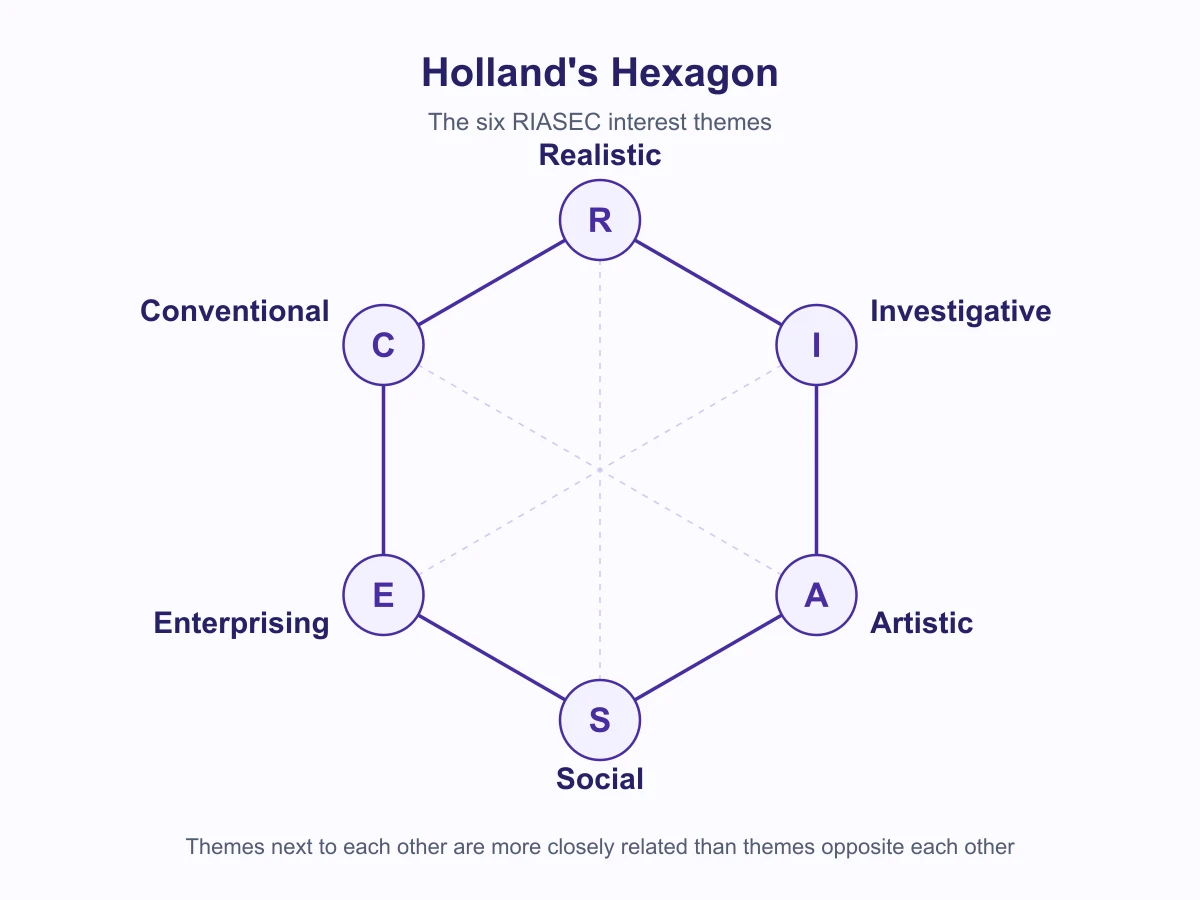
The six RIASEC themes in their standard hexagon arrangement. Adjacent themes are more closely related than opposite ones.
The six RIASEC themes in their standard hexagon arrangement. Adjacent themes are more closely related than opposite ones.
The National Center for O*NET Development's psychometric summary describes this directly, stating that because of the circular nature of Holland's RIASEC model, correlations decrease as one scale moves farther from another and increase again as it moves closer around the circular structure. The same document reports that the Interest Profiler Short Form conforms to Holland's circular order structure, also called a hexagon.
This is why some codes feel coherent and others feel contradictory. A code of adjacent themes tends to describe a consistent kind of work. A code combining opposite themes, such as Realistic and Social, is not wrong or unusual, but it often points to roles that deliberately bridge two worlds rather than to a single obvious occupation.
Is a Holland Code the Same as a Personality Test?
No. A Holland Code measures interests, meaning what you are drawn to. A personality test such as the Big Five measures traits, meaning how you tend to behave. Two people with identical codes can work very differently, and your interests can point somewhere your personality does not.
Dimension | What a Holland Code tells you | What a Big Five profile tells you |
Core question | What kind of work pulls you in | How you tend to behave and respond |
Stability | Can shift as you gain experience | Relatively stable across adult life |
Best used for | Narrowing which fields to explore | Understanding how you will work inside a role |
Typical output | Three letters ranking six interest themes | Scores across five independent traits |
What it cannot do | Predict how well you will perform | Tell you which field you will enjoy |
What Your Interests Predict
Interests are a reasonable guide to what you will find engaging and what you are likely to keep doing voluntarily. That matters, because sustained attention is hard to fake over a career. What interests do not tell you is how good you will be at the work.
What Your Personality Traits Predict
Traits describe your default behaviour. How you handle pressure, how much structure you need, how you respond to other people, how open you are to unfamiliar approaches. Two people can share an interest in design work and need completely different working conditions to do it well. If you want the full picture, start with the Big Five personality framework.
When Your Interests and Your Personality Disagree
This is common and it is not a contradiction. It usually means the interest is real but the assumed job is wrong.
Illustrative example. Imagine someone with a strong Artistic theme who is also low on Extraversion. They assume the code points toward performing, client pitching, or running a studio, and they conclude that creative work is not for them. The interest is genuine; the job they pictured simply does not suit how they work. The same Artistic theme is served by illustration, writing, editing, technical design or research-heavy creative work, all of which reward the interest without demanding constant social exposure. The code told them what to move toward. It did not tell them what conditions they need, and it was never designed to.
If you know both your interest themes and your personality profile, use the first to choose the field and the second to choose the format.
How Do You Find Your Holland Code?
Take a structured interest inventory instead of guessing. The free O*NET Interest Profiler scores you across all six types and links your results to hundreds of occupations. TalentRank does not offer a Holland Code or RIASEC assessment, so use an external interest inventory to get your code.
The O*NET Interest Profiler is the most accessible option. Its official documentation describes it as compatible with Holland's R-I-A-S-E-C interest structure, and lists a 30 question web version in English and Spanish alongside a 60 question paper version. Completion takes roughly 10 to 20 minutes, and results link to over 900 occupations.
Answer for interest, not ability. The question is whether you would like doing the activity, not whether you would be good at it.
Answer for the activity, not the job title. Job titles carry status and salary associations that distort interest answers.
Do not optimise. Answering as the person you think you should be produces a code for someone who does not exist.
What Can a Holland Code Not Tell You?
It cannot tell you whether you will be good at a job, how much you will earn, or which single career to choose. Interests predict what you will find engaging, not your ability, your work ethic, or whether a specific employer will be a good fit.
What you want to know | Does a Holland Code answer it? | What answers it better |
Which fields might suit me | Yes | This is what it is for |
Will I be good at this work | No | Skills assessment, aptitude measures, actual practice |
How will I behave in the role | No | A personality measure such as the Big Five |
What conditions do I need to do well | No | Work values and personality together |
Will I like this specific employer | No | Culture research, interviews, talking to people there |
What should I earn | No | Labour market and salary data |
Two further limits are worth stating. A code reflects how you answered on one particular day, so a marginal difference between two themes should not be treated as a fixed ranking. And interests can shift with exposure, because it is difficult to be interested in work you have never encountered.
How to Turn Your Code Into an Actual Career Decision
Read the themes, not just the letters. Write down what each of your three themes actually means for the work you want.
Generate options, do not narrow yet. Use an occupational database to build a long list from your code rather than jumping to one title.
Filter by ability and constraint. Interest gets a role onto the list. Qualifications, training time and practical limits decide what stays.
Check the format against your personality. Same field, different working conditions. This is where a personality profile earns its place.
Test one option cheaply. A conversation, a short course, a volunteer project. Real exposure beats another assessment.
Career fit has four layers, and interests are one of them. Your interests say what you are drawn to. Your personality says how you will work. Your abilities say what you can do well. Your work values say what an environment has to provide before the job feels right. TalentRank measures two of these four. A decision made on any single layer is usually a decision you end up revisiting. |
What TalentRank Measures and What It Does Not
This article is written from experience building and interpreting personality and cognitive assessments. It is not written from experience administering RIASEC instruments, because TalentRank does not offer one.
TalentRank does not offer a Holland Code, RIASEC, or career interest assessment. If you want your code, use an external interest inventory such as the one described above.
What TalentRank does measure is personality and cognitive ability. The assessment covers the Big Five personality traits and a cognitive reasoning estimate. Those answer a different question from the one a Holland Code answers. Interests suggest what to move toward; personality and ability describe how you are likely to work once you get there. Both are useful, and neither replaces the other. If that is what you are looking for, you can explore the TalentRank assessment.
Can your Holland Code change over time?
Yes, and it commonly does. Interests develop as you are exposed to new kinds of work, and a theme you scored low on at twenty may rise once you have actually tried it. Treat a code as a current reading rather than a permanent label, and retake an inventory after a significant change.
What if two of your types score almost the same?
Treat them as tied rather than ranked. A one or two point gap is well inside the range that a slightly different mood on the day could produce. Look at what the tied themes have in common and explore roles that draw on both, instead of forcing an order the scores do not support.
Do employers use Holland Codes?
The framework is used mainly in career guidance, counselling and education rather than in hiring. Occupational databases organise roles by interest category, which helps people explore options. A Holland Code is not designed as a selection tool and should not be used to screen or reject candidates.
Is the RIASEC model scientifically supported?
The structure has real evidence behind it. O*NET's psychometric summary reports that the Interest Profiler Short Form fits Holland's circular RIASEC structure, with a correspondence index of .69. The same document describes the tool as built for career counseling, planning and exploration, not for predicting job performance.
Evidence and Limitations of This Guide
The claims here about the RIASEC structure, the Interest Profiler's format and its intended use are taken from the official O*NET documentation cited below. This guide deliberately makes no claim about how strongly interests predict job satisfaction, performance or tenure, because no source was verified for it during writing.
Sources
Your Code Is a Starting Point, Not a Job Title
Three letters cannot decide your career, and a framework that claimed otherwise would deserve the scepticism people bring to online tests. What a Holland Code does well is narrow an impossibly wide question into a manageable one, by telling you which kinds of work are worth investigating before you spend years finding out the slow way. Pair it with an honest view of what you are good at, how you prefer to work, and what you need from an employer, and it becomes genuinely useful. Read on its own, it is just three letters.