

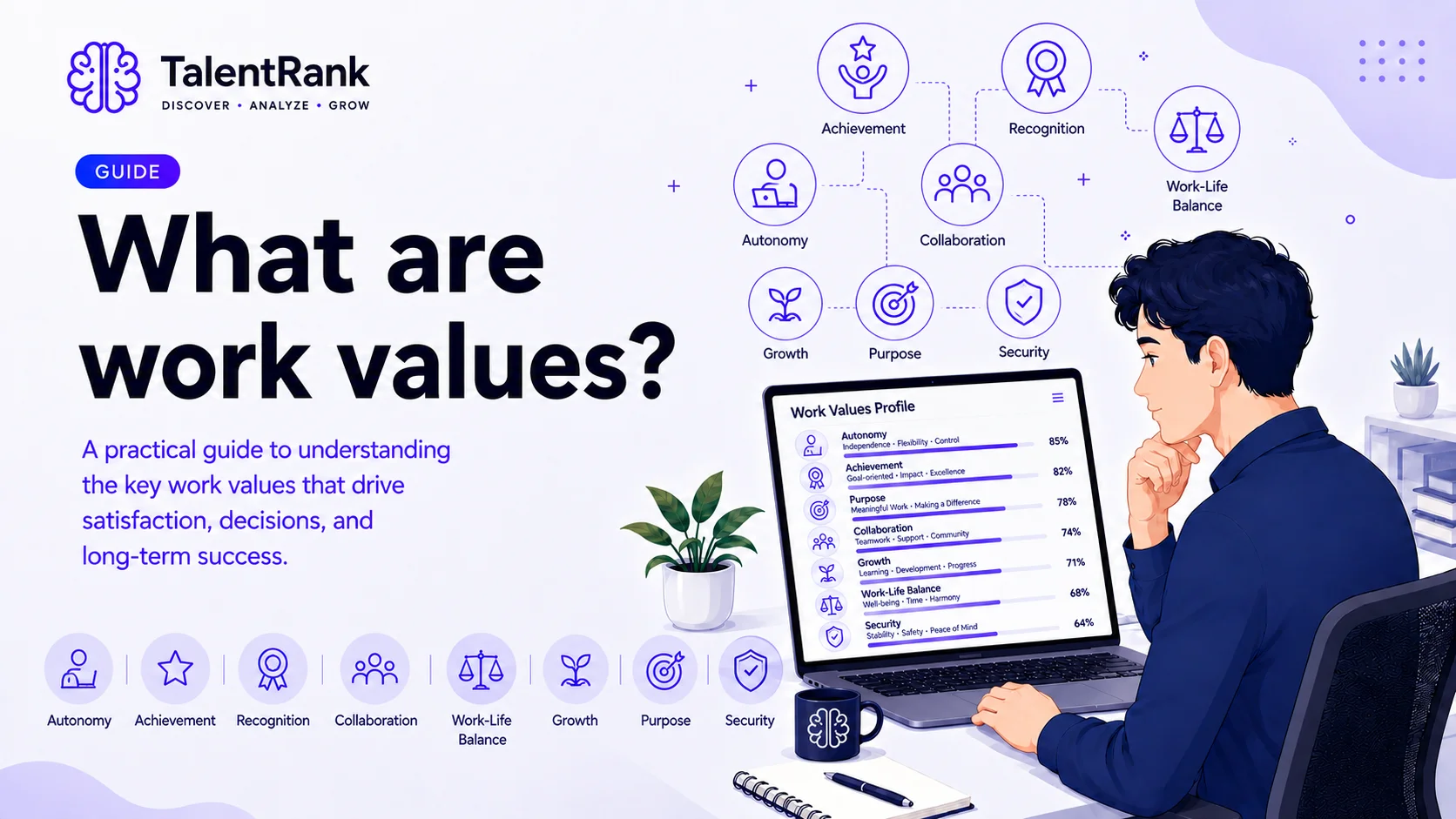
A job can match your qualifications and still feel wrong. You may be capable of doing the work, interested in the field, and comfortable with the daily tasks, yet find that the environment drains you. The missing piece may be your work values: the conditions and outcomes you need from work to feel that your effort is worthwhile.
Understanding your work values does not reveal one perfect career, and it should not replace experience or careful research. It gives you a clearer way to compare options. When you consider work values alongside personality, interests, abilities, and practical needs, you can ask better questions about which roles and workplaces deserve further exploration.
Key takeaways
Work values describe what you need work to provide.
O*NET groups work values into six broad categories.
Values and personality are related but distinct.
Career choices should also consider interests, abilities, constraints, and experience.
Work values are what you need from work to feel satisfied
Work values are the outcomes and conditions you want your job to provide, such as independence, recognition, supportive relationships, achievement, or job security. They help explain why a role can match your skills yet still feel unsatisfying. Work values guide career decisions, but they should be considered alongside interests, abilities, personality, and practical needs.
Work values are not the same as personal morals. Honesty and fairness may guide how you behave in every part of life, while independence or supportive management may describe what you need from a workplace. Work values are also different from company values, which are the principles an organization says guide its decisions and culture.
This distinction matters because the phrase "work values" is sometimes used for all three ideas. In this guide, it means the aspects or conditions of work that are important to a person, consistent with the definition used in the O*NET Work Importance Locator guide.
Work values at a glance
The O*NET framework organizes work values into six broad categories. Each category represents a different kind of need that a job or work environment may satisfy.
Work value | What it means | What it can look like at work | Question to ask |
Achievement | Using your abilities and gaining a sense of accomplishment | Solving difficult problems or completing meaningful projects | Will this role let me use and develop my strongest abilities? |
Independence | Having room to make decisions and use initiative | Choosing how to approach tasks or owning a project | How much control will I have over my work? |
Recognition | Receiving advancement, status, leadership, or acknowledgement | A visible promotion path or formal responsibility | How are contribution and growth recognized here? |
Relationships | Helping others and working in a cooperative environment | Serving people or working with supportive colleagues | Will the work let me contribute without constant unhealthy competition? |
Support | Having fair, capable, and considerate management | Clear guidance, useful feedback, and managers who support employees | What happens when an employee needs help or raises a concern? |
Working Conditions | Having suitable security, compensation, variety, activity, and surroundings | Predictable hours, appropriate pay, or a preferred work setting | Do the conditions support the life I need outside work? |
The categories give you a useful structure, but they are not boxes that define your identity. Most people care about several work values at once, and the order can change with new responsibilities, experiences, or life circumstances.
The six O*NET work values
The CareerOneStop Work Values Matcher uses Achievement, Working Conditions, Recognition, Relationships, Support, and Independence. It is based on the O*NET Work Importance Locator and continues to use the framework for career exploration, although O*NET no longer updates or displays the underlying work-values dataset. These categories help turn a vague question such as "What do I want from work?" into more specific questions.
Achievement
Achievement matters when you want work to use your abilities and give you a clear sense of accomplishment. A person who values achievement may enjoy solving difficult problems, mastering a demanding skill, or seeing a project reach a meaningful result.
Achievement does not always mean competing with other people. For one person, it may mean meeting an ambitious target. For another, it may mean improving a process, completing careful research, or helping a client make progress.
Ask yourself: Which past tasks made me proud because I used my abilities well?
Independence
Independence concerns initiative, responsibility, creativity, and the freedom to make decisions. Someone who values independence may prefer clear goals with flexibility in how to reach them, rather than constant instructions about every step.
Independence is not the same as working alone. A person can value teamwork while still wanting ownership of their decisions. What matters is whether the role provides an appropriate level of autonomy.
Ask yourself: How much direction helps me, and when does direction start to feel like unnecessary control?
Recognition
Recognition can include advancement, responsibility, leadership, respect, and acknowledgement. A person who values recognition may want a visible path for growth or assurance that excellent work will not remain unnoticed.
Recognition does not have to mean public praise. It may come through expanded responsibility, a promotion, professional credibility, or feedback that clearly connects effort with impact.
Ask yourself: What kind of acknowledgement helps me know that my contribution matters?
Relationships
Relationships matter when you want to help others, work with cooperative colleagues, or act in ways that support your conscience. This value can appear in service-focused careers, but it also matters in any role where collaboration and respect shape daily work.
A highly social workplace will not automatically satisfy this value. Frequent interaction can still feel unhealthy if the environment is hostile or excessively competitive.
Ask yourself: Do I need my work to help people directly, or is a respectful and cooperative team enough?
Support
Support describes the quality of management and organizational backing available to employees. It can include fair policies, technically capable supervisors, considerate leadership, useful feedback, and help when problems arise.
Support does not mean avoiding accountability. Good support can include honest feedback and demanding standards, provided expectations are clear and employees receive the resources needed to improve.
Ask yourself: What evidence would show me that a manager supports people when work becomes difficult?
Working Conditions
Working Conditions cover practical aspects such as compensation, security, activity level, variety, independence within the role, and the physical or social environment. These factors often determine whether an attractive career is sustainable in daily life.
For example, someone may value meaningful work but also need predictable hours, accessible transportation, health insurance, or a stable income. These are not lesser values. They are legitimate conditions that can shape a responsible career decision.
Ask yourself: Which conditions are essential for my health, responsibilities, and financial stability?
Examples of work values in real career decisions
Work values become useful when they help you compare real choices. Consider someone who enjoys analysis and has the ability to succeed in two roles. The first offers a stable schedule, supportive management, and a clear promotion path. The second offers greater autonomy, varied projects, and more creative control. Both roles use similar skills, but they satisfy different values.
The decision becomes clearer when the person asks which needs are essential now. Someone supporting a family may prioritize security and predictable hours. Someone else may accept less certainty in exchange for independence and variety. Neither choice is automatically better.
Values can also conflict within the same person:
You may want autonomy but also want the security of close supervision.
You may value high income and flexible hours, although a role may provide only one.
You may want recognition without wanting a high-pressure environment.
You may want meaningful service work but need a specific location or schedule.
You may enjoy variety while also needing predictable routines.
The goal is not to eliminate every tradeoff. It is to recognize the tradeoffs before accepting a role and decide which compromises you can sustain.
A tradeoff is not automatically a bad fit. A role can meet your essential needs while requiring a reasonable compromise on values that are preferred rather than essential. The important step is to identify the compromise before you commit and decide whether it is sustainable. |
Personal values and work values are related, but not identical
Personal values concern what you consider important across life, such as honesty, compassion, responsibility, or freedom. Work values focus on what you need or prefer in a job and work environment. The two may influence each other, but they answer different questions.
For example, a person who values compassion may seek work that helps others. That is a connection between a personal value and the O*NET Relationships category. The same person may also require independence, good compensation, and predictable hours. Those work needs do not weaken their compassion. They describe the environment in which they can continue contributing.
Keeping the concepts separate also prevents company slogans from replacing evidence. An organization may describe itself as supportive, innovative, or people-focused. You still need to investigate how managers behave, how decisions are made, and what employees experience.
Work values vs personality: what each one tells you
Personality describes your typical patterns of thinking, feeling, and behaving, while work values describe what you want work to provide or protect. Two people with similar personalities can prefer different careers because one values independence and variety while the other values stability, teamwork, or recognition. Neither construct replaces the other in career decisions. Read the Big Five personality traits guide for a deeper explanation of the personality model.
A meta-analysis of personality traits and personal values found meaningful relationships between the two, but those relationships were generally not large. This supports treating traits and values as related but distinct constructs.
Factor | Core question | What it describes | Example | What it cannot decide alone |
Personality | How do I usually think, feel, and behave? | Typical patterns and tendencies | Preference for social stimulation or careful planning | Which job conditions matter most to you |
Interests | What activities attract and energize me? | Preferred topics and activities | Enjoying investigation, design, persuasion, or service | Whether you can perform a role well |
Abilities | What can I learn or perform effectively? | Capacity to handle kinds of tasks | Reasoning, verbal, numerical, or spatial ability | Whether the environment will feel worthwhile |
Work values | What do I need work to provide or protect? | Desired outcomes and conditions | Independence, recognition, support, or security | The one career you must choose |
Imagine two people who are both organized, reserved, and comfortable with analytical work. One values independence and wants control over methods and schedules. The other values support and prefers frequent guidance from an experienced manager. A similar personality profile does not make the same workplace suitable for both people.
Why work-value fit can affect career satisfaction
Work-value fit can support career satisfaction because the job provides conditions the person considers important. However, fit is not a guarantee of happiness, performance, or retention. Abilities, interests, personality, management, pay, health, opportunity, family responsibilities, and economic conditions can also affect whether a career remains workable and satisfying over time.
Person-job fit concerns the match between a person and the demands or supplies of a particular role. Person-organization fit concerns the match between a person and the wider organization. A role may offer meaningful tasks but exist inside an organization whose management practices conflict with the employee's values.
A major meta-analysis of fit at work examined person-job, person-organization, person-group, and person-supervisor fit across workplace outcomes. The research supports taking fit seriously, but it does not justify promising that a good values match will determine every outcome.
Research can show associations between kinds of fit and workplace outcomes, but it cannot guarantee that a particular role will make one person satisfied or successful. |
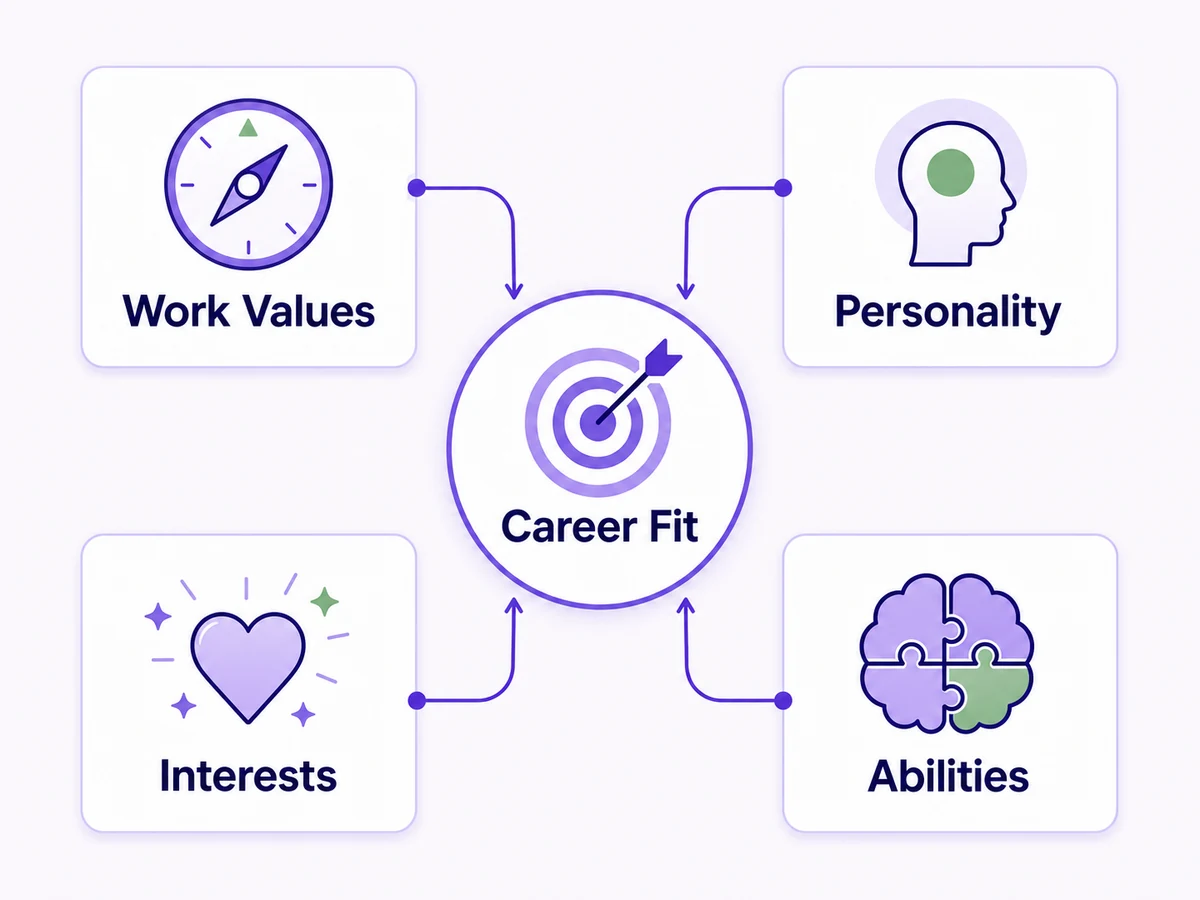
Career fit needs abilities, interests, personality, and values
Career fit is an exploration process that combines personal characteristics with real-world constraints. It does not identify one guaranteed perfect career.
Career fit is stronger as an exploration framework when it considers several kinds of information:
Personality helps you understand typical behavioral and emotional patterns.
Interests point toward activities and subjects you may want to pursue.
Abilities show where learning and performance may come more naturally.
Work values clarify the conditions and outcomes you want from work.
Practical constraints determine which options are accessible and sustainable.
These factors can support one another or reveal a tradeoff. You may have the ability and interest needed for a career but dislike its common working conditions. You may value a particular outcome but need more training before entering the role. You may enjoy the daily tasks but find that available jobs conflict with your location or family responsibilities. See how personality and cognitive ability work together without treating either one as the complete answer.
Use the framework to create career options to explore, not to declare a perfect career. Researching real roles, speaking with people in the field, trying relevant projects, and gaining experience can test whether an option works beyond an assessment result.
How to identify your work values from lived experience
Start by recalling work, study, or volunteer experiences that gave you energy and experiences that repeatedly frustrated you. Identify the conditions behind those reactions, group them into value themes, then rank each as essential, preferred, or negotiable. Finally, compare your priorities with real job descriptions, workplace information, and practical constraints before deciding.
1. Recall work that gave you energy
List three moments when you felt engaged or proud. Describe what you were doing, who was involved, how much freedom you had, and what result made the experience worthwhile.
2. Notice the tradeoffs that frustrate you
List three repeated frustrations. Instead of writing only "bad manager" or "boring work," identify the missing condition. You may have lacked support, variety, recognition, independence, or a manageable schedule.
3. Turn experiences into value themes
Match the conditions you identified with the six O*NET categories. You do not need to force every detail into a category. The framework is a tool for organizing your thinking, not a verdict.
4. Rank what you need, prefer, and can compromise on
Sort each priority into one of three groups:
Essential: Without this, the role is unlikely to remain workable.
Preferred: This would improve the role, but you could accept a tradeoff.
Negotiable: This matters less than your other needs right now.
5. Test your priorities against real job options
Compare two real roles, not imagined perfect jobs.
Priority | Job or career A | Job or career B | Evidence available | Tradeoff |
Independence | High control over methods | Clear procedures and close guidance | Job descriptions and employee conversations | Autonomy versus support |
Working Conditions | Variable schedule | Predictable hours | Interview questions and published policies | Variety versus stability |
Recognition | Fast promotion path | Deep specialist path | Career framework and manager discussion | Status versus mastery |
Treat this as a reflection exercise, not a validated assessment. Your conclusions depend on the quality of the evidence you collect about yourself and the workplace.
Illustrative example
Maya is comparing a structured analyst role with a consulting role. The analyst role offers supportive management, predictable hours, and clear procedures. The consulting role offers more autonomy, varied projects, travel, and less predictable hours.
Maya ranks predictable hours as essential because of family responsibilities. She ranks variety as preferred and travel as negotiable. The consulting role sounds exciting, but the analyst role currently meets more of her essential needs. This example does not prove that the analyst role is universally better. It shows how priorities and evidence can make a tradeoff visible.
When your values conflict with practical constraints
Sometimes the work that best matches your values is not immediately available. You may need income now, live in a limited job market, support family members, manage a health condition, or qualify through additional education. A responsible career plan must include these realities.
This does not make work values useless. It changes the question from "Which job matches everything I want?" to "Which option meets my essential needs, and which tradeoffs can I manage for now?" A temporary compromise can be reasonable when you understand it and keep a longer-term goal in view.
Values may also change in priority. Independence may matter most early in one career, while security or flexibility becomes more important later. Revisit your ranking after major life changes or new work experiences.
Career option verification checklist
Have I separated essential needs from preferences?
Do I have evidence about the manager and work environment?
Have I checked pay, schedule, location, training, and accessibility?
Have I spoken with someone who knows the role?
Can I test the work through a project, course, volunteering, or shadowing?
Which tradeoff am I knowingly accepting?
When will I review this decision?
Frequently asked questions about work values
Can work values change over time?
Yes. Experience and changing responsibilities can alter which work conditions matter most. The values themselves may remain familiar while their order changes. Review your priorities after a career transition, major life event, or repeated change in how you experience work.
Are work values the same as company values?
No. Work values describe what an individual wants work to provide, while company values describe the principles an organization claims to follow. A good match requires evidence from policies, management behavior, employee experience, and daily work, not just similar words on a careers page.
Can a personality test identify my work values?
Not completely. Personality and values can be related, but they are distinct constructs. A personality result may help explain your tendencies, while a separate values reflection or appropriate values assessment explores what you want from work.
Should I choose a career based only on my values?
No. Work values are one part of career fit. Consider interests, abilities, personality, training requirements, opportunities, pay, health, family needs, and direct experience before making a decision.
References
CareerOneStop. Work Values Matcher.
O*NET Resource Center. O*NET 30.1 Work Values data dictionary.
O*NET Resource Center. Work Importance Locator User's Guide.
Parks-Leduc, L., Feldman, G., and Bardi, A. (2015). Personality Traits and Personal Values: A Meta-Analysis.
Kristof-Brown, A. L., Zimmerman, R. D., and Johnson, E. C. (2005). Consequences of Individuals' Fit at Work: A Meta-Analysis.
Use your work values as one part of a better career decision
Work values give you practical language for needs that are easy to overlook when a job appears attractive on paper. Use them to compare real environments, identify essential conditions, and recognize tradeoffs, then combine what you learn with personality, interests, abilities, constraints, and experience. TalentRank can help you explore measured aspects of personality and ability, but it should not be presented as a separate work-values test or as a system that chooses a career for you. You can take the TalentRank assessment or explore more career growth guides as your next step.