


ESFP stands for Extraversion, Sensing, Feeling, and Perceiving, four preferences used in the Myers-Briggs type framework. This profile can suggest patterns in how someone engages with people, notices information, weighs decisions, and responds to changing situations. It does not determine ability, intelligence, reliability, empathy, or career success.
That distinction matters because descriptions of this type are often reduced to the “entertainer” stereotype: highly social, spontaneous, expressive, and always ready for action. Some people will recognize parts of themselves in that picture; others will not. A more useful ESFP personality profile looks at preferences, context, strengths, tradeoffs, communication, and work habits without treating four letters as a complete identity.
What Does ESFP Stand For?
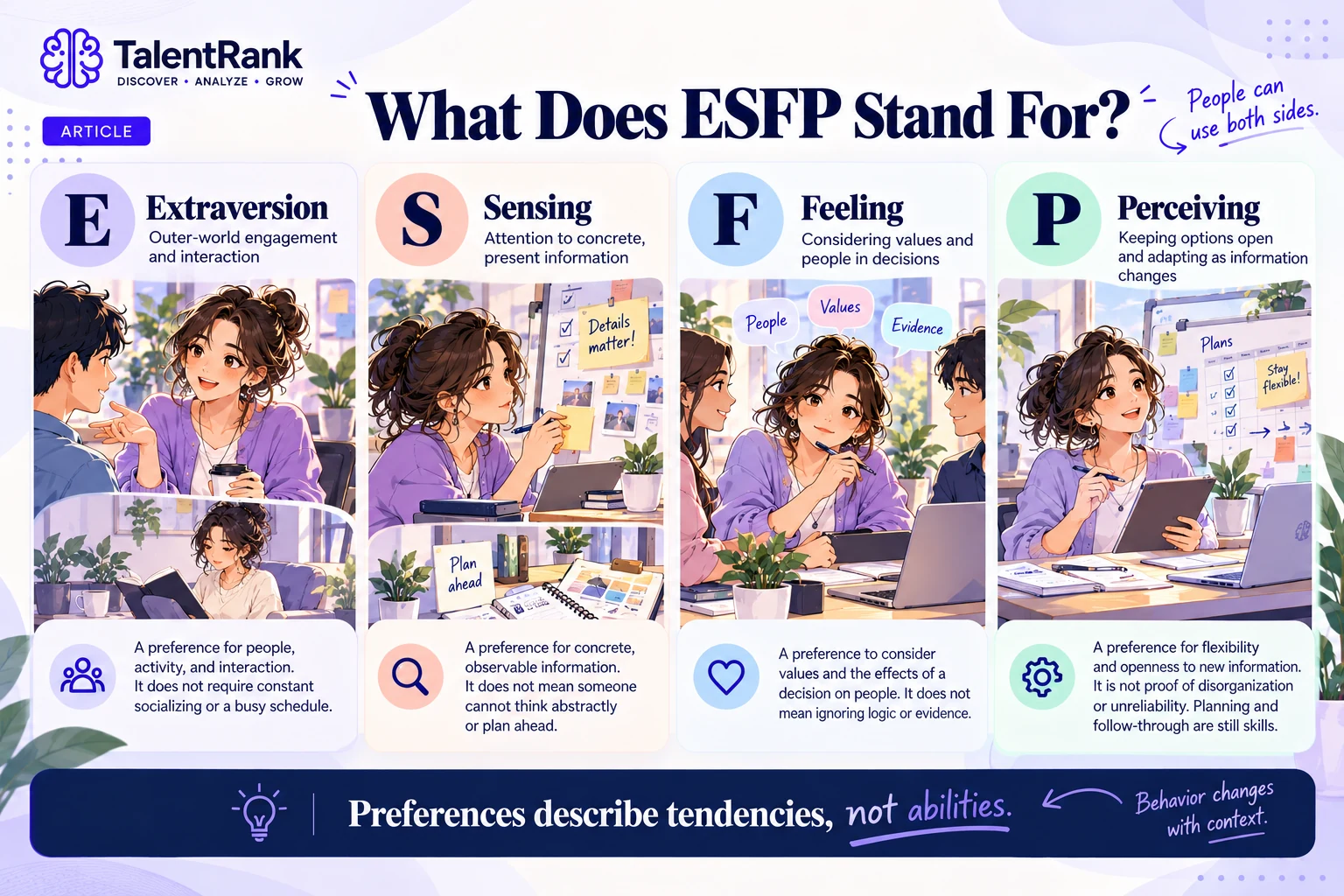
Within the Myers-Briggs framework, the label combines Extraversion, Sensing, Feeling, and Perceiving. These are preferences, not exclusive abilities. A person can use both sides of each preference pair, even if one side feels more natural.
E — Extraversion
Extraversion describes a preference for directing attention and energy toward the outer world of people, activity, and interaction. Someone might think through a problem by talking with a colleague or trying something in practice.
That does not mean wanting a crowded calendar. A person can prefer Extraversion and still value privacy, quiet hobbies, or time alone. For a deeper comparison, see Extraversion and Introversion.
S — Sensing
Sensing emphasizes concrete, observable information. At work, this might look like noticing the exact wording of a customer complaint or spotting a process change.
It does not mean someone cannot think abstractly or plan ahead. Sensing is an information preference, not an intellectual limit. For more detail, see Sensing and Intuition.
F — Feeling
Feeling gives weight to values and the effects of a decision on people. Someone might ask how a policy change will affect a team before deciding how to introduce it.
Feeling is not the opposite of reasoning. A person can care about people and still ask for evidence, compare costs, or make an unpopular decision. For a fuller explanation, see Thinking and Feeling.
P — Perceiving
Perceiving describes an open, adaptable approach to the outside world and comfort with keeping options open as new information appears.
This is not proof of disorganization or unreliability. Planning and follow-through are skills; a flexible person can still use calendars, deadlines, routines, or detailed plans. For a deeper comparison, see Judging and Perceiving.
ESFP Traits in Everyday Life
ESFP traits are more useful when treated as possible patterns rather than a checklist. The same person may be engaged in one setting and reserved in another, practical in a crisis but reflective in a personal decision, or flexible during a project while maintaining strict routines elsewhere.
Present and Responsive
Someone who favors concrete, present information may respond quickly to visible needs. Imagine a team event that suddenly loses a supplier. One person might immediately check what is still available, divide the remaining tasks, and keep the event moving.
That present focus can be useful when circumstances change. It does not mean ignoring the future; the same person can solve the immediate problem and review it later.
Socially Engaged in Different Ways
Extraversion can show up through conversation, shared activity, collaboration, or simply visible participation. It does not require constant talking or a desire to be the center of attention.
One person may enjoy leading a lively discussion; another may prefer working alongside one or two people. Context shapes how social engagement looks.
Values and Visible Action
Feeling and Sensing together are often interpreted as attention to people alongside concrete circumstances. In a hypothetical workplace situation, someone might notice that a new process is confusing colleagues, ask what is going wrong, and suggest a practical adjustment.
That example should not become a claim about natural empathy or morality. Type only offers one language for reflecting on preferred ways of noticing and deciding.
Possible ESFP Strengths and Their Tradeoffs
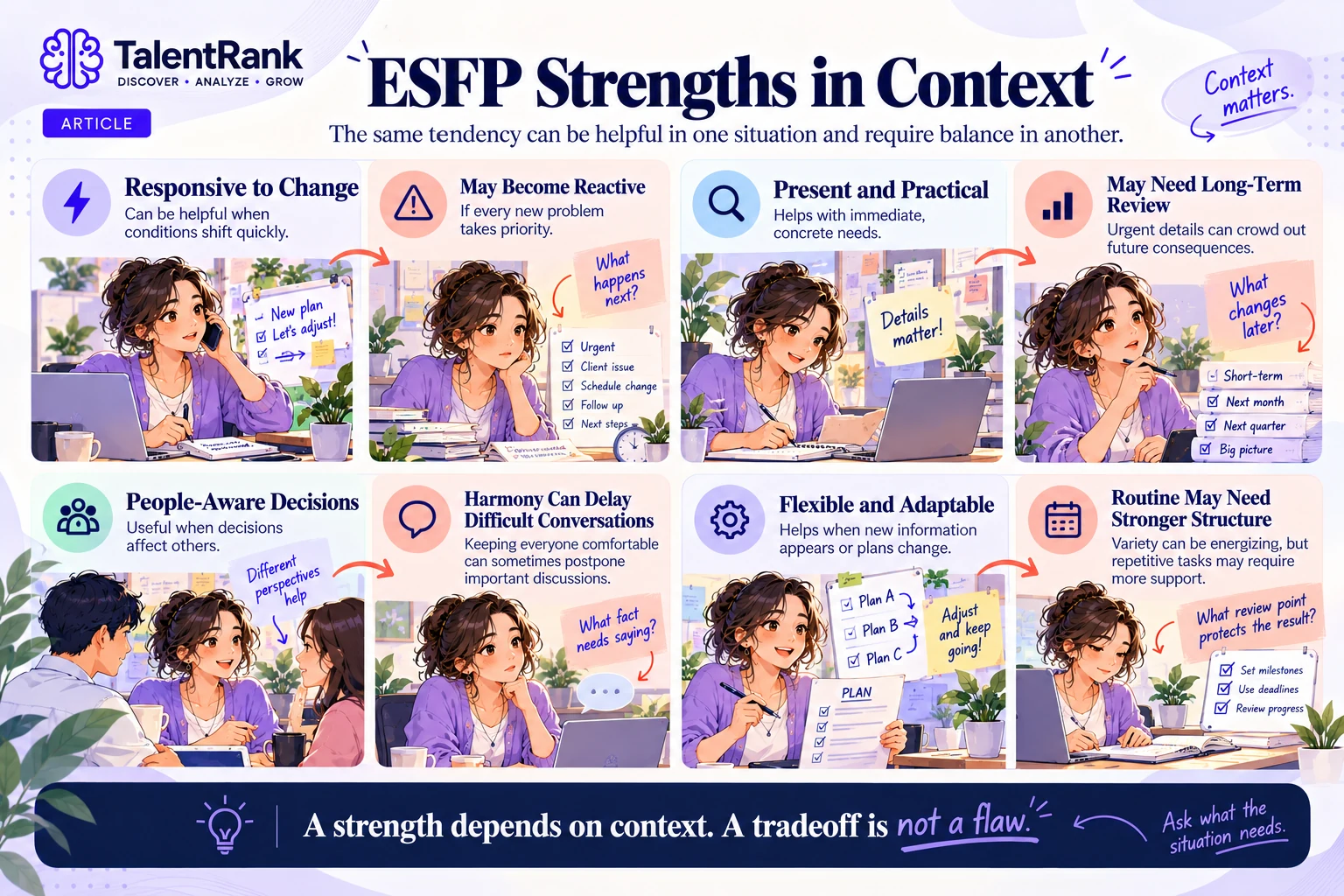
A strength is rarely useful in every situation. The same tendency that helps in one context can create friction in another. This Context Map is a reflection tool, not a scorecard or validated assessment.
Possible preference pattern | Where it may help | Possible tradeoff | Balancing question |
Responding to present information | Live coordination, immediate customer needs, changing conditions | Urgent details can crowd out longer-term consequences | What could this choice change next week or next quarter? |
Keeping options open | Work where new information arrives frequently | A decision can remain open after commitment is needed | What is the latest useful decision point? |
Considering people and values | Stakeholder communication and decisions with human impact | Harmony can delay a difficult conversation | What respectful fact needs to be said clearly? |
Engaging through action and interaction | Collaborative tasks, demonstrations, visible feedback | Constant activity can crowd out quiet review or follow-through | Which short review point would protect the result? |
Adaptability Can Become Reactive Decision-Making
Adjusting when a plan stops working can be valuable during events, customer-facing work, fast projects, or any situation where the original plan becomes outdated.
The tradeoff appears when the newest problem always becomes the most important. Asking what can wait and what changes later can preserve flexibility without losing direction.
Practical Observation Can Narrow the Time Horizon
Attention to immediate facts can help someone identify a problem others have missed. In a live situation, that may be exactly what the team needs.
Some decisions require stepping away from what is visible today. Budgets, training plans, and long projects benefit from a deliberate future-focused review.
Warm Participation Can Lead to Overcommitment
A socially engaged person may be quick to volunteer, help, or join an activity. That participation can make collaboration easier and keep momentum high.
The risk is agreeing before checking time, energy, or existing commitments. A pause before saying yes can protect follow-through.
Flexibility Can Make Routine Harder to Sustain
Some people enjoy variety more than repetitive maintenance. Long, unbroken routines may feel less engaging than work with visible change.
Short milestones, visible deadlines, check-ins, or reminders can make repetitive tasks easier to manage. These are general productivity options, not type-specific treatments.
Communication and Decision-Making
Type descriptions are most useful when they improve a conversation rather than becoming an excuse for behavior. The label should not be used to say, “I am just like this.” It can instead prompt better questions about missing information, people affected, and what the situation actually requires.
Give Context, Not Just Conclusions
Concrete feedback is usually more actionable than a vague label. Compare “You need to be more professional” with “During yesterday’s client call, the answer changed three times, which confused the client. Before the next call, confirm the final numbers in the shared document.”
The second version gives an observable situation, an impact, and a next step without assuming how someone must respond to criticism.
Make Room for Values and Evidence
A useful decision does not have to choose between people and facts. Someone can ask, “Who will be affected by this?” and also ask, “What information supports the decision?”
That balance matters when a Feeling preference is misunderstood as emotional reasoning. Values can be part of a decision without replacing evidence.
Address Tension Before Flexibility Becomes Avoidance
If a difficult conversation keeps being postponed, reflection can be more useful than a type explanation. What is the specific issue? What fact needs to be stated? What outcome is actually being protected by waiting?
Flexibility may help adaptation, but too much openness can postpone closure. The behavior matters more than the label.
Explore your own personality traits
A type profile can be a useful starting point, but it does not show the full range or strength of individual traits. TalentRank explores Big Five personality dimensions on continuous scales rather than confirming a four-letter type.
Start the TalentRank assessment
How ESFP Preferences May Show Up at Work
These preferences may shape which tasks feel more natural, engaging, or comfortable, but they do not determine competence or occupation. Work satisfaction also depends on skills, experience, management, values, financial needs, responsibilities, and the actual design of the job.
Tasks With Immediate Feedback
Some readers may enjoy work where the result of an action becomes visible quickly. A customer issue, live project, event, demonstration, or hands-on task can provide information that can be acted on immediately.
Enjoyment and competence are separate questions. Someone can enjoy fast feedback and still need training, while another person may be highly skilled in slower technical work.
Teams, Autonomy, and Structure
A workable environment does not have to be either highly social or completely independent. One person may prefer frequent collaboration but want freedom over how a task is completed. Another may enjoy interaction while also needing uninterrupted blocks of individual work.
Instead of asking which management style is “best for ESFPs,” ask what mix of contact, autonomy, structure, and feedback helps the individual work well.
Planning and Follow-Through
If flexibility comes naturally, planning tools can create useful boundaries without making every hour rigid. A project can be divided into short milestones, visible deadlines, and review points while leaving room to adapt between them.
The relevant evidence is whether the person reliably completes the work, not whether the label sounds spontaneous.
Remote Work Can Still Fit
Imagine two remote roles. In the first, the employee works independently, receives feedback once a week, and completes long projects with little live interaction. In the second, the employee has daily collaboration, short project cycles, customer calls, and visible progress throughout the day.
A person with these preferences might prefer either role, dislike either role, or want a mixture. Remote work itself is not the deciding factor. Interaction, task variety, autonomy, feedback, home environment, and work habits are more useful questions.

Common ESFP Stereotypes, Reconsidered
“Every ESFP Is a Party Person”
Extraversion does not prescribe a hobby, social schedule, or personality performance. Someone may enjoy group activity, one-to-one conversation, active hobbies, or quiet time. Needing solitude does not automatically contradict an Extraversion preference.
“Feeling Means Emotion Replaces Logic”
Feeling describes a judgment preference that gives weight to values and people. It does not show that someone cannot analyze evidence, use logic, or make a difficult decision. Treating Feeling as irrationality turns a preference description into an ability judgment.
“Perceiving Means Unreliable or Disorganized”
Perceiving is associated with openness and flexibility, not a diagnosis of poor planning. Reliability is better judged through behavior: whether someone keeps commitments, manages responsibilities, communicates changes, and finishes what needs to be done.
“An ESFP Must Love Performing”
“Entertainer” is a popular nickname, not a job requirement. Someone can identify with the type and have no interest in acting, public speaking, performance, or being the center of attention. Four letters do not assign a profession or talent.
What an ESFP Label Cannot Tell You
A four-letter category cannot describe the complete strength, range, or context of a person’s traits. It does not diagnose a mental health condition, measure intelligence, prove empathy or leadership ability, determine morality, or select the right career.
A type label can still give useful language for reflection while remaining incomplete as a measurement of personality.
Types Describe Categories; Traits Describe Degrees
The Big Five takes a dimensional approach across Extraversion, Neuroticism, Agreeableness, Conscientiousness, and Openness to Experience.
Consider two hypothetical people who both identify with the same type. Person A enjoys frequent group discussion, plans projects in weekly blocks, and uses a shared calendar. Person B prefers one-to-one interaction, improvises during live work, and needs quiet recovery afterward. The shared category does not make their social habits, organization, or measured trait levels identical.
That is why a category and a trait profile answer somewhat different questions. For a deeper comparison, see Big Five and MBTI frameworks.
Use the Label as a Reflection Prompt
Instead of asking whether every sentence in a type description is “true,” ask which examples match your actual behavior, in what situations they appear, and what evidence from recent experience supports your conclusion. A useful personality description should improve observation, not replace it.
Frequently Asked Questions About ESFP
What Is ESFP in Simple Terms?
ESFP is a Myers-Briggs type made up of Extraversion, Sensing, Feeling, and Perceiving preferences. It can suggest patterns in attention, information gathering, decision-making, and adaptability, but it does not define every behavior, ability, or interest a person will have.
Can an ESFP Be Quiet or Need Alone Time?
Yes. Someone can identify with this type and still be quiet, enjoy solitary activities, or need time alone. Extraversion is a preference, not a requirement to socialize constantly. Context, familiarity, stress, culture, interests, and individual differences affect how outwardly social someone appears.
Are ESFPs Good Planners?
Planning skill varies from person to person. A Perceiving preference may involve comfort with flexibility and keeping options open, but it does not establish organization, responsibility, or reliability. Those are better judged through habits and actual behavior.
What Is an ESFP Like at Work?
Someone with this profile may enjoy practical tasks, visible feedback, interaction, or changing priorities, but there is no single work environment for the type. Skills, goals, job design, responsibilities, team culture, and individual preferences all matter when deciding whether a role fits.
Is TalentRank an ESFP Test?
No. TalentRank does not confirm any Myers-Briggs type. Its current assessment explores Big Five personality traits on continuous dimensions, alongside other career-exploration components. That provides a different perspective on individual personality patterns rather than another four-letter result.
A Label Is a Starting Point for Reflection
The ESFP label can help you notice patterns in how you engage, decide, adapt, and work, but it becomes less useful when it turns into a rule about what you can or cannot do. Compare the description with your actual behavior, the situations in which it changes, and the skills you have built over time.
If you want another perspective, TalentRank can help you explore your Big Five traits on continuous dimensions rather than treating one type as your complete identity.