


ISFP characters are often written as private, values-driven people who respond to the world through direct experience rather than long explanations or rigid plans. Popular interpretations appear across anime, movies, television, books, and animation, with characters such as Ichigo Kurosaki, San, Eleven, Harry Potter, Zuko, and Eren Yeager frequently entering the discussion. The strongest examples are not simply quiet, artistic, emotional, or rebellious. Their repeated decisions matter more than those surface traits.
There is an important limitation, though. Fictional characters cannot normally complete an assessment and verify their own best-fit personality type, so character typing is interpretation rather than a confirmed result. Official Myers-Briggs material describes MBTI results as arising from a person's responses across four preference pairs, with the individual involved in best-fit verification. Myers & Briggs Foundation This guide therefore looks at why particular characters are commonly interpreted as ISFP, where the evidence becomes uncertain, and why alternative typings sometimes make sense.
Here is a starting list of fictional characters commonly discussed as ISFP. The status column is not a psychological score. It describes how confidently the example can be used here based on available interpretations, competing explanations, and adaptation issues.
Character | Story or franchise | Medium | Why the ISFP interpretation comes up | Status |
|---|---|---|---|---|
Ichigo Kurosaki | Bleach | Anime/manga | Strong personal standards, direct action, concrete focus | Strong interpretation |
San | Princess Mononoke | Animated film | Personal conviction, instinctive action, direct engagement with her environment | Common attribution |
Eren Yeager | Attack on Titan | Anime/manga | Intense personal convictions, freedom focus, action orientation | Debated |
Zuko | Avatar: The Last Airbender | Animation | Internal values, experiential growth, conflict between approval and conviction | Common but debatable |
Eleven | Stranger Things | TV | Private values, close personal bonds, rapid response to immediate circumstances | Common attribution |
Harry Potter | Harry Potter | Books/film | Internal sense of right and wrong, independence, practical action | Adaptation-dependent |
Rose DeWitt Bukater | Titanic | Movie | Personal authenticity and resistance to imposed expectations | Common attribution |
Éowyn | The Lord of the Rings | Literature/film | Personal conviction, independence, direct action | Adaptation-dependent |
Jonathan Byers | Stranger Things | TV | Private values, individuality, close observation | Common attribution |
Adonis Creed | Creed | Movie | Personal motivations, hands-on action, independence | Common attribution |
Several of these names recur in current fictional-character typing resources. Psychology Junkie's cross-media guide includes Eleven, Rose, Éowyn and Jonathan Byers among its examples, while Practical Typing gives detailed ISFP interpretations for Ichigo Kurosaki and Adonis Creed. Psychology Junkie The table is best treated as a map for further analysis, not a list of canonically confirmed labels.
What Makes a Fictional Character Seem ISFP?
Start With the Four ISFP Preferences
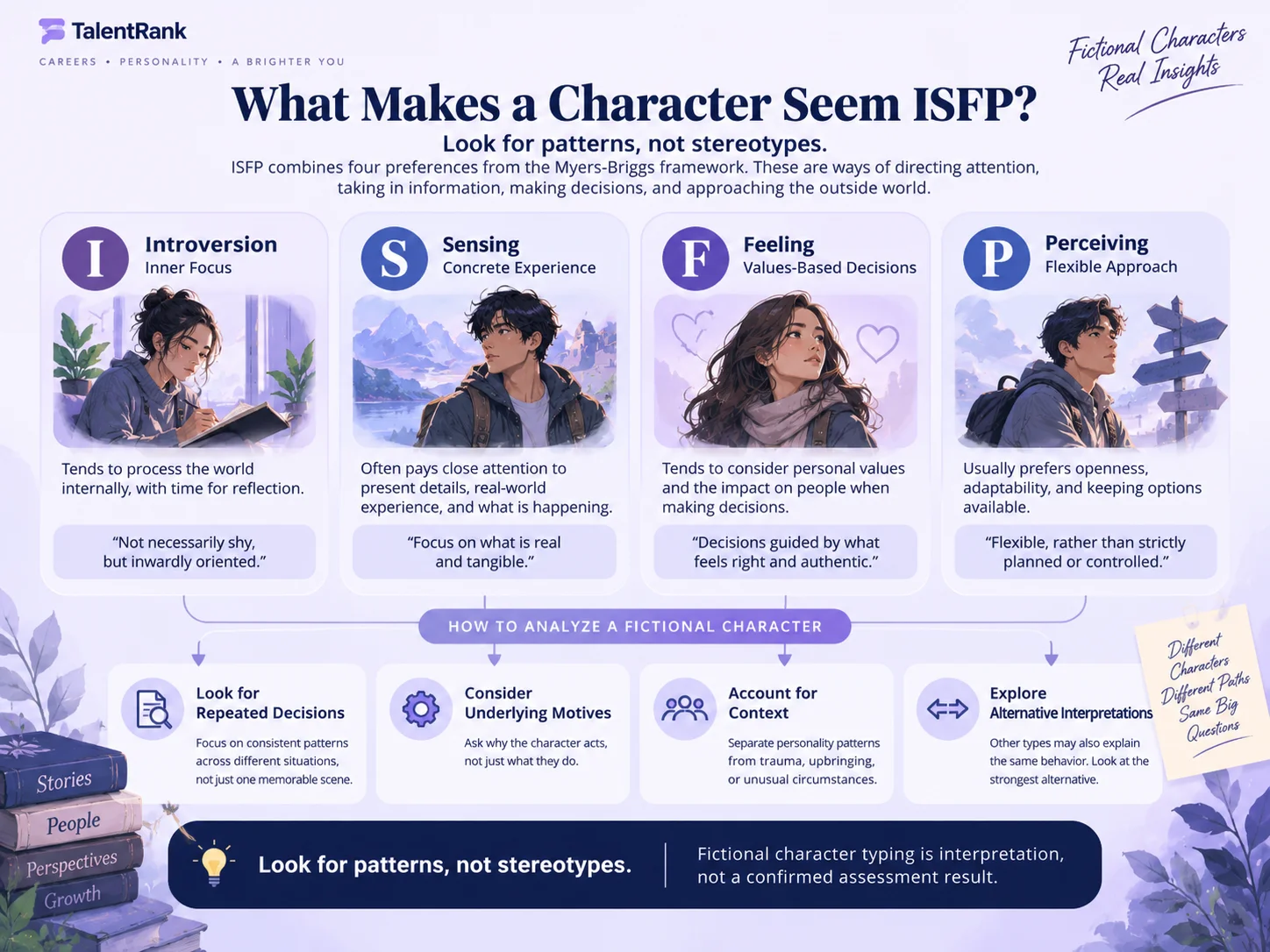
In the Myers-Briggs framework, ISFP combines Introversion, Sensing, Feeling, and Perceiving. The four preference pairs are Extraversion-Introversion, Sensing-Intuition, Thinking-Feeling, and Judging-Perceiving. Official Myers-Briggs guidance also stresses that people use both sides of these pairs even when they have a natural preference. Myers-Briggs preference overview
In simple terms, an ISFP interpretation may look for a character who tends to process inwardly, pays close attention to concrete experience, gives significant weight to values and personal circumstances when deciding, and remains relatively open or adaptable in the outside world.
That does not mean every quiet character is an Introvert, every practical character prefers Sensing, or every emotional character prefers Feeling. In Myers-Briggs terminology, Feeling concerns a way of making decisions. It is not a synonym for being emotional, just as Thinking does not mean being more intelligent.
Look at Decisions, Not the “Sensitive Artist” Stereotype
One of the easiest ways to mistype ISFP characters is to start with aesthetics. A character paints. Another plays guitar. Someone dresses creatively, spends time in nature, cries easily, or resists authority. None of those behaviors establishes ISFP on its own.
A better question is: what pattern keeps appearing when the character has to choose? Does the character repeatedly rely on personally important values even when the group wants something else? Do they engage closely with what is happening around them? Do they learn through experience? Can they adapt when circumstances change? Are their motives more consistent with an ISFP interpretation than with a plausible alternative?
Repeated patterns are more useful than a collection of stereotypes.
Fictional Typing Is Interpretation, Not Confirmation
This distinction matters because real MBTI assessment involves self-report. Official guidance says results are based on how the person answered assessment items, and the Myers-Briggs best-fit process gives that person an active role in deciding which type fits best. Fictional characters generally cannot do that.
A writer can create behavior that resembles a type pattern, and readers can make reasoned interpretations from the story. But saying “this character is commonly typed ISFP” is more defensible than pretending the character has a verified psychological result.
It is also useful to remember that personality frameworks answer different questions. TalentRank's Big Five vs MBTI guide explains why a type model and a continuous trait model should not be treated as interchangeable.
Curious about your own personality patterns? Fictional characters can make personality ideas easier to notice, but relating to a character is not an assessment result. TalentRank lets you explore your own Big Five personality traits and a brief cognitive estimate for self-reflection and career exploration. TalentRank does not return an MBTI or ISFP label.
ISFP Anime Characters
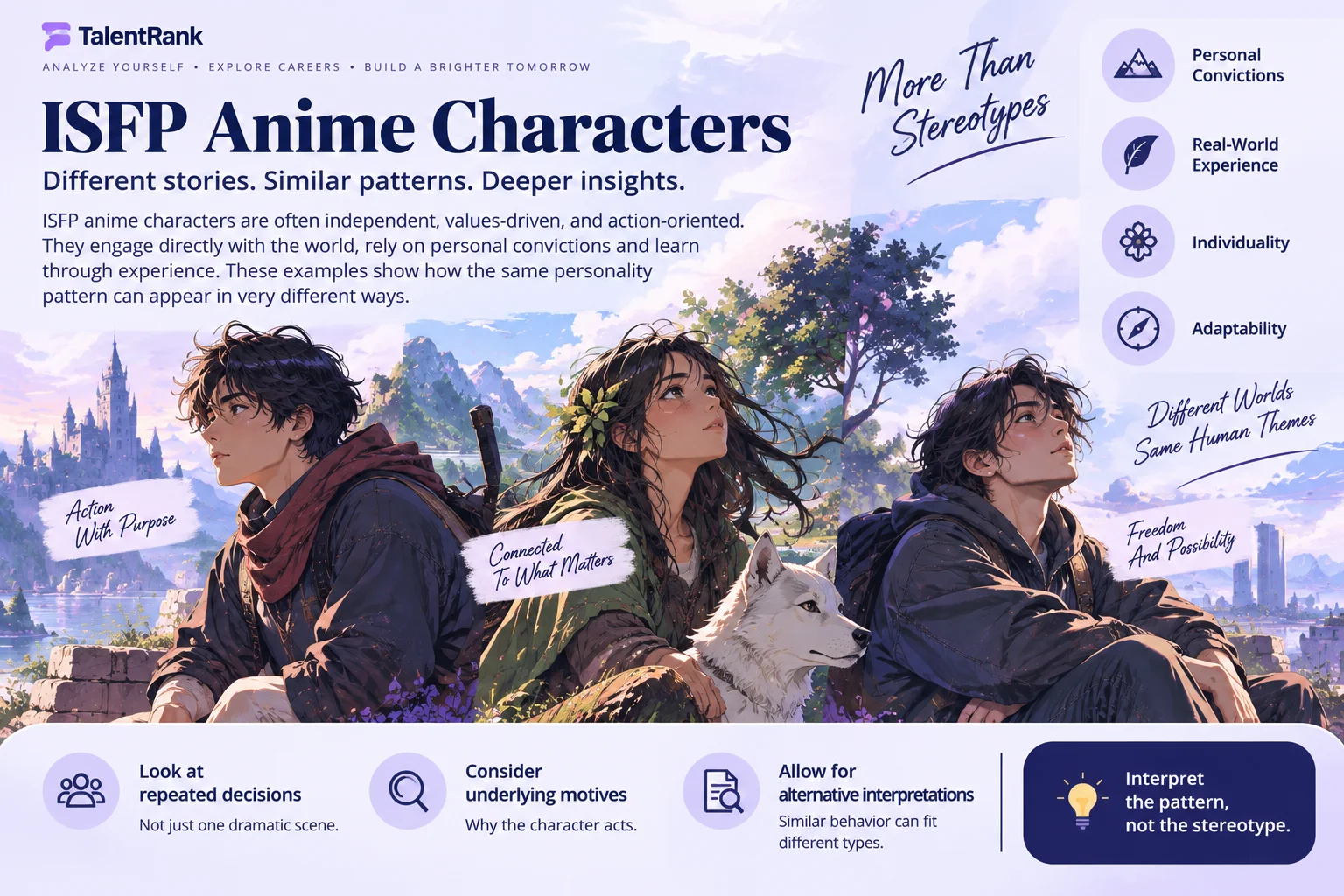
Searches for ISFP anime characters often produce long lists, but anime makes stereotype-based typing especially tempting. A reserved swordsman is not automatically an Introvert. A passionate protagonist is not automatically a Feeling type. Fighting on instinct does not by itself establish Sensing or Perceiving.
The more useful examples are characters for whom the same pattern appears across different situations.
Ichigo Kurosaki, Bleach
Ichigo Kurosaki is one of the more defensible ISFP anime characters in current typology coverage. Practical Typing identifies him as ISFP after considering alternatives, emphasizing his strong personal standards, self-focused moral evaluation, direct response to immediate problems, and tendency to act rather than spend excessive time exploring hypothetical possibilities. Practical Typing's Ichigo analysis
The important part is not that Ichigo can be brooding or emotional. Those are weak typing shortcuts. A stronger ISFP reading comes from how personally he holds his standards and how readily he moves into concrete action when someone needs protection. He does not need a universal theory before deciding that something matters to him.
Even here, “ISFP” remains an interpretation of the character rather than a canonical assessment result.
San, Princess Mononoke
San is another frequently cited example. Psychology Junkie's anime list classifies her as ISFP and focuses on her individuality, conviction, instinctive behavior, and determination to protect the forest. Psychology Junkie's ISFP anime list
It would be easy to make the wrong argument here: San loves nature, therefore she is ISFP. That does not follow. Her environment and upbringing are central to her story. A better analysis looks at the intensity of her personal commitments, her direct engagement with threats, and the way she acts on what she regards as non-negotiable.
San is useful precisely because she shows why the ISFP stereotype needs more care. An ISFP interpretation does not have to mean a soft-spoken artist peacefully observing the world. A character can be forceful, confrontational, and physically decisive while still being interpreted through the same preference pattern.
Eren Yeager, Attack on Titan
Eren Yeager is more interesting as a disputed case than as a clean example.
There is substantial ISFP attribution around the character. Psychology Junkie's anime list argues for ISFP while acknowledging that ESFP was considered. But there is a meaningful alternative: Practical Typing explicitly argues that ESFP, not ISFP, better explains Eren, particularly because it interprets his engagement with the external world as more dominant than inward processing. Read the competing ESFP interpretation
That disagreement is useful. Both interpretations may notice his intense personal convictions, concern with freedom, direct engagement with danger, and action orientation. They disagree over which tendencies appear primary and how later behavior should be interpreted.
Eren's development also makes it risky to take one season, one speech, or one extreme decision and use it as the whole personality. For this article, Debated is more informative than pretending the disagreement has been settled.
What About Yuji Itadori?
Yuji Itadori sometimes appears in informal ISFP discussions, but he is a good example of why names should not simply be copied from community lists.
A Psychology Junkie analysis types Yuji as ESFP, emphasizing his outward energy, rapid engagement with changing circumstances, learning through action, and personal ideals. See the Jujutsu Kaisen type analysis
That does not prove every other interpretation wrong. It does mean Yuji should not be presented here as an unquestioned ISFP example. When a popular character has credible competing interpretations, the disagreement belongs in the analysis.
ISFP Characters in Animation and Cartoons
Western animation produces the same typing challenges as anime, with one extra complication: a character may exist in several continuities, reboots, comics, films, and live-action adaptations. Zuko is a good example of why the version matters.
Zuko, Avatar: The Last Airbender
Zuko is commonly interpreted as ISFP in character-typing resources. One detailed analysis emphasizes the tension between his own moral compass and the values imposed by his father. Read the Zuko ISFP interpretation
The ISFP argument becomes more interesting over the course of his arc. Early Zuko is heavily driven by approval, status, anger, and a mission given to him by someone else. If those surface behaviors were all we examined, his personality would be easy to oversimplify.
His development increasingly asks a different question: what does he actually believe is right? That movement from external expectations toward personally accepted values supports the ISFP interpretation better than “Zuko is emotional” or “Zuko is rebellious.”
At the same time, his trauma, family environment, banishment, anger, and need for approval should not be converted into personality-type evidence. They are parts of his circumstances and development. That is why Zuko is best described as a strong discussion candidate rather than a laboratory-clean example of a type.
ISFP Movie Characters
Movie characters create another evidence problem: a two-hour story may reveal less repeated behavior than a long-running television or book series. Strong analysis therefore needs to distinguish meaningful patterns from a few memorable scenes.
Rose DeWitt Bukater, Titanic
Rose appears on current ISFP fictional-character lists. An ISFP interpretation can focus on her growing rejection of a life defined by other people's expectations, her attention to personally meaningful experience, and the increasing willingness to act according to what feels authentic to her.
But “rebellious young woman” is not a personality type. Her social constraints are part of the plot, and resistance to those constraints can arise from many personalities. What makes the ISFP interpretation more interesting is the combination of personal conviction, experiential engagement, and increasingly independent action.
Éowyn, The Lord of the Rings
Éowyn is another commonly listed ISFP example. She is also a case where version awareness matters.
Tolkien's written character and the film adaptation overlap substantially but are not identical presentations. A careful article should not quietly combine every book and film moment as if they were one dataset.
Her resistance to a prescribed role, deeply personal motivations, and willingness to act make an ISFP reading possible. Yet courage, frustration with restriction, or skill in battle cannot establish a personality type on their own.
Adonis Creed, Creed
Adonis offers a useful example outside the “quiet artist” stereotype. Practical Typing identifies him as ISFP after considering the available evidence across the Creed films, focusing on personal motivations, direct engagement with challenges, and an action-oriented way of dealing with the world. Read the Adonis Creed analysis
Whether a reader agrees with that final label or not, Adonis expands the conversation. An ISFP interpretation can include competitive, physically expressive, determined characters. The type should not be reduced to a gentle creative archetype.
ISFP TV Characters
Long-running television can give personality analysis more material because viewers see characters across relationships, conflicts, ordinary moments, and changing circumstances. It also creates another risk: character development can be mistaken for inconsistency when the person is actually changing over time.
Eleven, Stranger Things
Eleven is one of the most frequently recurring ISFP characters in current typing content. Psychology Junkie classifies her as ISFP in its fictional-character coverage. See the ISFP character examples
An ISFP interpretation can point to her private but strong evaluations of right and wrong, intense loyalty to a small circle, direct response to immediate danger, and gradual construction of an identity separate from what others want her to be.
But Eleven also demonstrates one of the biggest problems in fictional personality analysis. She grows up under extraordinary deprivation and control. Her early communication style, social uncertainty, guardedness, and reactions to danger cannot simply be translated into Introversion or any other personality preference.
Some behavior reflects circumstance, not necessarily stable personality. Separating those two things makes the ISFP interpretation more thoughtful.
Jonathan Byers, Stranger Things
Jonathan Byers also appears in current ISFP lists. The artistic elements are the least interesting evidence. Photography does not make Jonathan an ISFP.
More useful questions concern how he makes decisions, how privately he holds his priorities, how he responds to people close to him, and whether his behavior across the series fits the same pattern consistently. Jonathan is a useful reminder that hobbies can illustrate personality, but they should not determine it.
ISFP Characters in Books and Literature
Literary characters can sometimes offer an advantage: readers may have direct access to thoughts and internal motives that a screen adaptation has to communicate indirectly. That still does not make the typing official.
Harry Potter
Harry Potter is commonly interpreted as ISFP by typology writers. Funky MBTI, for example, argues for ISFP based on his internal sense of right and wrong, resistance to control, intense but private feelings, and action-oriented behavior. Read the Harry Potter ISFP interpretation
Harry is especially useful because his decisions are often personal before they are systematic. He can reject authority he does not trust, act rapidly when someone is threatened, and hold firm judgments about conduct without needing those judgments to be endorsed by an institution.
Yet “brave,” “loyal,” and “hates unfairness” are not enough to type him. Those qualities occur across many personality patterns. There is also a version issue. Book Harry gives readers more direct access to his internal reactions than film Harry. A discussion that uses evidence from both should say so rather than quietly treating every adaptation choice as identical.
ISFP-T Characters: What Does the “T” Actually Mean?
The phrase ISFP-T characters creates an important terminology problem because two related but different systems are often blended online.
ISFP-T Is Not a Five-Letter MBTI Type
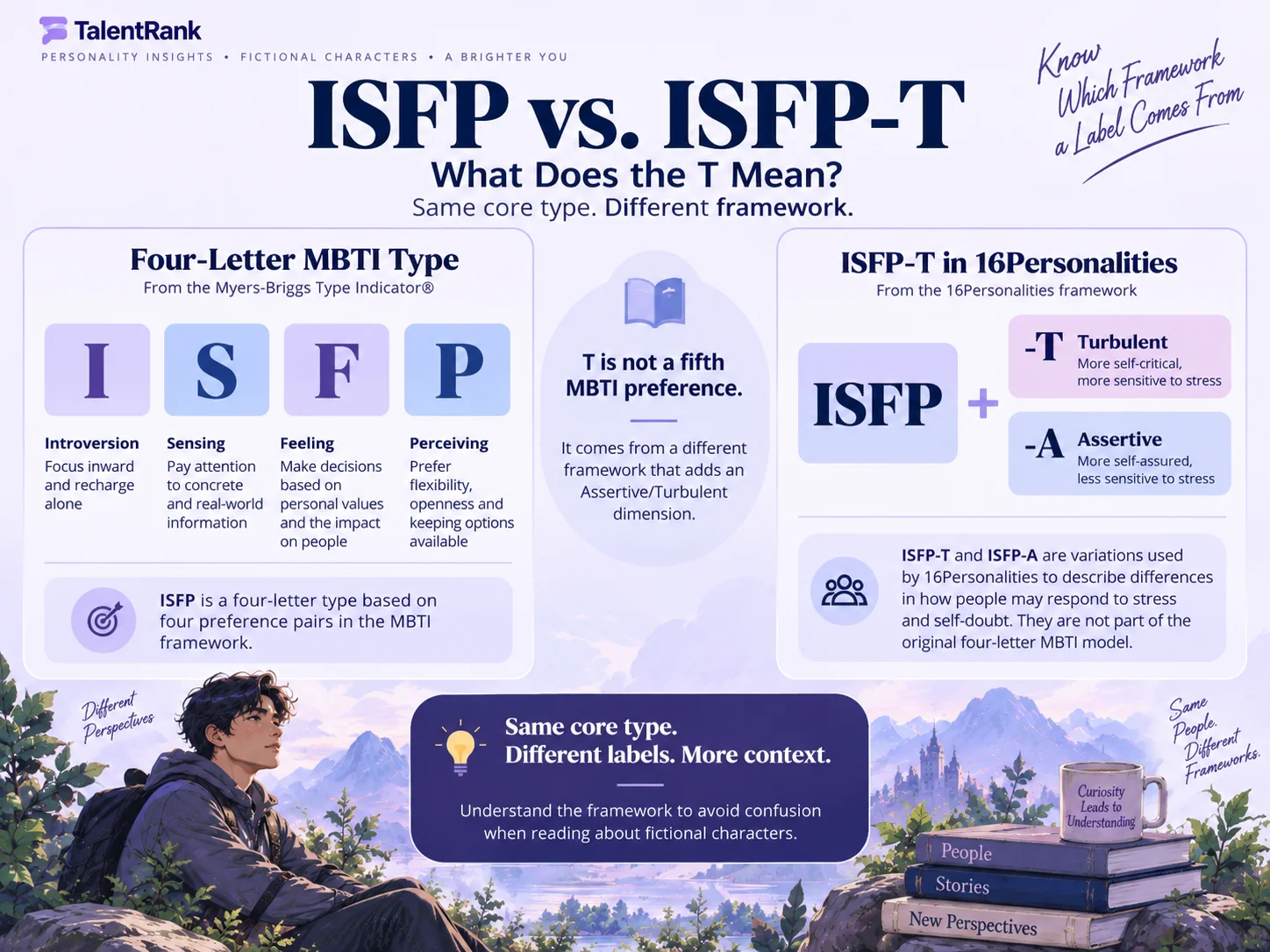
Official Myers-Briggs material describes four preference pairs. Choosing one preference from each produces four-letter types such as ISFP. Myers-Briggs overview
The -A and -T suffixes are used by 16Personalities, which describes Assertive Adventurers as ISFP-A and Turbulent Adventurers as ISFP-T. 16Personalities ISFP-A vs ISFP-T
So an accurate way to explain the term is: ISFP-T means a Turbulent ISFP within the 16Personalities framework. The T is not a fifth preference in the standard four-letter MBTI code.
That distinction matters because search results often use “MBTI” as a broad label for several online personality systems even when their models are not identical.
Can Fictional Characters Really Be Called ISFP-T?
A writer or fan can interpret a character as ISFP-T within the 16Personalities model, but the label carries extra uncertainty.
The Assertive/Turbulent distinction includes patterns related to confidence, stress sensitivity, self-perception, social pressure, and internal reactions. A story may reveal some of those patterns clearly. It may leave others almost entirely internal.
For that reason, a list of “confirmed ISFP-T fictional characters” would overstate what the evidence can establish. It is more accurate to say that a character can be interpreted as fitting an ISFP-T pattern within that framework.
Why Search Results Mix MBTI and ISFP-T
The confusion is understandable. Both systems use familiar four-letter labels such as ISFP. But the Myers-Briggs framework describes four preference pairs, while 16Personalities adds its Assertive/Turbulent Identity distinction to its model.
Readers do not need to choose a side to understand the terminology. They simply need to know which framework a claim is using. That is especially important when analyzing fictional ISFP characters because an already interpretive exercise becomes even less clear when frameworks are mixed without explanation.
ISFP Characters Beyond the “Sensitive Artist” Stereotype
The “artist” stereotype survives because it is easy to recognize. A musician, painter, designer, photographer, dancer, or nature-loving character looks like an obvious match for popular ISFP descriptions. But occupation and hobbies are weak evidence for a personality classification.
The same applies to other shortcuts. Introversion does not simply mean shy. Feeling does not mean irrational or constantly emotional. Perceiving does not mean irresponsible. In Myers-Briggs terminology, these preferences describe patterns in attention, information, decision-making, and approach to the outside world, not competence or morality.
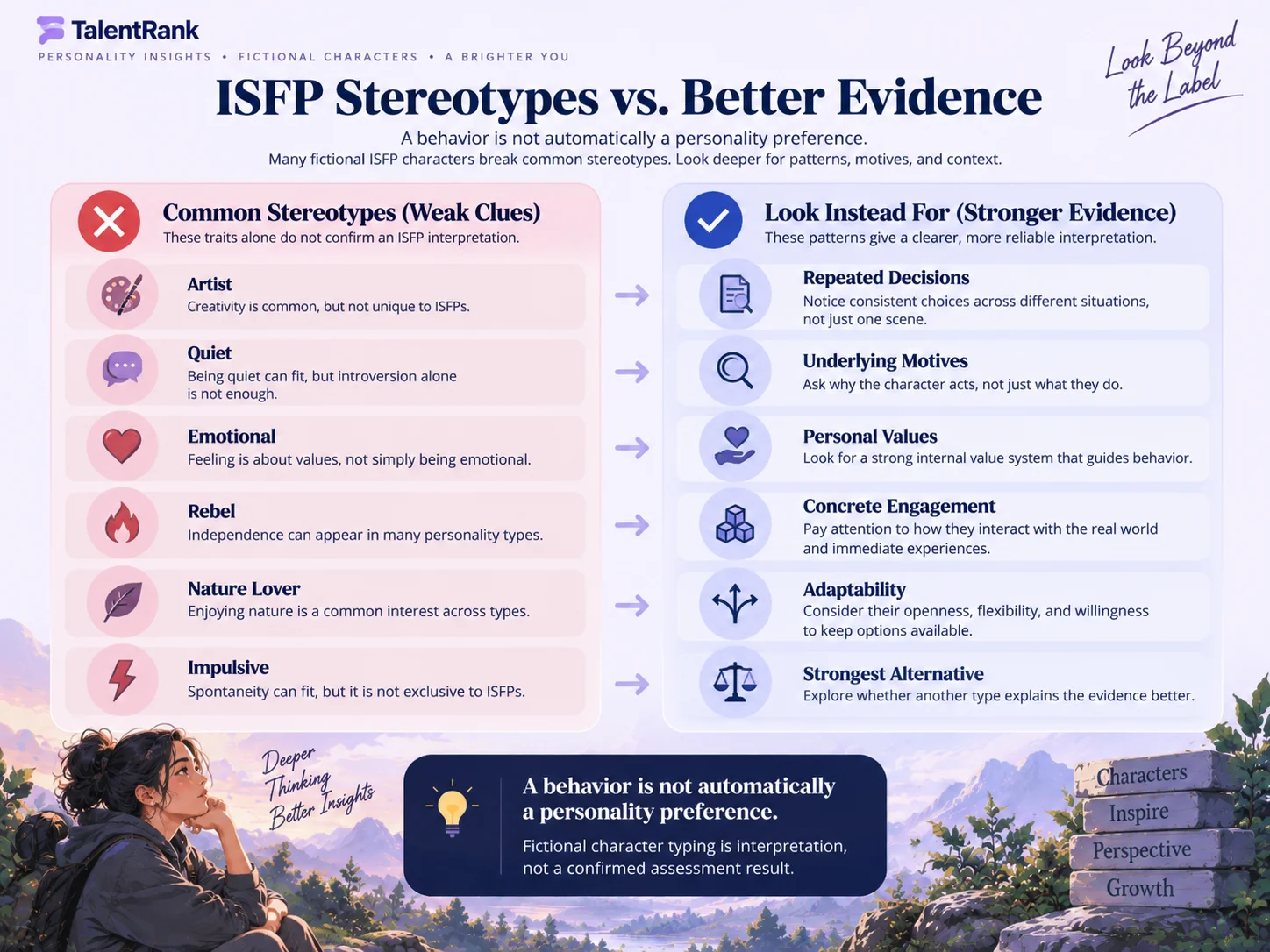
This is why characters such as Ichigo, San, Zuko, Eleven, and Adonis are more useful when analyzed through decisions than through aesthetics. An ISFP character can be disciplined. They can fight, lead, compete, plan, make logical decisions, or behave badly. Personality preferences do not measure skill, competence, morality, or character.
ISFP Characters That Are Commonly Debated or Mistyped
Disagreement is not a problem to hide. It is often where character typing becomes most useful.
Character | Why an ISFP reading appears | Alternative or complication | Why the debate matters |
|---|---|---|---|
Eren Yeager | Personal conviction, freedom focus, direct action | ESFP has a detailed competing case | Debate centers partly on whether inward values or outward engagement appear primary |
Zuko | Internal values, identity conflict, experiential development | Arc and circumstances complicate surface typing | Approval-seeking, trauma and growth should not be mistaken for stable preferences |
Harry Potter | Personal moral judgments, independence, practical action | Book and film evidence differ | Heroism and loyalty alone are weak type evidence |
Eleven | Private values, direct response, strong personal bonds | Upbringing and trauma affect behavior | Circumstance must be separated from personality |
Yuji Itadori | Sometimes appears in informal ISFP discussions | A detailed analysis supports ESFP | Similar traits can be explained by different preference patterns |
Eren provides the clearest documented disagreement in this group. The correct response to that conflict is not to count votes and announce a winner. It is to examine why analysts interpret the same evidence differently.
This principle applies to all fictional ISFP characters. A typing becomes more useful when it can survive a serious alternative explanation, not when disagreement is deleted from the page.
Character labels can stay debatable. Your own answers provide better material for self-reflection than trying to infer your personality from a fictional match. If you want to explore your patterns directly, TalentRank can help you examine your Big Five traits and a brief cognitive estimate rather than claiming to confirm an ISFP label.
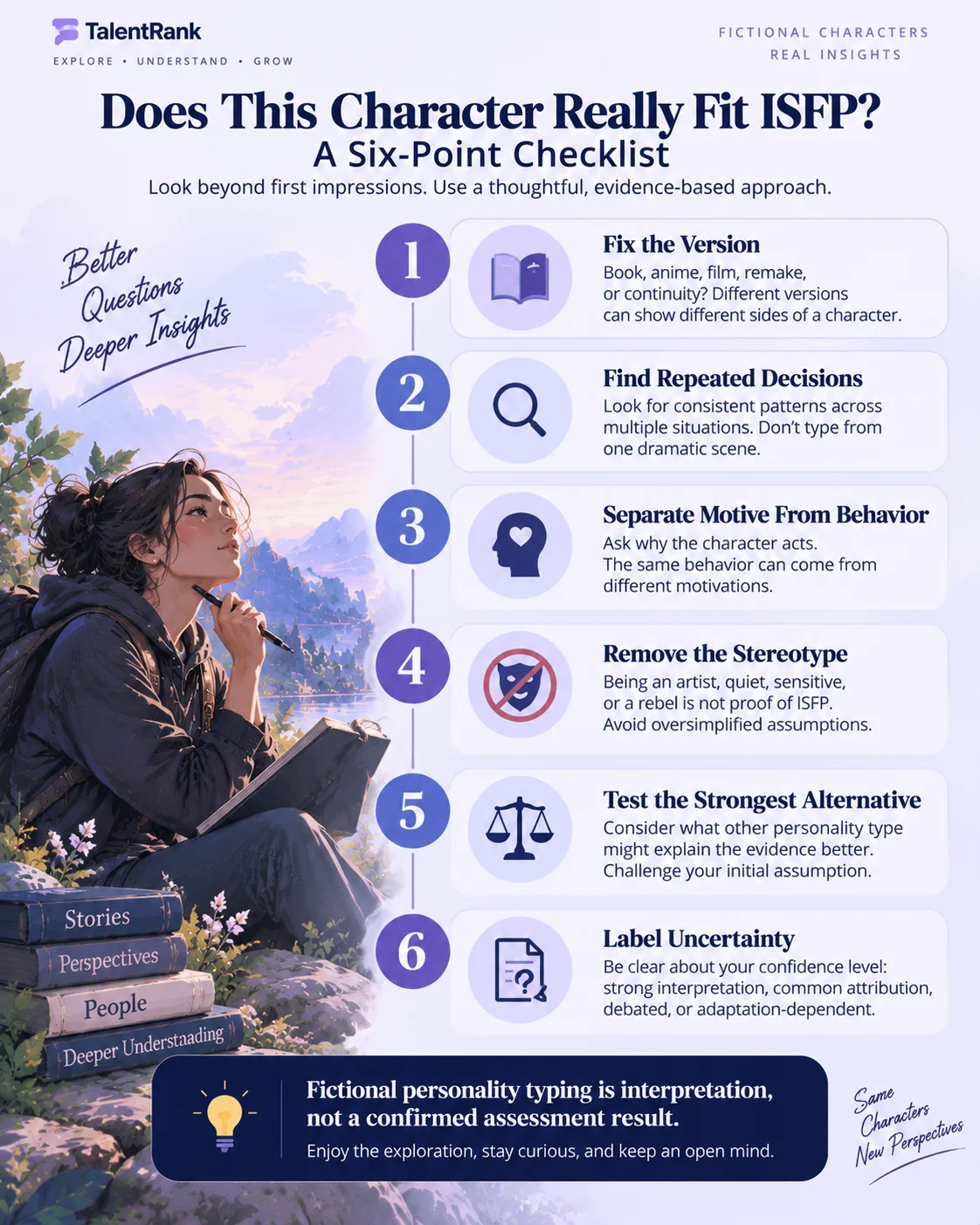
Does This Character Really Fit ISFP? A Six-Point Checklist
You do not need to accept a character database at face value. Use this checklist when evaluating any claim about ISFP characters.
1. Fix the Version
Identify what you are actually analyzing: novel, manga, anime, movie, television adaptation, reboot, comic continuity, or a combination. If versions behave differently, say so.
2. Find Repeated Decisions
One dramatic scene is weak evidence. Look for choices that recur in ordinary situations, relationships, conflict, and high-pressure moments.
3. Separate Motive From Behavior
Two characters can perform the same action for very different reasons. Ask why the character acts, not just what they do.
4. Remove the Stereotype
Temporarily ignore labels such as artist, quiet, emo, rebel, sensitive, creative, nature lover, and impulsive. Would the ISFP interpretation still make sense?
5. Test the Strongest Alternative
Do not ask only, “How can I prove ISFP?” Ask what other type could explain the character and what evidence would distinguish the two interpretations.
6. Label Uncertainty
Use wording that matches the evidence: strong interpretation, common attribution, debated, or adaptation-dependent. These are editorial labels, not validated psychological scores.
Why Are ISFP Characters Often Written as Rebels, Artists, or Outsiders?
It is tempting to conclude that real ISFP people must commonly be rebels, artists, or outsiders because fictional examples often use those archetypes. That conclusion would go too far.
These traits are useful storytelling devices. A character with strong private values can be placed in conflict with family, institutions, or society. Artistic expression gives writers and filmmakers a visible way to communicate an internal life. A spontaneous or action-oriented character can move a plot forward. An outsider can dramatize the tension between personal identity and external expectations.
Those are narrative advantages, not population statistics.
The pattern can also become repetitive. If every ISFP character is selected because they paint, brood, reject authority, or suffer dramatically, the list begins to describe a fictional trope rather than a personality framework.
The better examples are varied. Ichigo protects people while maintaining a strong personal identity. San acts fiercely on her convictions. Adonis competes in an intensely physical environment. Eleven develops a sense of self after others have tried to define her. Zuko's arc revolves around the difficult separation between external approval and internally accepted values. Their stories are different. That difference is exactly what helps prevent the label from becoming a costume.
FAQs About ISFP Characters
What are ISFP characters?
ISFP characters are fictional people interpreted as resembling the Introversion, Sensing, Feeling, and Perceiving preference pattern. Analysts may look at recurring decisions, personal values, concrete engagement, and adaptability. Because fictional characters generally cannot complete and verify an assessment themselves, their types are interpretations rather than confirmed personality results.
Who are popular ISFP anime characters?
Ichigo Kurosaki, San, and Eren Yeager are among commonly discussed ISFP anime characters. Ichigo and San have clear ISFP attributions in established typology articles, while Eren is more disputed. A detailed competing analysis identifies Eren as ESFP, making him a useful example of why fictional typing should allow alternatives.
Is Eren Yeager an ISFP?
Eren Yeager is commonly interpreted as ISFP, but the typing is debated. ISFP arguments emphasize personal conviction, freedom, and direct action. Practical Typing instead argues for ESFP, placing greater weight on his outward engagement with the world. His development across the story makes a definitive one-label answer difficult to justify.
Is Zuko an ISFP?
Zuko is commonly typed as ISFP in character-typing resources. The interpretation often emphasizes his internal moral conflict, direct engagement with problems, and eventual movement away from external approval toward personally accepted values. His trauma, anger, and family circumstances should be treated as story context, not proof of a personality type.
Is Harry Potter an ISFP?
Harry Potter has a well-developed ISFP interpretation in typology writing, including analysis of his personal moral judgments, resistance to control, private emotions, and practical action. The label remains interpretive, and book Harry should not automatically be treated as identical to every screen adaptation. Bravery and loyalty alone are not sufficient evidence of ISFP.
Is Eleven an ISFP?
Eleven is commonly interpreted as ISFP in current Stranger Things personality coverage. Arguments focus on her private values, strong personal attachments, identity development, and direct response to immediate circumstances. Her unusual upbringing and trauma also shape her behavior, so those factors should not be mistaken for stable personality preferences.
What are ISFP-T characters?
ISFP-T characters are fictional characters interpreted as Turbulent ISFPs using 16Personalities terminology. The -T refers to that framework's Turbulent Identity variant. Because characteristics such as confidence, stress sensitivity, and self-perception can be difficult to infer reliably from fiction, an ISFP-T label should be treated as interpretation rather than confirmation.
Is ISFP-T part of the standard MBTI four-letter type?
The standard Myers-Briggs framework uses four preference pairs to create four-letter types such as ISFP. ISFP-T is terminology used by 16Personalities, where -T means Turbulent and -A means Assertive. Therefore, the T should not be described as a fifth preference in the standard four-letter MBTI code.
Are all ISFP characters artistic or sensitive?
No. Artistic ability, emotional expression, clothing, hobbies, or occupation do not establish a personality preference. Personality frameworks look at broader patterns, and Myers-Briggs preferences do not measure skill, ability, or character.
Can a fictional character have a confirmed MBTI type?
Usually, “confirmed” is too strong. MBTI results are based on a person's own assessment responses, and official best-fit guidance gives the individual a role in verifying which type fits. Fictional characters normally cannot complete that process. A creator may assign a type, but that is better described as an attributed or canonical label than a self-verified assessment result.
Final Takeaway
The most useful ISFP characters are not necessarily the quietest, most artistic, most emotional, or most rebellious. Strong fictional typing looks at repeated decisions, motives, concrete engagement with the story world, personal values, adaptability, competing interpretations, and the version of the character being analyzed. Ichigo, San, Eleven, Harry, Zuko, Eren, and other examples become more interesting when the analysis allows uncertainty instead of forcing every behavior into a four-letter label. If these characters make you curious about your own personality, use that curiosity as a starting point for examining your own responses and traits rather than treating resemblance to a fictional character as evidence of your type.