

INTJ characters are often written as planners, independent thinkers, or people who see several moves ahead. Lelouch Lamperouge, Light Yagami, Beth Harmon, Michael Corleone, Fitzwilliam Darcy, Severus Snape, and Alhaitham are all commonly discussed examples. But fictional typing is interpretive. Intelligence, emotional restraint, villainy, or a talent for strategy does not prove that a character is INTJ.
This guide looks beyond the usual “cold mastermind” list. It explains why particular INTJ characters are plausible, where another type may fit better, and when a movie, television, book, anime, or game adaptation changes the case. The labels Strong case, Plausible, and Debatable describe our editorial confidence in an interpretation. They are not psychometric scores or diagnoses.
Quick List of INTJ Characters
Here is a quick starting point. The confidence labels reflect the version discussed in this article, not every adaptation of a character.
Character | Work or franchise | Medium | Confidence | Strongest alternative | Why the INTJ reading is plausible |
Lelouch Lamperouge | Code Geass | Anime | Strong case | ENTJ | Builds long-range plans around a private vision and layers contingencies |
Light Yagami | Death Note | Anime | Plausible | ENTJ | Creates elaborate future-oriented plans and a tightly organized worldview |
Ray | The Promised Neverland | Anime | Strong case | INTP | Quietly prepares for the future and manages information over a long horizon |
Sasuke Uchiha | Naruto | Anime | Plausible | ISTP | Pursues internally chosen goals with independence and strategic focus |
Kurapika | Hunter × Hunter | Anime/manga | Plausible | INFJ | Organizes his life around a long-term mission and controlled execution |
Kaguya Shinomiya | Kaguya-sama: Love Is War | Anime | Plausible | ENTJ | Constantly models outcomes and prepares elaborate social strategies |
Beth Harmon | The Queen's Gambit | TV | Plausible | INTP | Thinks in patterns, values mastery, and works with intense independence |
Michael Corleone | The Godfather | Film | Strong case | ENTJ | Uses patience, private judgment, and long-range strategic consolidation |
Wednesday Addams | Wednesday | TV | Debatable | INTP | Independent, skeptical, investigative, and strongly self-directed |
Fitzwilliam Darcy | Pride and Prejudice | Book | Plausible | ISTJ | Reserved and deliberate, with judgments formed privately before action |
Severus Snape | Harry Potter | Books | Plausible | ISTJ | Sustains a difficult long-term role with secrecy and strategic restraint |
Viktor | Arcane | Animation | Plausible | INTP | Pursues systems-level solutions with independence and future focus |
Silco | Arcane | Animation | Plausible | ENTJ | Builds patiently toward a political vision while managing complex alliances |
Alhaitham | Genshin Impact | Game | Strong case | INTP | Values autonomy, analysis, competence, and carefully bounded involvement |
Raiden Ei | Genshin Impact | Game | Debatable | ISTJ | Pursues an abstract long-term ideal through a rigid system |
A name appearing here does not mean the creator officially assigned that type. In most cases, fictional MBTI labels are interpretations of repeated behavior.
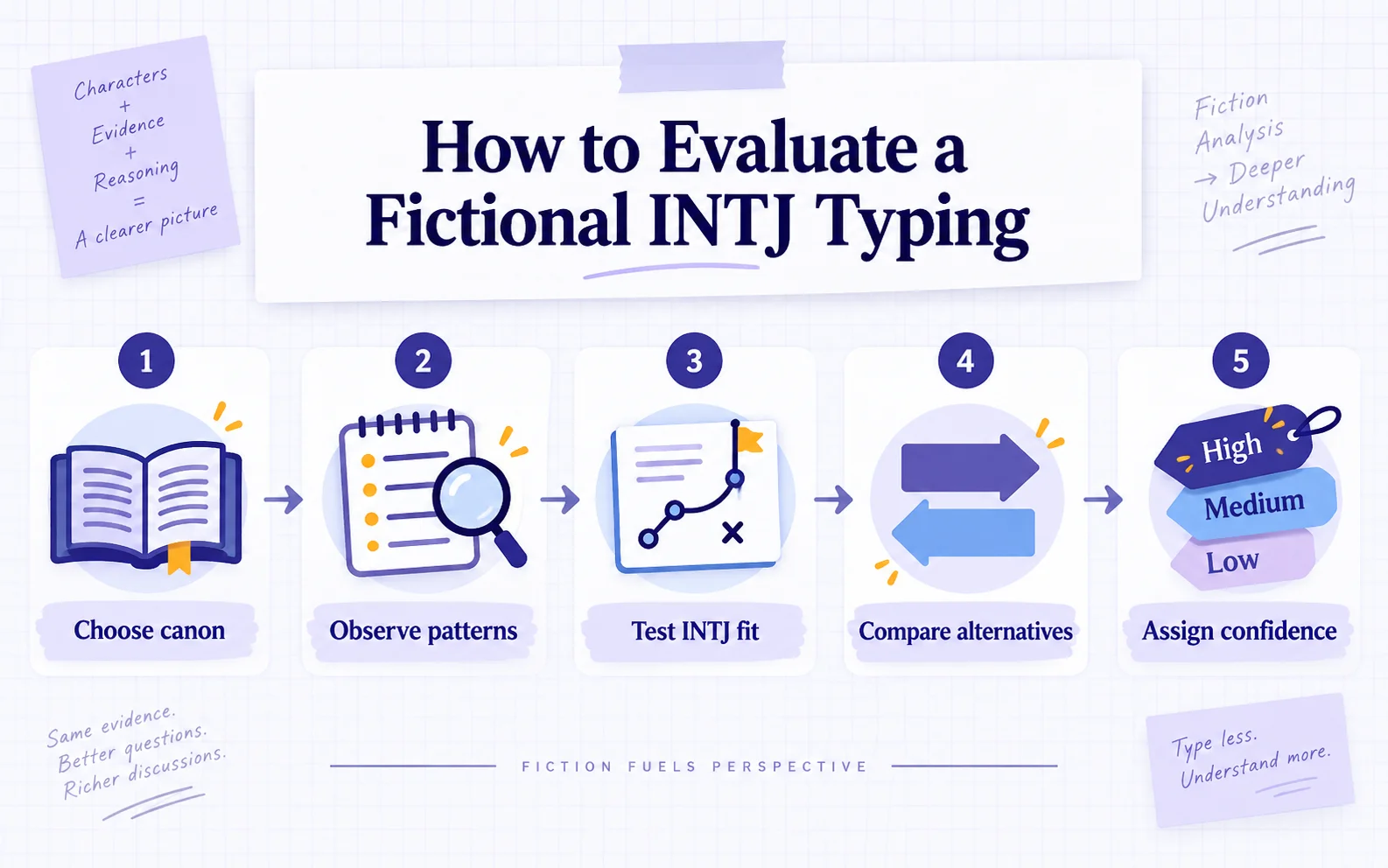
How We Decide Whether a Fictional Character Looks INTJ
INTJ is one of the 16 Myers-Briggs type codes, combining preferences commonly labeled Introversion, Intuition, Thinking, and Judging. Myers-Briggs describes these as preferences rather than measures of ability or character. That matters in fiction because being brilliant, antisocial, ruthless, or highly organized is not the same thing as demonstrating a particular personality preference.
Look for repeated patterns, not one dramatic scene
A useful character typing should survive more than a highlight reel. We look at how a character approaches long-term goals, uncertainty, decisions, structure, relationships, and changing information across a meaningful part of the story.
When evaluating INTJ characters, the strongest cases tend to combine inwardly developed judgment with future-oriented pattern recognition and purposeful execution. A character who makes one ingenious plan is not automatically INTJ. Neither is a character who simply prefers being alone.
Separate canon behavior from fan consensus
Fan databases, polls, and communities can reveal popular interpretations and disagreements, but they are not scientific confirmation. The underlying evidence has to come from the story itself, especially when later lists repeat an established label without reconsidering the source material.
Use confidence labels
Strong case means repeated behavior supports INTJ and major alternatives appear weaker. Plausible means meaningful evidence exists but another type also fits. Debatable means evidence is mixed, adaptation-dependent, or similarly supportive of another type. These editorial labels are not numerical probabilities.
Compare the strongest alternative
Many supposed INTJ characters sit close to other common interpretations. ENTJ is especially relevant for commanding strategists. INTP can fit analytical characters whose thinking stays more exploratory and open-ended. ISTJ can fit reserved planners who rely more heavily on precedent, duty, and established procedure. INFJ can be a serious alternative when a future-oriented character's decisions are strongly organized around people and values.
The comparison is more useful than asking whether a character is “smart enough” or “cold enough” to be INTJ.
Account for adaptations
Characters can change substantially between writers and formats. Batman in one film is not identical to Batman across decades of comics, and Netflix's Wednesday is more specific than every version of Wednesday Addams. This article therefore names a version or primary canon when the distinction matters.
Before You Type a Character as INTJ
Before settling on a label, check the evidence:
Are you looking at repeated behavior rather than one clever scene?
Does the character consistently think beyond the immediate situation?
Are decisions guided by an internally developed model or long-term objective?
Do ideas converge into purposeful structure rather than remaining purely exploratory?
Could ENTJ, INTP, ISTJ, or INFJ explain the same behavior better?
Are trauma, intelligence, villainy, social reserve, or profession influencing your judgment?
Have you specified the relevant book, film, series, game, or continuity?
Is the typing an interpretation, or is there genuine authoritative confirmation?
A compact comparison can also help:
Comparison | What to examine in fiction | Common mistake |
INTJ vs ENTJ | Is strategy mainly built around an inwardly formed long-range model, or outward organization and control? | Assuming every leader is ENTJ or every private strategist is INTJ |
INTJ vs INTP | Does thinking converge toward a structured future plan, or remain more exploratory and open-ended? | Using intelligence or analytical skill as the deciding factor |
INTJ vs ISTJ | Is the pattern more abstract and future-oriented, or more grounded in precedent, duty, and established procedure? | Treating seriousness and planning as uniquely INTJ |
When future-oriented, are decisions framed more through impersonal logical criteria or interpersonal and value consequences? | Calling Thinking “cold” and Feeling “emotional” |
This is an editorial comparison aid, not a diagnostic or validated scoring tool.
Relating to a fictional strategist can be interesting, but resemblance to a character does not establish your own personality type. If you want to explore your own trait patterns, TalentRank's broader personality assessment is available at https://www.talentrank.io/assessment-lander.
INTJ Anime Characters
Searches for INTJ anime characters often produce lists of INTJ characters that feature a familiar collection of geniuses, tacticians, antiheroes, and villains. Some are persuasive examples. Others are popular precisely because anime makes their strategic abilities unusually visible. The useful question is not whether a character can plan. It is whether the broader pattern fits.
Lelouch Lamperouge: Strong case
Lelouch is one of the clearest INTJ characters in anime, although ENTJ is a credible alternative. His story in Code Geass revolves around a privately held vision, long-range political modeling, concealed identities, and layered contingency plans. He often appears to work backward from an envisioned end state rather than simply reacting to the immediate environment.
ENTJ is credible because Lelouch mobilizes people and directs organizations. Yet leadership alone does not make someone extraverted. The INTJ case is stronger if his public command is understood as an instrument for a private strategic agenda.
Confidence: Strong case. Strongest alternative: ENTJ.
Light Yagami: Plausible, but heavily debated
Light Yagami is routinely placed on lists of INTJ anime characters, and there is a real case for it. In Death Note, he develops an internally coherent vision of how the world should operate, plans far ahead, controls information, and anticipates opponents' responses. His ability to maintain multiple layers of deception makes his strategic thinking unusually visible.
ENTJ is the major competing interpretation. Light increasingly seeks direct control over people and institutions, and his behavior can look more externally dominating than privately strategic. His intelligence, manipulation, and villain status should not decide the question. Those are narrative characteristics, not MBTI criteria.
Confidence: Plausible. Strongest alternative: ENTJ.
Ray: Strong case
Ray from The Promised Neverland offers a useful contrast to the flamboyant mastermind stereotype. His strategic behavior is quiet. He gathers information, prepares for future outcomes, withholds knowledge when he believes timing matters, and works within a long planning horizon.
An INTP interpretation can emphasize his analytical detachment and intellectual flexibility. The INTJ case rests more on how consistently his analysis is organized toward a defined future outcome rather than exploration for its own sake.
Confidence: Strong case. Strongest alternative: INTP.
Sasuke Uchiha: Plausible
Sasuke is harder to type cleanly because Naruto follows him through trauma, adolescence, changing loyalties, and radically different goals. Across much of the story, however, he is highly independent and organizes his actions around internally chosen long-term objectives. He can be patient, selective, and resistant to outside expectations.
ISTP is a serious alternative because Sasuke is also exceptionally responsive in immediate combat and often appears pragmatic rather than abstract. Some interpretations also emphasize INFJ-like elements in his later worldview. His trauma should not itself be treated as evidence for any personality type.
Confidence: Plausible. Strongest alternative: ISTP.
Kurapika: Plausible
Kurapika in Hunter × Hunter builds much of his adult identity around a defined long-term mission. He is disciplined, selective about trust, willing to acquire specialized knowledge, and capable of delaying gratification for a larger objective. That makes an INTJ reading understandable.
INFJ is a strong alternative because relationships, loyalty, and moral meaning are central to his decisions. His revenge motive also makes typing difficult: an extreme life objective can cause behavior that is not representative of a person's broader preferences.
Confidence: Plausible. Strongest alternative: INFJ.
Kaguya Shinomiya: Plausible
Kaguya is a useful reminder that INTJ characters do not need to be villains. Kaguya-sama: Love Is War turns strategic thinking into romantic comedy. She models possible reactions, builds elaborate plans, and tries to control uncertainty before acting.
The comedy exaggerates this behavior, so every scheme is not serious personality evidence. ENTJ is a reasonable alternative when Kaguya becomes more externally directive.
Confidence: Plausible. Strongest alternative: ENTJ.
Motoko Kusanagi: Plausible
Major Motoko Kusanagi, especially in Ghost in the Shell's more philosophical versions, combines independence, systems thinking, strategic judgment, and comfort with abstraction.
ISTP is a compelling alternative because of her tactical adaptability and action-oriented competence. Different Ghost in the Shell continuities also emphasize different sides of the Major, so any universal typing would be too confident.
Confidence: Plausible. Strongest alternative: ISTP.
Shoto Todoroki: Debatable
Shoto Todoroki is often typed as INTJ because he is restrained, focused, independent, and initially appears highly controlled. Those observations are real, but My Hero Academia also makes clear that family pressure and trauma shape much of his early behavior.
ISTJ and INFJ interpretations can both be argued depending on which parts of his development receive the most weight. This is a good example of why emotional reserve cannot serve as a shortcut to INTJ.
Confidence: Debatable. Strongest alternative: ISTJ.
INTJ Movie and TV Characters
Live-action INTJ characters create a different challenge across media. Prestige dramas often center on ambitious, wounded, secretive, or morally compromised people, all of whom can look “INTJ-like” if the analysis stops at surface traits. These examples need the same alternative-type test as anime characters.
Beth Harmon: Plausible
Beth Harmon in Netflix's The Queen's Gambit is intensely independent and absorbed by complex patterns. She visualizes chess structures, pursues mastery, and resists social expectations that interfere with her goals. Her inward concentration and future-oriented problem solving make an INTJ reading plausible.
INTP is equally important to consider. Beth's attraction to patterns and problem solving can look exploratory rather than consistently plan-driven. Her addiction and childhood experiences should be treated as parts of her story, not evidence of a personality preference.
Confidence: Plausible. Strongest alternative: INTP.
Michael Corleone: Strong case
Michael Corleone in The Godfather films is one of the stronger live-action examples. He tends to observe before acting, keeps crucial judgments private, and increasingly organizes events around long-range outcomes. His power comes less from constant visible force than from patience, timing, and controlled execution.
ENTJ remains plausible because Michael eventually commands a large organization and imposes decisions externally. Still, his reserved strategic style and tendency to form decisions internally make the INTJ interpretation especially persuasive.
Confidence: Strong case. Strongest alternative: ENTJ.
Wednesday Addams: Debatable
For Netflix's Wednesday, an INTJ reading is easy to understand. Wednesday is self-directed, skeptical of convention, investigative, persistent, and willing to follow her own interpretation despite social pressure.
But INTP is a serious alternative. Her curiosity can be open-ended, and she sometimes pursues a puzzle because it fascinates her rather than because it serves a carefully structured long-term plan. Other Addams Family adaptations should not automatically inherit the same typing.
Confidence: Debatable. Strongest alternative: INTP.
Thomas Shelby: Plausible
Thomas Shelby in Peaky Blinders thinks several moves ahead, withholds information, anticipates rivals, and works toward outcomes other people do not initially see.
The ENTJ interpretation is strong because Thomas also builds and controls organizations, negotiates aggressively, and exerts authority directly. His wartime trauma and later psychological distress complicate the picture and should not be converted into type evidence.
Confidence: Plausible. Strongest alternative: ENTJ.
Batman: Debatable and version-dependent
Batman may be one of the most frequently proposed INTJ characters, but “Batman” is not one stable portrayal. Some versions emphasize contingency planning, private strategic vision, and preparation for distant threats. Others emphasize discipline, procedure, immediate tactical competence, or different interpersonal motives.
ISTJ is a common alternative for portrayals built more heavily around duty, precedent, and structured procedure. A defensible article should therefore identify a specific comic run, film, animated series, or game before making a strong claim.
Confidence: Debatable without a specified continuity. Strongest alternative: ISTJ.
INTJ Animation and Cartoon Characters
The phrase INTJ animation characters overlaps with broader searches for INTJ characters, but Western animation provides useful examples of its own. It also shows why the framework has to survive comedy, fantasy, and highly stylized writing.
Viktor: Plausible
In Arcane, Viktor is future-focused, independent, and preoccupied with solving systemic limitations through invention. He thinks beyond the immediate problem and is willing to challenge accepted constraints when they obstruct his vision.
INTP is the strongest alternative because his intellectual exploration and scientific curiosity are central to his characterization. The distinction depends partly on whether his thinking is read as converging toward a defined future or remaining driven primarily by discovery.
Confidence: Plausible. Strongest alternative: INTP.
Silco: Plausible
Silco is a darker Arcane example. He works toward a long-term political objective, manages information carefully, and accepts short-term costs in pursuit of a larger vision. That supports an INTJ interpretation.
ENTJ is again the strongest alternative because Silco also builds an organization, commands subordinates, and exercises power externally. His role as an antagonist does not make him more or less INTJ.
Confidence: Plausible. Strongest alternative: ENTJ.
Anais Watterson: Plausible
Anais from The Amazing World of Gumball is unusually analytical and often becomes the person who sees structure where the rest of her family sees chaos. Her intelligence is exaggerated for comedy, but she also shows planning, independence, and a preference for solving problems systematically.
INTP is a reasonable alternative because the show's episodic comedy makes stable long-term patterns harder to judge.
Confidence: Plausible. Strongest alternative: INTP.
INTJ Book Characters
Literary INTJ characters can be easier to examine because narration often exposes motives and private judgments. Book-based INTJ characters can make motives easier to examine because readers often have access to narration, internal reflection, and longer developmental arcs. They also let us separate a literary character from the screen performance that later became famous.
Fitzwilliam Darcy: Plausible
In Jane Austen's Pride and Prejudice, Darcy is reserved, deliberate, and reluctant to shape his behavior around immediate social approval. He forms judgments privately and can hold them too rigidly, but he is also capable of revising those judgments when confronted with better evidence.
ISTJ is a credible alternative because duty, social structure, and established expectations matter to him. His reserve by itself is not evidence of Introverted Intuition.
Confidence: Plausible. Strongest alternative: ISTJ.
Edmond Dantès: Plausible
The Count of Monte Cristo transforms Edmond Dantès into a patient architect of an enormous long-term plan. He gathers information, constructs identities, anticipates consequences, and delays action until circumstances align.
That makes him look like a classic INTJ strategist, but the extraordinary revenge plot shapes his behavior. ENTJ and INFJ interpretations can emphasize different aspects of his execution and moral vision. The safest reading is that the INTJ case is plausible, not definitive.
Confidence: Plausible. Strongest alternative: ENTJ.
Captain Nemo: Plausible
Captain Nemo in Jules Verne's novels is fiercely autonomous, technically capable, visionary, and separated from ordinary institutions. His life aboard the Nautilus is organized around a private worldview and an alternative to the society he rejects.
INFJ is a meaningful alternative because moral conviction and human suffering remain central to his character. Different adaptations often simplify Nemo, so the literary version should be kept separate.
Confidence: Plausible. Strongest alternative: INFJ.
Victor Frankenstein: Debatable
Victor Frankenstein is ambitious, intellectually absorbed, and driven by a vision other people cannot see, which can initially resemble an INTJ pattern. Yet Mary Shelley's novel also portrays obsession, avoidance, emotional turmoil, and catastrophic failures of judgment.
INTP is a strong alternative, particularly if his intellectual exploration is seen as more central than structured execution. His scientific ambition should not be mistaken for personality-type proof.
Confidence: Debatable. Strongest alternative: INTP.
Severus Snape: Plausible
In the Harry Potter books, Snape sustains a secret and dangerous long-term commitment while presenting a very different public face. He is private, controlled, strategic, and capable of operating within a plan whose purpose is invisible to most people around him.
ISTJ and INFJ are both credible alternatives. Duty, loyalty, memory, and deeply personal values are essential to his choices. His bitterness or social coldness is not what makes the INTJ interpretation plausible.
Confidence: Plausible. Strongest alternative: ISTJ.
INTJ Video Game Characters
Video game INTJ characters can span sequels, optional dialogue, changing writers, and years of updates, so franchise scope matters especially here.
Alhaitham: Strong case
Alhaitham from Genshin Impact is one of the stronger modern game examples. He values autonomy, dislikes unnecessary social performance, analyzes systems quickly, and usually limits his involvement to what he believes is rationally necessary. When circumstances require action, he can work toward a defined outcome without seeking attention for leadership itself.
INTP is the clearest alternative because of his intellectual independence and analytical style. The INTJ case becomes stronger when his analysis is viewed as consistently converging on efficient, structured action.
Confidence: Strong case. Strongest alternative: INTP.
Raiden Ei: Debatable
Raiden Ei pursues an abstract idea of “eternity” and builds a rigid system around preserving it. That long-horizon ideal and willingness to restructure society around a private model can support an INTJ reading.
ISTJ is a serious alternative because preservation, stability, and resistance to change are so central to her story. Her characterization also develops as Genshin Impact expands its lore, making overly fixed labels risky.
Confidence: Debatable. Strongest alternative: ISTJ.
Shadow the Hedgehog: Debatable
Shadow is reserved, independent, mission-focused, and often resistant to social influence. Those traits can make an INTJ interpretation appealing.
ISTP is arguably stronger in versions that emphasize immediate action, combat adaptability, and direct problem solving. The Sonic franchise has also characterized Shadow differently across games and other media, so a universal label is difficult to defend.
Confidence: Debatable. Strongest alternative: ISTP.
Vergil: Plausible
Vergil in Devil May Cry is controlled, intensely goal-oriented, and committed to a private conception of strength. He tends to pursue that objective with focus rather than social approval, which supports an INTJ reading.
ENTJ and ISTJ can both be argued depending on the installment and which motives receive the most weight. His obsession with power is a story motive, not a personality criterion.
Confidence: Plausible. Strongest alternative: ENTJ.
If comparing yourself with fictional INTJ characters has made you curious about your own patterns, use your own responses rather than a character resemblance as the starting point. TalentRank's broader assessment is available at TalentRank assessment.
Are INTJ Characters Usually Villains or Cold Masterminds?
No. Fiction often uses strategic, private, or emotionally restrained characters as villains because those traits create obvious dramatic tension. Villainy is not an INTJ criterion, and neither are genius, manipulation, trauma, or low emotional expression. Ethical, relational, funny, uncertain, and emotionally intense characters can all support an INTJ interpretation.
The stereotype persists partly because strategy is easy to dramatize. Compare Light, Michael, and Silco with Ray, Beth Harmon, Kaguya, Darcy, Viktor, or Alhaitham. They do not occupy the same moral role. What connects stronger INTJ characters is not villainy but a recurring way of organizing information, judgment, and future action.
This distinction also protects against another common mistake: explaining behavior caused by trauma, addiction, grief, or mental-health struggles as a personality preference. A fictional person's circumstances can change how they act. Those circumstances should be considered before assigning a stable type label.
Which INTJ Characters Are the Strongest Examples?
When comparing INTJ characters, the strongest examples are not necessarily the most famous ones. A good example needs a consistent pattern and should remain persuasive after a competing interpretation is considered.
Character | Medium | Confidence | Why the case is strong | Main alternative | Main uncertainty |
Lelouch Lamperouge | Anime | Strong case | Private long-range vision plus layered strategic execution | ENTJ | Strong outward command |
Ray | Anime | Strong case | Quiet information control and sustained future planning | INTP | Analytical flexibility |
Michael Corleone | Film | Strong case | Patient, internally formed strategic decisions | ENTJ | Organizational authority |
Alhaitham | Game | Strong case | Autonomous analysis that converges on structured action | INTP | Strong analytical detachment |
Beth Harmon | TV | Plausible | Pattern-focused independence and mastery orientation | INTP | Exploration vs structured convergence |
Fitzwilliam Darcy | Book | Plausible | Private judgment, deliberation, and revision | ISTJ | Duty and social structure |
Some popular INTJ characters are much more debatable. Light Yagami can reasonably be read as ENTJ. Netflix's Wednesday has a strong INTP case. House may fit INTP better than INTJ. Batman cannot be typed responsibly without choosing a continuity. Plankton demonstrates why “schemer” is not a personality type.
That uncertainty is useful when discussing INTJ characters. Fictional typing becomes more interesting when the question changes from “What label does this character have?” to “Which repeated pattern best explains this version of the character?”
Character typing depends on interpretation. Your own personality should be explored from your responses, not from whether you resemble Lelouch, Light, Wednesday, or another fictional character. If you want a broader starting point for self-reflection, visit TalentRank assessment.
Frequently Asked Questions About INTJ Characters
What fictional characters are INTJ?
Commonly discussed INTJ characters include Lelouch Lamperouge, Light Yagami, Ray, Beth Harmon, Michael Corleone, Fitzwilliam Darcy, Severus Snape, Viktor, and Alhaitham. These are interpretations rather than diagnoses or universal facts. Stronger examples show repeated long-range planning, independent judgment, and structured decision-making while still surviving comparison with plausible alternative types.
Who are the best INTJ anime characters?
Among INTJ characters in anime, strong or plausible examples include Lelouch Lamperouge, Ray, Light Yagami, Sasuke Uchiha, Kurapika, Kaguya Shinomiya, and Motoko Kusanagi. Lelouch and Ray make particularly useful examples because their strategic behavior appears repeatedly across their stories. Light is more controversial because ENTJ provides a serious competing interpretation.
Is Light Yagami an INTJ?
Light Yagami is plausibly INTJ, but the typing is debated. His private long-range planning, information control, and tightly organized worldview support INTJ. His increasing drive to dominate people and shape the external environment supports ENTJ. His intelligence, manipulation, and villainy should not be used as evidence for either type by themselves.
Is Lelouch an INTJ or ENTJ?
Lelouch can reasonably be interpreted as INTJ or ENTJ. The INTJ case emphasizes his private strategic vision, contingency planning, and internally set agenda. The ENTJ case emphasizes command, mobilization, and external control. The distinction depends on which pattern appears more central across Code Geass, not simply on the fact that he leads people.
Is Batman an INTJ?
Batman is frequently typed as INTJ, but there is no single Batman personality across every continuity. Comics, films, animation, and games emphasize different traits, making ISTJ and other interpretations plausible. A useful analysis should identify the specific Batman version being discussed instead of treating every adaptation as psychologically identical.
Is Wednesday Addams an INTJ?
Netflix's Wednesday Addams can plausibly be read as INTJ because she is independent, investigative, skeptical, and strongly self-directed. INTP is also a serious interpretation because her curiosity can be exploratory and open-ended. Other Addams Family versions should be evaluated separately rather than automatically receiving the same type.
Are most INTJ characters villains?
No. Fiction often gives strategic, private, or emotionally restrained traits to villains because they create dramatic tension, but villainy is not an INTJ criterion. Non-villain examples can be just as plausible. Intelligence, manipulation, trauma, social distance, or low emotional expression should never determine a fictional character's personality type on their own.
Are fictional MBTI typings official?
Usually not. Most fictional MBTI typings come from readers, fan communities, personality databases, or editorial analysis rather than an official creator statement. They are best treated as interpretations of repeated behavior within a specified canon. If an authoritative creator or licensed source explicitly confirms a type, that evidence should be identified separately.
What female fictional characters are INTJ?
Plausible or debated female examples include Beth Harmon, Kaguya Shinomiya, Motoko Kusanagi, Wednesday Addams, and Raiden Ei. The exact typing varies by character and adaptation, and alternatives such as INTP, ENTJ, ISTJ, or other types may fit. Female INTJ characters should not be reduced to the same “cold mastermind” stereotype used for male characters.
Final Takeaway
The most useful INTJ characters are not simply the smartest, quietest, or most intimidating people in fiction. Stronger examples show a repeated combination of future-oriented thinking, independent judgment, and purposeful structure, while still leaving room to test another explanation. Lelouch, Ray, Michael Corleone, and Alhaitham make stronger cases in this framework, while Light, Wednesday, Batman, and several other popular examples remain genuinely debatable. That ambiguity is part of the value: fictional personality typing works best as a way to examine patterns, not as a diagnosis or a fixed truth about a character or reader.