

INFJ Characters: Fictional, Anime, Movie, and TV Examples Explained
INFJ characters are often portrayed as private, idealistic, future-focused, emotionally perceptive, and driven by a deeper purpose. Popular INFJ characters frequently include Armin Arlert, Itachi Uchiha, Louise Banks, Remus Lupin, Galadriel, Elsa, Matt Murdock, Atticus Finch, and Princess Zelda. Most of these typings are fan or editorial interpretations rather than official classifications.
This guide focuses on INFJ fictional characters across anime, movies, TV, books, animation, Disney, Marvel, and games. Instead of treating every typing as settled fact, it uses three confidence labels: Strong case, Plausible, and Debatable. Where useful, it also notes a competing type or the specific adaptation being discussed. In the official Myers-Briggs framework, INFJ combines preferences for Introversion, Intuition, Feeling, and Judging; fictional characters cannot take an assessment, so their typings remain interpretations. For a broader framework comparison, see TalentRank’s Big Five vs MBTI guide . Source note: Myers & Briggs Foundation, “MBTI Basics.”
Character | Franchise | Medium | Why people type them INFJ | Confidence | Strongest alternative |
Armin Arlert | Attack on Titan | Anime | Strategic foresight, moral reflection, people-focused planning | Strong case | INTP |
Itachi Uchiha | Naruto | Anime | Long-range sacrifice, restraint, hidden motives | Plausible | INTJ |
Norman | The Promised Neverland | Anime | Future-oriented strategy shaped by concern for others | Strong case | INTJ |
Kaworu Nagisa | Neon Genesis Evangelion | Anime | Emotional insight, symbolic thinking, unusual calm | Plausible | ENFJ |
Louise Banks | Arrival | Movie | Meaning-focused reflection, empathy, future perspective | Strong case | INFP |
Obi-Wan Kenobi | Star Wars | Movie/TV | Duty, mentorship, restraint, long-term perspective | Plausible | ISFJ |
Remus Lupin | Harry Potter | Books/film | Empathy, reserve, moral awareness, mentorship | Plausible | INFP |
Matt Murdock | Daredevil | TV/Marvel | Moral mission, private intensity, conflict between ideals and action | Plausible | ISFJ |
Elsa | Frozen | Animation | Self-restraint, concern about harming others, inward identity struggle | Debatable | INFP |
Atticus Finch | To Kill a Mockingbird | Book | Principle-centered judgment, restraint, moral purpose | Plausible | ISTJ |
Jane Eyre | Jane Eyre | Book | Introspection, moral independence, idealism | Plausible | INFP |
Galadriel | The Lord of the Rings | Book | Foresight, restraint, symbolic vision, long-term purpose | Strong case | INTJ |
Princess Zelda | The Legend of Zelda | Game | Wisdom, duty, strategic concern for the future | Plausible | INTJ |
Max Caulfield | Life is Strange | Game | Introspection, empathy, observation, moral conflict | Debatable | INFP |
The table gives a quick answer, but the interesting part is how these INFJ characters are interpreted. INFJ characters can look convincing in one scene and behave very differently across a full story. That is why the sections below focus on repeated patterns rather than one quote, one facial expression, or a popularity vote.
How We Decide Whether a Fictional Character Looks INFJ
The Myers-Briggs framework uses four preference pairs. INFJ refers to Introversion, Intuition, Feeling, and Judging. That framework describes preferences, not moral worth, intelligence, destiny, or a fictional archetype. A quiet, kind, mysterious character is not automatically an INFJ.
Canon vs. fan typing: Canon tells us what a character does. Typing interprets what those patterns may mean. A creator or licensed source can verify a character fact, but unless it explicitly assigns a personality type, the INFJ label remains an editorial or community interpretation. Popular database votes can show consensus; they do not make a typing scientific fact.
For this article, INFJ characters are evaluated using eight practical questions:
What behavior repeats across the story?
What long-term goal appears to organize the character’s choices?
What values or moral concerns shape decisions?
How does the character relate to other people?
How do they respond to conflict, pressure, or sacrifice?
Do they tend to think in patterns, meanings, or future consequences?
What alternative personality type explains the same behavior?
Does the answer change across adaptations?
Before Calling a Character INFJ, Ask:
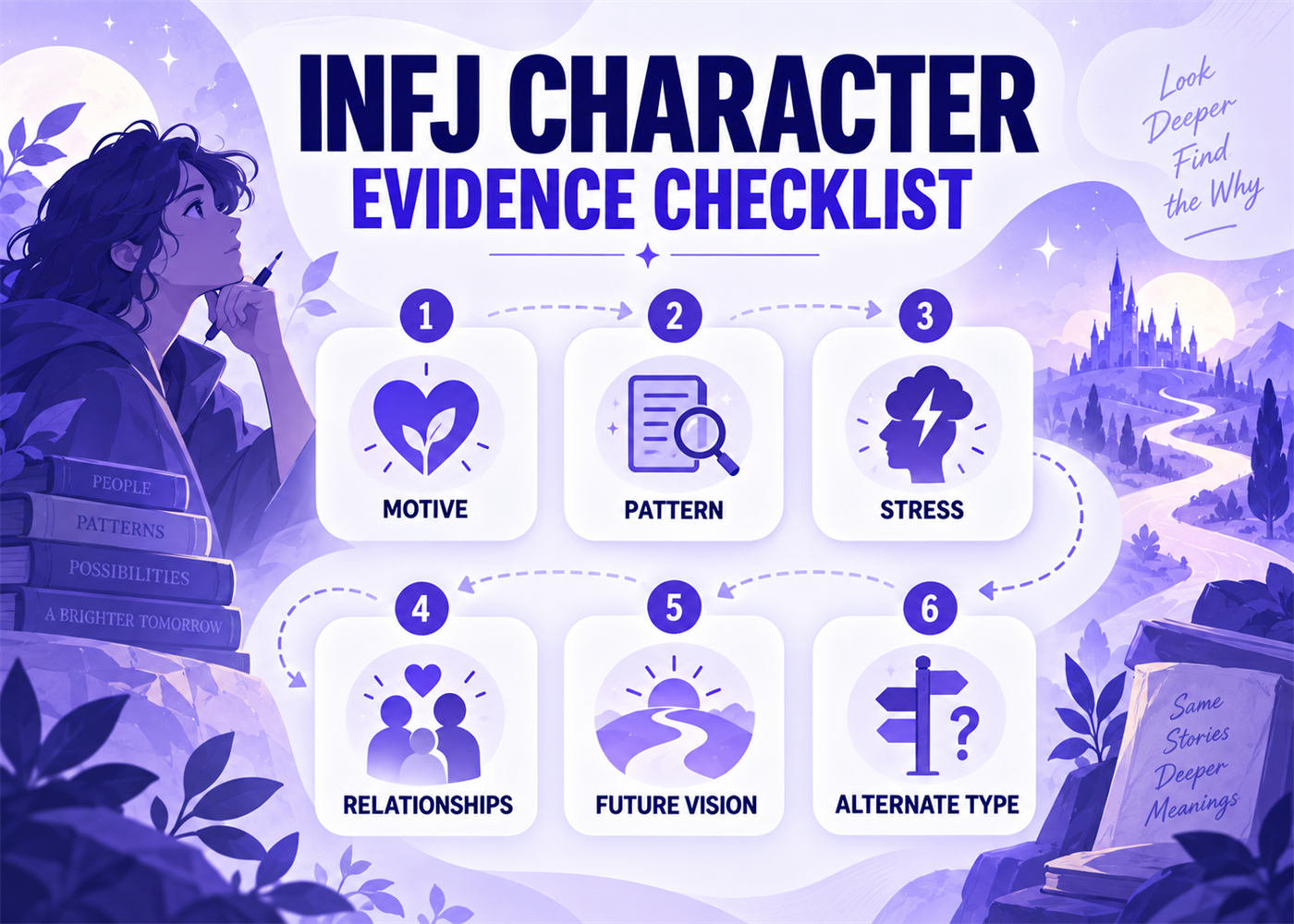
Does the pattern repeat across the story?
Is there a clear long-term vision or meaning?
How are other people factored into decisions?
What happens under pressure?
Is the evidence stronger than “quiet, caring, mysterious”?
Which alternative type fits?
Does another adaptation behave differently?
Canon evidence is different from fan consensus
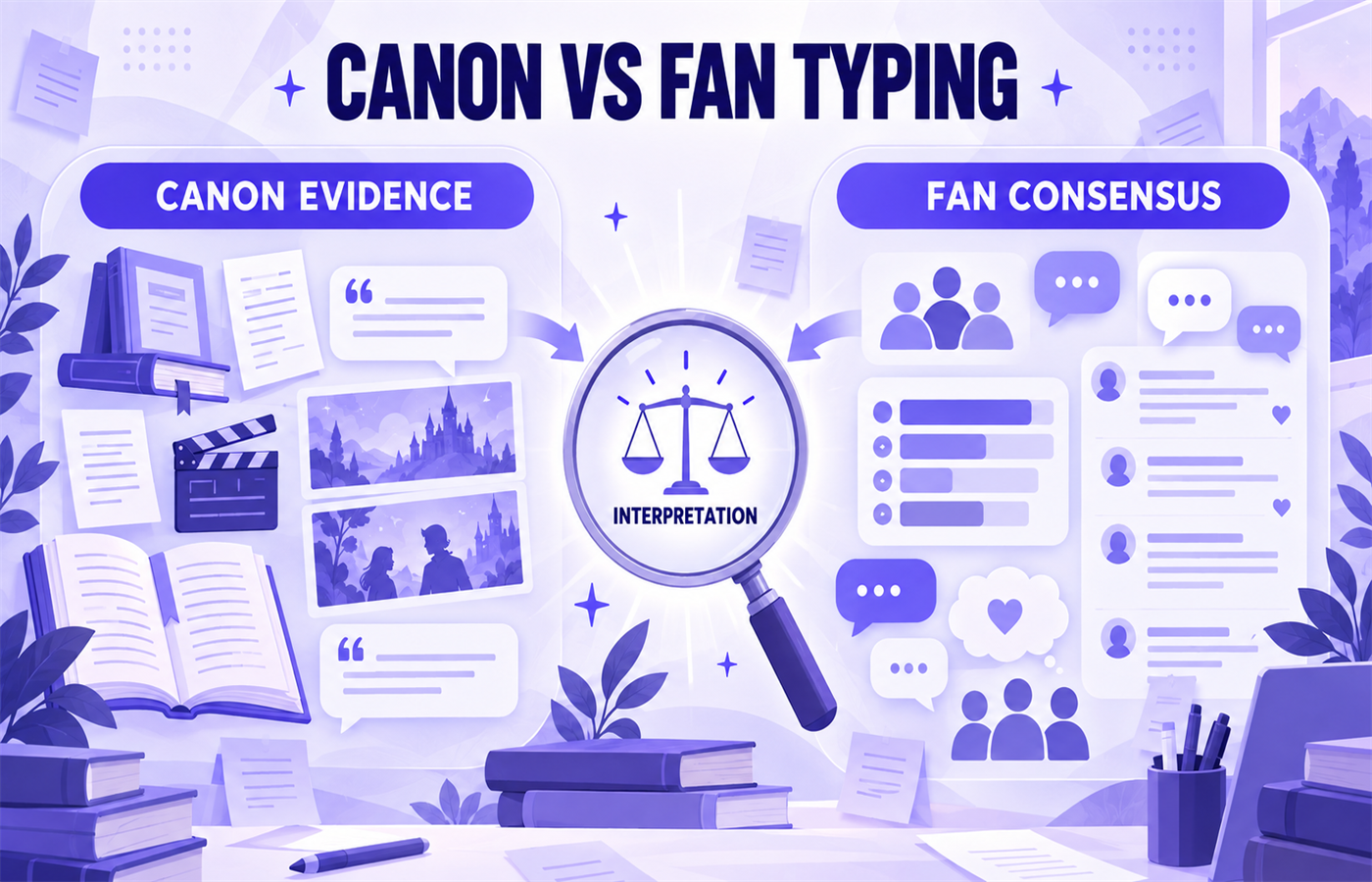
cisions, relationships, motives, conflicts, and consequences. Editorial interpretation is the argument we build from those details. Community consensus is simply what many fans or database voters tend to believe.
When discussing INFJ characters, those three things should not be mixed together. A character can be popular on a personality database and still be a weak INFJ case. Likewise, a less popular typing can be reasonable if the story supports it.
Confidence labels used in this guide
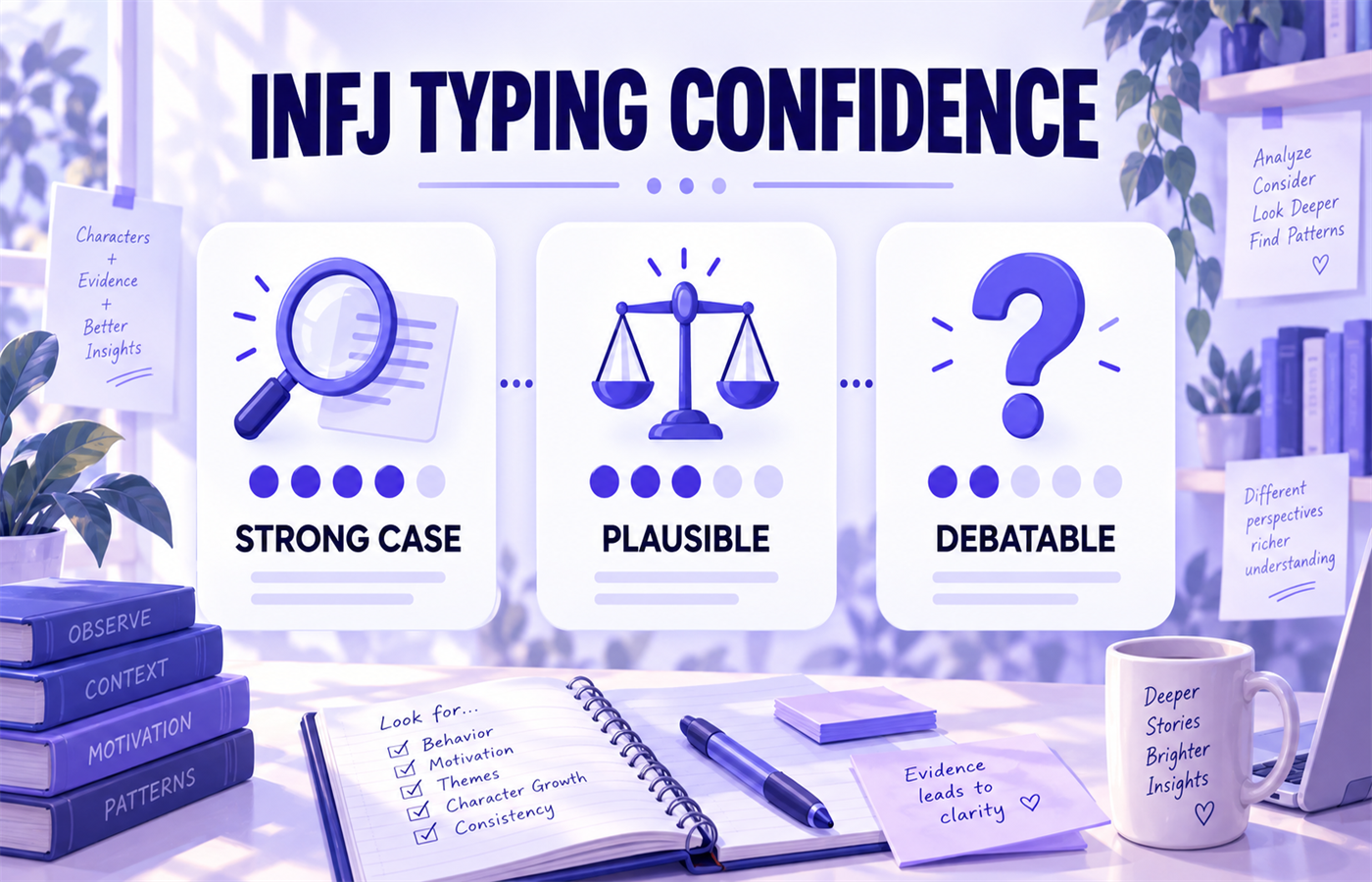
Strong case means the character shows a fairly consistent pattern that supports an INFJ reading within the stated version, while alternatives fit less well.
Plausible means meaningful INFJ evidence exists, but another type also explains the character reasonably well.
Debatable means INFJ is a popular or defensible reading, but the evidence is mixed, adaptation-dependent, or equally compatible with another type.
For INFJ characters, these labels are editorial judgments, not scientific scores.
Adaptations matter
Some INFJ characters change across versions. A literary Galadriel is not identical to every screen portrayal. Comic-book Matt Murdock has decades of material that cannot simply be blended with one television adaptation. Princess Zelda is also portrayed differently across games.
Whenever version differences matter, this guide names the scope rather than pretending all INFJ characters have one universal profile.
TalentRank reflection: Relating to fictional personalities can be fun, but it does not establish your own type. If you want a more structured view of your own traits, explore the TalentRank assessment (https://www.talentrank.io/assessment-lander) as another self-reflection tool.
INFJ Anime Characters
Anime is one of the strongest subtopics around INFJ characters, and it is also where fan typing becomes especially competitive. The best INFJ characters in anime are not simply soft-spoken or intelligent. They show a recurring combination of inward reflection, long-term meaning, concern for people, and structured action.
Armin Arlert (Attack on Titan)
Confidence: Strong case
Strongest alternative: INTP
Armin is one of the more defensible INFJ anime characters because his strategic thinking is repeatedly tied to human consequences. He notices possibilities other people miss, imagines future scenarios, and often frames decisions around what they mean for the group rather than personal status.
The case is not perfect. His analytical style is strong enough that INTP is a reasonable alternative. The INFJ reading becomes stronger when his planning is viewed together with his guilt, empathy, and willingness to take responsibility for choices that affect other people.
Itachi Uchiha (Naruto)
Confidence: Plausible
Strongest alternative: INTJ
Itachi is commonly typed as INFJ because he lives around a long-range internal vision that other characters cannot initially see. He suppresses his own reputation, accepts isolation, and makes extreme choices in the name of a larger outcome.
The difficulty is that the same traits can look very INTJ. His secrecy, strategic detachment, and willingness to carry out harsh plans can support a Thinking-oriented interpretation. Calling him a confirmed INFJ would overstate the evidence. Among popular INFJ characters, he is better treated as a high-profile, plausible case.
Norman (The Promised Neverland)
Confidence: Strong case
Strongest alternative: INTJ
Norman combines strategy with unusually strong attention to the emotional stakes of his plans. He thinks several steps ahead, reads people well, and frequently balances efficiency against the consequences for those he cares about.
That combination makes him a stronger INFJ case than characters who are typed primarily because they are “smart and quiet.” INTJ remains a reasonable alternative because of his planning ability and decisiveness, but his interpersonal orientation makes the INFJ interpretation persuasive.
Kaworu Nagisa (Neon Genesis Evangelion)
Confidence: Plausible
Strongest alternative: ENFJ
Kaworu is calm, symbolic, unusually accepting, and intensely attentive to Shinji’s emotional world. Fans often read him as INFJ because he seems to understand people beneath the surface and speaks in broad, meaning-heavy terms.
His limited screen time makes certainty difficult. ENFJ is also plausible because his interpersonal focus is so explicit. He is a good example of why a memorable emotional presence is not enough to create a “Strong case” label.
Tamayo (Demon Slayer)
Confidence: Plausible
Strongest alternative: ISFJ
Tamayo is restrained, compassionate, careful, and committed to a long-term moral purpose. She works patiently toward a goal that is larger than her own immediate survival and shows concern for the people affected by demons.
Her methodical care can also support an ISFJ reading. She fits the INFJ pattern best when her long-term purpose and willingness to work quietly behind the scenes are emphasized rather than simply her kindness.
Kagaya Ubuyashiki (Demon Slayer)
Confidence: Strong case
Strongest alternative: ENFJ
Kagaya is often read as an INFJ because he combines calm interpersonal influence with a long-range understanding of the conflict around him. He motivates others without dominating them and appears to organize decisions around a future he may never personally see.
ENFJ is a reasonable alternative because his leadership is highly relational. The INFJ case rests on how much of that leadership appears inwardly planned and quietly future-oriented rather than socially expansive.
Johan Liebert (Monster)
Confidence: Debatable
Strongest alternative: INTJ
Johan is useful because he breaks the assumption that INFJ characters must be kind or heroic. Personality type does not determine morality.
Some fans type Johan as INFJ because of his ability to read people, understand emotional vulnerabilities, and act around an abstract worldview. Others see INTJ or another type as a better explanation of his detachment and calculated behavior. He belongs in the “Debatable” category precisely because the INFJ label can become too easy when “psychologically perceptive” is mistaken for one specific type.
Izuku Midoriya (My Hero Academia)
Confidence: Debatable
Strongest alternative: INFP
Deku is compassionate, reflective, observant, and strongly motivated by an ideal of helping people. Those traits can produce an INFJ reading, especially when combined with his habit of analyzing others and thinking about future outcomes.
However, his emotional openness and personal idealism can also make INFP convincing. He is a high-recognition example, but not one that should be presented as settled.
Haku (Spirited Away)
Confidence: Plausible
Strongest alternative: ISFJ
Haku is reserved, protective, purposeful, and willing to act quietly in Chihiro’s interest. His role is built around memory, identity, loyalty, and helping another person navigate a confusing world.
Because he has limited narrative space compared with long-running anime characters, the INFJ reading remains plausible rather than definitive.
INFJ Movie and TV Characters
Movie and television INFJ characters can be easier to debate because viewers see performance, dialogue, editing, and adaptation choices together. The key is to separate the actor’s presentation from the character’s repeated motives.
Louise Banks (Arrival)
Confidence: Strong case
Strongest alternative: INFP
Louise Banks is one of the clearest movie examples. She approaches an unfamiliar intelligence through language, patience, pattern recognition, and empathy rather than force. Her story is also deeply concerned with meaning, time, grief, and accepting the consequences of knowledge.
An INFP interpretation can work because her inner emotional life is central. The INFJ case becomes stronger when her pattern-seeking, future perspective, and ability to translate between people are considered together.
Obi-Wan Kenobi (Star Wars)
Confidence: Plausible
Scope: Main film/television canon
Strongest alternative: ISFJ
Official Star Wars material describes Obi-Wan as a noble Jedi Master, mentor to Anakin Skywalker, general during the Clone Wars, and later a guide to Luke Skywalker. It also repeatedly portrays restraint under loss and a long commitment to protecting others. Source note: StarWars.com Databank.
Those qualities can support an INFJ reading: duty is tied to a broader vision, mentorship matters deeply, and emotion is usually controlled rather than absent. ISFJ remains a serious alternative because tradition, loyalty, and responsibility are also central to his character.
Remus Lupin (Harry Potter)
Confidence: Plausible
Scope: Primarily the book portrayal
Strongest alternative: INFP
Lupin is observant, empathetic, understated, and especially good at helping younger characters without making himself the center of attention. He tends to anticipate emotional reactions and often chooses restraint even when he is personally hurt.
His tendency to withdraw because of shame and fear of burdening others can also resemble an INFP pattern. He is a plausible INFJ rather than an unquestionable one.
Matt Murdock (Daredevil)
Confidence: Plausible
Scope: Live-action Daredevil portrayal
Strongest alternative: ISFJ
Matt Murdock is organized around a moral mission that constantly conflicts with his actions. He is private, intense, idealistic, and unusually sensitive to the suffering around him, yet he is also willing to enter violent situations when he believes ordinary systems are failing.
That tension between inner values, service, guilt, and action is why he is often included among INFJ characters. Different comic and screen versions can support different interpretations, so the adaptation matters.
Michael Scofield (Prison Break)
Confidence: Plausible
Strongest alternative: INTJ
Michael is defined by long-range planning, attention to patterns, emotional restraint, and willingness to sacrifice himself for someone he loves. His plans are highly structured, but they are usually organized around protecting people rather than personal power.
INTJ is the obvious alternative because of his strategic competence and detached presentation. The INFJ reading depends on whether his interpersonal motives are treated as the center of the character rather than simply the reason for the plan.
Lexi Howard (Euphoria)
Confidence: Plausible
Strongest alternative: INFP
Lexi is an observer. She watches relationships, interprets them, and eventually turns what she has noticed into a structured creative project. Her quiet social position and tendency to process experience internally make her a plausible INFJ example.
INFP is also reasonable because her personal emotional perspective shapes the way she narrates other people. She is a useful modern example of why INFJ characters cannot be identified from introversion plus creativity alone.
Joe Goldberg (You)
Confidence: Debatable
Strongest alternative: INTJ
Joe is sometimes typed as INFJ because he narrates other people’s motives, creates elaborate future stories, and frames harmful behavior through a distorted idea of care and meaning. He is included here only as a debated example.
His manipulation and planning can support INTJ or other interpretations just as easily. More importantly, his presence makes one point clear: even if a villain is typed INFJ, that says nothing about real INFJs being dangerous or immoral.
INFJ Cartoon, Animation, and Disney Characters
Animation produces some of the most recognizable INFJ characters, but it also produces some of the most disputed typings. Simple visual storytelling can make one personality trait look more dominant than it would in a longer novel or series.
Elsa (Frozen)
Confidence: Debatable
Strongest alternative: INFP
Elsa is commonly typed as INFJ because much of her story revolves around restraint, fear of harming others, emotional privacy, responsibility, and the search for a stable identity. Disney’s current Frozen character page describes her later portrayal as confident, resolved, warm, and in control of her powers. Source note: Disney, Frozen official site.
The INFJ case is plausible, but not settled. INFP can fit her highly personal identity struggle, while other introverted readings are also possible. Elsa is better presented as a famous debated case than a textbook INFJ.
Lisa Simpson (The Simpsons)
Confidence: Plausible
Strongest alternative: INTP
Lisa is idealistic, intellectually curious, socially concerned, and frequently frustrated by environments that do not match her values. She is also drawn to larger questions about ethics, culture, justice, and identity.
Her analytical side is strong enough to support INTP. What gives the INFJ interpretation weight is the consistency with which ideas become moral and social concerns rather than remaining purely intellectual problems.
Bruno Madrigal (Encanto)
Confidence: Plausible
Strongest alternative: INFP
Bruno is withdrawn, sensitive to how others see him, future-oriented by the nature of his gift, and deeply attached to his family despite years of separation. His behavior is shaped by the belief that his presence may hurt people he cares about.
That can look INFJ, but INFP is also plausible because his emotional world is highly personal and identity-focused. The character works best as a nuanced example rather than a “definite INFJ.”
Pocahontas (Disney)
Confidence: Plausible
Strongest alternative: ENFJ
Within Disney’s fictionalized portrayal, Pocahontas is guided by a larger sense of meaning and repeatedly tries to understand conflict from more than one perspective. She seeks a path that can prevent violence rather than simply choosing one group against another.
Her willingness to step publicly into conflict can also support ENFJ. This is another case where the story’s version must be distinguished from the historical person, who should not be typed from a Disney character portrayal.
INFJ Book Characters
Books are especially useful for this topic because readers often have access to a character’s thoughts, motives, and recurring choices. That can make the reasoning behind INFJ fictional characters more transparent than a short screen appearance.
Atticus Finch (To Kill a Mockingbird)
Confidence: Plausible
Strongest alternative: ISTJ
Atticus is principled, restrained, future-conscious, and willing to act on a moral position even when his community resists it. He also tries to teach his children how to understand people before judging them.
The alternative ISTJ reading is strong because duty, consistency, and personal responsibility are central to him. The INFJ case rests on how much weight is given to his perspective-taking and idealistic social purpose.
Jane Eyre (Jane Eyre)
Confidence: Plausible
Strongest alternative: INFP
Jane is deeply introspective and unwilling to abandon her moral boundaries simply because emotion or social pressure pushes in another direction. She wants love, but not at the cost of self-respect or principle.
That combination can support INFJ, while her strong individual values also make INFP a compelling alternative. She illustrates why a serious typing needs more than “quiet and idealistic.”
Jean Valjean (Les Misérables)
Confidence: Plausible
Strongest alternative: ISFJ
Valjean’s life becomes organized around moral transformation, compassion, responsibility, and protection. His decisions repeatedly show a willingness to sacrifice comfort and safety for what he believes is right.
ISFJ can fit his service-oriented loyalty and practical care. INFJ becomes more convincing when his transformation is read as a long-term moral vision that reorganizes his identity and choices.
Galadriel (The Lord of the Rings)
Confidence: Strong case
Scope: Tolkien’s literary portrayal
Strongest alternative: INTJ
Galadriel is one of the stronger literary INFJ characters because she is associated with foresight, restraint, symbolic understanding, and a long view of events. She has significant power, but one of her defining moments is choosing not to take greater power when it would corrupt the purpose she serves.
INTJ is a reasonable alternative because of her strategic distance and authority. The INFJ reading is strongest when her foresight is considered together with moral restraint and concern for the fate of others.
Jay Gatsby (The Great Gatsby)
Confidence: Debatable
Strongest alternative: INFP
Gatsby lives around an internal future-image so powerful that he tries to reshape reality around it. That intense focus on meaning, possibility, and an idealized relationship can look INFJ.
The problem is that his vision is profoundly personal. INFP can therefore explain him just as well, and perhaps better. Gatsby belongs in the debated category because “future-focused idealist” is not enough to establish INFJ.
INFJ Marvel and Superhero Characters
Superhero typing becomes difficult when comics, films, television, alternate universes, and reboots are blended together. For this section, version matters more than popularity.
Matt Murdock / Daredevil
Matt Murdock is already discussed above using the live-action Daredevil portrayal. He remains one of the more interesting INFJ Marvel characters because moral purpose, guilt, service, privacy, and controlled intensity repeatedly collide in the same character.
Marvel’s official character material identifies Matt Murdock as the lawyer and vigilante Daredevil, but it does not assign him an MBTI type. Any INFJ label is therefore editorial or community interpretation rather than official Marvel classification.
Professor X / Charles Xavier
Confidence: Plausible
Scope: Broad modern X-Men portrayal; specific adaptations can differ
Strongest alternative: ENFJ
Professor X is driven by a large social vision: peaceful coexistence between mutants and humans. He is future-oriented, strategic, persuasive, and deeply focused on how individuals fit into a larger social outcome.
ENFJ is a strong alternative because he is often a public leader and teacher. The INFJ case becomes stronger in portrayals that emphasize private vision and long-term strategy over outward charisma.
INFJ Video Game Characters
INFJ characters in games can be difficult to type because player choice sometimes changes behavior. The most useful examples are characters whose core motives remain stable regardless of gameplay.
Princess Zelda (The Legend of Zelda)
Confidence: Plausible
Scope: The franchise contains multiple incarnations; do not treat every Zelda as identical
Strongest alternative: INTJ
Princess Zelda is commonly typed as INFJ because many versions combine duty, wisdom, restraint, and concern for Hyrule’s future. Nintendo’s official Zelda material connects Princess Zelda with the Triforce of Wisdom, but that is a story role, not a personality classification. Source note: Nintendo, The Legend of Zelda official character material.
Because Zelda is reincarnated or reimagined across different eras, a single personality label should be used cautiously. Some versions can look more INTJ, ISFJ, or another type.
Max Caulfield (Life is Strange)
Confidence: Debatable
Strongest alternative: INFP
Max is reflective, observant, empathetic, conflict-averse, and highly concerned with the consequences of her choices. Her photography also reinforces the character’s habit of observing and interpreting rather than immediately acting.
INFP is an especially strong alternative because so much of her decision-making is personal, emotional, and identity-centered. She is a good example of a character who can plausibly sit near the INFJ/INFP debate rather than fitting neatly into one label.
INFJ-T Characters: Does “Turbulent” Change the Typing?
INFJ-T is a label used by 16Personalities. In its NERIS model, the fifth dimension is called Identity, producing Assertive and Turbulent variants such as INFJ-A and INFJ-T. 16Personalities itself describes Turbulent Advocates as more likely to question themselves and be sensitive to stress than Assertive Advocates. Source note: 16Personalities, “Assertive Advocate (INFJ-A) vs. Turbulent Advocate (INFJ-T).”
That does not make INFJ-T an additional standard MBTI preference pair. The Myers-Briggs type code itself uses four preference pairs. For fictional typing, “Turbulent” is best treated as an extra interpretive layer about stress, confidence, and self-evaluation.
So if a database calls Elsa, Deku, or another character “INFJ-T,” that should not be treated as a separate official fictional subtype. It is one framework’s additional label.
Which INFJ Characters Are the Strongest Examples?
The strongest examples are not necessarily the most famous ones. Popularity tells you what fans discuss; it does not tell you how well a typing holds up.
Category | Character | Why they stand out | Confidence |
Strong anime example | Armin Arlert | Combines strategic foresight with moral and interpersonal concern | Strong case |
Strong anime strategist | Norman | Future planning remains tied to protecting others | Strong case |
Strong movie example | Louise Banks | Meaning, empathy, pattern recognition, and future perspective interact consistently | Strong case |
Strong literary example | Galadriel | Foresight, restraint, long-term purpose, symbolic thinking | Strong case |
Most debated popular example | Elsa | Highly recognizable INFJ typing, but INFP and other readings remain plausible | Debatable |
Morally gray / unhealthy debate | Johan Liebert | Shows why type should never be equated with goodness | Debatable |
Adaptation-sensitive example | Princess Zelda | Different incarnations can support different readings | Plausible |
If you want one rule to remember, use this: the best INFJ characters are not simply the ones who look mysterious. They are the ones whose recurring choices connect inward reflection, future meaning, human consequences, and structured action.
TalentRank reflection: If you have spent the article comparing your own reactions with these characters, that can be a useful prompt, but it is still informal. A structured assessment based on your own responses gives you a more direct self-reflection input than fandom typing. Explore the TalentRank assessment (https://www.talentrank.io/assessment-lander).
Frequently Asked Questions About INFJ Characters
What fictional characters are INFJ?
Commonly typed INFJ characters include Armin Arlert, Itachi Uchiha, Norman, Louise Banks, Remus Lupin, Galadriel, Elsa, Matt Murdock, Atticus Finch, and Princess Zelda. Most are not officially classified. Their typings are interpretations based on recurring behavior, motives, relationships, and the version of the character being discussed.
Who are the best INFJ anime characters?
Frequently discussed INFJ anime characters include Armin Arlert, Itachi Uchiha, Norman, Kaworu Nagisa, Tamayo, Kagaya Ubuyashiki, Johan Liebert, Deku, and Haku. Armin and Norman are among the stronger cases in this guide, while characters such as Johan and Deku are more debatable because alternative typings fit them well.
Is Elsa an INFJ?
Elsa is commonly typed as INFJ, but the label is not official and the case is debatable. Her restraint, concern about harming others, inward identity struggle, and sense of responsibility can support an INFJ interpretation. INFP and other introverted readings also explain important parts of her portrayal, so certainty would be misleading. If that distinction interests you, TalentRank’s INFP vs INFJ guide (https://www.talentrank.io/blog/infp-vs-infj) covers the comparison in more depth.
Is Itachi Uchiha an INFJ?
Itachi is often typed as INFJ because of his long-range planning, emotional restraint, hidden sacrifice, and focus on a larger outcome. INTJ is a strong alternative because the same character is highly strategic and capable of severe, detached decisions. The most accurate wording is that INFJ is plausible, not confirmed. For the broader type distinction, see TalentRank’s INTJ vs INFJ guide (https://www.talentrank.io/blog/intj-vs-infj).
Are there villainous or unhealthy INFJ characters?
Yes, at least in fan and editorial typing. Johan Liebert and Joe Goldberg are sometimes placed in INFJ discussions, although both are highly debatable. More importantly, personality type does not determine morality. A fictional villain receiving an INFJ label says nothing about real people with that type being dangerous or unethical.
What does INFJ-T mean for fictional characters?
INFJ-T is 16Personalities terminology. The “T” means Turbulent on its Identity dimension, which it uses in addition to the four familiar letters. For fictional characters, it is best treated as an extra interpretation about stress, confidence, or self-evaluation rather than a separate official MBTI subtype.
Are fictional character MBTI typings official?
Usually not. Most fictional MBTI typings are fan or editorial interpretations based on dialogue, motives, choices, relationships, and recurring behavior. TalentRank uses the same cautious approach in its INFP characters guide (https://www.talentrank.io/blog/infp-characters). A typing should only be called official when a creator, publisher, licensed guide, or other authoritative source explicitly provides it. Popular database votes alone do not make a typing official.
Final Takeaway
The most useful way to read lists of INFJ characters is as interpretation, not proof. Armin Arlert, Norman, Louise Banks, and literary Galadriel make relatively strong cases in this guide, while Elsa, Johan Liebert, Deku, and Max Caulfield are better treated as debated examples. Different adaptations can also change the answer. If you enjoy comparing fictional personalities, use those comparisons as a prompt to notice patterns rather than a shortcut to certainty. And if you want to explore your own traits in a more structured way, TalentRank can give you a broader personality profile (https://www.talentrank.io/assessment-lander) based on your own responses rather than a fictional-character match.
---