

ENTJ characters are often written as commanders, executives, reformers, strategists, and people who push a story toward a concrete outcome. Erwin Smith, Roy Mustang, Miranda Priestly, Tywin Lannister, Number Five, and Thomas Shelby are frequently discussed through an ENTJ lens. But a forceful personality, a leadership title, or a talent for strategy is not enough to establish the type.
A better way to read fictional personality is to look for repeated decisions, underlying motives, context, and plausible alternatives. That matters especially for debated characters such as Light Yagami and Harvey Specter. Fictional typing is interpretation rather than a confirmed assessment result, so this guide focuses on the reasoning behind the label instead of treating four letters as canon.

Quick List of ENTJ Characters
Character | Story | Why the ENTJ reading appears | Status |
Erwin Smith | Attack on Titan | Long-range objectives, external coordination, decisive execution | Strong interpretation |
Roy Mustang | Fullmetal Alchemist | Institutional reform goals paired with organized action | Common attribution |
Light Yagami | Death Note | Large-scale goals and control-oriented execution | Debated: ENTJ / INTJ |
Miranda Priestly | The Devil Wears Prada | Standards, decisions, delegation, and external organization | Common attribution |
Tywin Lannister | Game of Thrones | Dynastic goals, systems of power, and strategic implementation | Common attribution |
Number Five | The Umbrella Academy | Goal-focused planning under pressure and rapid coordination | Common attribution |
Thomas Shelby | Peaky Blinders | Long-horizon plans translated into organized action | Common attribution |
Harvey Specter | Suits | Fast decisions, confidence, competition, and outcome focus | Debated: ENTJ / ESTP |
What Makes a Fictional Character Seem ENTJ?
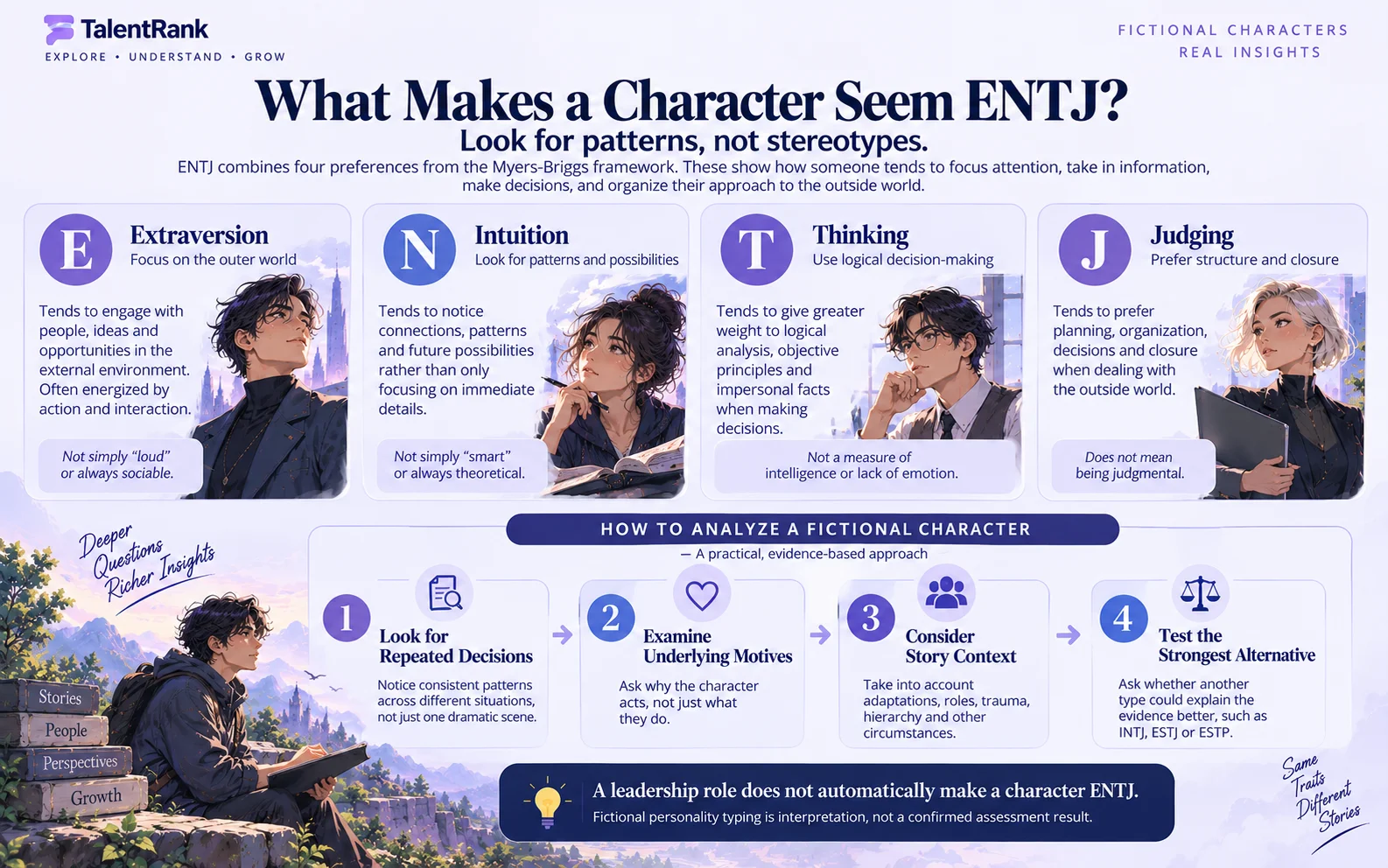
ENTJ is a four-letter MBTI type built from Extraversion, Intuition, Thinking, and Judging. In the Myers-Briggs framework, these letters describe preferences for directing attention, taking in information, making decisions, and approaching the outer world. Thinking is not a synonym for intelligence, and Judging does not mean being judgmental.
For framework context, see TalentRank's Big Five vs MBTI guide and the official Myers-Briggs explanation of MBTI preferences.
Start With the Four ENTJ Preferences
Extraversion points attention toward the outer world and engagement with people, activity, or external systems. It does not require a character to be constantly social or loud.
Intuition favors patterns, possibilities, implications, and the bigger picture rather than relying only on immediate concrete detail. A clever plan by itself does not prove Intuition.
Thinking gives more weight to logic and objective principles when reaching conclusions. It should not be reduced to coldness, cruelty, or intelligence.
Judging describes a preference for structure, decisions, planning, and closure in the outer world. It does not mean that an ENTJ must be rigid in every situation.
Leadership and Strategy Are Not Enough
Stories make leaders easy to notice. They give orders, make consequential choices, and often explain their plans aloud. That creates a visibility bias: a commander can look more 'ENTJ' than a quieter character even when the underlying personality evidence is mixed. The useful question is not whether a character leads. It is how they repeatedly gather information, decide, organize action, and respond when reality disrupts the plan.
Fictional ENTJ Typing Is Interpretation, Not Confirmation
Real MBTI best-fit work involves a person reviewing and deciding what type fits them best. Fictional characters cannot complete that process, and writers may never have intended a type at all. Adaptations can also change motives, dialogue, and behavior. Treat every label here as an interpretation of the text or screen portrayal, not a diagnosis or official result.
Curious about your own patterns rather than a fictional label? TalentRank's assessment explores your own responses through a trait-based personality approach and other assessment components. It does not confirm whether you are an ENTJ.
ENTJ Anime Characters
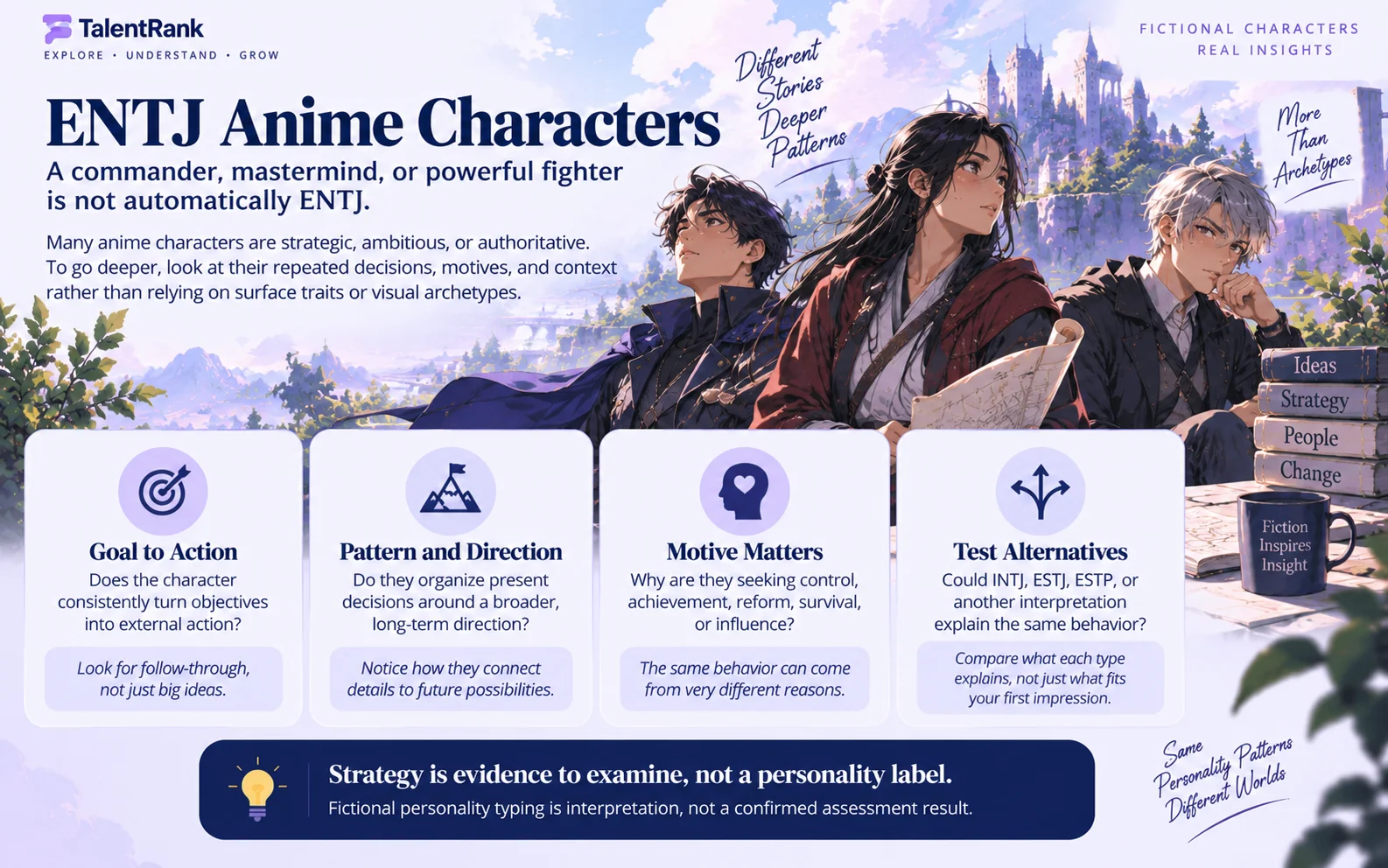
Anime is full of commanders, masterminds, ambitious rivals, and powerful fighters, which makes stereotype-based typing especially tempting. A character should not be called ENTJ simply because they dominate a room or plan several moves ahead. Look for the pattern behind the role.
Erwin Smith, Attack on Titan
Erwin Smith is one of the cleaner ENTJ interpretations in popular anime discussion because his characterization repeatedly connects a long-range objective with external organization. He coordinates people and resources, makes decisions under extreme uncertainty, and accepts the practical consequences of pursuing a larger goal.
What makes the case more useful than 'he is a commander' is consistency. His role certainly shapes his behavior, but the ENTJ reading rests on how he repeatedly turns an abstract objective into organized collective action. Practical Typing has published a dedicated ENTJ analysis of Erwin, making the reasoning easier to inspect than a database vote or unsourced list.
Read the independent Erwin Smith ENTJ analysis
Roy Mustang, Fullmetal Alchemist
Roy Mustang is frequently interpreted as ENTJ because his ambition is tied to institutional change rather than status alone. He builds alliances, navigates a hierarchy, plans around political constraints, and tries to convert a future vision into practical reform.
The important distinction is motive. 'Ambitious military officer' is a trope, not a type. The ENTJ case becomes stronger when the analysis follows how Roy organizes people and action around a larger objective across the story. His humor, loyalty, anger, and vulnerability do not contradict an ENTJ interpretation; personality preferences do not erase emotional complexity.
Light Yagami, Death Note: ENTJ or INTJ?
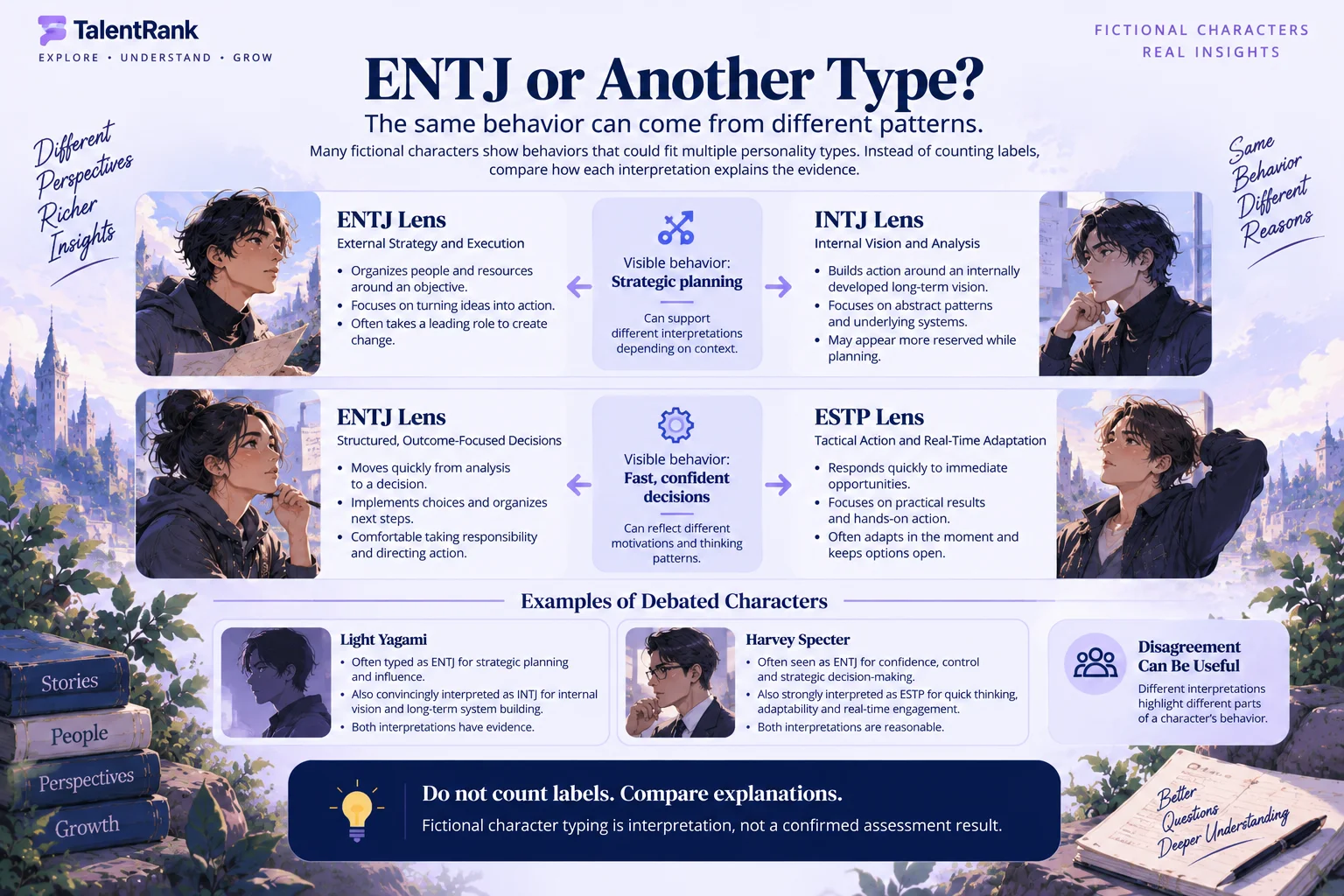
Light Yagami is a useful example of why fictional typing should allow disagreement. An ENTJ interpretation emphasizes his drive to impose an external order, control systems and people, and turn a sweeping objective into active execution. An INTJ interpretation emphasizes internally developed vision, private strategic modeling, and the way he can appear self-contained.
Both readings can point to genuine evidence, which is why simply counting websites that use one label does not settle the question. The stronger exercise is to compare what each interpretation explains, where each struggles, and whether the analysis is using the same version of the character.
Additional ENTJ Anime Characters Worth Considering
Other names commonly discussed through an ENTJ lens include Madara Uchiha, Katsuki Bakugo, Mei Mei, Yami Yugi, Esdeath, and Satsuki Kiryūin. These are better treated as candidates for analysis than as a checklist of confirmed types. Satsuki in particular is often debated against INTJ interpretations. For every candidate, ask what remains after you remove power, combat ability, ambition, and narrative role.
ENTJ Characters in Animation
Animation outside Japanese anime creates the same challenge. Characters with authority, intensity, or a commanding presence are often typed ENTJ quickly. Azula and Princess Carolyn, for example, appear in personality discussions because they are highly goal-directed and exert strong influence on their environments. Yet their motives, emotional histories, and story contexts differ dramatically.
That difference matters. The goal is not to force every decisive animated character into one type. It is to identify a repeated preference pattern while keeping alternative interpretations open.
ENTJ Movie Characters
Miranda Priestly, The Devil Wears Prada
Miranda Priestly is commonly typed ENTJ because her characterization centers on standards, rapid decisions, delegation, hierarchy, and control of an external professional system. She expects people around her to anticipate needs and execute without lengthy negotiation.
But 'demanding executive' is not evidence by itself. Her job rewards authority and decisiveness. A stronger reading asks whether the same organized, outcome-focused pattern appears consistently and whether another type explains her priorities better. The distinction keeps the analysis focused on personality rather than equating corporate power with ENTJ.
ENTJ TV Characters
Tywin Lannister, Game of Thrones
Tywin Lannister is often read as ENTJ because he treats family power as a system to manage. He thinks in terms of alliances, legacy, resources, political leverage, and long-term consequences, then pushes those calculations into action through other people.
His ruthlessness is not what makes the interpretation. Morality and personality type are separate questions. It is also important to distinguish the television portrayal from the book continuity, since adaptations can emphasize different aspects of a character.
Number Five, The Umbrella Academy
Number Five combines long-range problem solving with urgent external execution. He frequently identifies a looming objective, cuts through competing priorities, and tries to coordinate other people around what he sees as necessary action. That pattern makes an ENTJ interpretation understandable even though his abrasive style alone proves nothing.
His unusual circumstances are also a reminder to separate personality from plot pressure. Extreme stakes can make almost any character more directive, impatient, or controlling than they would appear in ordinary conditions.
Thomas Shelby, Peaky Blinders
Thomas Shelby is regularly associated with strategic, future-oriented thinking and the ability to turn plans into coordinated action. His decisions often involve organizations, alliances, resources, and consequences that extend well beyond the immediate scene.
At the same time, trauma, criminal hierarchy, family obligation, and survival pressure shape his behavior. Those factors should not be converted into personality evidence. The most defensible analysis focuses on recurring decision patterns while acknowledging how much the story context influences what viewers see.
Harvey Specter: ENTJ or ESTP?
Harvey Specter is another useful disputed case. ENTJ readings emphasize his confidence, competitive goals, decisive style, and ability to move people toward outcomes. ESTP interpretations instead emphasize tactical responsiveness, direct engagement with the immediate situation, risk tolerance, and a preference for acting on what is happening now.
Practical Typing has argued for ESTP, which makes Harvey a good reminder that outward confidence and fast decision-making do not uniquely identify ENTJ. The disagreement is more informative than pretending the label is settled.
See the alternative Harvey Specter analysis
ENTJ K-Drama Characters
K-dramas add another useful context because hierarchy, family expectations, workplace roles, and social obligations can strongly shape visible behavior. Editorial personality guides have proposed several ENTJ interpretations, but these examples should be handled carefully rather than treated as confirmed types.
A demanding executive may be responding to workplace hierarchy. A highly controlled character may be coping with unusual pressure. A reform-minded leader may look similar to an ENTJ for narrative reasons while being motivated by a different preference pattern. K-drama examples are therefore most useful when the analysis separates cultural and story context from recurring personality choices.
ENTJ Characters Beyond the “Commander” Stereotype
ENTJ is sometimes flattened into a fictional archetype: powerful leader, genius strategist, ruthless CEO, mastermind, or villain. Those shortcuts are attractive because they are easy to recognize, but they confuse visible behavior with the reasons behind it.
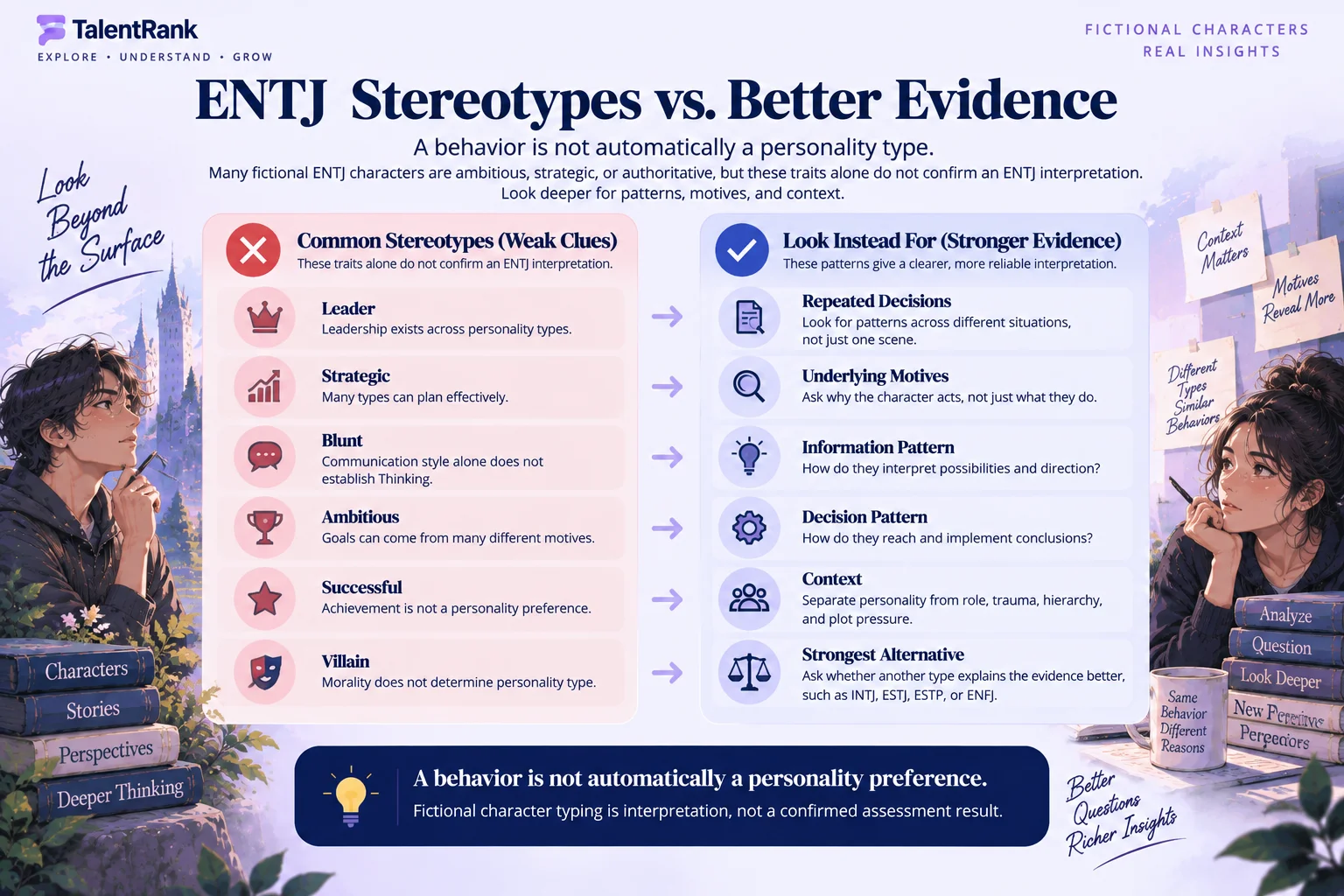
A healthy or mature ENTJ interpretation does not require domination. A character can coordinate people without humiliating them, pursue ambitious goals without treating relationships as disposable, and revise a plan when evidence changes. Likewise, a villain can be any personality type. Cruelty, manipulation, and moral choices are not MBTI preferences.
The same applies to intelligence and success. Thinking is a decision preference, not an IQ score. Intuition is not a synonym for genius. Judging does not guarantee organization in every area of life. Extraversion does not guarantee charisma. Removing these shortcuts creates more interesting character analysis.
ENTJ Characters That Are Commonly Debated or Mistyped
Disagreement is not a flaw in fictional typing. It can reveal which pieces of evidence actually matter. The table below keeps the alternatives visible instead of declaring a winner where the interpretation remains contested.
Character | ENTJ reading | Common alternative |
Light Yagami | External control and execution of a sweeping objective | INTJ: internally developed long-range vision |
Harvey Specter | Outcome focus, confidence, decisive external action | ESTP: tactical responsiveness and immediate engagement |
Satsuki Kiryūin | Command, organization, long-range objectives | INTJ: private vision and strategic independence |
Margaery Tyrell | Political coordination and goal-directed influence | ENFJ: relationship-centered influence and social attunement |
Fictional motives have to be inferred. Your own assessment can use your own responses instead. Explore TalentRank's assessment if you want a trait-based view of your personality rather than a fictional MBTI label.
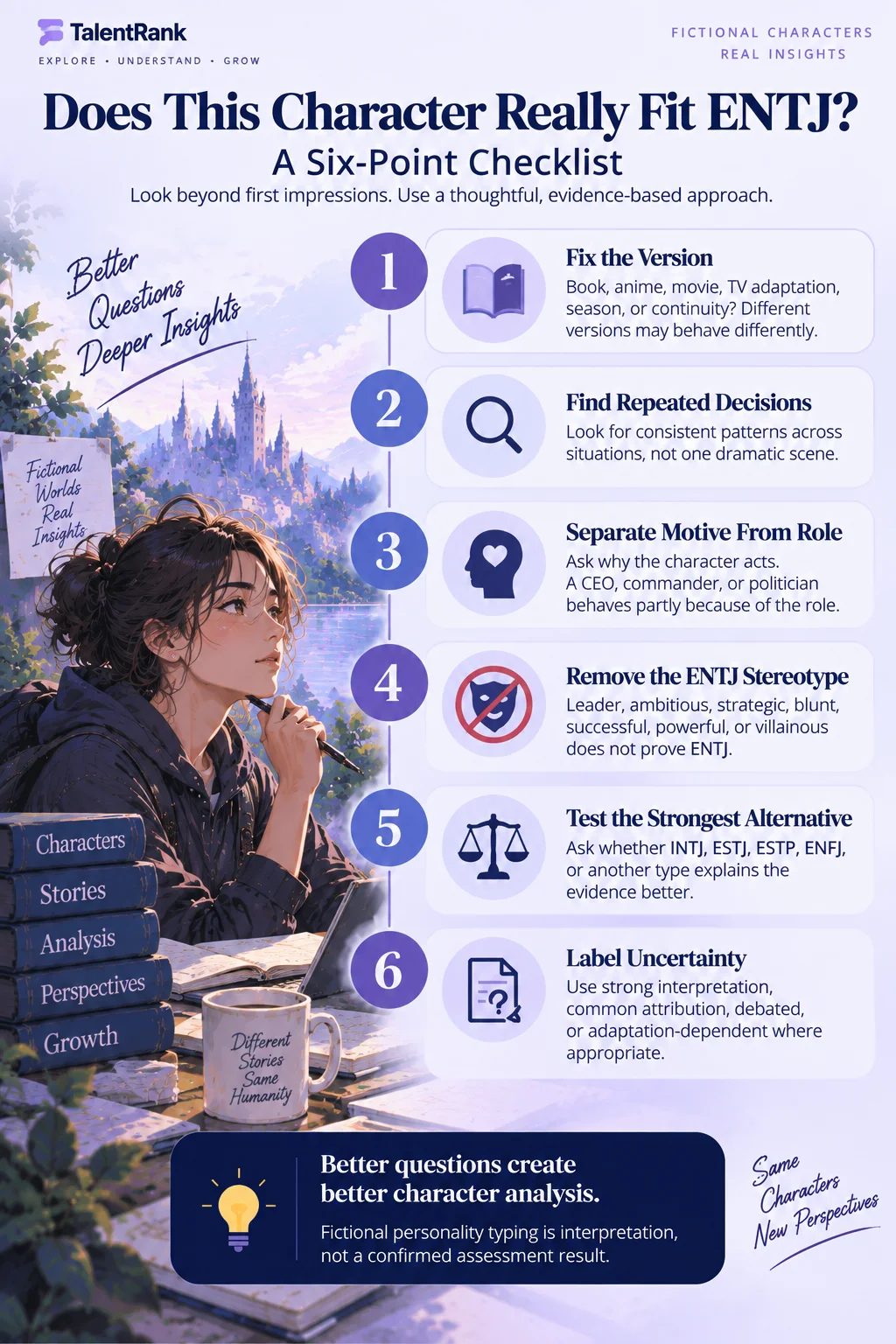
Does This Character Really Fit ENTJ? A Six-Point Checklist
1. Fix the Version
Identify the book, anime, film, television adaptation, season, remake, or continuity you are analyzing. Different versions can change motives and behavior enough to change the interpretation.
2. Find Repeated Decisions
One dramatic scene is rarely enough. Look for choices that recur across different stakes, relationships, and situations.
3. Separate Motive From Role
Ask why the character acts. A CEO, commander, politician, criminal leader, or student council president behaves partly because the role demands it.
4. Remove the ENTJ Stereotype
Mentally remove labels such as leader, ambitious, strategic, blunt, successful, powerful, and villainous. If the ENTJ case disappears, the original argument was probably relying on an archetype.
5. Test the Strongest Alternative
Compare the ENTJ interpretation with the most plausible alternative, such as INTJ, ESTJ, ESTP, ENFJ, or another type. Ask which explanation accounts for more of the repeated evidence with fewer stereotype-based assumptions.
6. Label Uncertainty
Use language that matches the evidence: strong interpretation, common attribution, debated, or adaptation-dependent. Fictional typing becomes more useful when uncertainty is visible rather than hidden.
Why Are ENTJ Characters Often Written as Leaders or Villains?
Leadership and antagonism are narratively efficient. A decisive character can create conflict, move organizations, force other characters to respond, and make long-term goals visible to the audience. Those roles naturally highlight behaviors that readers associate with ENTJ.
That does not tell us how common ENTJs are among real leaders, villains, or any other population. Fiction selects for dramatic usefulness, not representative sampling. It also tends to make external action easier to see than private reflection, which can exaggerate the apparent connection between ENTJ and authority.
The more interesting question is how writers vary the pattern. Some ENTJ interpretations are reformers, some protect institutions, some pursue personal power, and some use organization in service of people they care about. Similar methods can serve very different motives and moral choices.
FAQs About ENTJ Characters
What are ENTJ characters?
ENTJ characters are fictional people interpreted through the Myers-Briggs ENTJ preference pattern: Extraversion, Intuition, Thinking, and Judging. The label is an interpretation of recurring characterization, not a confirmed assessment result.
Who are popular ENTJ anime characters?
Erwin Smith and Roy Mustang are frequently discussed as ENTJ examples. Light Yagami is also widely associated with ENTJ but has a substantial INTJ alternative interpretation. Other candidates vary in evidential strength.
Is Erwin Smith an ENTJ?
Erwin has a comparatively strong ENTJ interpretation because his characterization repeatedly combines long-range objectives with external coordination and decisive implementation. That remains an interpretation rather than an official psychological result.
Is Roy Mustang an ENTJ?
Roy Mustang is commonly interpreted as ENTJ because his future goals are tied to organized institutional action. His military rank alone is not sufficient evidence; the stronger case comes from his repeated decision pattern and reform-oriented objectives.
Is Light Yagami ENTJ or INTJ?
Both interpretations are common. ENTJ readings emphasize external control and execution, while INTJ readings emphasize an internally developed vision and private strategic orientation. The disagreement is best treated as a genuine debate rather than resolved by popularity.
Is Harvey Specter an ENTJ?
Harvey is often typed ENTJ, but ESTP is a meaningful alternative. The distinction depends on whether his recurring pattern is better explained by structured long-range execution or rapid tactical engagement with immediate circumstances.
Are most ENTJ characters villains or leaders?
No reliable evidence establishes that. Fiction often makes leaders and antagonists highly visible because they move plots forward, and online typing lists can amplify that stereotype. Villainy and leadership are not personality preferences.
Does being strategic or ambitious make a character ENTJ?
No. Many personality types can be strategic or ambitious. A stronger analysis looks at repeated decisions, motives, information preferences, implementation style, context, and plausible alternative types.
Can a fictional character be a confirmed ENTJ?
Usually not in the same sense as a real person completing and reviewing an assessment. An author may describe a character using a type label, but that still differs from a real best-fit assessment process. For most fictional characters, the responsible wording is interpretive.
Final Takeaway
The best ENTJ character analysis goes beyond the commander archetype. Erwin Smith, Roy Mustang, Miranda Priestly, Tywin Lannister, Number Five, Thomas Shelby, Light Yagami, and Harvey Specter are interesting not because they all look powerful, but because comparing their decisions, motives, contexts, and alternatives reveals where an ENTJ interpretation becomes stronger or weaker.
Use the six-point checklist whenever a new name appears on an ENTJ list: fix the version, follow repeated decisions, separate motive from role, remove the stereotype, test the strongest alternative, and label uncertainty. That approach keeps fictional personality typing useful as a way to ask better questions about characters without pretending the label is a diagnosis or destiny.