


ISTJ Characters: Fictional, Anime, Movie, and TV Examples Explained
ISTJ characters are often portrayed as practical, dependable, detail-conscious, and structured. Kento Nanami, Ned Stark, Raymond Holt, Violet Evergarden, Giyu Tomioka, and Mikasa Ackerman are among the fictional characters commonly interpreted as ISTJ. But those labels are interpretations, not confirmed personality assessment results. A useful analysis looks beyond whether a character is quiet, serious, loyal, or good at following rules.
That is the approach used here. Instead of building the biggest possible list, we will look at recurring decisions, information preferences, decision criteria, planning, story context, and credible alternative typings. Adaptations matter too. A novel, movie, television, game, or anime version can provide different evidence, so a fictional typing is best treated as an informed reading rather than a settled fact.
Quick List of ISTJ Characters
The confidence labels below describe the strength of the editorial interpretation in this article. They are not personality test scores or probabilities.
Character | Work | Medium | Interpretation | Why it is plausible |
Kento Nanami | Jujutsu Kaisen | Anime/manga | Stronger case | Practical judgment, responsibility, measured methods |
Ned Stark | A Song of Ice and Fire / Game of Thrones | Books/TV | Stronger case | Duty, consistency, established commitments |
Raymond Holt | Brooklyn Nine-Nine | TV | Stronger case | Procedure, measured decisions, consistency |
Violet Evergarden | Violet Evergarden | Anime/light novel | Plausible | Precision, concrete detail, methodical work |
Giyu Tomioka | Demon Slayer | Anime/manga | Plausible | Duty, discipline, structured responsibility |
Mikasa Ackerman | Attack on Titan | Anime/manga | Debated | Concrete action and discipline, with strong context effects |
Hermione Granger | Harry Potter | Books/films | Debated | Preparation, learned information, rules, organization |
Thorin Oakenshield | The Hobbit | Book/film | Plausible | Duty, precedent, inherited obligations |
Inspector Javert | Les Misérables | Novel/adaptations | Plausible | Reliance on established systems and structure |
Carl Fredricksen | Up | Animation | Plausible | Routine, commitments, attachment to established experience |
A character appearing on a popular list does not establish a personality type. The reasoning matters more than the vote count.
What Makes a Character Seem ISTJ?
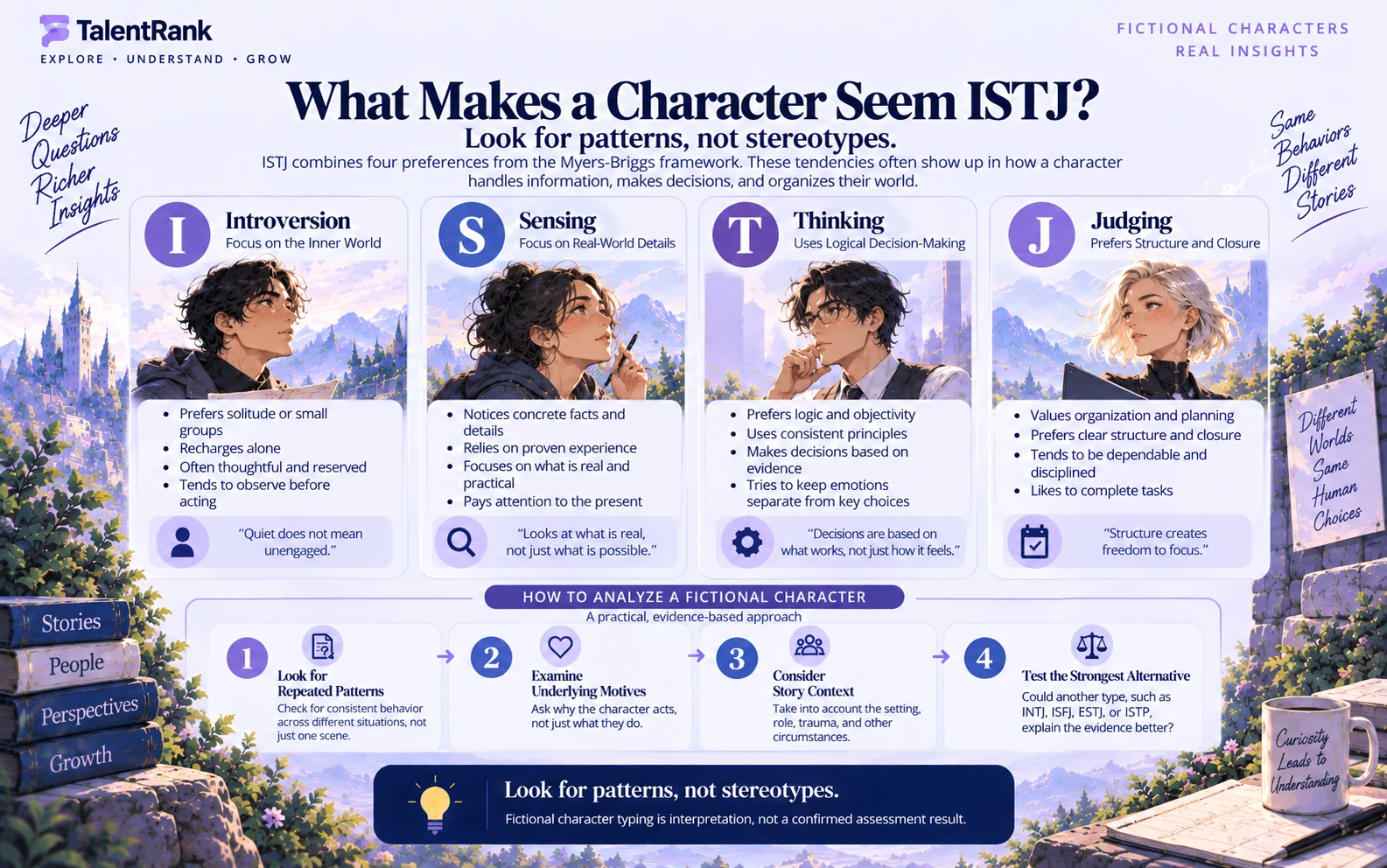
In the Myers-Briggs framework, ISTJ combines Introversion, Sensing, Thinking, and Judging. The Myers & Briggs Foundation describes ISTJ as practical, realistic, responsible, logical in deciding what should be done, and steady in working toward it. Those descriptions are more useful when treated as patterns, not stereotypes.
Introversion Does Not Simply Mean Quiet
Within MBTI terminology, Introversion concerns where attention and energy are naturally directed. It should not be reduced to shyness, silence, social anxiety, or dislike of other people. TalentRank's E vs I guide explores that distinction in more detail. A fictional character may speak little because of trauma, secrecy, role expectations, or writing style, none of which settles the personality question.
Sensing Does Not Mean Unimaginative
The official MBTI preference guide describes Sensing as paying more attention to concrete, tangible information, specific details, facts, and experience. Intuition gives more attention to patterns, possibilities, connections, and the big picture. TalentRank's S vs N guide gives practical examples of the difference. A character does not become ISTJ merely because they are practical. Look for the information they repeatedly notice and trust.
Thinking Does Not Mean Emotionless
Thinking and Feeling describe decision-making preferences in MBTI theory. Thinking gives more weight to objective principles and impersonal facts, while Feeling gives more weight to personal concerns, values, and the people involved. Neither is a measure of intelligence or emotional capacity. TalentRank's T vs F guide addresses this common misconception.
Judging Does Not Mean Judgmental
Judging refers to a preference for structure, decisions, and closure in dealing with the outside world. It does not mean being critical or judgmental. The J vs P guide explains why the final letter is more nuanced than organized versus spontaneous. For fictional analysis, the useful question is how a character deals with plans and external organization when meaningful choices are available.
ISTJ Anime Characters
Kento Nanami, Jujutsu Kaisen
Kento Nanami is one of the more coherent ISTJ interpretations in this group. His practical risk calculations, preference for reliable methods, attention to schedules, and strong sense of responsibility make the reading plausible. The important evidence is not his suit, serious expression, or dislike of overtime. Those are memorable details, but they do not establish a personality type.
A stronger case comes from the way Nanami repeatedly assesses what is workable, controls unnecessary risk, sets boundaries, and fulfills responsibilities even when he dislikes the system around him. His willingness to reject an institution while remaining methodical also complicates the stereotype that an ISTJ simply obeys authority.
Interpretation: Stronger case.
Mikasa Ackerman, Attack on Titan
Mikasa Ackerman is frequently interpreted as ISTJ because of her reserve, discipline, rapid execution, focus on immediate threats, and intense loyalty. Yet she is also a useful example of why context matters. Her behavior develops under extreme conditions involving childhood loss, warfare, survival, and her relationship with Eren.
Loyalty alone does not demonstrate Sensing, Thinking, or Judging. Being a disciplined soldier is also weak evidence by itself because military environments reward disciplined behavior across personality types. ISFJ and ISTP are reasonable alternatives to examine, especially when comparing what drives her choices rather than how controlled she appears.
Interpretation: Debated.
Giyu Tomioka, Demon Slayer
Giyu Tomioka is another common ISTJ candidate. His disciplined approach, responsibility, reserve, and commitment to the Demon Slayer Corps can support the interpretation. Still, quietness and duty are not enough. A more useful reading asks how he applies established training, handles responsibility, and maintains commitments when doing so is personally difficult.
His story also gives reasons for self-doubt and emotional restraint that should not automatically be attributed to personality type.
Interpretation: Plausible.
Violet Evergarden, Violet Evergarden
Violet is often interpreted as ISTJ because of her precision, attention to wording, reliance on instructions, formality, and methodical work. She also presents one of the clearest context problems in the article. Her early behavior cannot be separated neatly from her upbringing as a child soldier and her attempt to understand a civilian world that is unfamiliar to her.
Her development as an Auto Memory Doll is more informative than the fact that she initially follows orders. She learns from repeated experiences, approaches her work carefully, and gradually develops a richer understanding of language and emotion. That makes an ISTJ interpretation plausible, but following instructions should never be the central argument.
Interpretation: Plausible.
ISTJ Characters in Movies and TV
Ned Stark, Game of Thrones
Ned Stark is commonly interpreted as ISTJ because duty, responsibility, consistency, and established obligations shape so many of his decisions. The more interesting evidence appears when law, family, honor, and political survival conflict. He does not simply follow whichever authority is closest. He chooses among competing commitments and accepts substantial personal costs for duties he considers real.
Calling Ned ISTJ merely because he is traditional would flatten the character. His repeated decision pattern makes the case more interesting than the surface stereotype.
Interpretation: Stronger case.
Raymond Holt, Brooklyn Nine-Nine
Captain Raymond Holt is another persuasive ISTJ interpretation. His methodical leadership, respect for procedure, careful language, consistency, and long-term commitment to professional standards all fit the reading. At the same time, his relationships and dry humor are useful reminders that structure and affection are not opposites.
Holt also shows why occupation should not drive the typing. A police captain may value procedure because the role requires it. The stronger evidence is that Holt's measured, structured approach remains visible across professional, social, and personal situations.
Interpretation: Stronger case.
ISTJ Characters in Books, Animation, and Games
Thorin Oakenshield is often read through duty, inherited responsibility, precedent, and his commitment to reclaiming his people's home. His changing judgment under pressure means any typing should account for his entire arc rather than selecting only his most disciplined scenes.
Inspector Javert is an obvious candidate because he structures his worldview around an established legal order. Yet he also illustrates the danger of equating rigidity with ISTJ. The more revealing question is what happens when the framework he trusts can no longer explain the evidence in front of him.
Carl Fredricksen from Up offers a different kind of example. His attachment to familiar routines, concrete promises, established memories, and a life built around shared experience can support an ISTJ interpretation without relying on an authority-figure stereotype.
These examples also show that personality type does not determine morality, intelligence, profession, or narrative role. Two fictional characters can share a proposed type while making very different ethical choices.
Popular ISTJ Typings That Are Debatable
Hermione Granger: ISTJ or ESTJ?
Hermione Granger is one of the most useful disputed examples. The ISTJ argument is easy to see: she prepares extensively, remembers detailed information, values established knowledge, respects rules for much of the story, and prefers plans over improvising without information.
ESTJ is a credible alternative. Hermione frequently organizes other people, takes charge of group activity, pushes plans into action, and applies her judgments outwardly. The book and film portrayals also deserve to be separated when the evidence differs. The better takeaway is that reading books, studying hard, and following rules cannot settle the question.
Interpretation: Debated.
ISTJ or Another Type?
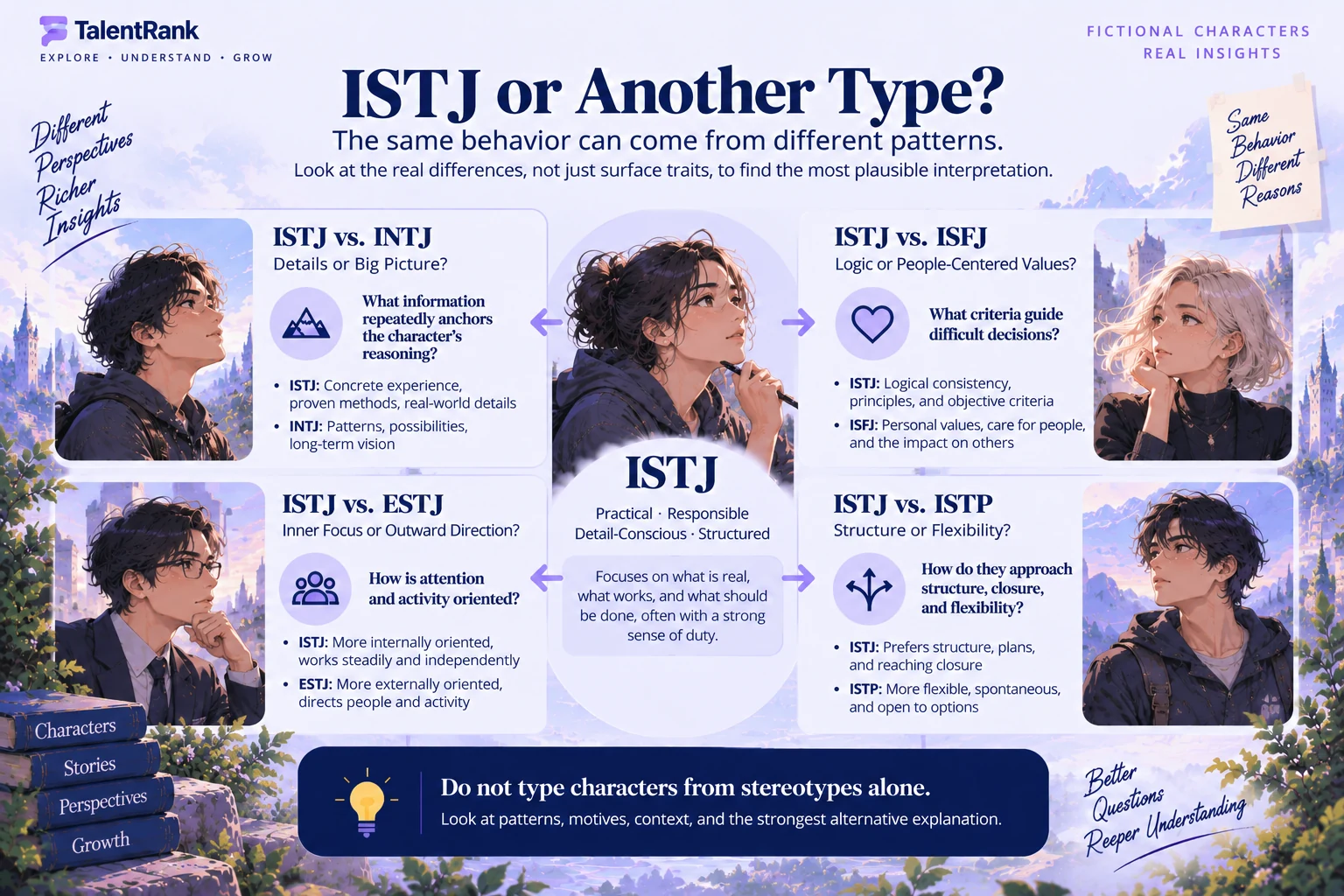
Neighboring types can produce similar visible behavior for different reasons. Use the questions below to compare explanations rather than treating one trait as decisive.
Comparison | Do not rely on | More useful question |
ISTJ vs. INTJ | Practical vs. smart | What information repeatedly anchors the character's reasoning: concrete experience or broader patterns and possibilities? |
ISTJ vs. ISFJ | Logical vs. emotional | What criteria repeatedly guide difficult decisions? |
ISTJ vs. ESTJ | Quiet vs. loud | How is attention and activity oriented across different settings? |
ISTJ vs. ISTP | Organized vs. messy | How does the character repeatedly approach structure, closure, flexibility, and changing information? |
How to Evaluate Whether a Character Fits ISTJ
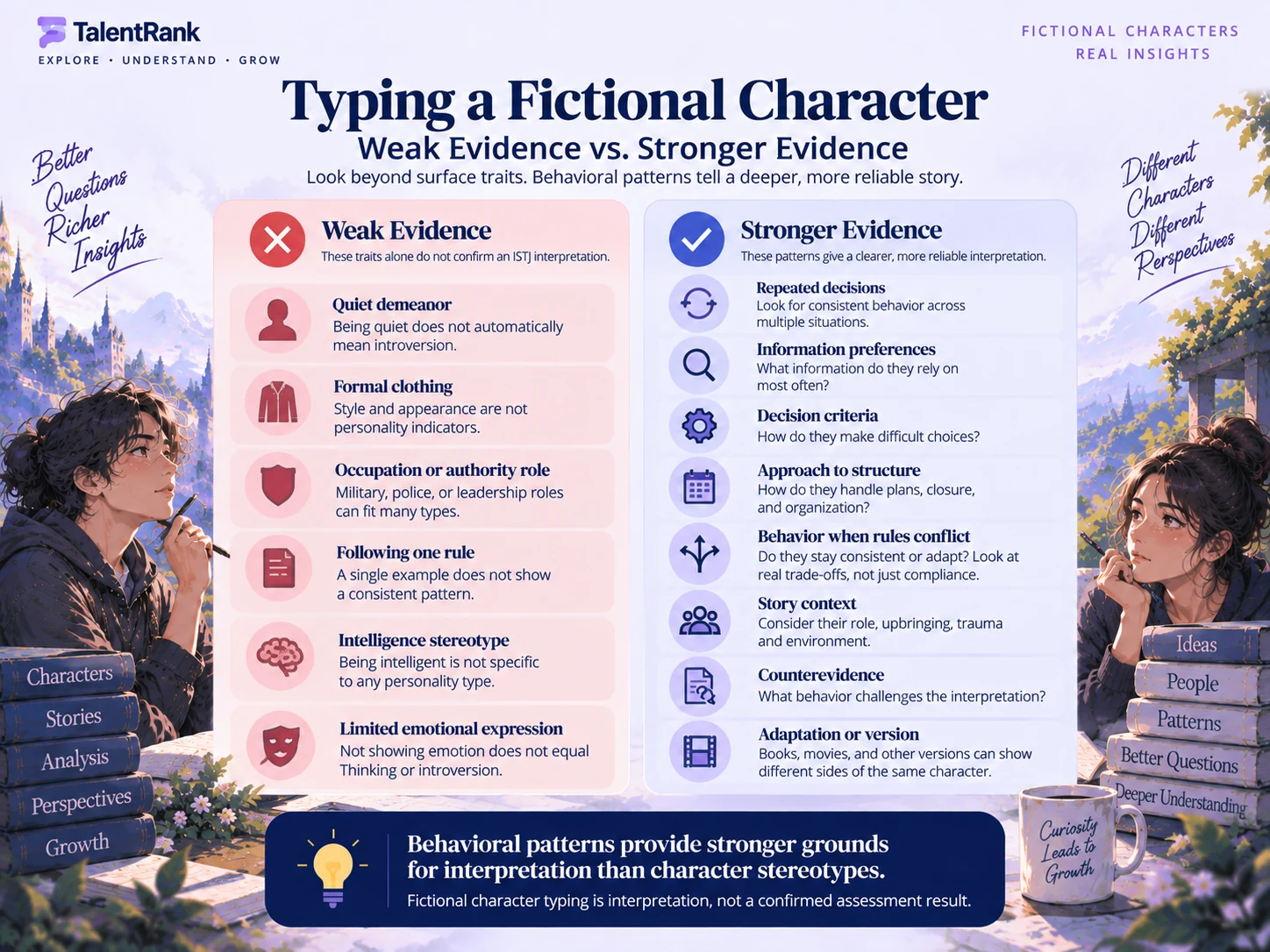
Before calling a fictional character ISTJ, work through the evidence rather than starting with the label.
Pattern: Does the behavior repeat across the story? One scene is rarely enough.
Information: What kind of information does the character repeatedly notice, seek, and trust?
Decisions: What criteria guide consequential choices? Focus on the decision process, not emotional expression.
Structure: How does the character approach plans, closure, schedules, and flexibility?
Context: Could a job, culture, trauma, hierarchy, or unusual circumstance explain the behavior?
Counterevidence: Which repeated behaviors challenge the ISTJ interpretation?
Alternative: Does another type explain the same evidence as well or better?
Version: Which book, film, game, reboot, season, or adaptation are you evaluating?
This checklist is an editorial framework for discussing fictional characters. It is not a validated personality assessment or scoring instrument. A particularly useful rule is to separate context from preference. If a character follows strict procedures only because an institution forces them to, that is weaker personality evidence than choosing structure consistently when several reasonable options are available.
ISTJ, ISTJ-T, and the Big Five Are Not the Same Thing
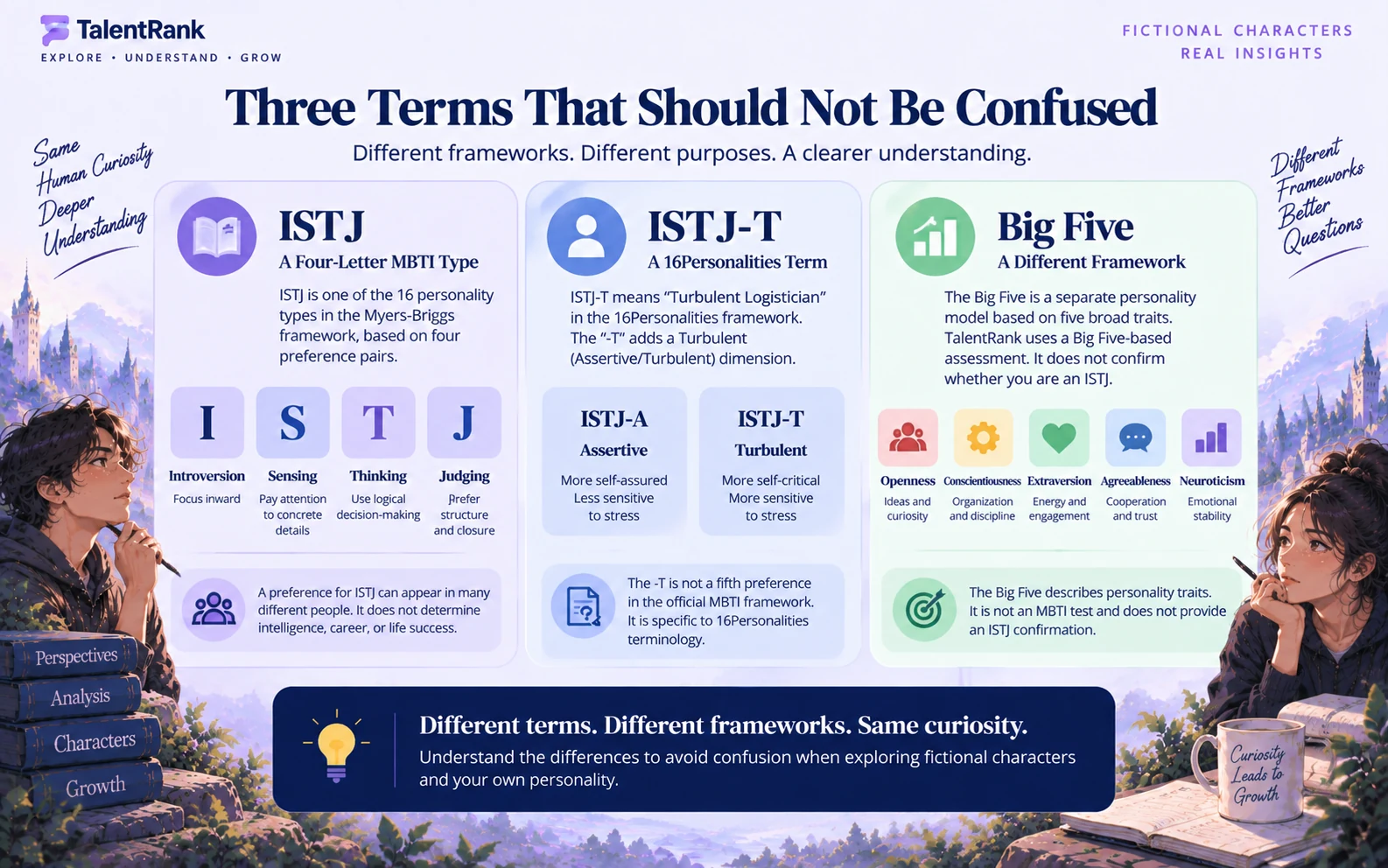
ISTJ is a four-letter type in the Myers-Briggs framework. The official system forms 16 types from four preference pairs: Extraversion or Introversion, Sensing or Intuition, Thinking or Feeling, and Judging or Perceiving. The Myers & Briggs Foundation explains those preference pairs directly.
ISTJ-T is terminology used by 16Personalities for its Turbulent Logistician profile. The T suffix belongs to its Assertive and Turbulent Identity distinction. It is not a fifth preference in the official four-letter MBTI structure.
The Big Five is a different personality framework built around continuous traits. TalentRank uses a Big Five-based approach rather than an ISTJ confirmation test. For a broader framework comparison, see TalentRank's Big Five vs. MBTI guide.
Explore Your Own Personality Traits
Fictional character typing involves interpreting behavior written for a story. Exploring your own personality is a different task. If this discussion has made you curious about your own traits, TalentRank's assessment explores the Big Five alongside other assessment components. It does not confirm whether you are an ISTJ.
Start the Assessment → TalentRank Assessment
Frequently Asked Questions About ISTJ Characters
What fictional characters are ISTJ?
Fictional characters commonly interpreted as ISTJ include Kento Nanami, Ned Stark, Raymond Holt, Violet Evergarden, Giyu Tomioka, and Mikasa Ackerman. These are interpretations rather than confirmed assessment results. Stronger analyses examine repeated decisions, information preferences, decision criteria, story context, and credible alternatives instead of relying on stereotypes.
What anime characters are commonly considered ISTJ?
Commonly proposed ISTJ anime characters include Kento Nanami from Jujutsu Kaisen, Mikasa Ackerman from Attack on Titan, Giyu Tomioka from Demon Slayer, and Violet Evergarden. Their typings remain interpretations, so seriousness, loyalty, reserve, or discipline alone should not be treated as proof.
Is Hermione Granger an ISTJ?
Hermione Granger is often interpreted as ISTJ, but ESTJ is a credible alternative. Her preparation, detailed knowledge, respect for established information, and planning can support an ISTJ reading. Her frequent organization of other people and outwardly directive behavior can support an ESTJ interpretation. The book and film portrayals should also be distinguished where relevant.
What makes a character an ISTJ?
An ISTJ interpretation becomes more plausible when a character repeatedly shows an inward orientation, attention to concrete information and established experience, Thinking-oriented decision criteria, and a preference for external structure or closure. Being quiet, intelligent, serious, traditional, emotionally restrained, or good at following rules does not establish the type by itself.
What does ISTJ-T mean?
ISTJ-T means Turbulent Logistician in the terminology used by 16Personalities. That system adds an Assertive or Turbulent Identity distinction to its type labels and uses ISTJ-T for its Turbulent Logistician profile.
Is ISTJ-T an official MBTI personality type?
Not as a five-letter MBTI type. The official Myers-Briggs system builds its 16 types from four preference pairs, producing the four-letter ISTJ designation. The additional Assertive or Turbulent distinction used in labels such as ISTJ-A and ISTJ-T belongs to the 16Personalities framework rather than the official MBTI four-preference structure.
The Takeaway
The most useful ISTJ characters are not necessarily the ones who look the most serious, traditional, or disciplined. A stronger interpretation asks what information a character repeatedly trusts, how they make consequential decisions, how they approach structure, what their circumstances explain, and whether another type fits the evidence just as well. Kento Nanami, Ned Stark, Raymond Holt, Violet Evergarden, Giyu Tomioka, Mikasa Ackerman, and Hermione Granger demonstrate different parts of that process, including why disagreement can be informative. Fictional typing works best as a framework for discussing character patterns, not as a confirmed assessment result or a shortcut for deciding who a character really is.