

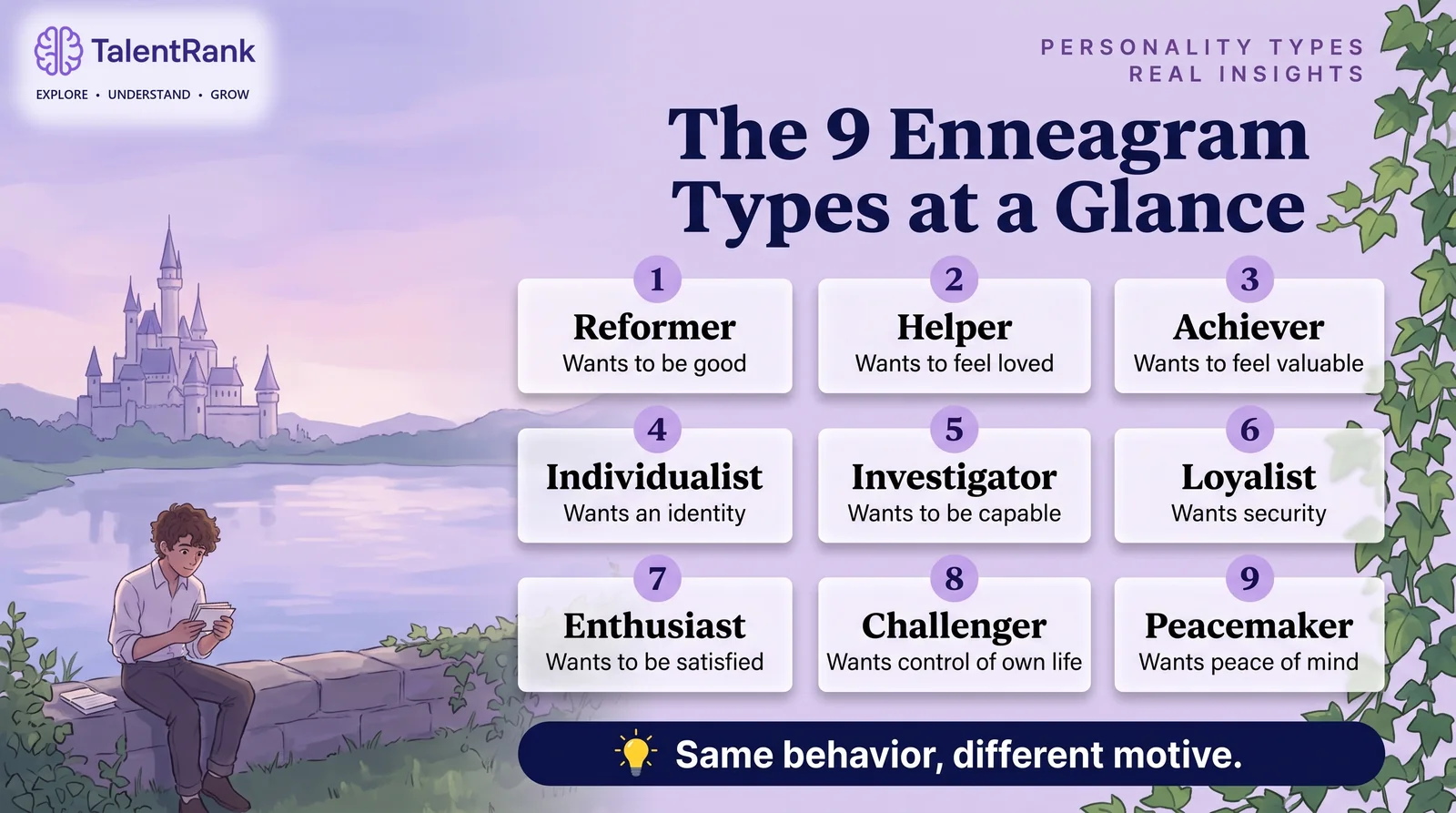
There are nine Enneagram types, numbered 1 to 9: the Reformer, the Helper, the Achiever, the Individualist, the Investigator, the Loyalist, the Enthusiast, the Challenger, and the Peacemaker. Those names come from the Riso-Hudson version of the system taught by the Enneagram Institute, which is the version most people meet first.
What makes the Enneagram different from most personality models is that it sorts people by motivation, not behavior. Two people can both work late every night. One is a Three who wants to be seen as successful; the other is a Six who's worried about what happens if the project fails. Same habit, different engine.
Below you'll find all nine types in one table, a plain-English profile of each, how the system connects them, and what the research actually supports.
The 9 Enneagram Types at a Glance
Each type is built around a basic desire and a basic fear. The table pairs those with a common strength and the blind spot that tends to come with it.
Type | Name | Wants | Fears | Strength | Blind spot |
1 | Reformer | To be good and have integrity | Being corrupt or defective | Principled, reliable | Harsh inner critic |
2 | Helper | To feel loved | Being unwanted | Generous, warm | Neglects own needs |
3 | Achiever | To feel valuable | Being worthless | Driven, adaptable | Image over substance |
4 | Individualist | To find their identity | Having no significance | Emotionally honest, creative | Comparison and envy |
5 | Investigator | To be capable | Being useless or helpless | Perceptive, independent | Withdraws from people |
6 | Loyalist | Security and support | Being without support | Committed, prepared | Anxiety and doubt |
7 | Enthusiast | To be satisfied | Deprivation and pain | Energetic, inventive | Avoids discomfort |
8 | Challenger | To protect themselves | Being controlled | Decisive, protective | Can overpower others |
9 | Peacemaker | Peace of mind | Loss and separation | Calm, accepting | Goes along to get along |
The "wants" and "fears" columns paraphrase the Enneagram Institute's type pages. The strengths and blind spots are summaries, not scores.
Each Enneagram Type in Plain English
Type 1: The Reformer
Ones want to do things right, and they usually have a clear sense of what "right" is. They're the coworker who catches the error in the contract and the friend who actually keeps promises. The Enneagram Institute describes them as "principled, purposeful, self-controlled, and perfectionistic."
The cost is an inner voice that rarely switches off. Ones can be as hard on themselves as they are on a sloppy process, and resentment can build when other people don't seem to care as much. Our full Enneagram 1 profile covers the inner critic and how Ones grow.
Type 2: The Helper
Twos notice what other people need, often before those people do. They remember birthdays and make newcomers feel welcome. Their basic desire is simple: to feel loved.
The tradeoff is that giving can become a way of earning a place. A Two may say yes to everything, then feel unappreciated when nobody asks how they're doing. Learning to name their own needs is a big part of Two growth. Our full Enneagram 2 profile covers both wings and how Twos grow.
Type 3: The Achiever
Threes are goal-driven and quick to read what a room values. Give a Three a target and a deadline and they'll usually hit both, polished. The Enneagram Institute's summary is "adaptive, excelling, driven, and image-conscious."
That adaptability has a downside. A Three can get so good at being what's admired that they lose track of what they actually want. Burnout often shows up when the achievements stop feeling like theirs. Our full Enneagram 3 profile covers both wings and how Threes grow.
Type 4: The Individualist
Fours want to understand who they are and to have that self be meaningful. They're often drawn to art, writing, or any work where depth of feeling matters. They're also comfortable with sadness in a way many people aren't, which makes them good company in a hard moment.
The blind spot is comparison. A Four can feel that something essential is missing in them that other people seem to have, and that sense of lack can turn into envy or withdrawal. Our full Enneagram 4 profile looks at the wings and growth path.
Type 5: The Investigator
Fives want to be capable, and they get there by understanding things thoroughly. They're the person who reads the whole manual, then three forum threads about the manual. Many need generous time alone to recharge.
Their fear of being useless or helpless can make them guard their time and energy closely. At their least healthy, Fives retreat into their heads and stop sharing what they know, which leaves people around them guessing. Our full Enneagram 5 profile covers the wings and how Fives grow.
Type 6: The Loyalist
Sixes want security and support, and they're often the most committed members of any team. They think through what could go wrong, which makes them excellent at risk planning and at spotting the flaw in a too-good-to-be-true offer.
That same scanning can tip into anxiety. Some Sixes cope by seeking reassurance from authority; others push against it hard. Either way, the core issue is trust.
Hypothetical example: a Six project manager builds a backup plan for every milestone. The team benefits when the vendor falls through. The same manager may still lie awake before a launch that's fully covered. Our full Enneagram 6 profile explains the two ways Sixes handle fear.
Type 7: The Enthusiast
Sevens want to be satisfied and free, and they're great at finding options. They bring energy to brainstorming and to anything new. The Enneagram Institute calls them "spontaneous, versatile, distractible, and scattered," which captures both sides.
The catch is that Sevens tend to move toward the next fun thing whenever a situation gets painful or boring. Finishing projects and sitting with hard feelings are common growth edges. Our full Enneagram 7 profile covers both wings and how Sevens grow.
Type 8: The Challenger
Eights want to stay in control of their own lives, and they won't be pushed around. They're direct and decisive. They're also fiercely protective of people they see as vulnerable. In a crisis, they're the ones who make the call.
Their intensity can land harder than they mean it to. An Eight may see a heated argument as honest engagement while the other person sees it as an attack. Softness can feel risky to them, even when it's what a relationship needs. Our full Enneagram 8 profile covers the wings and growth path in more detail.
Hypothetical example: an Eight team lead defends a junior colleague against unfair criticism from a senior manager. The same lead may not notice that their own blunt feedback is the reason that colleague stopped speaking up in meetings.
Type 9: The Peacemaker
Nines want peace of mind, and they create calm around them. They see every side of a disagreement, which makes them natural mediators and easy people to be with.
The cost is self-erasure. To avoid conflict, a Nine may go along with plans they don't like and lose touch with what they want. Their anger tends to show up quietly, as stubbornness or procrastination. Our full Enneagram 9 profile covers the wings and how Nines grow.
Hypothetical example: a Nine agrees to the restaurant and then to the vacation spot. Weeks later they're exhausted and can't say why, because they never noticed they had preferences of their own.
How the Enneagram Fits Together
The nine types aren't a flat list. The system groups them into centers and connects them with lines.
The Three Centers: Head, Heart, and Gut
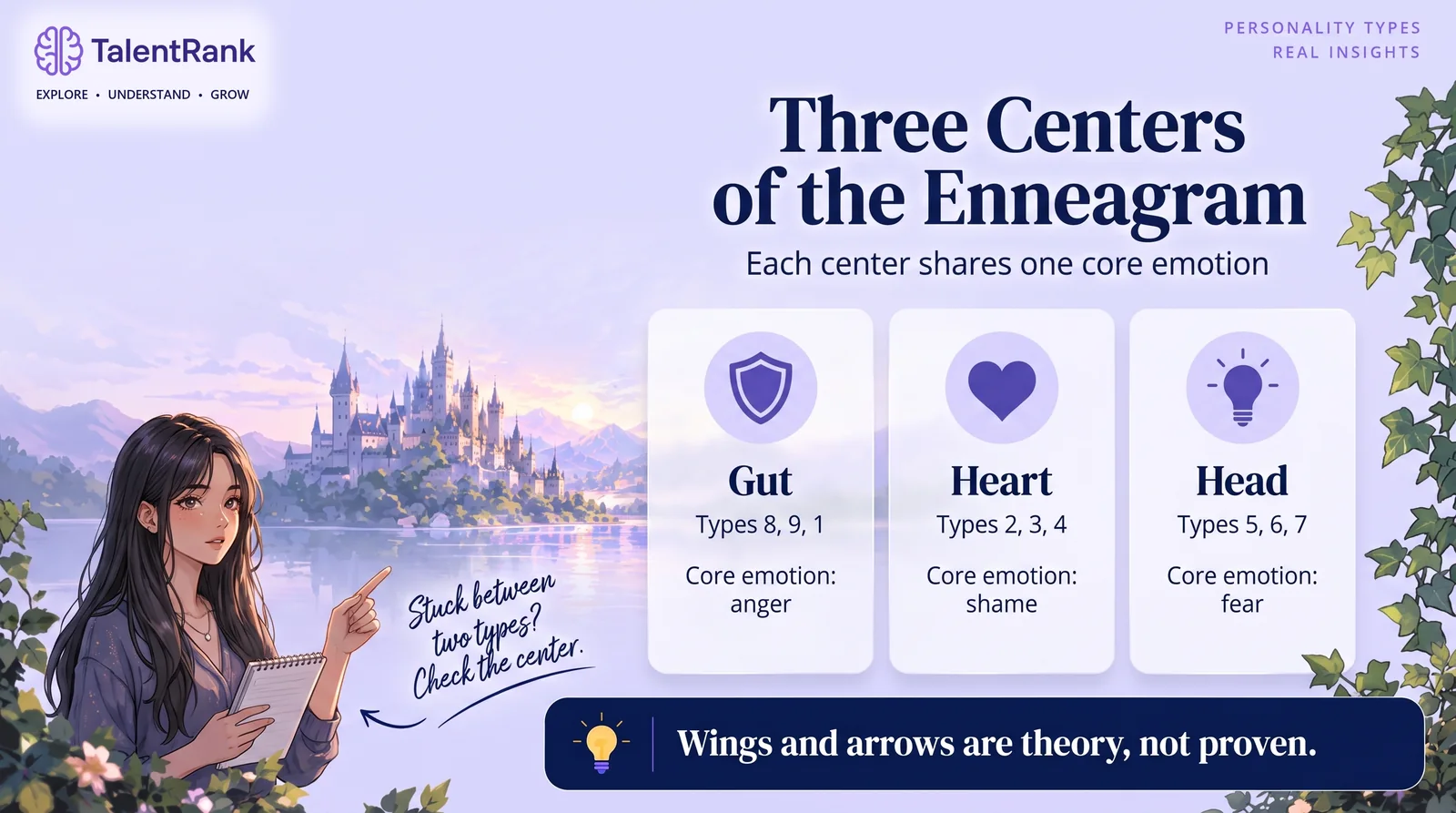
The Enneagram Institute groups the types into three centers:
Gut (instinctive) center, Types 8, 9 and 1: the dominant emotion is anger. Eights express it, Nines numb it, and Ones hold it in.
Heart (feeling) center, Types 2, 3 and 4: the underlying issue is shame and self-image.
Head (thinking) center, Types 5, 6 and 7: the underlying emotion is fear.
The centers are a useful shortcut if you're stuck between types. If you're torn between Two and Seven, for example, ask whether you're more driven by how you're seen or by what might go wrong.
Wings
Your wing is one of the two types next to yours on the circle. A Four can have a Three wing (4w3) or a Five wing (4w5). The wing adds flavor without replacing the main type: a 4w3 tends to share its individuality more openly, while a 4w5 is usually more private and cerebral. Our guide to Enneagram wings lists all 18 wing types.
Stress and Growth Lines
The lines inside the circle connect each type to two others. According to the Enneagram Institute, under stress the types move along the sequence 1-4-2-8-5-7-1 and 9-6-3-9. In growth they move the other way: 1-7-5-8-2-4-1 and 9-3-6-9.
In practice, that means a stressed Seven may start acting like a critical One, and a growing Seven takes on some of a Five's focus. Keep in mind this part of the theory has the least research behind it.
Enneagram Types That Are Easy to Confuse
Because the types are defined by motivation, the same behavior can point in two directions. A few common mix-ups:
1 and 6: both are responsible and rule-conscious. Ones follow their own sense of right; Sixes look for trustworthy guidance and test it.
2 and 9: both accommodate others. Twos move toward people to be needed; Nines go along to keep the peace.
3 and 8: both are assertive and results-focused. Threes care about how success looks; Eights care about not being controlled.
4 and 5: both can be withdrawn and intense. Fours withdraw into feeling; Fives withdraw into thinking.
7 and 3: both are upbeat and busy. Sevens chase experiences; Threes chase accomplishments.
How to Find Your Enneagram Type
Start with motivation, not behavior. Read the "wants" and "fears" columns in the table and notice which ones make you uncomfortable. The fear that stings is often more telling than the strength that flatters.
Then narrow it down:
Pick your top two or three candidates and read their full descriptions.
Ask what you do under stress, and compare it with each candidate's stress line.
Ask someone who knows you well which description fits. People often see our patterns more clearly than we do.
Use an online Enneagram test as a starting point, not a verdict. Results can shift with your mood that day.
The Enneagram Institute's position is that people don't change from one basic type to another, though how healthily you express your type can change a lot. Plenty of people spend months deciding between two types, and that process can teach more than the final number.
What the Research Says About the Enneagram
The modern Enneagram of personality traces back to Oscar Ichazo, who taught it at his Arica school, and to Chilean psychiatrist Claudio Naranjo, who studied with Ichazo in 1970 and developed it further, according to Wikipedia's history of the model. The nine-pointed symbol is older and is associated with George Gurdjieff, but he didn't describe the nine personality types.
The best summary of the evidence is a 2021 systematic review in the Journal of Clinical Psychology by Joshua Hook and colleagues. They looked at 104 independent samples and found mixed evidence for the Enneagram's reliability and validity. Some findings support it: subscales relate to the Big Five traits in ways the theory predicts, and several studies found it helpful for personal or spiritual growth. Others don't: factor analyses usually find fewer than nine factors, and there's little research behind wings and movement between types.
So the honest position is this. The Enneagram can be a good language for reflection and conversation. It isn't a validated tool for diagnosing anyone, predicting job performance, or making hiring decisions.
Using Your Type Without Getting Boxed In
Used well, your type is a set of questions. Why do I overcommit? Why does conflict drain me? What do I do when I'm scared?
A few ground rules help:
Treat your type as a description of a habit, not an excuse. "I'm an Eight" explains bluntness; it doesn't make it fine.
Don't type other people for them. It rarely goes well.
At work, use the Enneagram to talk about how people like to communicate, not to decide who gets which role.
Expect overlap. Most people recognize themselves in parts of several types.
Enneagram Types and the Big Five
If you want a measured picture of your personality to sit alongside your Enneagram type, the Big Five is the framework personality researchers rely on most. It scores five traits on a spectrum: openness, conscientiousness, extraversion, agreeableness, and neuroticism. Our guide to the Big Five personality traits explains each one.
The two models answer different questions. The Enneagram asks why you do things. The Big Five asks how much of each trait you show, compared with other people. A Six who also scores high in neuroticism has a different growth path than a Six who scores low, and that's the kind of detail a type alone can't give you. If you're weighing frameworks, our comparison of the Big Five and MBTI covers similar ground.
The TalentRank assessment measures your Big Five traits and takes about 12 to 15 minutes. It won't tell you your Enneagram number. It will show where you land on each trait, which you can read next to your type. Start the TalentRank assessment.
Frequently Asked Questions About Enneagram Types
What are the 9 Enneagram types?
Type 1 Reformer, Type 2 Helper, Type 3 Achiever, Type 4 Individualist, Type 5 Investigator, Type 6 Loyalist, Type 7 Enthusiast, Type 8 Challenger, and Type 9 Peacemaker.
What is the most common Enneagram type?
There's no reliable population data. The figures you'll see online come from people who chose to take a particular company's test, and different providers report different winners. Treat any "most common type" claim as a statistic about that test's users.
Can your Enneagram type change?
The Enneagram Institute says people don't change from one basic type to another. What does shift is how healthily you live out your type. Research hasn't tested either claim well.
What is the difference between the Enneagram and MBTI?
MBTI sorts preferences into 16 four-letter types (our guide to the MBTI letters explains each one). The Enneagram sorts people by core motivation and fear into nine types. Many people use both; our guide to MBTI and the Enneagram covers where they overlap.
Are Enneagram tests accurate?
They're a reasonable starting point. A 2021 review found mixed evidence for the Enneagram's reliability and validity, so confirm a test result by reading the descriptions and reflecting, not by taking the score as final.
Final Takeaway
The nine Enneagram types are best read as nine different answers to the question "what am I protecting?" Find the one whose fear you recognize and read its costs as honestly as its strengths. Then use it to start conversations rather than end them. And if you want numbers next to the story, take the TalentRank assessment and read your Big Five scores alongside your type.