

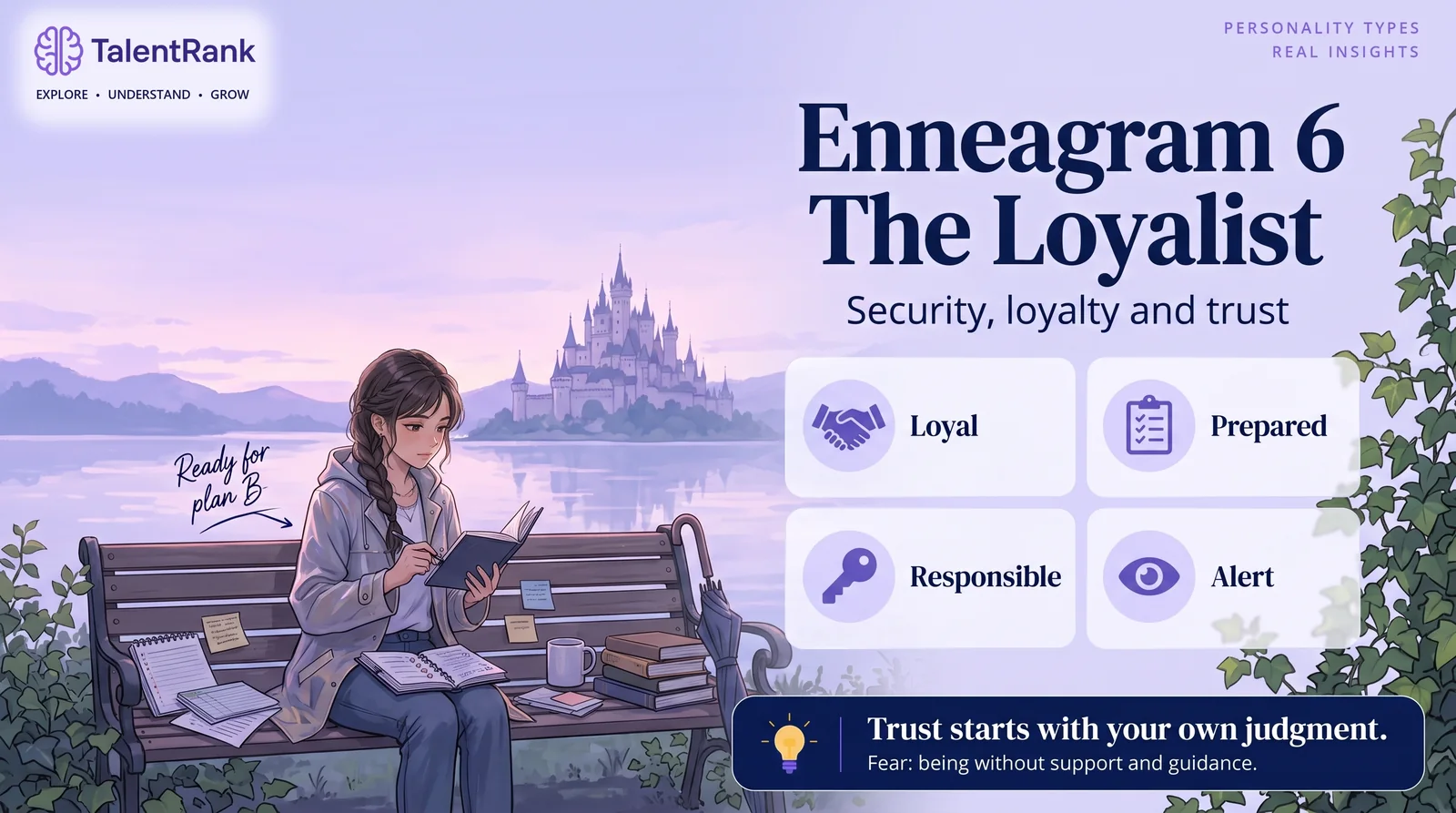
Enneagram 6, the Loyalist, is the type built around security. Sixes want to know they're supported and that the ground under them is solid. The Enneagram Institute gives their basic desire as "to have security and support" and their basic fear as "being without support and guidance," and calls them "the most loyal to their friends and to their beliefs."
Sixes are the people who read the fine print, back up the files, and stay when others leave. They're also the type most associated with worry. This guide explains where that worry comes from, the two very different ways Sixes handle it, and how Sixes learn to trust themselves.
Enneagram 6 at a Glance
Type 6: The Loyalist | |
Core desire | Security and support |
Core fear | Being without support and guidance |
Center | Head (thinking), where fear is the key emotion |
Wings | 6w5 "The Defender" and 6w7 "The Buddy" |
In growth | Moves toward Type 9: more relaxed and optimistic |
Under stress | Moves toward Type 3: competitive and arrogant |
Typical strengths | Loyal, responsible, prepared, good at spotting risk |
Typical blind spots | Worry, self-doubt, suspicion of others |
Our guide to all nine Enneagram types shows where the Six sits in the system.
How a Six Thinks About Safety
Sixes are always running a quiet risk check. Who can I trust? What could go wrong? What's the backup plan? That habit makes them excellent at planning. It also makes it hard for them to relax.
The Six sits right in the middle of the head center, where fear is the core emotion. Fives handle fear by retreating into knowledge, Sevens by staying busy. Sixes face it head on, by looking for something or someone solid to lean on, and by testing whether that support will hold.
That testing can confuse people. A Six may ask the same question three times or poke holes in a plan they actually like. They're not being difficult. They want to know the plan will survive contact with reality.
Two Ways Sixes Handle Fear
Not every Six looks anxious. Enneagram teachers often describe two broad patterns, and many Sixes mix both.
Some Sixes move toward security. They seek out trusted authorities and stick to proven paths, and they're often warm and cooperative. They can come across as cautious or as people-pleasers.
Other Sixes push against the fear. They challenge authority, take risks to prove they're not scared, and can seem bold or even confrontational. People sometimes mistake these Sixes for Eights.
The Enneagram Institute captures the tension in one phrase: average Sixes can be "authoritarian while fearful of authority." Both patterns come from the same place, a deep need to know what's safe.
Six Strengths and Their Costs
At their best, the Institute says, Sixes become "self-affirming, trusting of self and others." Healthy Sixes are often the backbone of teams and communities.
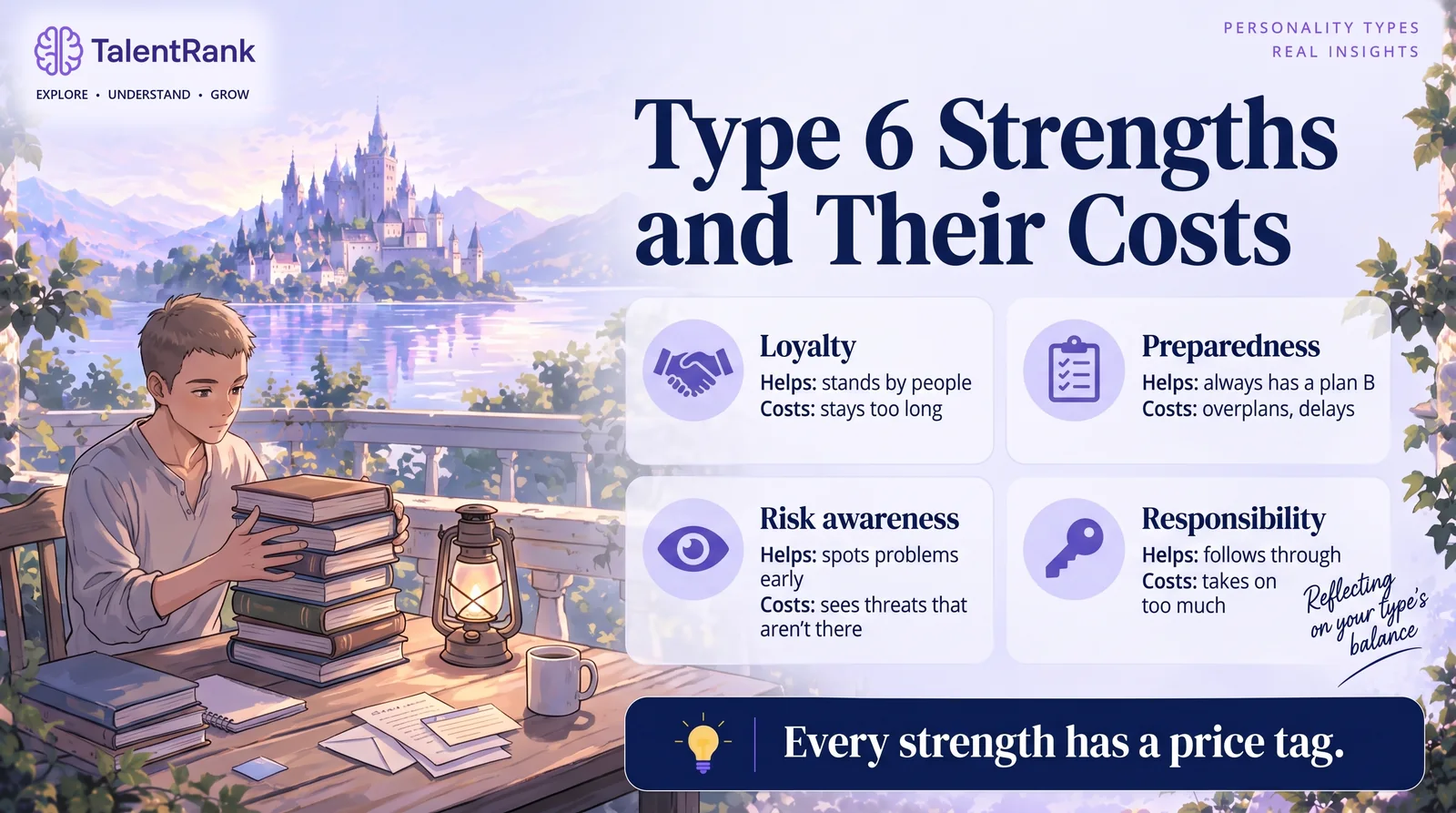
Strength | Where it helps | What it can cost |
Loyalty | Stands by people for years | Stays with what no longer works |
Preparedness | Has a plan B and plan C | Overplans and delays action |
Risk awareness | Spots problems early | Sees threats that aren't there |
Responsibility | Follows through reliably | Takes on too much |
Skepticism | Isn't easily fooled | Struggles to trust good news |
When a Six Is Under Stress
At average levels, the Institute describes Sixes as "evasive, indecisive, cautious, procrastinating." A Six facing a big decision may gather opinions from everyone they know and then still not decide.
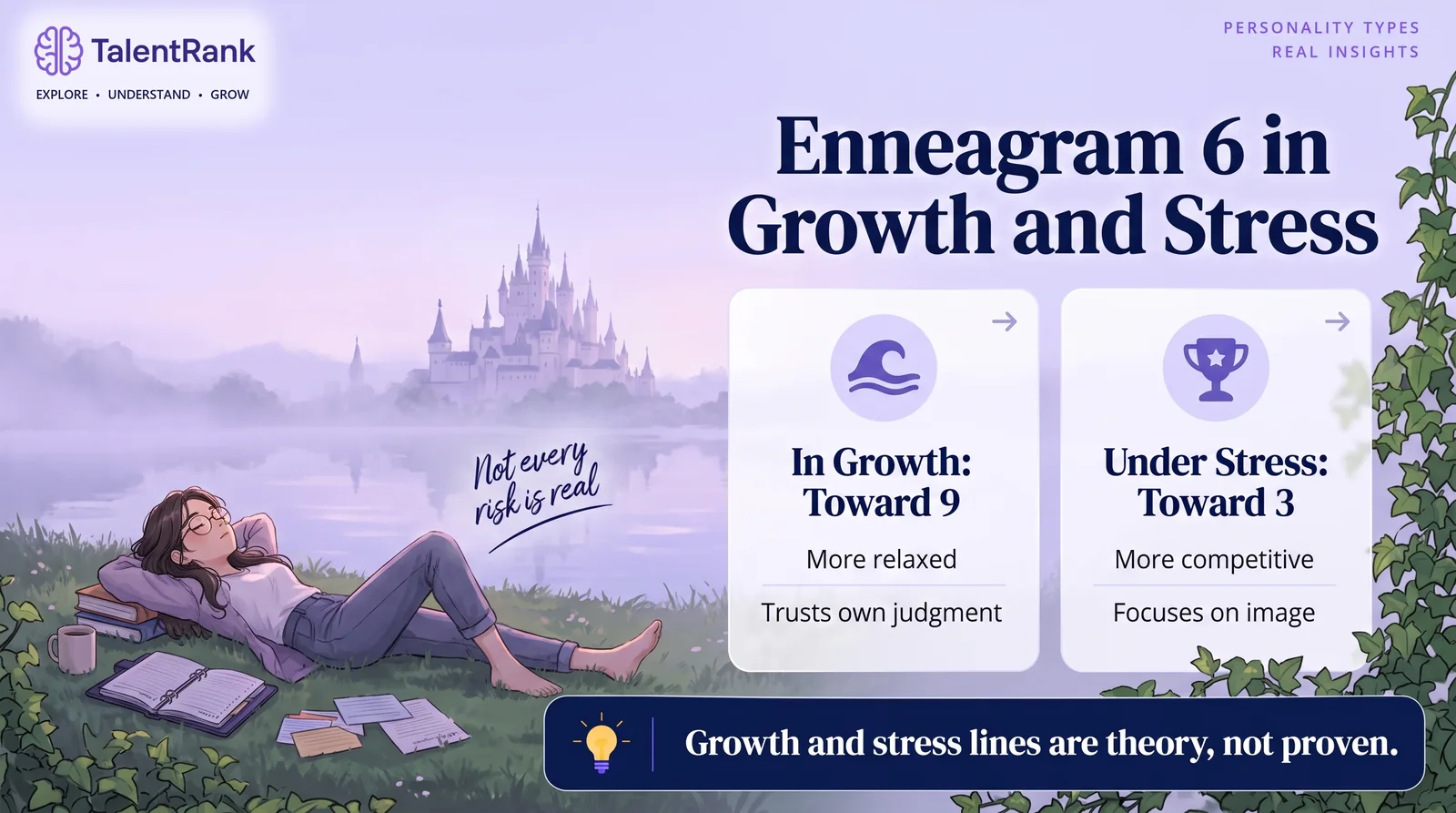
Under stress, Enneagram theory says Sixes move toward Type 3 and become "competitive and arrogant." The usually loyal team player suddenly starts working the angles and focusing on how they look. It's often a sign they feel the ground shifting and want to secure their position.
Being a Six is not the same as having an anxiety disorder. But if worry keeps you up at night or gets in the way of daily life, that's worth raising with a doctor or therapist, whatever your type.
How Sixes Grow
In growth, Sixes move toward Type 9 and become "more relaxed and optimistic." They stop needing every risk covered before they can rest. Trust shifts inward too: instead of waiting for someone else to say it's safe, they learn to rely on their own judgment.
Habits that help:
Writing down the worst case, then the most likely case, and noticing the gap.
Making small decisions without asking anyone first.
Keeping a record of times their judgment turned out right.
Noticing when "being careful" has turned into avoiding a decision.
6w5 and 6w7: The Two Wings
The 6w5 (the Defender) adds the Five's need to understand. These Sixes tend to be more reserved and analytical, and they often become experts in the things that worry them most. They tend to prefer a few trusted people over a crowd.
The 6w7 (the Buddy) adds the Seven's warmth and humor. These Sixes are usually more social and playful, and they often use humor to ease tension. They can be the friend who checks in on everyone.
Enneagram 6 at Work
Sixes are often the people organizations depend on most and notice least. They thrive where reliability and good judgment about risk matter, like compliance or project management. Any team that needs someone to ask "what happens if this fails?" benefits from a Six.
Hypothetical example: a Six analyst flags a supplier risk in a planning meeting, and the team brushes it off. Three months later, the supplier misses a shipment, and her backup plan saves the launch. The same analyst still spends the night before every presentation rehearsing answers to questions nobody asks. Her growth step is to trust that her preparation has already done its job, and to get some sleep.
Sixes do best with managers who are consistent and explain the reasoning behind decisions. Sudden changes without explanation can shake their trust for a long time.
Enneagram 6 in Relationships
Sixes are some of the most committed partners and friends in the Enneagram. Once they trust someone, they're in for the long haul.
The challenge is that trust takes time, and a Six may test it. Questions like "are we okay?" can come up more than a partner expects. Some Sixes also project their own doubts onto a partner and read hidden meanings into small things.
What helps: partners who are consistent and keep their word on small things, and Sixes who notice when they're reacting to an imagined problem rather than a real one.
Six, One or Nine?
Six or One: both are responsible and rule-conscious. Ones follow their own inner sense of right; Sixes look for guidance they can trust and then test it.
Six or Nine: both can be agreeable and loyal. Nines tune out danger to keep the peace; Sixes tune in to danger to stay safe.
Six or Eight: a Six who pushes against fear can look like an Eight. Eights rarely doubt themselves; Sixes doubt themselves a lot, even when they look bold.
The Evidence, and a Measured Next Step
The Enneagram is a reflection tool, not a validated measurement. A 2021 systematic review of 104 samples in the Journal of Clinical Psychology found mixed evidence for its reliability and validity and little research behind wings or movement between types, though Enneagram scales did relate to the Big Five traits in ways the theory predicts.
If the Six sounds like you, two Big Five traits are worth checking. Our guide to high conscientiousness covers reliability and planning. Our guide to high neuroticism covers worry and emotional sensitivity, and how to work with them.
The TalentRank assessment measures your Big Five traits and takes about 12 to 15 minutes. It won't assign an Enneagram number, but it gives you measured scores to set beside the Six description. Start the TalentRank assessment.
Frequently Asked Questions About Enneagram 6
What is an Enneagram 6?
Type 6, the Loyalist, is the Enneagram type driven by the need for security and support. Sixes tend to be loyal and responsible. They're also quick to spot risk.
What is the Enneagram 6's core fear?
According to the Enneagram Institute, Sixes fear being without support and guidance.
What is the difference between 6w5 and 6w7?
The 6w5 is usually more reserved and analytical. The 6w7 is usually more social and uses humor to ease tension.
Where does a Six go in stress and growth?
In Enneagram theory, Sixes move toward Type 3 under stress (more competitive and image-focused) and toward Type 9 in growth (more relaxed and optimistic).
Are all Enneagram 6s anxious?
Not visibly. Some Sixes handle fear by seeking security, others by pushing against it and taking risks. Both patterns come from the same need to feel safe.
Final Takeaway
Enneagram 6s keep the people and organizations around them safe, often without credit. Their growth comes from learning that the support they've been looking for outside is also available inside, in their own track record of good judgment.