

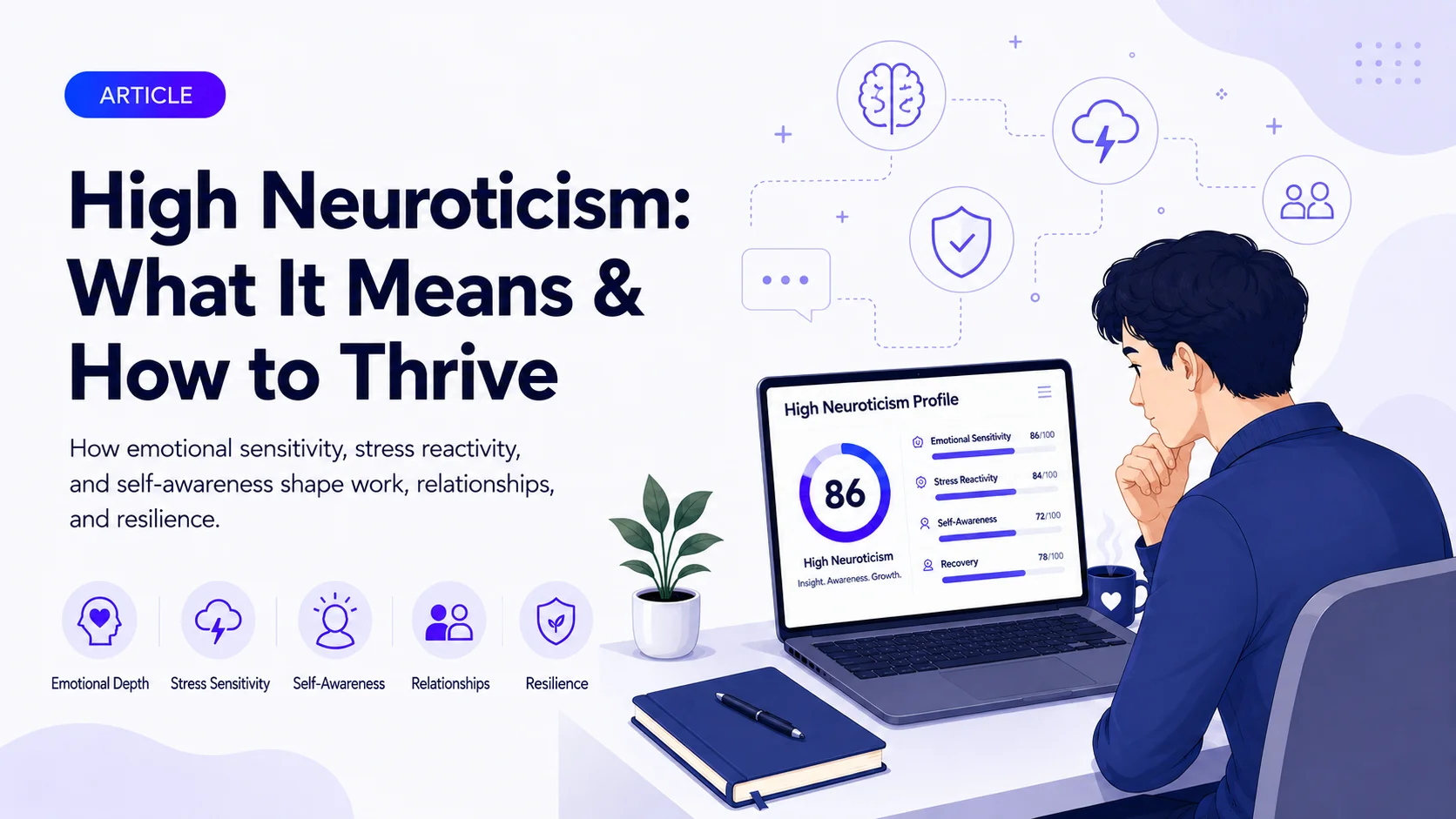
If you scored high on Neuroticism, your first instinct was probably to worry about what it means. That instinct is itself a perfect illustration of the trait.
You're not broken. You're not mentally ill. You are, by temperament, someone whose nervous system registers threat, uncertainty, and emotional signal more intensely than most people around you. That creates real costs. It also creates real capabilities that most people never develop.
High neuroticism personality is a dimension of human variation as old as the species. And understanding it clearly, without flinching and without spiraling, is the most useful thing you can do with your score.
What High Neuroticism Feels Like
You probably experience emotions more intensely than most people around you seem to. Worry comes easily, even when things are objectively fine. Self-doubt shows up in moments where you know, logically, that you're capable. Small cues that others don't notice, a slightly flat tone in a text, a pause before someone answers, can shift your mood significantly.
You replay conversations. You anticipate problems several steps before they exist. You sometimes feel as if you're running a background anxiety program that other people simply don't have installed.
That experience is real and it has a biological basis. Research by DeYoung et al. (2007) links Neuroticism to heightened activity in threat-response systems in the brain, particularly those governing emotional reactivity and behavioral inhibition. Your nervous system isn't malfunctioning. It's calibrated differently.
The challenging part is that this calibration comes with costs. Chronic low-grade worry. Difficulty shaking criticism even when you logically disagree with it. A tendency to interpret ambiguous situations as threatening.
The underappreciated part is that the same sensitivity creates things most people can't access as easily: Real empathy, the ability to anticipate how something could go wrong before it does, a depth of emotional experience that produces extraordinary art, writing, and human connection. Lahey (2009) identifies Neuroticism as one of the most consequential personality dimensions for mental health outcomes, which cuts both ways. The sensitivity that creates vulnerability also creates awareness.
This is also, incidentally, the dimension your MBTI type couldn't show you. Whether you tested as an INFJ or an ENTJ, Myers-Briggs doesn't measure emotional reactivity in a psychometrically valid way. The Big Five does. Your score here is, in most respects, the most personally significant number in your results.
High Neuroticism at Work
Career fit matters more for high-Neuroticism individuals than for almost any other trait configuration. It’s very important to recognize that your nervous system will be shaped by your environment, and to choose that environment deliberately.
Roles with high rejection volume, constant ambiguity, and unpredictable performance feedback are genuinely harder for people with elevated Neuroticism. Cold sales, crisis management, cutthroat negotiation environments, and high-visibility performance roles create chronic stress that wears on you differently than it would someone scoring in the 20th percentile.
Environments that tend to work well: structured, predictable, and meaningful. Research, writing, data analysis, editing, quality assurance, accounting, software development (particularly back-end), library science, counseling and therapeutic work, and certain healthcare roles all offer the combination of clear feedback, low arbitrary social judgment, and work that rewards thoroughness. These aren't consolation careers. Many of them attract the most intellectually rigorous, emotionally perceptive people in any organization.
Your work strengths are real. You catch problems early. You are thorough in ways that your less-anxious colleagues are not, because you care about what happens if something goes wrong. You read emotional dynamics in teams and meetings that others miss entirely. Risk awareness, when channeled productively, is a professional asset.
The pitfalls are worth naming plainly. Catastrophizing under pressure, procrastination driven by anxiety about imperfect outcomes, difficulty making decisions when the stakes feel uncertain, and a tendency to take critical feedback personally rather than professionally. These are learnable patterns to interrupt as opposed to fixed personality sentences.
Costa and McCrae's foundational work (1989) established that Neuroticism is one of the most stable personality traits across adulthood, which means you probably won’t be able to transform yourself. Instead, focus on building an environment and set of habits that work with your actual temperament rather than constantly against it.
High Neuroticism in Relationships
People high in Neuroticism often love deeply. The same intensity that makes worry exhausting also makes connection profound. You feel things, and that means people who know you feel seen, because you are genuinely paying attention.
The relational challenges are worth being honest about. Reassurance-seeking is common, and when it becomes repetitive, it can strain even loving partnerships. The tendency to interpret neutral behavior as negative, a slow text reply becoming evidence of something wrong, a quiet dinner becoming a sign someone is angry, creates friction that can feel disproportionate to your partner. Conflict avoidance, which often comes from an intense fear of rupture, has a way of building suppressed resentment that eventually surfaces harder than the original issue would have.
What partners of high-Neuroticism people should understand: the feelings are real, even when the interpretation is sometimes distorted. Dismissing the emotion because the trigger seems small misses the point. The experience is genuine. What can be worked on is the story built around it.
And for you: knowing that your emotional read of a situation is sometimes amplified by your nervous system rather than dictated by reality is one of the most practically useful things to internalize. Your feelings are data. They're just not always accurate data.
High Neuroticism Combined with Other Traits
Neuroticism doesn't operate in isolation. How it expresses depends heavily on what it's paired with.
High Neuroticism + High Openness produces someone emotionally intense and creatively alive. Art, writing, philosophy, and music often come naturally to this combination. So does existential restlessness.
High Neuroticism + High Agreeableness creates the anxious people-pleaser: someone who genuinely cares about others and also struggles to assert their own needs, often at personal cost.
High Neuroticism + High IQ tends to produce what some researchers call the brilliant worrier. Analytical depth combined with hyperactive threat detection. Often the person in the room who asks the uncomfortable question everyone else was avoiding.
High Neuroticism + Low Extraversion is the quiet struggler: internal, sensitive, and highly self-contained. The emotional processing happens mostly alone. The external world rarely sees the full weight of what's being carried.
Common Challenges and Growth Areas
The most important lever you have isn't changing your personality. It's choosing your environment.
Research consistently shows that high-Neuroticism individuals are more vulnerable to stressful, unpredictable, and socially hostile environments, and more sensitive to the benefits of calm, structured, supportive ones. Before optimizing your inner life, optimize your outer circumstances. The job, the relationship, the living situation. Environment selection is the highest-return intervention available.
That said, Neuroticism can shift. Hudson (2019) found that individuals who actively worked on changing their emotional reactivity, particularly through behaviors that directly challenged anxiety patterns, showed meaningful decreases in Neuroticism over time. The key variable was personal motivation. You can't change this trait by being told to. But people who genuinely want to develop more stability, and take deliberate behavioral steps toward it, often do.
Cognitive Behavioral Therapy has a strong documented track record for the specific patterns associated with high Neuroticism: catastrophizing, reassurance-seeking, avoidance, and rumination. It doesn't alter your temperament, but it can interrupt the specific cognitive habits that amplify your natural sensitivity into dysfunction.
Practically, two things are worth distinguishing: Withdrawal and Volatility. Withdrawal refers to the anxious, avoidant, self-critical side of high Neuroticism. Volatility refers to the irritable, emotionally reactive side. Most people lean toward one or the other. Identifying which one is more characteristic for you points toward different growth strategies.
Routines also matter more for you than for most people. Predictability in sleep, food, exercise, and social exposure reduces the load on a nervous system that is already working harder than average.
And one last practical distinction worth making: productive worry and unproductive worry are not the same thing. Productive worry leads to a plan, a preparation, an action. Unproductive worry is rumination that loops without resolution. Learning to ask "is there something I can do about this right now?" and then either doing it or letting it go is one of the more valuable cognitive habits you can build.
Frequently Asked Questions
Is high neuroticism a mental health condition? No. Neuroticism is a personality trait, not a diagnosis. It does function as a risk factor for anxiety disorders and depression, meaning people scoring high are statistically more likely to develop these conditions under stress. But a high score alone describes temperament, not pathology.
Can you reduce neuroticism? Yes, though not by willpower alone. Hudson (2019) found meaningful decreases in Neuroticism among individuals who took deliberate behavioral steps to challenge their emotional patterns. CBT-based approaches, environment changes, and consistent behavioral practice all contribute. Neuroticism also tends to decrease naturally with age, independent of deliberate intervention.
What careers are best for emotionally sensitive people? Roles with structure, clear feedback, and meaningful work tend to fit well: research, writing, editing, data analysis, back-end development, counseling, quality assurance, accounting, and certain healthcare positions. The common thread is predictability and work that rewards the thoroughness and risk-awareness that high-Neuroticism individuals naturally bring.