

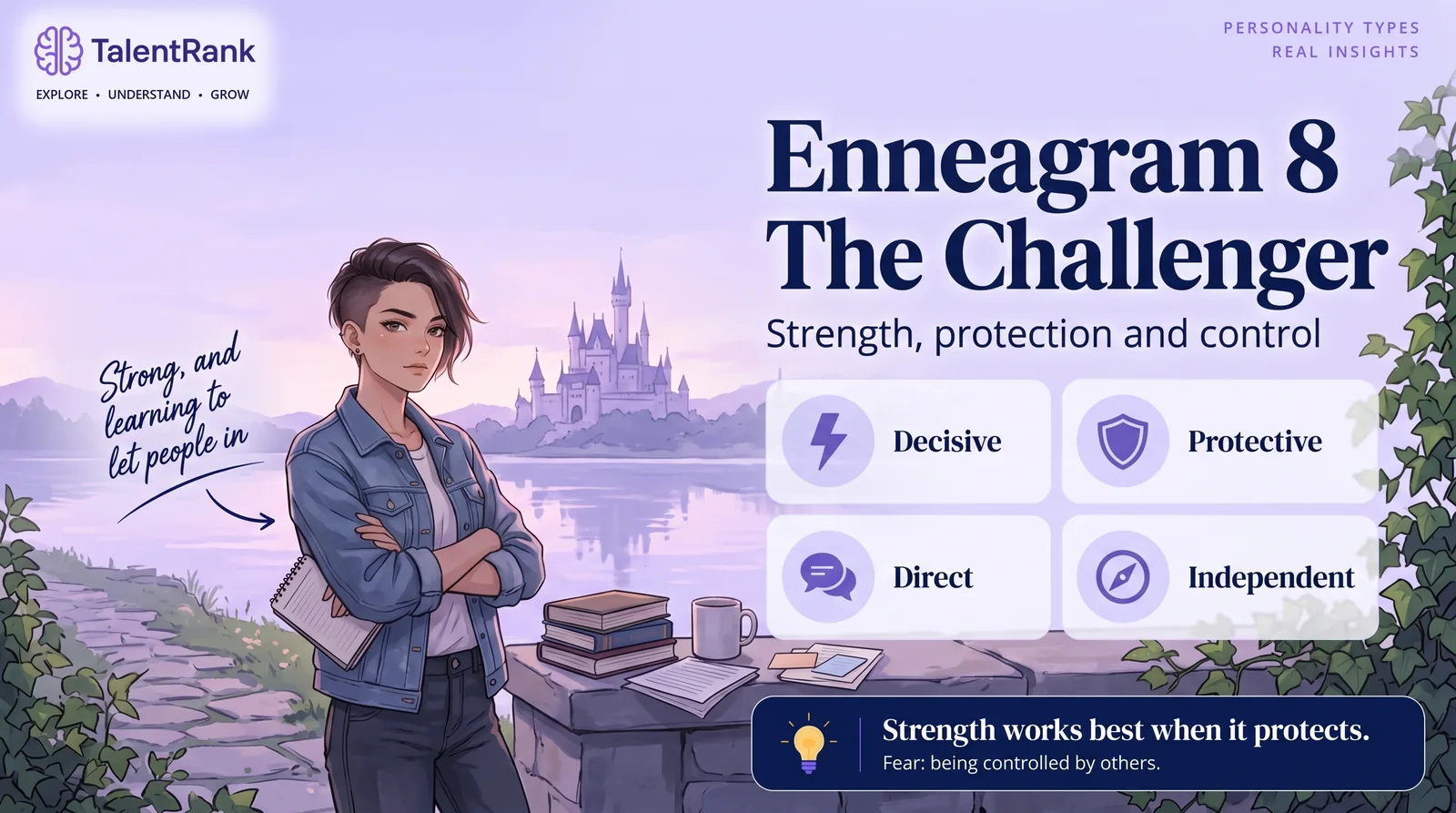
Enneagram 8, the Challenger, is the type built around strength and control. Eights want to protect themselves and stay in charge of their own lives, and their deepest fear, in the Enneagram Institute's words, is "being harmed or controlled by others." They tend to be direct and decisive, and they're protective of the people they care about.
That same drive can make an Eight hard to work with. The traits that help them lead in a crisis can flatten a quieter colleague on an ordinary Tuesday. This guide covers both sides: what drives an Eight, the two wings, how Eights change under stress and in growth, and how to tell an Eight from types that look similar.
Enneagram 8 at a Glance
Type 8: The Challenger | |
Core desire | To protect themselves and control their own life |
Core fear | Being harmed or controlled by others |
Center | Gut (instinctive), where anger is the key emotion |
Wings | 8w7 "The Maverick" and 8w9 "The Bear" |
In growth | Moves toward Type 2: more open-hearted and caring |
Under stress | Moves toward Type 5: more secretive and fearful |
Typical strengths | Decisive, protective, resilient, honest |
Typical blind spots | Overpowering others, hiding vulnerability |
If you're new to the system, our overview of all nine Enneagram types shows where the Eight sits among the others.
What Drives an Enneagram Type 8
Underneath the confidence, the Eight's engine is self-protection. Many Eights learned early that the world rewards strength and punishes softness, so they built themselves into someone nobody can push around.
That's why control matters so much to them. Not control of other people, usually. Control of their own situation, so they're never at anyone else's mercy. An Eight would rather make a hard decision and own the result than wait for someone else to decide for them.
Eights sit in the gut center, where the core emotion is anger. Unlike Ones, who hold anger in, Eights usually let it out. To them, a heated argument can feel like honest engagement, and they often trust people more after a good fight.
Enneagram 8 Strengths and Their Costs
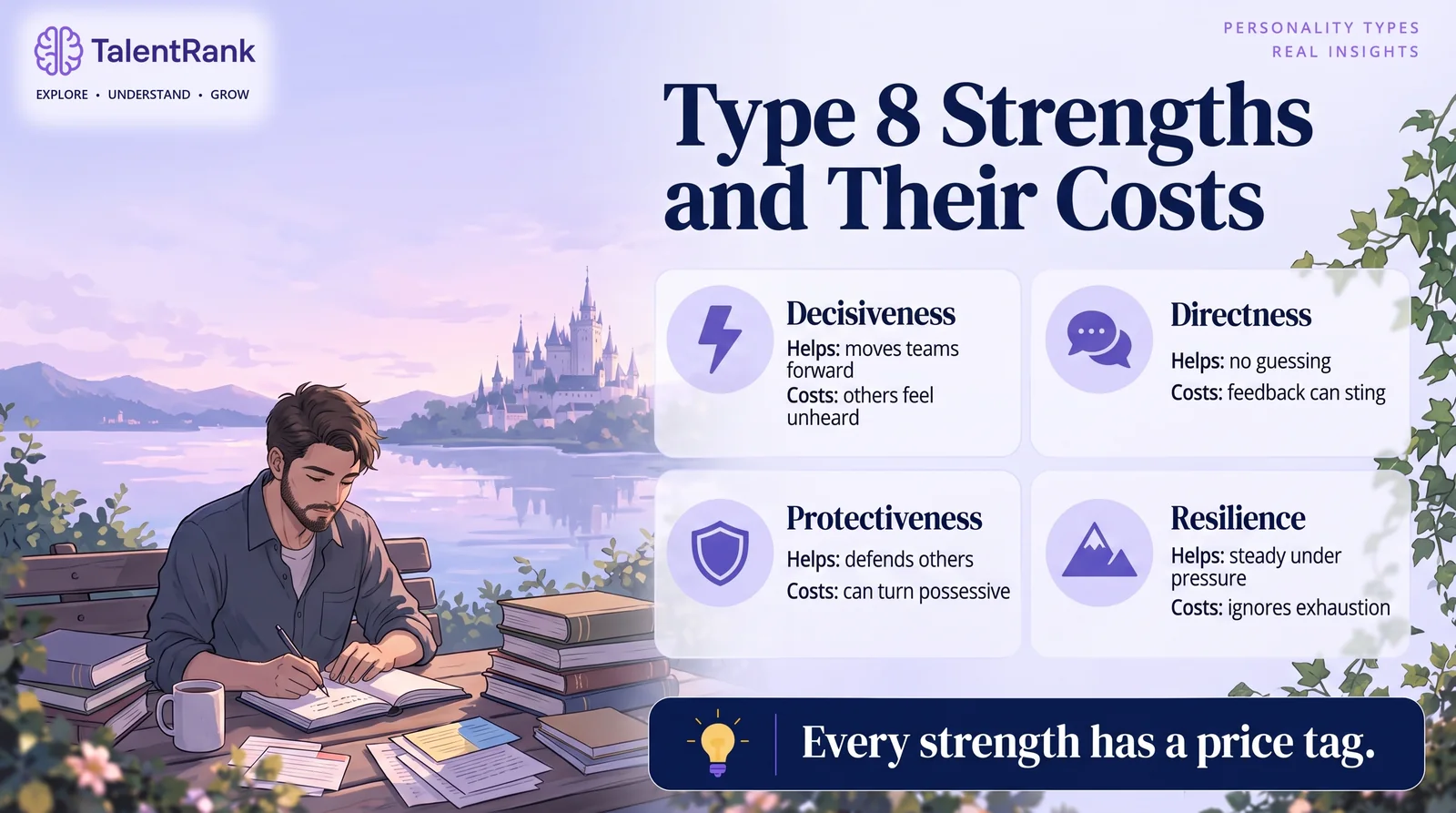
Every Eight strength has a cost attached. Knowing both helps more than a list of compliments.
Strength | Where it helps | What it can cost |
Decisiveness | Moves a stuck team forward | Others feel unheard |
Directness | People always know where they stand | Feedback lands as an attack |
Protectiveness | Defends people who can't defend themselves | Can become possessive |
Resilience | Keeps going under pressure | Ignores their own exhaustion |
Independence | Takes full ownership | Struggles to ask for help |
The Enneagram Institute describes healthy Eights as "self-restrained and magnanimous": strong people who use that strength on behalf of others. At average levels, the same energy turns domineering, and Eights start using pressure to get their way.
Healthy and Stressed Eights
The Enneagram's growth and stress lines give Eights a useful map.
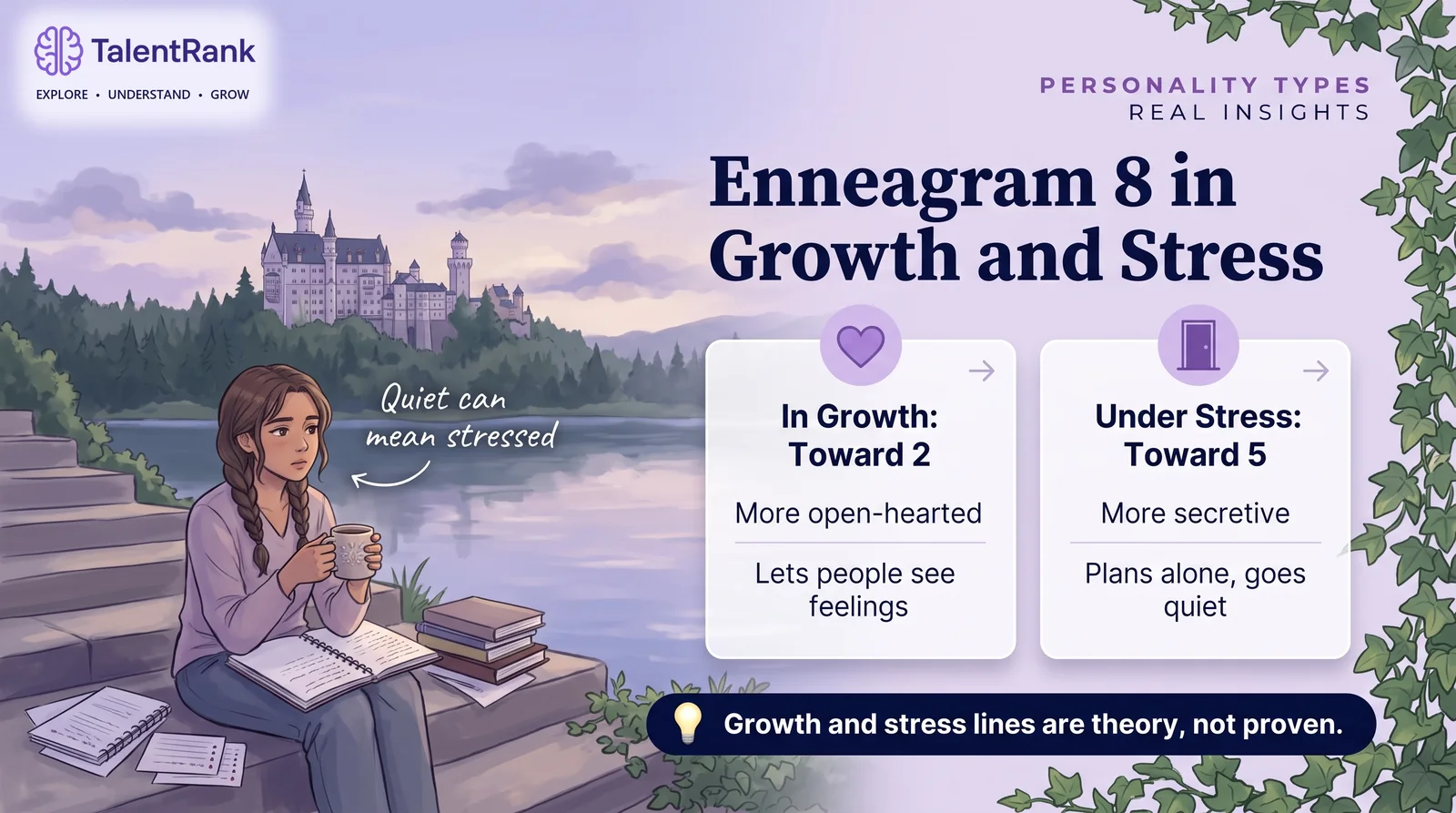
In growth, Eights move toward Type 2. They become more open-hearted and caring, and they let people see what they feel rather than only what they think. For an Eight, that kind of softness is a sign of security, not weakness.
Under stress, Eights move toward Type 5. They pull back and start planning in private. Quiet Eight? Often a stressed Eight. The one who's usually loud and suddenly says nothing in a meeting may be under more pressure than anyone in the room.
Keep in mind that these lines are part of Enneagram theory. Research hasn't tested them much (more on that below).
The Two Wings: 8w7 and 8w9
An Eight's wing is one of the two neighboring types, Seven or Nine.
The 8w7 (the Maverick) adds the Seven's energy and appetite for new things. These Eights tend to move fast. They like big projects and bigger risks, and routine bores them quickly.
The 8w9 (the Bear) adds the Nine's steadiness. These Eights are usually calmer and slower to anger, though formidable once they decide to act. Many people see them as a protective, grounded presence rather than a forceful one.
Enneagram 8 at Work
Eights often do well wherever someone has to make the call and take responsibility for it: leading a team through a turnaround, running their own business, emergency work, negotiation, or advocacy. They tend to dislike micromanagement and any rule that seems to exist only to slow things down.
The challenge is that an Eight's natural pace can leave others behind. Colleagues may stop raising concerns, not because they agree, but because pushing back feels like a fight.
Hypothetical example: an Eight operations manager inherits a project that's three months late. Within a week she has cut two low-value features and renegotiated a vendor contract, and the deadline looks possible again. Six weeks later, she notices that nobody on the team brings her problems anymore. They fix what they can and hide the rest. Her growth step isn't to become less decisive. It's to ask "what am I missing?" before deciding, and to make it safe for people to answer.
Enneagram 8 in Relationships
In relationships, Eights are loyal and generous. They'll show up when it counts, and they'll defend a partner against anyone. They usually prefer honesty to diplomacy and get uneasy when they sense someone is hiding something.
The Enneagram Institute notes that Eights can "lose emotional connection" with people they work hard to provide for. They may show love by solving problems and being strong, while a partner wants them to slow down and let their guard drop.
What helps: partners who can stand their ground without escalating, and Eights who practice saying "I'm worried" or "that hurt" out loud instead of turning it into anger.
Is It an Eight or Another Type?
A few types are easy to confuse with the Eight:
Three: both are confident and results-driven. Threes care about how success looks to others; Eights care about not being controlled and rarely worry about image.
One: both can be blunt and intense. Ones are driven by what's right and often hold anger in; Eights are driven by strength and let it out.
Seven: both are energetic and bold, especially an 8w7. Sevens move toward pleasure and options; Eights move toward control and impact.
If your first question in a new situation is "who's in charge here, and can I trust them?", that leans Eight.
How Enneagram 8s Can Grow
Pause before deciding for others. A ten-second check ("does anyone see this differently?") changes how people experience you.
Name the feeling under the anger. Hurt and fear often show up first as irritation.
Let someone help you with something small. It builds the muscle for bigger things.
Notice when you go quiet and secretive. That's often stress, not strategy.
What the Research Says, and How to Go Further
The Enneagram is better treated as a tool for reflection than as a measurement. A 2021 systematic review of 104 samples in the Journal of Clinical Psychology found mixed evidence for its reliability and validity, and little research support for wings or for movement between types. It did find that Enneagram scales relate to the Big Five traits in ways the theory predicts.
That's a good reason to pair your type with a measured profile. If the Eight's bluntness sounds familiar, your agreeableness score is worth a look; our guide to low agreeableness explains what that trait looks like at work. The Big Five guide covers all five traits.
The TalentRank assessment measures your Big Five traits and takes about 12 to 15 minutes. It won't assign you an Enneagram type, but it shows where you land on each trait so you can compare the scores with how you see yourself. Start the TalentRank assessment.
Frequently Asked Questions About Enneagram 8
What is an Enneagram 8?
Type 8, the Challenger, is the Enneagram type motivated by protecting themselves and staying in control of their own life. Eights tend to be direct and protective. They hate being controlled.
What is the Enneagram 8's biggest fear?
According to the Enneagram Institute, it's being harmed or controlled by others.
What are the Enneagram 8 wings?
8w7, called the Maverick, and 8w9, called the Bear. The 8w7 tends to be bolder and more restless; the 8w9 tends to be calmer and more measured.
Where does an Eight go in stress and growth?
In Enneagram theory, Eights move toward Type 5 under stress (more withdrawn and secretive) and toward Type 2 in growth (more open-hearted and caring).
Are Enneagram 8s good leaders?
Many are effective in situations that need quick decisions and clear ownership. Their growth edge is listening before deciding, so the people around them keep speaking up.
Final Takeaway
Enneagram 8s are at their best when their strength protects other people instead of overpowering them. If you're an Eight, the goal isn't to soften into someone else. It's to let a few trusted people see the parts of you that strength was built to guard.