

MBTI and Enneagram types don't convert neatly into each other, and no reliable chart exists for it. An INFJ isn't automatically a Four, and a Five can be an INTP or an ISTJ. What the research does show is a set of tendencies: some Enneagram types lean toward certain MBTI preferences more often than chance would predict.
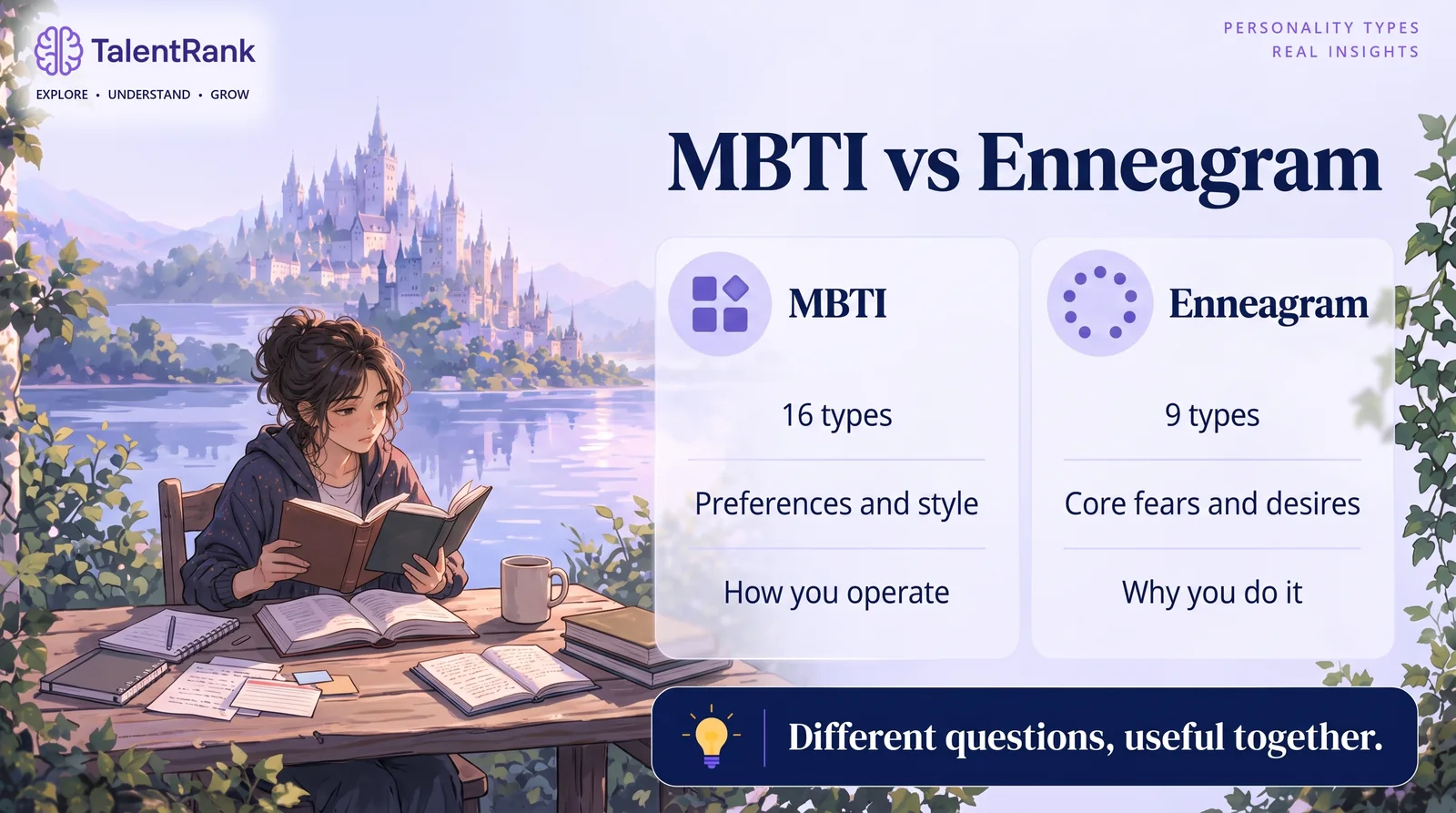
The two systems answer different questions. MBTI describes how you prefer to take in information and make decisions. The Enneagram describes why you do what you do, built around a core fear and desire. Used together, they can give a fuller picture than either one alone.
This guide covers what each system describes, what studies found when they compared the two, and how to use both without forcing them into a lookup table.
What Each System Describes
MBTI sorts people into 16 types using four pairs of preferences: Extraversion or Introversion, Sensing or Intuition, Thinking or Feeling, and Judging or Perceiving. Our guide to what the MBTI letters mean explains each pair in detail.
The Enneagram sorts people into nine types, each built around a core motivation. A Three wants to feel valuable; a Six wants security; a Nine wants peace of mind. Our overview of all nine Enneagram types walks through each one.
Put simply, MBTI is closer to a description of style. The Enneagram is closer to a description of motive. Two people with the same MBTI type can want very different things, and two people with the same Enneagram type can go about getting them in very different ways.
MBTI and Enneagram Side by Side
MBTI | Enneagram | |
Number of types | 16 | 9 (plus 18 wing variations) |
Built around | Preferences for perceiving and deciding | Core fears and desires |
Main question | How do you prefer to operate? | Why do you do what you do? |
Describes change? | Not really; preferences are treated as stable | Yes, through growth and stress lines |
Typical use | Communication styles, teamwork | Self-reflection, personal growth |
What Research Found When It Compared the Two
A 2021 systematic review of Enneagram research by Hook and colleagues identified seven studies, published between 1983 and 1998, that compared Enneagram types with MBTI results. Scientific Enneagram's summary of those studies counts how often each link showed up. Some of the clearer patterns:
Type 5 leaned toward Thinking in all seven studies and toward Introversion in six.
Type 4 leaned toward Feeling in six studies and toward Intuition in five.
Type 7 leaned toward Extraversion in six studies and toward Intuition in five.
Type 3 leaned toward Extraversion in five studies.
Type 2 leaned toward Feeling in five studies.
Type 9 showed no consistent pattern at all.
The earliest of these, a 1983 study by Wagner and Walker, gave the MBTI to 390 people who had typed themselves on the Enneagram and found that the types produced different but sensible MBTI profiles.
These patterns make intuitive sense. A Five's drive to understand fits Thinking and Introversion; a Seven's chase for new options fits Extraversion and Intuition. But they're tendencies across groups, not rules for individuals, and the studies are old and small by today's standards. The overall review also found mixed evidence for the Enneagram's reliability and validity.
Why There's No Reliable MBTI-to-Enneagram Chart
You'll find plenty of charts online claiming "INFJ = 4" or "ENTJ = 8." Treat them as guesses. Even where a tendency exists, it describes a small shift in the odds, not a match.
Here's why the systems don't map neatly:
They measure different things. A preference for Thinking says nothing about whether you fear being controlled or fear being worthless.
Most of the 16 MBTI types can show up with most of the nine Enneagram types.
Both systems rely heavily on self-report, so a person's results in each depend on how they see themselves that day.
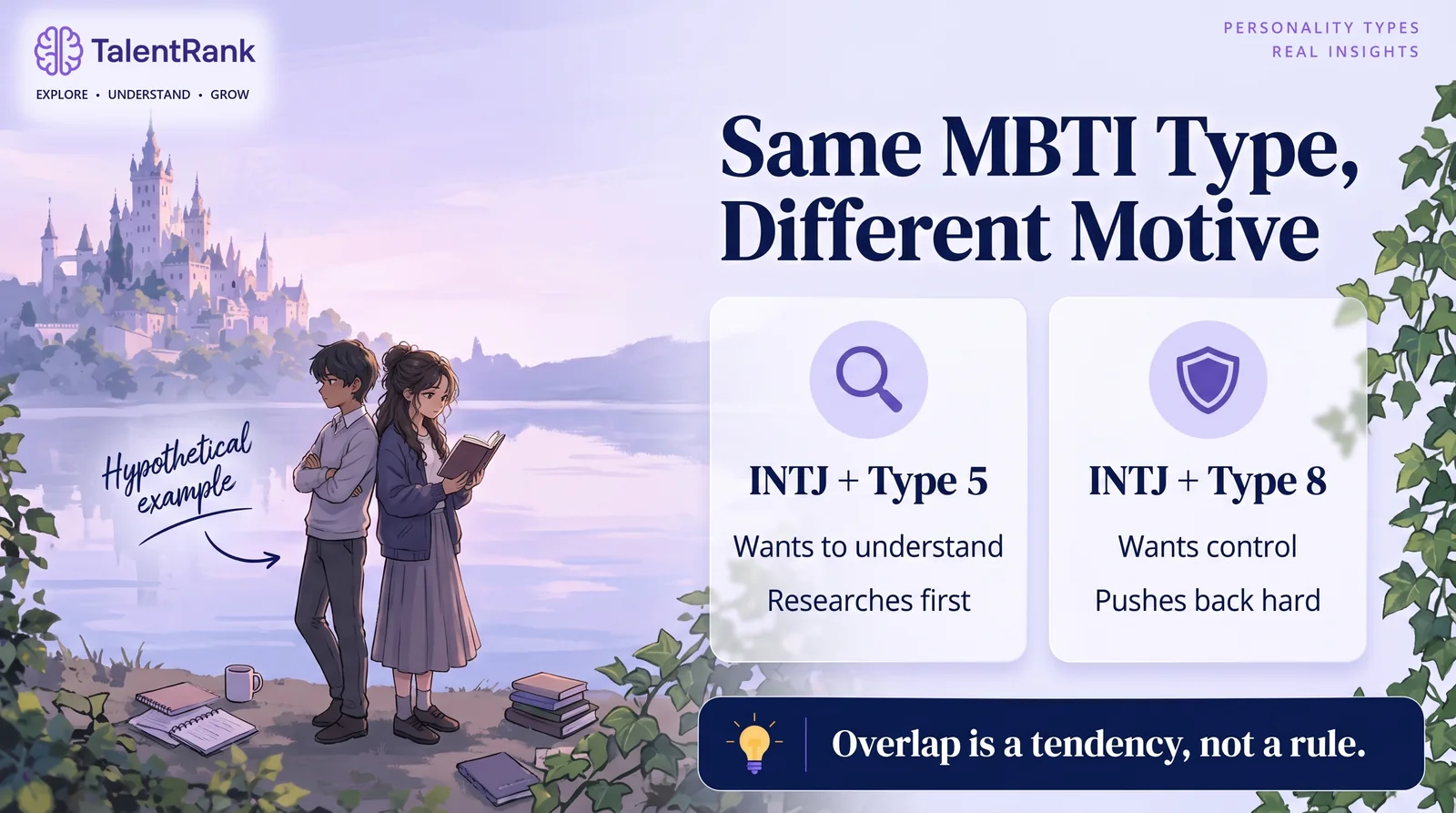
Hypothetical example: two INTJs take an Enneagram test. One is a Five who wants to understand everything before acting. The other is an Eight who wants control over their own projects and pushes hard against interference. Same MBTI type, very different engines underneath.
Hypothetical example: two Twos compare notes. One is an ESFJ who hosts every gathering. The other is an INFP who helps quietly, one friend at a time. Same core motive, very different styles.
How to Use Both Systems Together
Used side by side, the two systems can explain things neither covers alone.
Use your MBTI type to understand how you communicate and make decisions.
Use your Enneagram type to understand what you're protecting and what drives you under pressure.
When the two seem to clash, look closer. An ENFP who's also a Six may be outgoing and idea-driven while carrying more worry than other ENFPs.
Don't use either one to predict what someone else will do, or to make hiring decisions.
Where the Big Five Fits
If you want something measured rather than sorted into types, the Big Five is the framework personality researchers rely on most. It scores five traits on a continuum instead of putting you in a category, and the Enneagram review found that Enneagram scales relate to Big Five traits in the ways the theory predicts. Our comparison of the Big Five and MBTI explains the difference in more detail.
The TalentRank assessment measures your Big Five traits and takes about 12 to 15 minutes. It won't assign you an MBTI or Enneagram type, but it gives you measured scores to read alongside both. Start the TalentRank assessment.
Frequently Asked Questions About MBTI and Enneagram
Is there a chart that matches MBTI types to Enneagram types?
Not a reliable one. Studies found tendencies, such as Fives leaning toward Introversion and Thinking, but most MBTI types can appear with most Enneagram types.
What MBTI type is most common for Enneagram 5?
In the studies summarized in the 2021 review, Fives leaned toward Introversion and Thinking. That fits types like INTJ, INTP, ISTJ, and ISTP, but it isn't a rule.
Which is more accurate, MBTI or the Enneagram?
Neither has the research support of the Big Five. MBTI is better for describing style, and the Enneagram is better for exploring motivation.
Can I be an INFJ and an Enneagram 8?
Yes. It's less common in the studies than some other combinations, but nothing in either system rules it out.
Should I take both tests?
You can. Read each result as a starting point. Then compare them and notice where they disagree.
Final Takeaway
MBTI describes how you operate, and the Enneagram describes why. They overlap in places, but they don't translate into each other. Use them as two lenses, and look for the places where they disagree. That's often where the most useful self-knowledge is.