

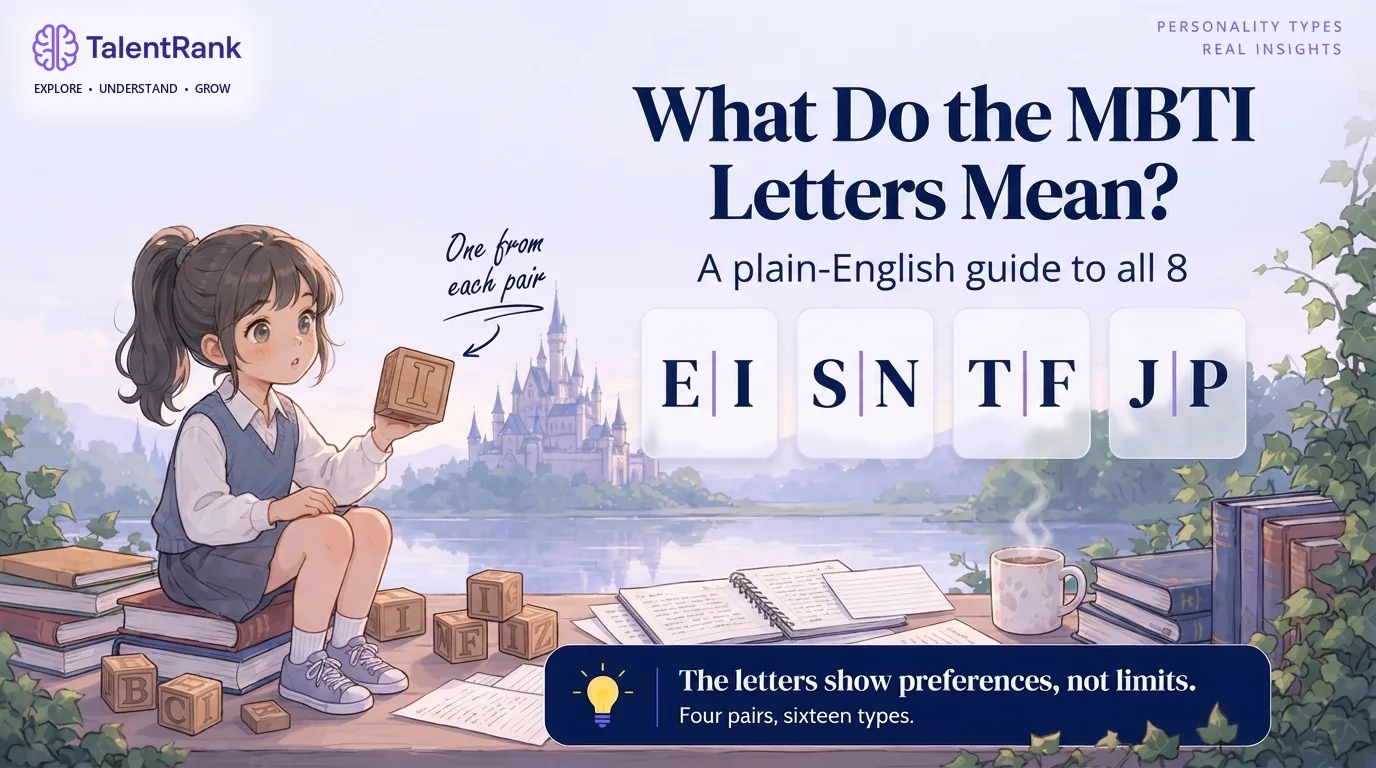
The MBTI letters' meaning is simpler than the four-letter codes make it look. Each type is built from four pairs of opposite preferences, and you take one letter from each pair:
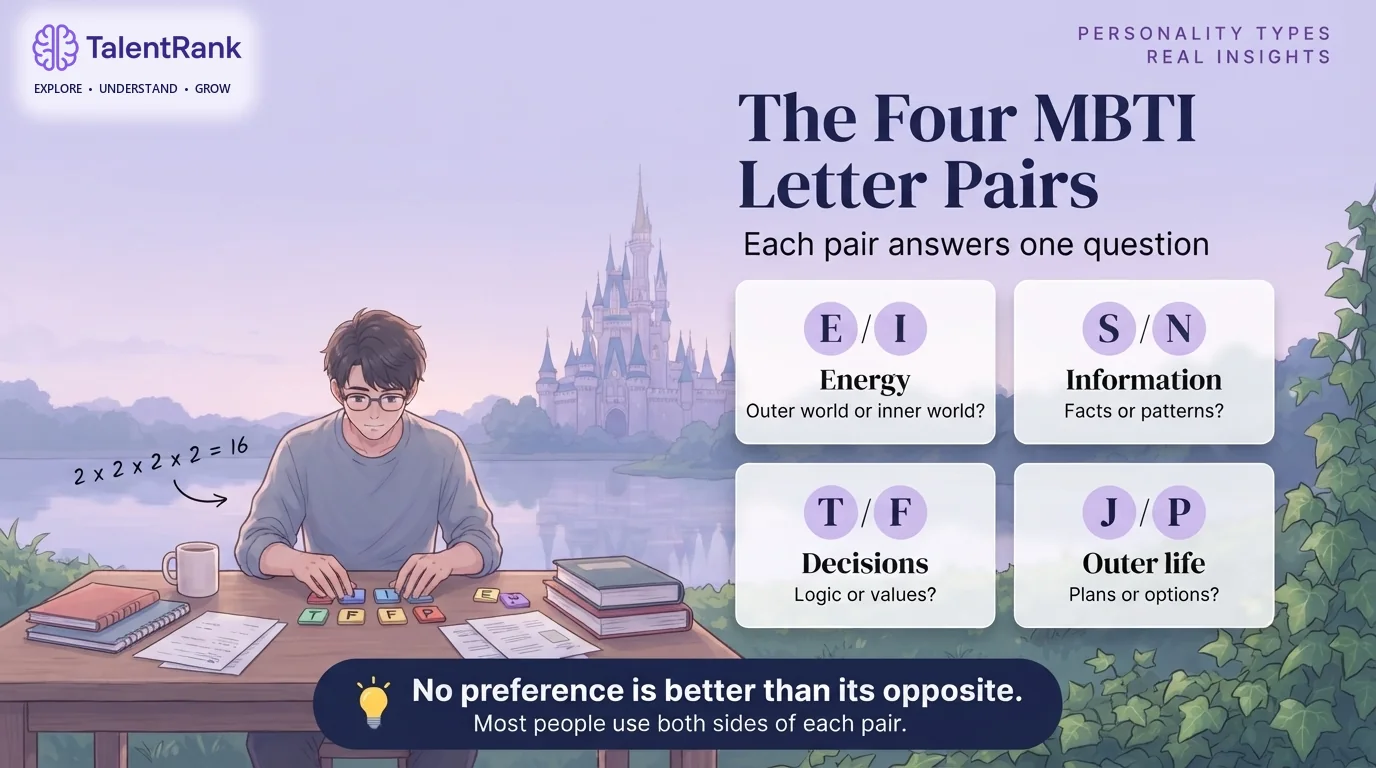
E or I: Extraversion or Introversion, which describes where you direct and get your energy.
S or N: Sensing or Intuition, which describes how you take in information.
T or F: Thinking or Feeling, which describes how you make decisions.
J or P: Judging or Perceiving, which describes how you approach the outside world.
Put four letters together and you get one of 16 types, like INTJ or ESFP. This guide explains what each letter actually means, clears up the most common misunderstandings, and points you to our deeper guides for each pair.
The Four Letter Pairs at a Glance
Position | Letters | Question it answers | What the preference means |
1st | E / I | Where do you direct your energy? | E: toward people and activity. I: toward thoughts and reflection. |
2nd | S / N | How do you take in information? | S: facts and specifics. N: patterns and possibilities. |
3rd | T / F | How do you make decisions? | T: logical analysis. F: personal and social values. |
4th | J / P | How do you approach the outside world? | J: plans and closure. P: flexibility and options. |
These descriptions follow the Myers-Briggs Foundation, which frames each pair as a question about how you prefer to operate.
E vs. I: Extraversion or Introversion
The first letter describes where your attention and energy naturally go. The Myers-Briggs Foundation describes Extraversion as focusing on the outside world and gaining energy from interacting with people, and Introversion as focusing on the inner world and gaining energy from reflecting on ideas, experiences, and memories.
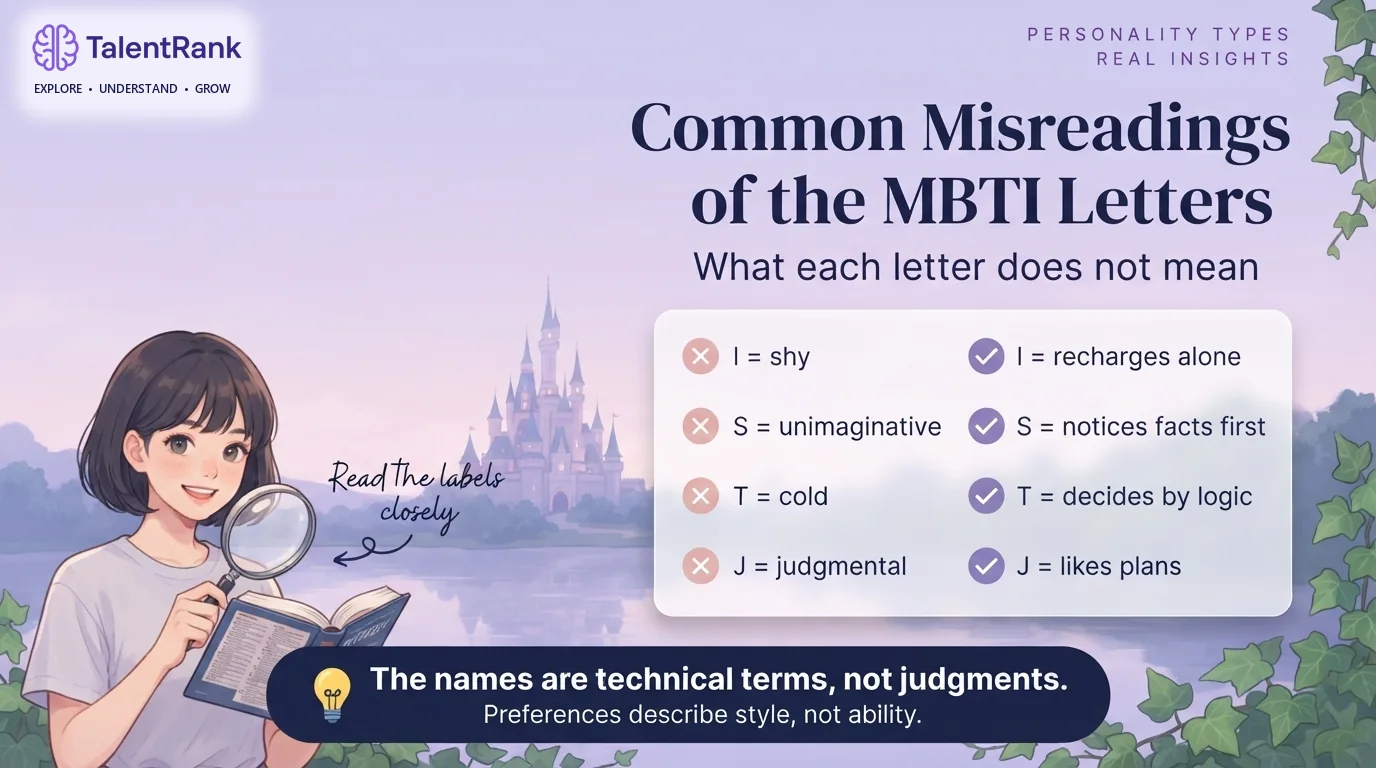
The big misunderstanding: Introversion isn't shyness, and Extraversion isn't confidence. An introvert can be a great public speaker who needs quiet time afterward. For examples and a full breakdown, see our guide to E vs. I in MBTI.
S vs. N: Sensing or Intuition
The second letter describes what kind of information you trust and notice first. Sensing focuses on facts and specifics and takes a realistic approach. Intuition looks for new ideas and the big picture.
Why N instead of I? Because I was already taken. The official MBTI site explains that N stands for Intuition "because we already used the letter I for Introversion." (MBTIonline)
The common mistake here is treating Sensing as unimaginative or Intuition as smarter. Neither is true. They describe what you pay attention to, not how well you think. Our S vs. N guide has real-life examples.
T vs. F: Thinking or Feeling
The third letter describes how you prefer to make decisions. Thinking uses logical analysis and is system-oriented. Feeling applies personal and social values and is people-oriented.
This is the pair people misread most. Thinking doesn't mean cold or emotionless, and Feeling doesn't mean emotional or irrational. A Thinking type can be very caring; they just weigh decisions by logic first. Read more in our T vs. F guide.
J vs. P: Judging or Perceiving
The fourth letter describes how you approach the outside world. Judging types like making and sticking to plans and want closure. Perceiving types prefer to stay flexible and keep options open.
Despite the names, Judging has nothing to do with being judgmental, and Perceiving has nothing to do with being perceptive. The terms are technical labels, not compliments or insults. Our J vs. P guide covers the difference in depth.
How the Letters Combine Into 16 Types
Each of the four pairs has two options, so there are 2 × 2 × 2 × 2 = 16 possible combinations. Here's how to read one:
INFJ = Introversion + Intuition + Feeling + Judging. Someone who recharges alone, notices patterns, decides by values, and likes a plan.
ESTP = Extraversion + Sensing + Thinking + Perceiving. Someone who draws energy from activity, focuses on the here and now, decides by logic, and keeps options open.
The letters describe preferences that interact. The Myers-Briggs Foundation also describes "type dynamics", the idea that the four preferences work together rather than as independent switches. (Myers-Briggs Foundation) That's why two types that differ by one letter, like INTJ and INTP, can feel quite different in practice.
Preferences, Not Skills
One of the most important points about the MBTI letters is also the most overlooked. The Myers-Briggs Foundation notes that "most people have the ability to do both, even if they don't like doing one or the other." A preference for Introversion doesn't mean you can't network. A preference for Thinking doesn't mean you can't be empathetic.
The Myers-Briggs Company adds that preferences "do not indicate skill or ability," and that the assessment shouldn't be used to select people for jobs. (The Myers-Briggs Company) Think of the letters as describing what feels natural, not what you're capable of.
What About the -A and -T at the End?
If you've seen a fifth letter, like INTJ-A or ENFP-T, that comes from 16Personalities, not the official MBTI. 16Personalities adds a fifth scale it calls Identity (Assertive or Turbulent) and builds its model on Big Five research rather than Myers-Briggs theory. (16Personalities) It uses the same four letters, but it's a different system.
Common Mistakes When Reading the MBTI Letters
Treating the letters as all-or-nothing. Most people use both sides of each pair; the letter shows which one they prefer.
Reading the names literally. "Judging" and "Feeling" are technical terms with specific meanings.
Assuming one pole is better. No preference is superior to its opposite.
Using the letters to predict ability or job performance. They describe preferences, not skills.
Forgetting that four letters are a summary. Two people with the same type can still be very different.
Beyond the Four Letters
Four letters sort people into 16 groups, but people vary within each group. The Big Five model, which is widely used in personality research, measures traits like openness and extraversion on a spectrum instead. (Our comparison of the Big Five and MBTI explains the difference.)
The TalentRank assessment measures your Big Five personality traits and takes about 12 to 15 minutes. It won't assign you four MBTI letters, but it shows where you fall on each trait in more detail. Take the TalentRank assessment.
Frequently Asked Questions About MBTI Letters
What do the 4 letters in MBTI stand for?
Each letter represents one preference from a pair: E or I (Extraversion or Introversion), S or N (Sensing or Intuition), T or F (Thinking or Feeling), and J or P (Judging or Perceiving).
Why is Intuition N instead of I?
Because I was already used for Introversion. The official MBTI site gives exactly that reason.
What does the J mean in MBTI?
J stands for Judging, a preference for plans, structure, and closure. It has nothing to do with being judgmental.
Is one MBTI letter better than its opposite?
No. Each pair describes two different preferences, and neither is better. Most people use both sides; the letter shows which one comes more naturally.
How many MBTI types are there?
There are 16, because each of the four letter positions has two options.
What does the -T or -A at the end mean?
It comes from 16Personalities, not the official MBTI. It stands for Turbulent or Assertive on a fifth scale that 16Personalities calls Identity.
Final Takeaway
The MBTI letters describe four preferences: where you get energy, what information you notice, how you decide, and how you approach the outside world. Once you know what E, I, S, N, T, F, J, and P mean, any four-letter type becomes easy to read. Just remember that the letters show preferences, not limits, and use the pair guides above if you want to go deeper on any one of them.