


Enneagram wings are the two types on either side of your main type on the Enneagram circle. A Four's wings are Three and Five, so a Four is usually described as a 4w3 or a 4w5. The Enneagram Institute explains that the wing "complements" your basic type and adds "important, sometimes contradictory, elements" to it.
Your wing doesn't change your core type. It changes the flavor. Two Fours can share the same longing for identity, while one shares it on a stage and the other keeps it in a notebook. That difference is often the wing.
Below you'll find what a wing is, all 18 wing types in one table, a simple way to work out your own wing, and an honest note on how much of this is backed by research.
What a Wing Is
The nine Enneagram types sit in a circle, numbered 1 to 9. Each type has two neighbors. Type 1 sits between 9 and 2. Type 5 sits between 4 and 6. Those neighbors are the possible wings.
The shorthand is simple. "4w5" means a Four with a Five wing. "9w1" means a Nine with a One wing. The first number is your core type, the one built around your basic fear and desire. The second number is the neighbor whose traits show up most in how you express that core.
A wing never replaces your type. A 4w5 is still a Four: still driven by the search for identity, still prone to envy. The Five wing simply adds some of the Five's privacy and need to understand.
All 18 Enneagram Wing Types
The names in the second column are the ones the Enneagram Institute uses on its type pages. The descriptions are our short summaries, meant as a quick guide rather than a full profile.
Wing type | Institute name | In one line |
1w9 | The Idealist | A One who is calmer, more reserved, and philosophical |
1w2 | The Advocate | A One who is warmer and focused on helping people |
2w1 | Servant | A Two with a strong sense of duty and principle |
2w3 | The Host/Hostess | A Two who is outgoing and socially confident |
3w2 | The Charmer | A Three who wins people over with warmth |
3w4 | The Professional | A Three who is more private and focused on quality |
4w3 | The Aristocrat | A Four who shares their individuality more openly |
4w5 | The Bohemian | A Four who is quieter and more cerebral |
5w4 | The Iconoclast | A Five who is creative and unconventional |
5w6 | The Problem Solver | A Five who applies knowledge to practical problems |
6w5 | The Defender | A Six who is reserved and analytical |
6w7 | The Buddy | A Six who is social and uses humor to ease tension |
7w6 | The Entertainer | A Seven who is warm, playful, and people-focused |
7w8 | The Realist | A Seven who is assertive and goal-driven |
8w7 | The Maverick | An Eight who is bold, fast, and entrepreneurial |
8w9 | The Bear | An Eight who is steadier and slower to anger |
9w8 | The Referee | A Nine who is grounded and firm when pushed |
9w1 | The Dreamer | A Nine who is idealistic and quietly principled |
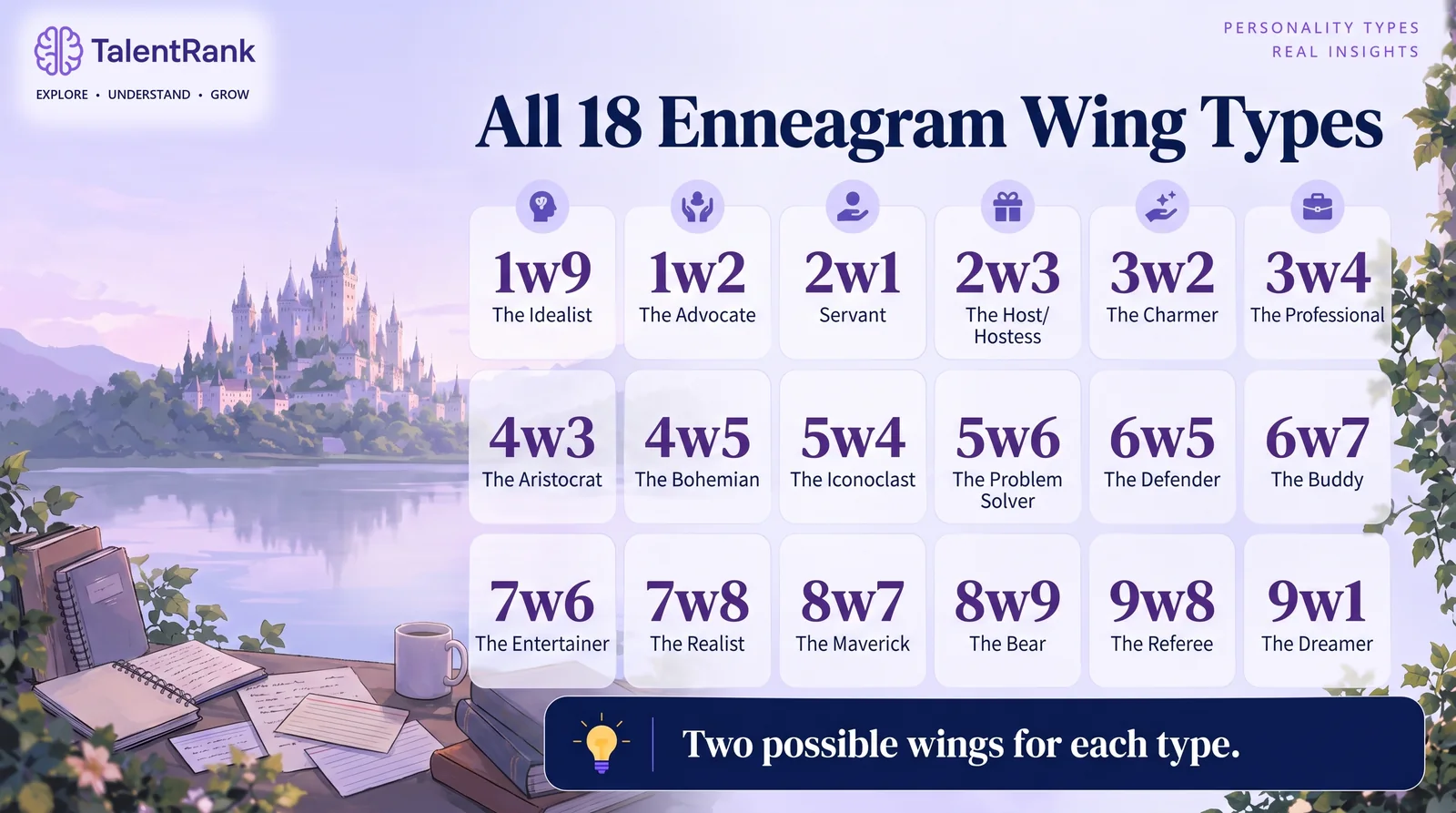
Each of our type guides covers its two wings in more detail. For example, the Enneagram 4 profile compares the 4w3 and 4w5, and the Enneagram 8 profile compares the 8w7 and 8w9.
How to Find Your Wing
Start with your core type. If you're not sure of that yet, our overview of all nine Enneagram types is the place to begin, because a wing only makes sense once the core type fits.
Then try this:
Read the profiles of the two neighboring types, not just the wing summaries.
Ask which neighbor's motivations you recognize in yourself, even if they're not your main drive.
Look at how you express your core type under ordinary conditions. A Six who jokes to ease tension leans 7; a Six who goes quiet and researches leans 5.
Ask someone who knows you well which description fits better.
If both neighbors feel equally familiar, that's fine. You don't have to choose today.
Hypothetical example: a Nine notices she rarely gets angry, but when she does, she becomes immovable and blunt. That firmness suggests a 9w8. Her friend, also a Nine, rarely gets angry either, but he spends a lot of time quietly frustrated that things aren't as they should be. That pull toward ideals suggests a 9w1.
Can You Have Both Wings, or No Wing?
The Enneagram Institute's view is that most people have one dominant wing, though some develop both over time. Many teachers describe people who seem "balanced" between the two, and a few who show neither strongly.
In practice, it helps to hold your wing loosely. It's a description of a tendency, not a second identity. And it may look different in different parts of your life, at work versus at home, for instance.
Wings vs Growth and Stress Lines
Wings and lines are easy to mix up, but they're different ideas.
Wings are the two neighbors on the circle. They describe a steady flavor in how you express your type.
Growth and stress lines run across the circle. They describe how you change when you're thriving or under pressure. A Four, for example, moves toward One in growth and toward Two under stress.
So a 4w5 has a Five wing every day, and may still act more like a One when growing or more like a Two when stressed. Each type guide covers that type's lines.

What the Research Says About Wings
Here's the honest part. A 2021 systematic review of 104 samples in the Journal of Clinical Psychology found mixed evidence for the Enneagram's reliability and validity overall. On wings specifically, it found little research support. The same goes for movement between types.
That doesn't make wings useless. Plenty of people find the idea helpful for describing why two people of the same type can seem so different. But it's a teaching concept, not a measured result, and no test score should settle your wing for you.
Pairing Your Wing With a Measured Profile
If you want something measured alongside your Enneagram type and wing, the Big Five is the framework personality researchers use most. It scores traits like extraversion and openness on a scale. Those scores often explain the same differences people attribute to wings: a 7w6 and a 7w8 may simply differ in agreeableness, for example. Our guide to the Big Five personality traits covers all five.
The TalentRank assessment measures your Big Five traits and takes about 12 to 15 minutes. It won't tell you your Enneagram type or wing, but it gives you measured scores to set beside them. Start the TalentRank assessment.
Frequently Asked Questions About Enneagram Wings
What are Enneagram wings?
Wings are the two types next to your core type on the Enneagram circle. Your dominant wing adds some of that neighbor's traits to how you express your core type.
How many Enneagram wing types are there?
There are 18: two possible wings for each of the nine types, such as 1w9 and 1w2.
Can your wing change?
Many Enneagram teachers say people can develop their other wing over time, or move between them. Research hasn't tested this well.
What is a 4w5?
A Four with a Five wing, which the Enneagram Institute calls "The Bohemian." These Fours tend to be quieter and more cerebral than Fours with a Three wing.
Do wings matter more than my core type?
No. Your core type is built around your basic fear and desire. The wing only shapes how that core shows up.
Final Takeaway
Your wing explains part of why you don't look exactly like every other person who shares your type. Use it as one more lens for self-understanding, hold it loosely, and keep your attention on the core motivation underneath.