


Enneagram 4, the Individualist, is the type organized around identity. Fours want to find out who they really are and to have that self matter. Their basic fear, as the Enneagram Institute puts it, is "that they have no identity or personal significance."
That search gives Fours real gifts: emotional honesty, a feel for beauty, and the ability to sit with pain without rushing to fix it. It also gives them a familiar trap, the sense that something essential is missing in them that other people seem to have. This guide covers both, along with the 4w3 and 4w5 wings and what growth looks like for a Four.
Enneagram Type 4 in Brief
Type 4: The Individualist | |
Core desire | To find themselves and their significance |
Core fear | Having no identity or personal significance |
Center | Heart (feeling), where image and shame are the key issues |
Wings | 4w3 "The Aristocrat" and 4w5 "The Bohemian" |
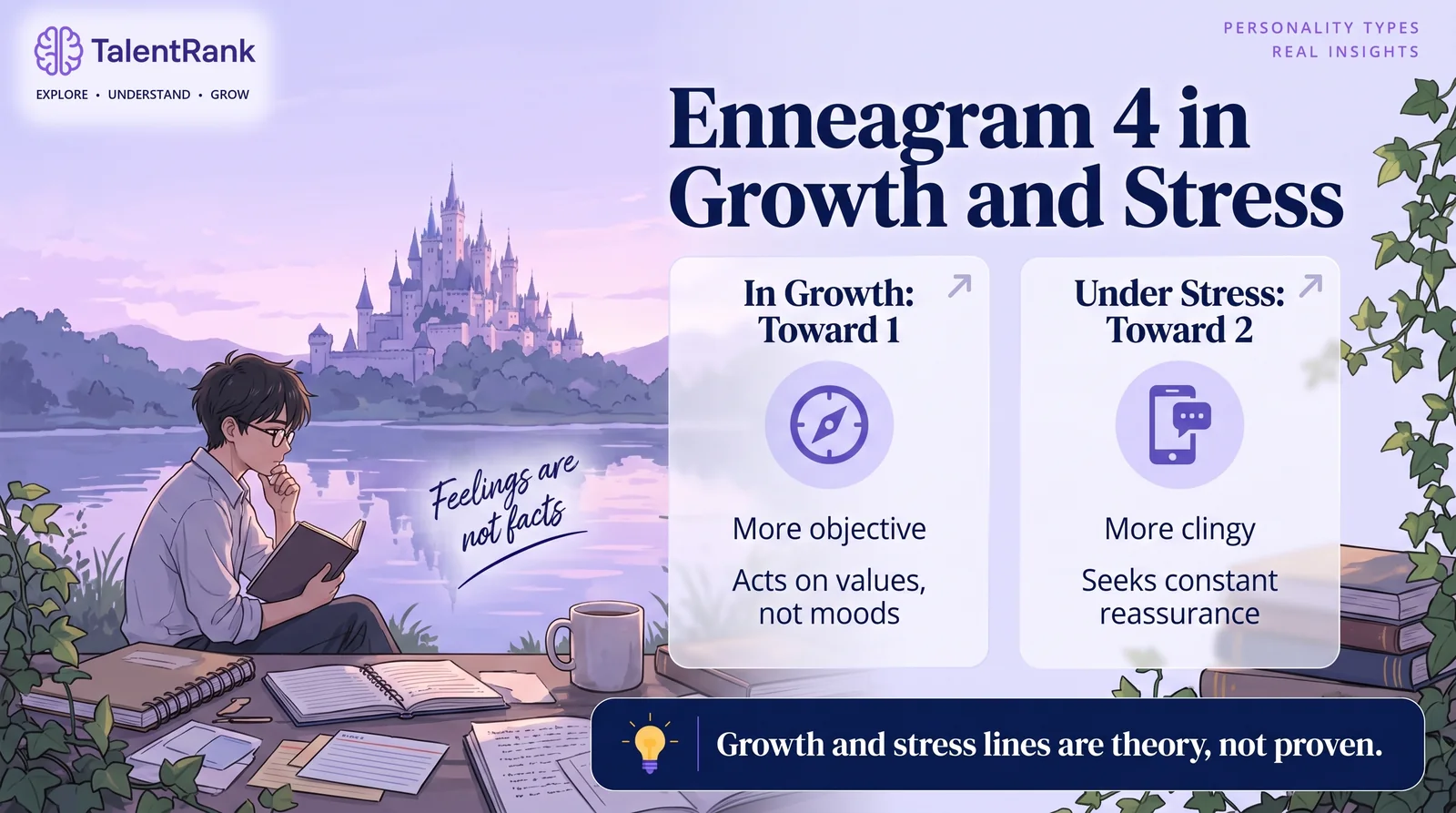
In growth | Moves toward Type 1: more objective and principled |
Under stress | Moves toward Type 2: over-involved and clinging |
Typical strengths | Emotionally honest, creative, empathetic with pain |
Typical blind spots | Envy, moodiness, withdrawing to protect their image |
New to the system? Our overview of all nine Enneagram types shows how the Four fits with the rest.
The Longing at the Center of Type 4
Most Fours know the feeling of being on the outside. It starts early. Other people seem to know how to belong, how to be content, how to be ordinary. A Four often feels they missed the instructions.
In response, many Fours build their identity around being different. They're drawn to whatever feels authentic. They notice fake things fast. The Enneagram Institute describes healthy Fours as "profoundly creative" and "self-renewing," able to turn their inner life into art, ideas, or simply honest conversation.
The trouble starts when the longing becomes the point. A Four can get more attached to what's missing than to what's here, replaying a hurt or idealizing a life they don't have. The Institute calls this an idealized "Fantasy Self," and it's one of the main things Fours learn to see through.
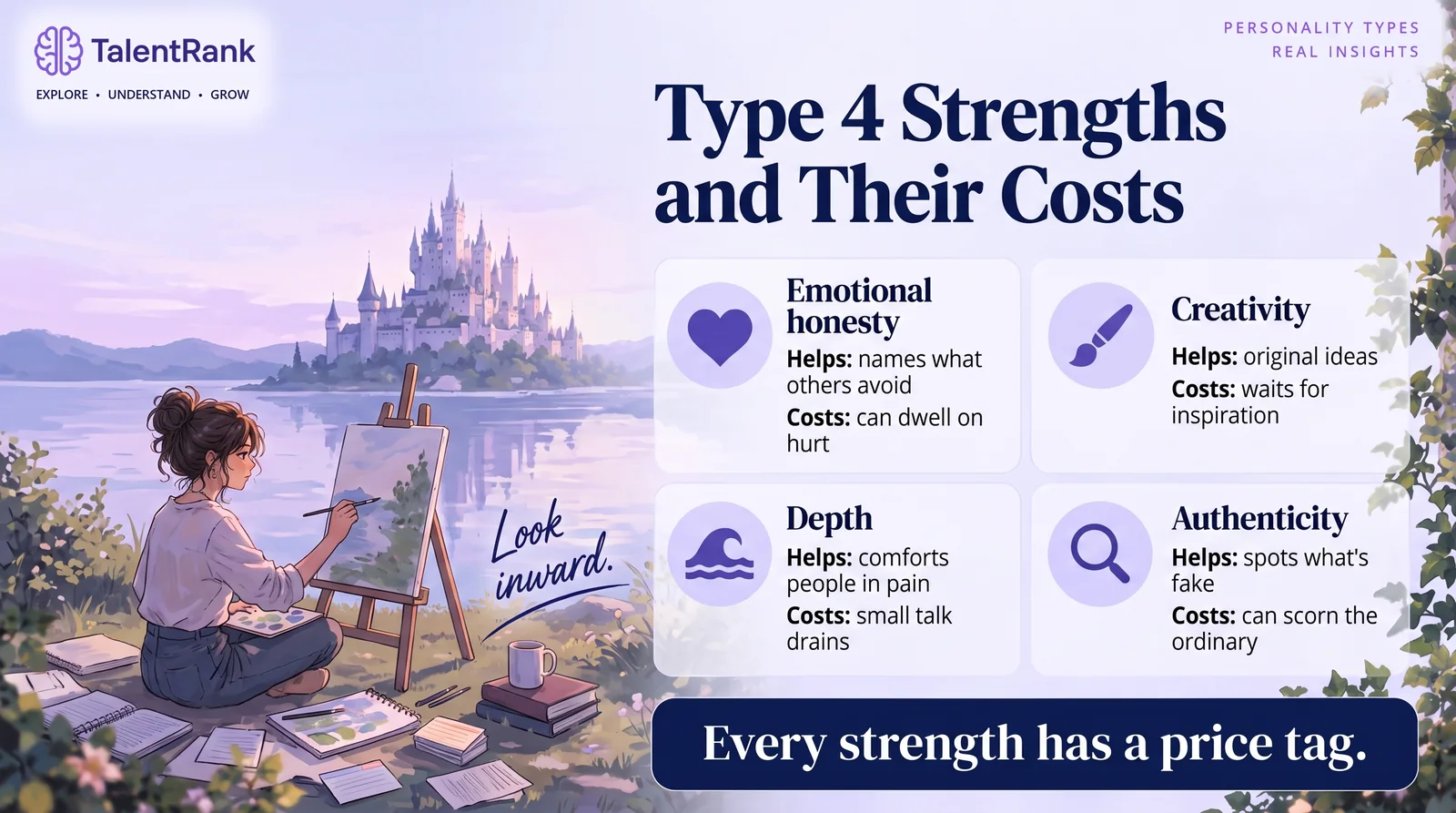
What Fours Bring, and What It Costs
Fours often make the people around them braver about their own feelings. They don't flinch at grief, and they're usually the friend who asks the second question.
Strength | Where it helps | What it can cost |
Emotional honesty | Names what others avoid | Can overshare or dwell |
Creativity | Original work and ideas | Waits for inspiration instead of practicing |
Depth | Comforts people in hard times | Finds small talk exhausting |
Authenticity | Spots what's fake | Can turn contemptuous of the ordinary |
Sensitivity | Reads mood and subtext | Hurt lingers for a long time |
When a Four Is Struggling
At average levels, the Institute describes Fours as "self-absorbed and introverted, moody and hypersensitive," withdrawing to protect their self-image. Envy is common. A Four may scroll through other people's lives and feel worse with every post.
Under stress, Enneagram theory says Fours move toward Type 2. The usually reserved Four becomes "over-involved and clinging," chasing reassurance from the people they care about. If a Four who normally keeps to themselves starts texting a partner every hour, stress is a likely explanation.
None of this means a Four is depressed, and the type isn't a diagnosis. But Fours who notice long stretches of hopelessness should treat that as a health issue and talk to a professional, the same as anyone else.
How Fours Grow
In growth, Fours move toward Type 1 and become "more objective and principled." In plain terms, they start acting on their values instead of waiting until they feel like it.
That shift shows up in small habits:
Making things on a schedule, not only when inspired.
Separating "I feel worthless" from "I am worthless." The first is a feeling; the second is a claim it can't prove.
Noticing envy and asking what it points to. Envy often marks something a Four wants and could work toward.
Letting ordinary moments count. A good coffee with a friend is not a lesser experience because it's simple.
4w3 vs 4w5: The Two Wings
The 4w3 (the Aristocrat) borrows the Three's drive and awareness of an audience. These Fours tend to be more outgoing and more interested in sharing their work, and they often care how it's received. They can do well in creative fields with a public side, like design, performance, or brand work.
The 4w5 (the Bohemian) borrows the Five's need for privacy and understanding. These Fours tend to be quieter and more cerebral, and less concerned with an audience. They're often drawn to writing, research, or art made mostly for themselves.
Neither wing is better. They just fail differently. A 4w3 may need to watch for performing their feelings; a 4w5 may need to watch for disappearing into them.
Enneagram 4 at Work
Fours tend to do their best work when it means something to them personally. Routine work with no room for their own judgment can feel like slow erosion, even when the pay is good.
Hypothetical example: a Four copywriter turns in the most original pitch on the team, then takes the client's edits as a rejection of who she is, not of three sentences. Her growth step isn't to care less about the work. It's to separate her identity from the draft, so feedback can make the work better without making her feel smaller.
Roles that use a Four's strengths often involve meaning-making, like counseling or writing, or any job where empathy for people in pain matters. Clear deadlines help too. Structure gives a Four's creativity something to push against.
Enneagram 4 in Relationships
In relationships, Fours offer intensity and real attention. They want to be known, and they want to know their partner just as deeply.
The common pattern to watch is push and pull. A Four may idealize a partner from a distance, then feel disappointed up close when the partner turns out to be ordinary. Some Fours also test whether they'll be abandoned, which can create the very distance they fear.
What helps: partners who stay steady when a Four's mood shifts, and Fours who say what they need directly instead of hoping to be understood without asking.
Four, Five or Nine?
Four or Five: both can be private and intense. Fours withdraw into feelings; Fives withdraw into thinking. A Four wants to be understood; a Five wants to understand.
Four or Nine: both can feel disconnected from others. Fours feel their difference sharply; Nines tend to merge with others and lose track of themselves.
Four or Two: both are in the heart center and care about relationships. Twos focus outward on others' needs; Fours focus inward on their own experience.
The Evidence, and a Measured Next Step
The Enneagram is better used for reflection than measurement. A 2021 systematic review of 104 samples in the Journal of Clinical Psychology found mixed evidence for its reliability and validity and little support for wings or movement between types, though Enneagram scales did relate to the Big Five traits in ways the theory predicts.
If you recognize yourself in the Four, two Big Five traits are worth a look. Our guide to high openness covers imagination and sensitivity to art and ideas. Our guide to high neuroticism covers emotional intensity and how to work with it. These traits don't define a Four; they're simply measured on a scale instead of described as a type.
The TalentRank assessment measures all five traits and takes about 12 to 15 minutes. It won't tell you your Enneagram number, but it gives you scores you can compare with what you recognize in the Four description. Take the TalentRank assessment.
Frequently Asked Questions About Enneagram 4
What is an Enneagram 4?
Type 4, the Individualist, is the Enneagram type driven by the search for identity and meaning. Fours tend to be emotionally honest and creative, and often feel different from other people.
What is the Enneagram 4's core fear?
According to the Enneagram Institute, Fours fear having no identity or personal significance.
What is the difference between 4w3 and 4w5?
The 4w3 is usually more outgoing and aware of an audience. The 4w5 is usually more private and cerebral.
Where does a Four go in stress and growth?
In Enneagram theory, Fours move toward Type 2 under stress (more clingy and over-involved) and toward Type 1 in growth (more objective and principled).
Is Enneagram 4 the same as being depressed?
No. Fours often feel emotions intensely, but the type isn't a diagnosis. Anyone with ongoing low mood should talk to a health professional.
Final Takeaway
Enneagram 4s carry a rare comfort with the full range of human feeling. Growth for a Four means acting on what they value even when the mood isn't there. It also means noticing that an ordinary life can still be theirs.