

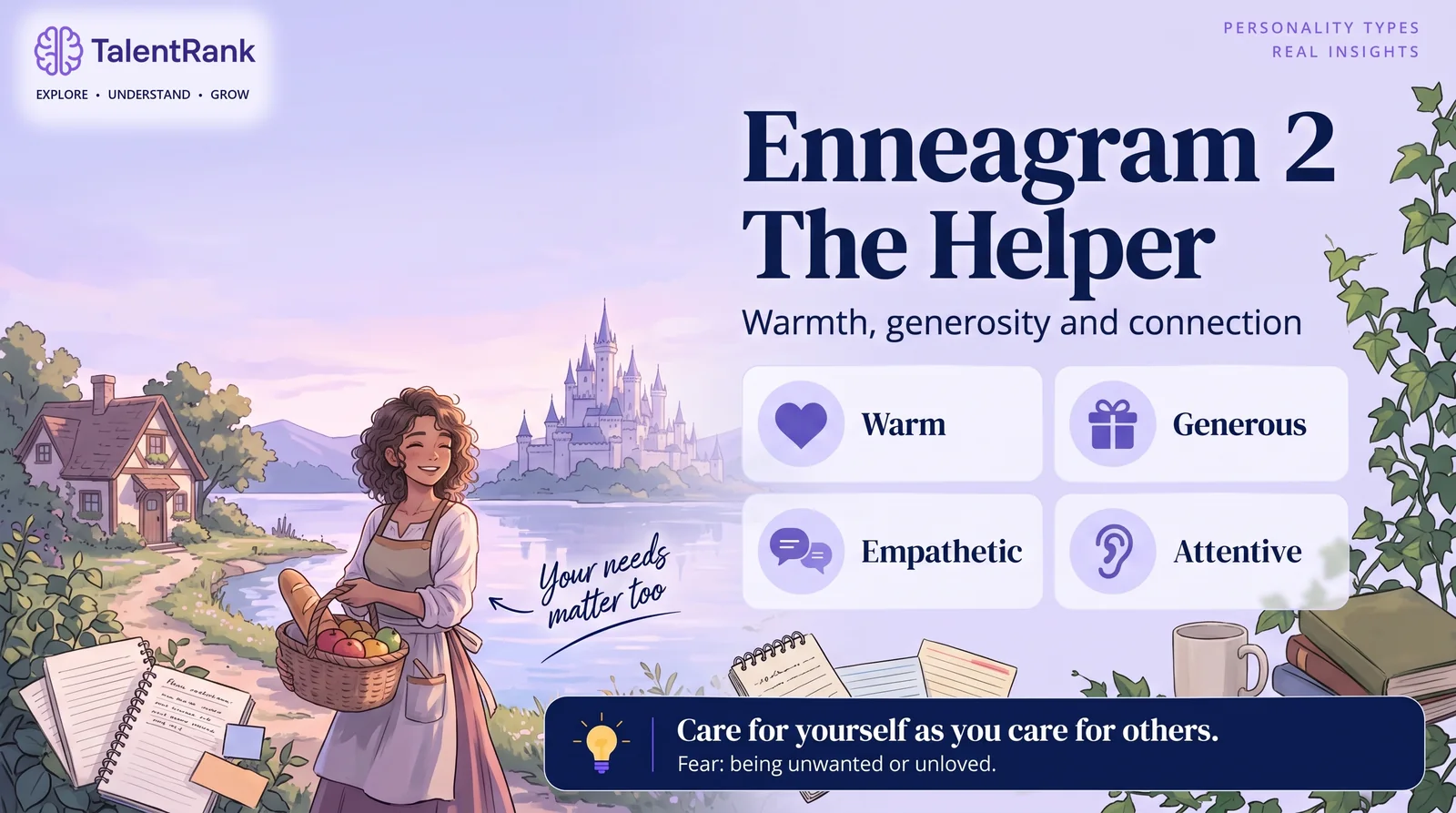
Enneagram 2, the Helper, is the type built around love and connection. Twos notice what people need and move to meet it, often before anyone asks. The Enneagram Institute gives their basic desire as "to feel loved" and their basic fear as "being unwanted, unworthy of being loved."
Twos make the world warmer. They also tend to run on empty, because the person whose needs they're least likely to notice is themselves. This guide covers why helping matters so much to a Two and what the two wings add. It also covers how Twos learn to receive care as well as give it.
Enneagram 2 at a Glance
Type 2: The Helper | |
Core desire | To feel loved |
Core fear | Being unwanted, unworthy of being loved |
Center | Heart (feeling), where image and shame are the key issues |
Wings | 2w1 "Servant" and 2w3 "The Host/Hostess" |
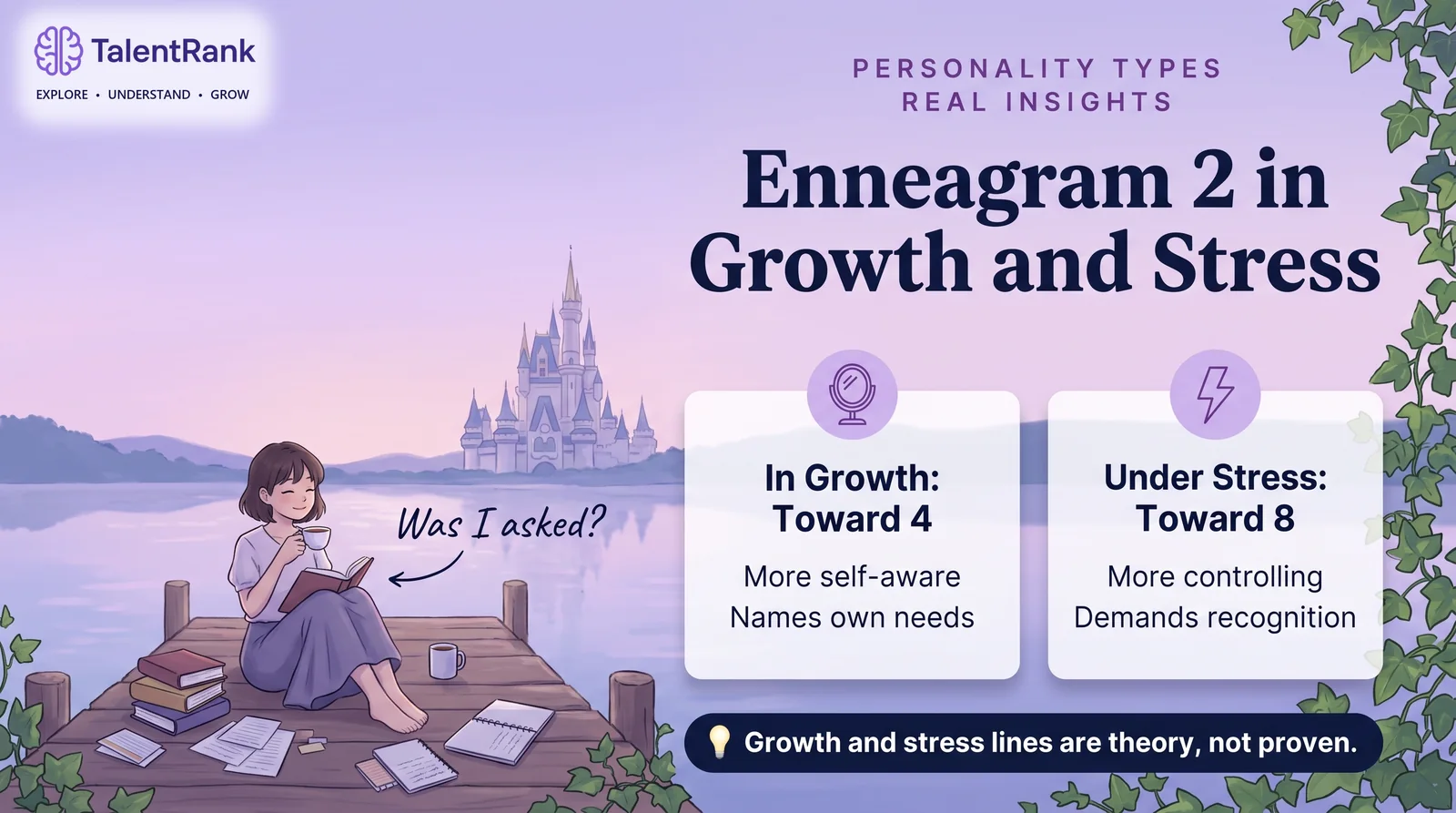
In growth | Moves toward Type 4: more self-nurturing and emotionally aware |
Under stress | Moves toward Type 8: aggressive and dominating |
Typical strengths | Warm, generous, empathetic, attentive |
Typical blind spots | Neglecting own needs, people-pleasing, quiet resentment |
Our guide to all nine Enneagram types shows where the Two fits.
Why Helping Matters So Much to a Two
For many Twos, being needed feels like proof of being loved. If they're useful, they belong. So they become very good at being useful: remembering the coffee order, noticing the colleague who's struggling, showing up with food after a loss.
None of that is fake. Twos genuinely care. But the giving can carry a quiet hope that it will come back. When it doesn't, a Two may feel hurt without being able to say why, because asking directly for care feels selfish to them.
Twos sit in the heart center, where self-image and shame are central. Their self-image is often "I'm the one who helps," which makes it hard to admit they need help themselves.
Two Strengths and Their Costs
At their best, the Institute describes Twos as "deeply unselfish, humble, and altruistic." Healthy Twos give freely. They're also able to receive.
Strength | Where it helps | What it can cost |
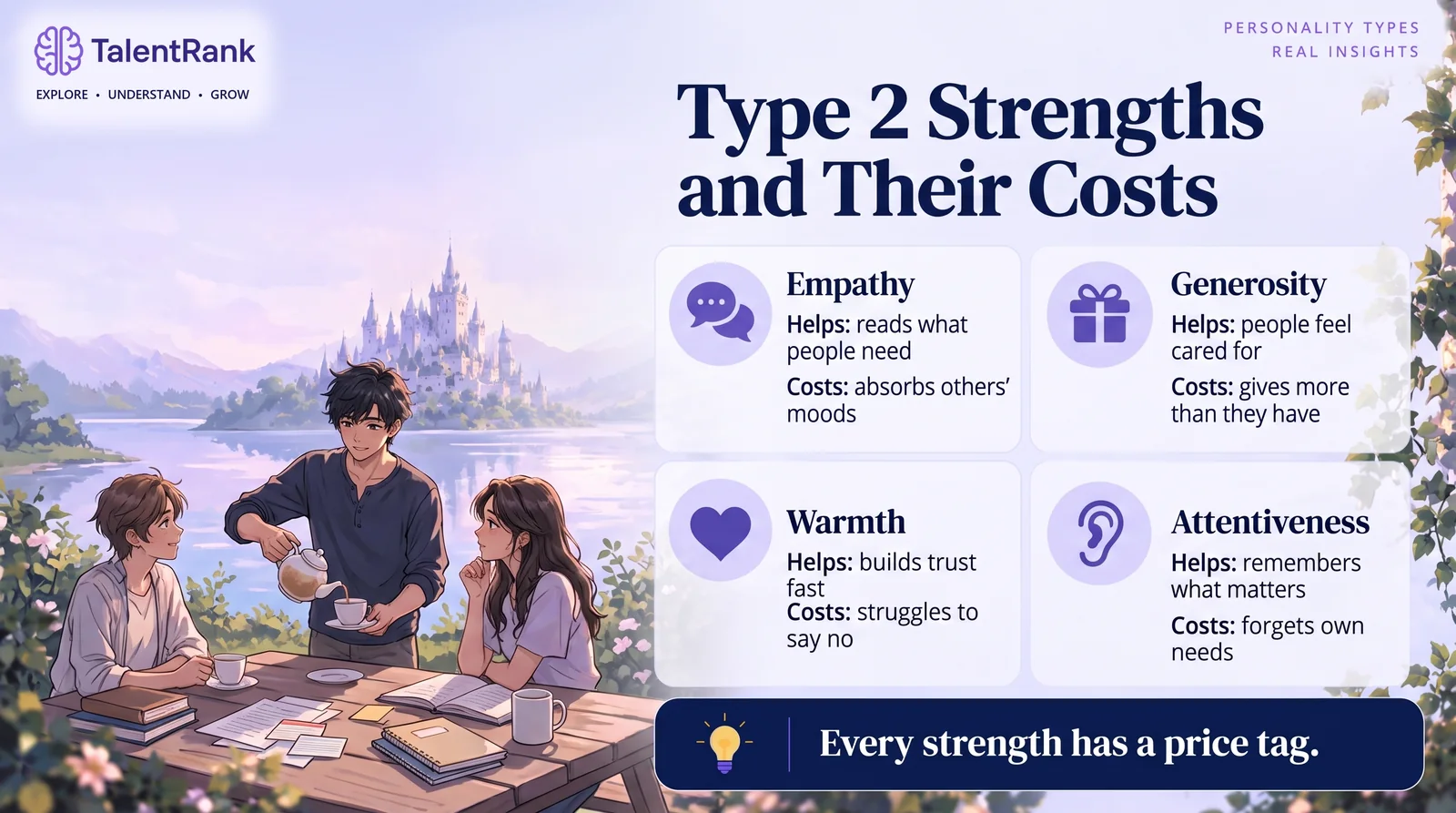
Empathy | Reads what people need | Absorbs others' moods |
Generosity | Makes people feel cared for | Gives more than they have |
Warmth | Builds trust fast | Struggles to say no |
Attentiveness | Remembers what matters to people | Forgets their own needs |
Loyalty | Shows up in a crisis | Stays in one-sided relationships |
When Giving Turns Into Keeping Score
At average levels, the Institute notes that Twos "need to be needed, so they hover, meddle, and control in the name of love." Help arrives whether it was wanted or not. Unspoken expectations build up. The Two starts to feel taken for granted.
Under stress, Enneagram theory says Twos move toward Type 8 and become "aggressive and dominating." The gentle, accommodating Two suddenly lays out everything they've done for people and demands recognition. It can shock everyone, including the Two. Usually it's a sign that too many of their own needs have gone unmet for too long.
How Twos Grow
In growth, Twos move toward Type 4 and become "more self-nurturing and emotionally aware." They start to ask what they feel and want, not just what others need. That's often the hardest and most freeing step for a Two.
Habits that help:
Pausing before offering help to ask, "was I asked, or am I assuming?"
Saying one direct request a day: "could you help me with this?"
Noticing resentment as a signal that a need went unspoken.
Spending time alone doing something that is purely for them.
2w1 and 2w3: The Two Wings
The 2w1 ("Servant") adds the One's sense of duty. These Twos tend to be principled and service-oriented, often drawn to caring work with a moral dimension, like nursing or teaching. They may be quieter about their own needs and harder on themselves.
The 2w3 ("The Host/Hostess") adds the Three's charm and ambition. These Twos tend to be more outgoing and socially confident, and they enjoy bringing people together. They may also care more about being seen as helpful and well liked.
Enneagram 2 at Work
Twos thrive in roles centered on people, like healthcare or teaching, or any job where team morale depends on someone paying attention. They're often the glue of a team, the person who notices morale before the manager does.
Hypothetical example: a Two office manager stays late to help three colleagues meet their deadlines, then misses her own. When her review notes the missed deadline, she feels crushed, because no one mentioned how much she'd helped. Her growth step isn't to stop helping. It's to finish her own priorities first and to say clearly, "I can help after 3 p.m."
Twos usually do best with managers who recognize the relationship work they do and who encourage them to protect their own time.
Enneagram 2 in Relationships
Twos are affectionate and attentive partners. They remember details and plan thoughtful surprises. Loved ones feel seen.
The challenge is balance. A Two may give so much that their partner never learns what the Two actually wants, partly because the Two hasn't said it. Over time, that can turn into a feeling of being unappreciated.
What helps: partners who ask a Two directly what they need and keep asking, and Twos who practice answering honestly instead of saying "I'm fine."
Two, Nine or Seven?
Two or Nine: both accommodate others. Twos move toward people to be needed and loved; Nines go along to keep the peace.
Two or Seven: both are warm and sociable. Twos focus on others' needs; Sevens focus on keeping life interesting and fun.
Two or Six: both are loyal and supportive. Sixes are driven by a need for security; Twos are driven by a need for love and closeness.
The Evidence, and a Measured Next Step
The Enneagram is a reflection tool, not a validated measurement. A 2021 systematic review of 104 samples in the Journal of Clinical Psychology found mixed evidence for its reliability and validity and little support for wings or movement between types, though Enneagram scales did relate to the Big Five traits in the directions the theory predicts.
If the Two sounds like you, two Big Five traits are worth comparing. Our guide to high agreeableness covers warmth and cooperation, including the risk of always putting others first. Our guide to high extraversion covers social energy.
The TalentRank assessment measures your Big Five traits and takes about 12 to 15 minutes. It won't give you an Enneagram number, but it shows where you land on each trait. Start the TalentRank assessment.
Frequently Asked Questions About Enneagram 2
What is an Enneagram 2?
Type 2, the Helper, is the Enneagram type driven by the desire to feel loved. Twos tend to be warm and generous, and very attentive to what other people need.
What is the Enneagram 2's core fear?
According to the Enneagram Institute, Twos fear being unwanted or unworthy of being loved.
What is the difference between 2w1 and 2w3?
The 2w1 is usually more principled and duty-driven. The 2w3 is usually more outgoing and socially ambitious.
Where does a Two go in stress and growth?
In Enneagram theory, Twos move toward Type 8 under stress (more aggressive and controlling) and toward Type 4 in growth (more self-nurturing and emotionally aware).
Why are Enneagram 2s so tired?
Many Twos give more energy than they take in, and they rarely ask for help. Learning to name their own needs is usually the fix.
Final Takeaway
Enneagram 2s make the people around them feel cared for. Growth for a Two means extending that same care inward, and trusting that they're loved for who they are, not only for what they give.