


Enneagram 5, the Investigator, is the type that copes with the world by understanding it. Fives want to be capable, and they get there by learning everything they can about whatever matters to them. The Enneagram Institute gives their basic desire as "to be capable and competent" and their basic fear as "being useless, helpless, or incapable."
Fives are often described as detached or aloof. That's half the story. Many Fives care deeply about people; they just have a limited supply of social energy and spend it carefully. This guide covers what drives a Five and the two wings. It also covers how Fives move from knowing to doing.
Enneagram 5 at a Glance
Type 5: The Investigator | |
Core desire | To be capable and competent |
Core fear | Being useless, helpless, or incapable |
Center | Head (thinking), where fear is the key emotion |
Wings | 5w4 "The Iconoclast" and 5w6 "The Problem Solver" |
In growth | Moves toward Type 8: more self-confident and decisive |
Under stress | Moves toward Type 7: hyperactive and scattered |
Typical strengths | Perceptive, independent, calm in a crisis, deep expertise |
Typical blind spots | Withdrawing, holding back, overpreparing |
Our guide to all nine Enneagram types shows how the Five relates to the rest.
Why Fives Guard Their Time and Energy
Many Fives experience the world as demanding more than they can give. Other people want time, attention, emotional responses, small talk. Each request feels like a withdrawal from a small account.
So Fives budget. They keep their schedules light and their commitments few, and they protect the private time where they can think. To others, this can look cold. To a Five, it's simply how they make sure they'll have something left for the things that matter.
Fives handle fear by retreating into their minds. If they can understand a situation fully, they feel safer in it. The Enneagram Institute notes that they want "to have everything figured out" as a way of defending themselves. The trap is that understanding can become a substitute for engaging.
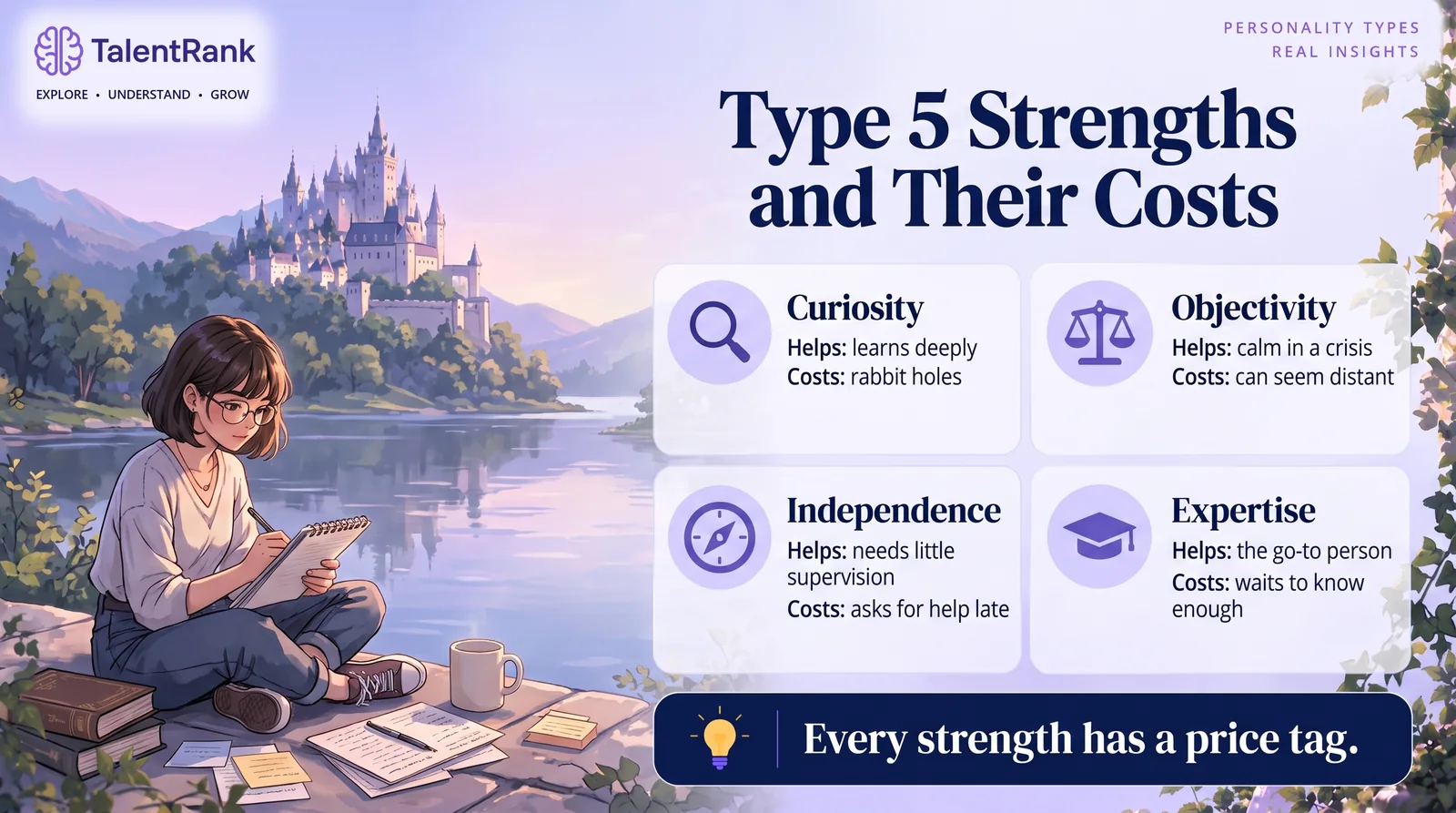
Five Strengths and Their Costs
Healthy Fives, the Institute says, show "extraordinary perceptiveness" and can reach "skillful mastery" in their fields. Give a healthy Five a hard problem and some quiet, and they'll usually go deeper than you expected.
Strength | Where it helps | What it can cost |
Curiosity | Learns complex topics deeply | Goes down rabbit holes |
Objectivity | Stays calm when others panic | Seems unmoved when people need warmth |
Independence | Needs little supervision | Doesn't ask for help in time |
Expertise | Becomes the go-to person | Waits to act until they know "enough" |
Privacy | Keeps their energy steady | Leaves others guessing about them |
A Five Under Pressure
At average levels, the Institute describes Fives as "increasingly detached" and "preoccupied with their visions." A Five might spend weeks researching a decision that needed a day, or stay in a bad situation because leaving would mean dealing with people.
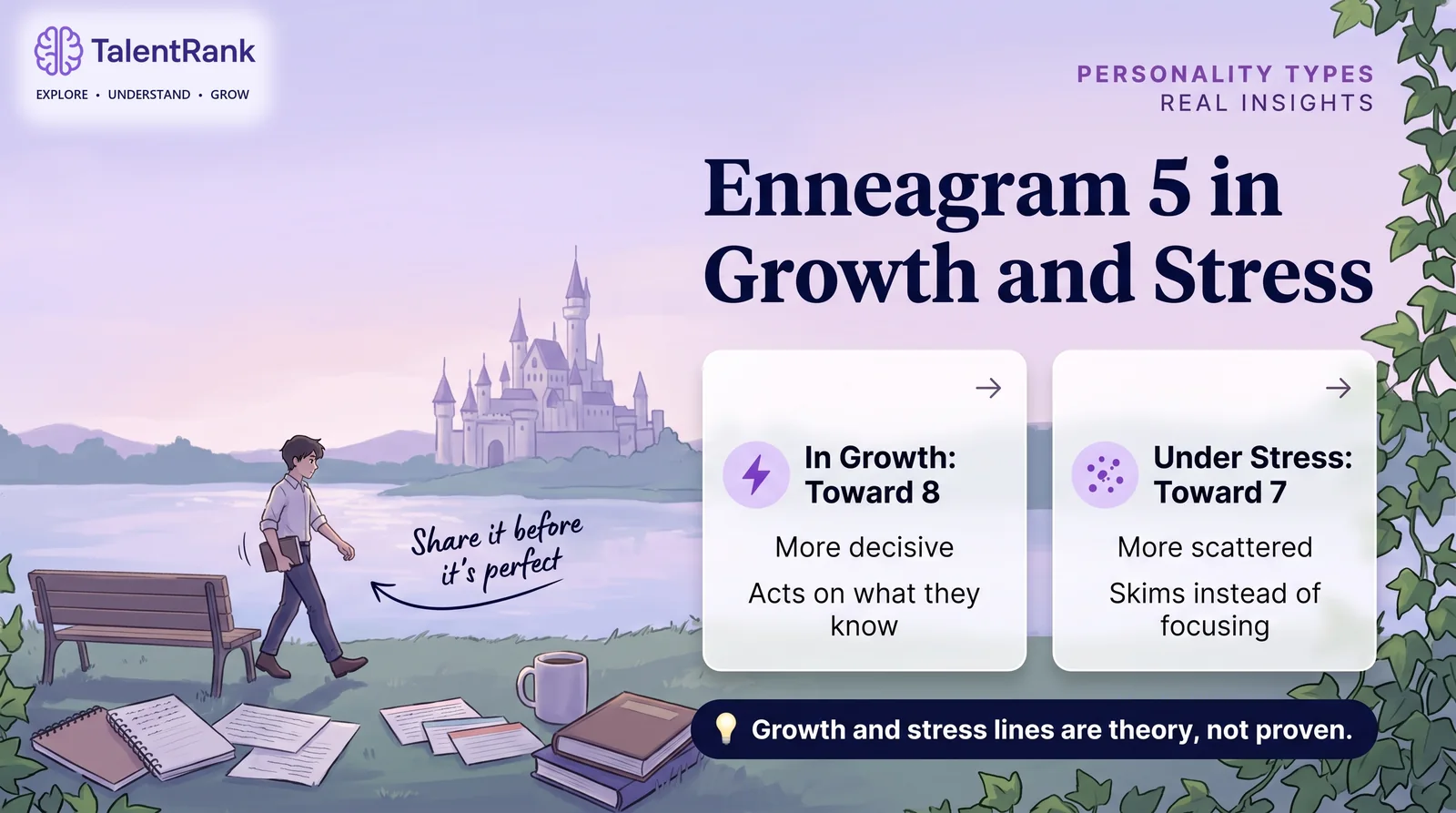
Under stress, Enneagram theory says Fives move toward Type 7 and become "hyperactive and scattered." The focused, quiet Five suddenly juggles a dozen ideas and can't settle on any. If a Five who usually goes deep starts skimming everything, they're probably overwhelmed.
How Fives Grow
In growth, Fives move toward Type 8 and become "more self-confident and decisive." They stop waiting until they know everything and start acting on what they know. They also discover they have more energy than they thought, once they stop treating every interaction as a cost.
Steps that help:
Setting a research deadline before starting, then deciding when it arrives.
Sharing one idea in a meeting before it feels fully ready.
Noticing the urge to withdraw and staying ten minutes longer.
Spending time on physical activity, which gets a Five out of their head.
5w4 and 5w6: The Two Wings
The 5w4 (the Iconoclast) adds the Four's emotional depth and originality. These Fives are often unconventional thinkers drawn to art or philosophy. They can be more emotionally intense than the stereotype suggests.
The 5w6 (the Problem Solver) adds the Six's practicality and loyalty. These Fives tend to apply their knowledge to real problems, often in technical or scientific work. They're usually more cooperative and more cautious than 5w4s.
Enneagram 5 at Work
Fives do their best work with autonomy, quiet time to think, and problems worth solving. Research and engineering suit many Fives, as do data work and academia. Open-plan offices and back-to-back meetings usually don't.
Hypothetical example: a Five engineer spots a flaw in a system design during a project kickoff but doesn't mention it, because he wants to check his reasoning first. Two weeks later, he writes a thorough memo, but by then the team has built on the flawed design. His growth step isn't to stop checking his work. It's to say "I might be wrong, but I'm seeing a problem here" on the day he sees it.
Managers get the most from Fives by giving them clear problems and real independence. Advance notice before big meetings helps too.
Enneagram 5 in Relationships
Fives are loyal and thoughtful partners who show love through attention: remembering the book you mentioned, fixing the thing that's been broken for months, or explaining something you care about in depth.
The difficulty is emotional availability. A Five may need time to process feelings before they can share them, and a partner may read that pause as indifference. Fives also tend to need more alone time than their partners expect.
What helps: partners who don't take a Five's need for space personally, and Fives who say "I need some time to think about this, and I'll come back to it" instead of simply going quiet.
Is It a Five, or Just Introversion?
Many Fives are introverts, but not every introvert is a Five. Introversion is about where people get their energy. Being a Five is about why someone withdraws: to protect their competence and their limited reserves.
Five or Four: both can be private and intense. Fours withdraw into feelings; Fives withdraw into thinking.
Five or Six: both live in the head and think about risk. Sixes look for trusted support; Fives look for enough knowledge to stand alone.
Five or Nine: both can seem detached. Nines tune out to keep the peace; Fives step back to observe and understand.
The Evidence, and a Measured Next Step
The Enneagram is useful for reflection but isn't a validated measurement. A 2021 systematic review of 104 samples in the Journal of Clinical Psychology found mixed evidence for its reliability and validity and little support for wings or movement between types. Enneagram scales did relate to the Big Five traits in the directions the theory predicts.
If the Five sounds like you, two Big Five traits are worth comparing. Our guide to introversion and low extraversion covers where social energy comes from. Our guide to high openness covers intellectual curiosity.
The TalentRank assessment measures your Big Five traits and takes about 12 to 15 minutes. It won't give you an Enneagram number, but it does give measured scores to set beside what you recognize in the Five. Start the TalentRank assessment.
Frequently Asked Questions About Enneagram 5
What is an Enneagram 5?
Type 5, the Investigator, is the Enneagram type driven by the desire to be capable and competent. Fives tend to be perceptive and independent, and they need time alone to think.
What is the Enneagram 5's core fear?
According to the Enneagram Institute, Fives fear being useless, helpless, or incapable.
What is the difference between 5w4 and 5w6?
The 5w4 is usually more creative and unconventional. The 5w6 is usually more practical and focused on solving concrete problems.
Where does a Five go in stress and growth?
In Enneagram theory, Fives move toward Type 7 under stress (more scattered) and toward Type 8 in growth (more confident and decisive).
Are Enneagram 5s cold?
Usually not. Many Fives care deeply but spend their social energy carefully and need time to process feelings before sharing them.
Final Takeaway
Enneagram 5s bring clear thinking and real expertise to the people who know them. Growth for a Five means trusting that they already know enough to act, and that the people worth their energy tend to give some back.