

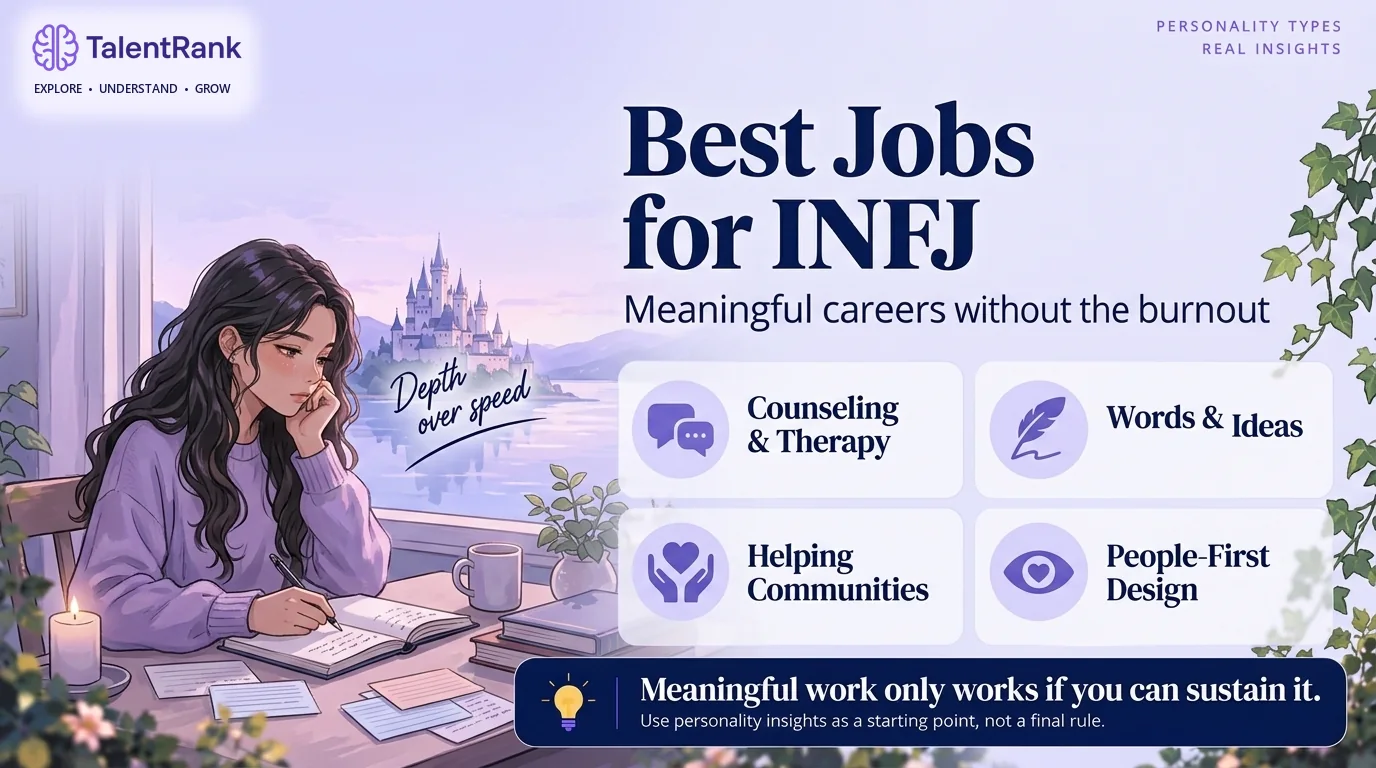
The best jobs for INFJ personalities usually let you help people one at a time, work on something you believe in, and think deeply without constant interruption. Counseling and therapy, psychology, occupational and speech therapy, social work, writing and editing, library work, health education, training, and user experience design all come up often.
Still, type isn't destiny. The Myers-Briggs Company says preferences "do not indicate skill or ability" and warns against using the assessment to select people for jobs. (The Myers-Briggs Company) INFJs work as lawyers and engineers too.
This guide covers thirteen careers INFJs often explore, with 2025 pay and 2025–35 growth figures from the U.S. Bureau of Labor Statistics. It also looks at something many INFJs care about as much as the job title: how to do meaningful, people-heavy work without burning out.
What INFJs Tend to Need From Work
INFJ stands for Introversion, Intuition, Feeling, and Judging. You probably recharge alone, look for patterns and meaning, make decisions based on values and their effect on people, and like to have a plan. INFJ is also one of the less common types in most samples. (Our guide to the INFJ personality type covers the traits in more depth.)
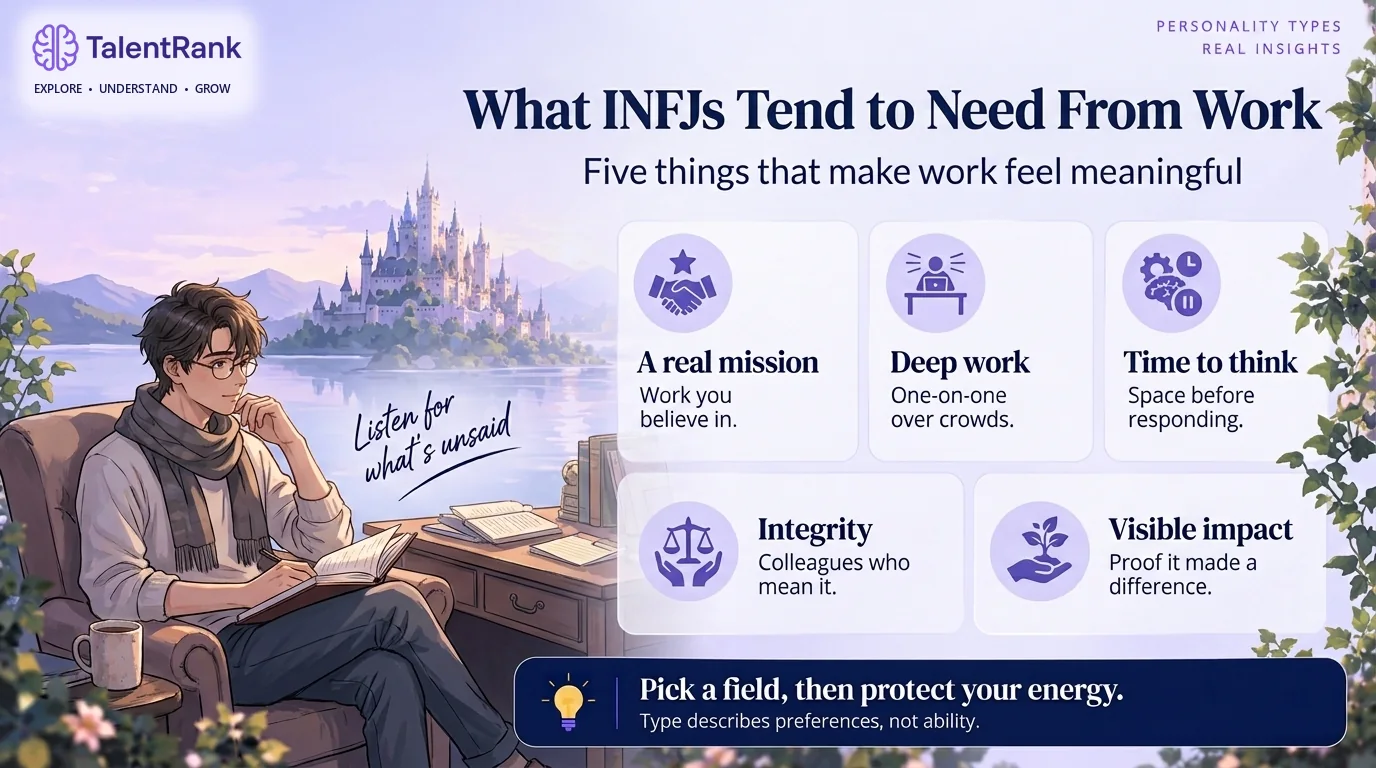
At work, that often shows up as:
A mission you actually believe in.
Deep, one-on-one work rather than constant group activity.
Time and space to think before responding.
Colleagues who act with integrity.
A way to see that your work made a difference.
The catch: INFJ descriptions often mention feeling other people's stress strongly. That makes them good at helping roles and also vulnerable to exhaustion in them. Choosing the right job is only half the answer. The other half is choosing a workplace that protects your energy.
Best Jobs for INFJs to Explore
These careers reward insight, empathy, and focused work. Figures come from the Bureau of Labor Statistics Occupational Outlook Handbook: median pay in May 2025 and projected employment change from 2025 to 2035.
Career | 2025 median pay | Projected growth, 2025–35 | Typical entry education |
Web and digital interface designer | $104,000 | 5% | Bachelor's degree |
Occupational therapist | $100,330 | 15% | Master's degree |
Psychologist | $99,110 | 6% | Master's or doctoral degree |
Speech-language pathologist | $97,870 | 17% | Master's degree |
Editor | $77,920 | -1% | Bachelor's degree |
Writer or author | $76,910 | 0% | Bachelor's degree |
Human resources specialist | $75,940 | 6% | Bachelor's degree |
Training and development specialist | $69,280 | 11% | Bachelor's degree |
Librarian | $68,270 | 3% | Master's degree |
Marriage and family therapist | $66,940 | 14% | Master's degree |
Health education specialist | $64,070 | 6% | Bachelor's degree |
Social worker | $61,780 | 6% | Bachelor's or master's in social work |
Mental health counselor | $59,350 | 18% | Master's degree |
Source: BLS Occupational Outlook Handbook, pages updated August 2026. The mental health counselor row covers substance abuse, behavioral disorder, and mental health counselors.
Counseling and Therapy
Mental health counselors and marriage and family therapists do exactly the kind of deep, one-on-one work many INFJs are drawn to. Demand is strong, with 18% and 14% projected growth. Psychologists earn more but usually need a doctorate for clinical practice.
Be clear-eyed about the math. Counselors typically need a master's degree and supervised hours for licensure, yet the 2025 median was $59,350. Some counselors raise their income through private practice or specialization, but that takes time. Budget for it before you commit to graduate school.
Therapy Through Everyday Skills
Occupational therapists help people regain the ability to handle daily life after injury or illness, and speech-language pathologists help people communicate. Both combine one-on-one care with visible progress, both pay close to $100,000, and both are growing faster than average.
Words and Ideas
Writers and editors get the quiet focus INFJs often crave. The outlook is flat to slightly declining, so pair the craft with a specialty, like health, technology, or nonprofit communications. Librarians help people find what they need, usually in a calm setting.
Helping Organizations and Communities
Human resources specialists and training and development specialists help people grow inside organizations. Health education specialists design programs that help communities live healthier, and social workers help clients with practical and emotional challenges.
Design That Starts With People
Web and digital interface designers had the highest median pay in this guide. User experience work starts with understanding how people think and feel, which suits INFJs who enjoy reading between the lines.
How INFJs Can Avoid Burnout in Helping Careers
Many of the best jobs for INFJs involve other people's pain. That's where the meaning comes from, and it's also where the exhaustion comes from. A few things make a real difference:
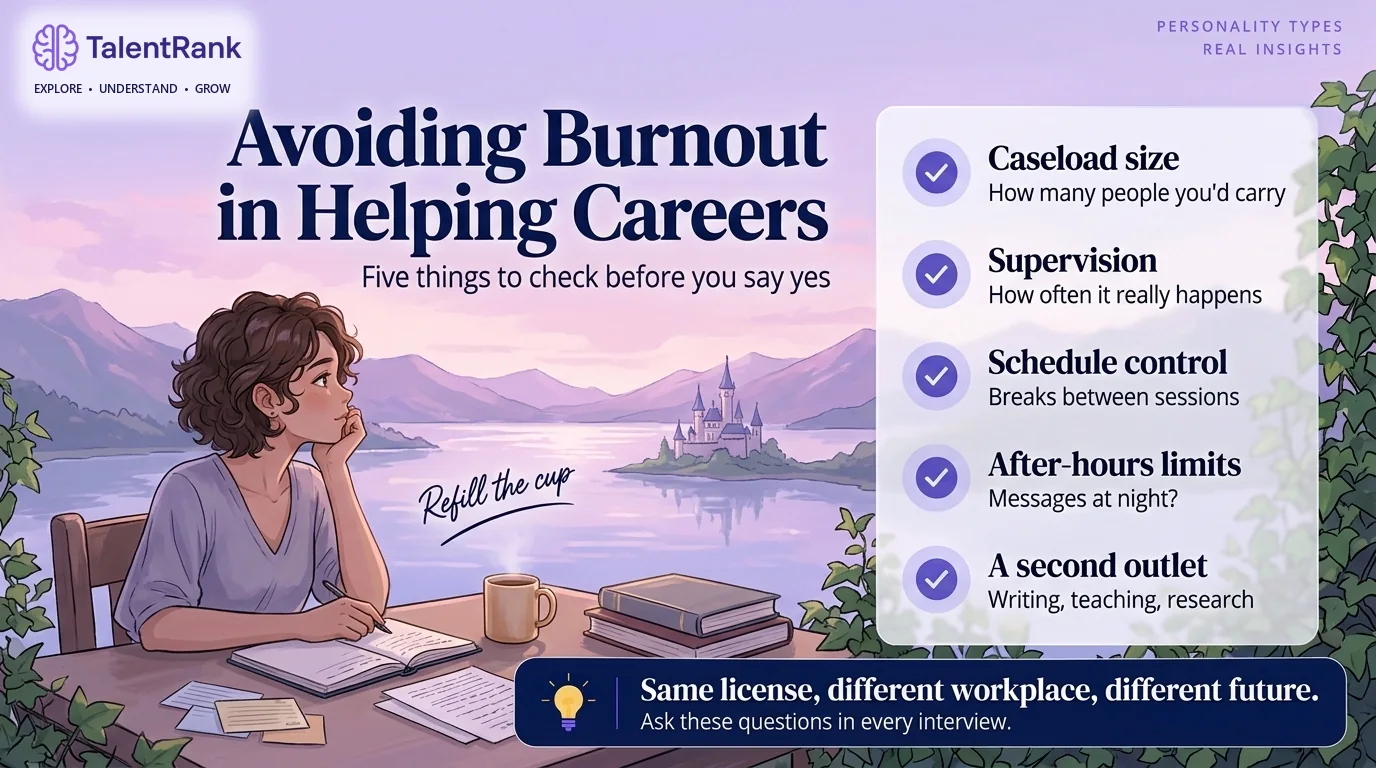
Caseload size. Ask how many clients or students you'd carry, and how that compares with others in your field.
Supervision and peer support. Supervision is a normal part of early-career counseling and social work. Ask how often it actually happens.
Control over your schedule. Back-to-back sessions with no breaks wear anyone down.
Boundaries after hours. Find out whether you're expected to answer messages at night.
A second outlet. Some INFJs pair client work with writing, teaching, or research to vary the emotional load.
Hypothetical example: two INFJs become licensed counselors. One joins a group practice with a capped caseload and weekly peer consultation. The other joins an understaffed agency where 40 clients a week is normal. Same license, very different chances of lasting ten years in the field.
INFJ Jobs That Don't Require a Four-Year Degree
Many INFJ favorites require graduate degrees, but some paths start sooner:
Community health workers help people get access to care, typically with a high school diploma plus training. The median was $51,850, with 13% projected growth.
Occupational therapy assistants need an associate's degree and earned a median of $72,300, with 21% projected growth.
Peer support specialist and case aide roles can offer a way into mental health work while you decide whether graduate school is right for you.
INFJ Jobs to Avoid (or Conditions to Watch)
Popular "INFJ jobs to avoid" lists name sales, politics, customer service, and fast-paced corporate roles. The reasoning is that INFJs dislike conflict and shallow interaction. That's a tendency, not a law. Some INFJs are thoughtful, effective leaders in those exact fields.
What tends to drain INFJs is more specific:
Work that conflicts with your values, like pushing products people don't need.
Constant noise, interruptions, and open-plan chaos.
Shallow, high-volume interactions with no depth.
Office politics and unresolved conflict.
No time to think before being asked to decide.
INFJ-T Best Jobs: Does Turbulent Change Anything?
The -A (Assertive) and -T (Turbulent) suffixes come from 16Personalities, not the official MBTI. 16Personalities adds a fifth scale it calls Identity and builds its model on Big Five research. (16Personalities)
There's no separate list of best jobs for INFJ-T. The same careers apply. If the Turbulent label fits, burnout protections matter even more, especially in helping roles where you may already take other people's problems home.
How to Choose Among INFJ Career Options
Pick three careers from this guide.
Read the daily tasks for each on O*NET OnLine.
Ask one person in each role what drains them most, and what keeps them going.
Try a small version: volunteer on a crisis line, tutor, write for a nonprofit, or shadow a therapist.
Compare training time and cost, especially graduate school, against the pay and outlook above.
If you want another angle, the Holland Code groups careers by interests, and clarifying your work values can help you decide how much income matters relative to meaning.
Beyond the Four Letters
Two INFJs can differ a lot in how they handle stress and how much people contact they want. Trait measures pick up those differences. Emotional stability, for instance, matters a lot in helping roles. (Our guide to high neuroticism looks at what higher stress sensitivity can mean at work.)
The TalentRank assessment measures your Big Five personality traits and takes about 12 to 15 minutes. It won't confirm an MBTI type or pick a career for you. It can show where you land on traits like agreeableness, emotional stability, and openness, which are useful when you're weighing people-heavy careers. Take the TalentRank assessment and use it as one input.
Frequently Asked Questions About INFJ Jobs
What are the best jobs for INFJ personalities?
INFJs often do well in counseling, therapy, psychology, occupational and speech therapy, social work, writing, editing, library work, health education, training, and user experience design. Skills and the specific workplace matter as much as type.
What jobs should INFJs avoid?
No job is off-limits because of type. It's more useful to avoid conditions that drain INFJs, like values conflicts, constant interruptions, shallow high-volume interactions, and office politics.
Is counseling a good career for an INFJ?
It can be, and demand is growing. It also requires a master's degree and licensure, the median pay is modest, and burnout is a real risk. Check caseloads and supervision before accepting a role.
What INFJ jobs pay well?
In this guide, web and digital interface designers had a 2025 median of $104,000, occupational therapists $100,330, and psychologists $99,110, according to BLS.
What are the best jobs for INFJ-T?
The same careers apply. The A/T distinction comes from 16Personalities, not the official MBTI. If you identify as Turbulent, pay extra attention to caseloads, feedback, and burnout protections.
Can an INFJ work in business?
Yes. HR, training, user experience, and mission-driven organizations are common fits, and INFJs can lead well when the work aligns with their values.
Final Takeaway
The best jobs for INFJ personalities tend to share one thing: meaningful work with people, done with depth rather than speed. Counseling, therapy, writing, and design all offer that. Protect your energy as carefully as you choose your field, because a meaningful career only works if you can sustain it.