


INFJ Personality Type: Traits, Strengths, Weaknesses, and Work Style
The INFJ personality type describes four Myers-Briggs preferences: Introversion, Intuition, Feeling, and Judging. People who identify with this type may prefer time to reflect, look for patterns and possibilities, consider values and people when making decisions, and bring structure to plans. Those preferences can influence behavior, but they do not dictate it. The Myers & Briggs Foundation notes that people can use both sides of each preference pair and that life experience and environment affect how preferences are expressed.
An INFJ result can be useful for self-reflection, but it is not a complete explanation of personality, a career prescription, or a relationship verdict. This guide looks at INFJ traits, strengths, weaknesses, work style, careers, leadership, relationships, and compatibility with that distinction in mind.
INFJ stands for Introversion, Intuition, Feeling, and Judging. In the Myers-Briggs framework, these letters come from four preference pairs: Extraversion or Introversion, Sensing or Intuition, Thinking or Feeling, and Judging or Perceiving. A four-letter type reflects the preferences that best describe a person's natural way of doing things.
Introversion (I): a preference for inward reflection. It does not automatically mean shyness or poor social skills.
Intuition (N): a preference for patterns, possibilities, and broader meaning rather than relying only on concrete details.
Feeling (F): a preference for considering values and human impact when making decisions. It does not mean being irrational.
Judging (J): a preference for structure, planning, and closure in the outside world. It does not mean being judgmental.
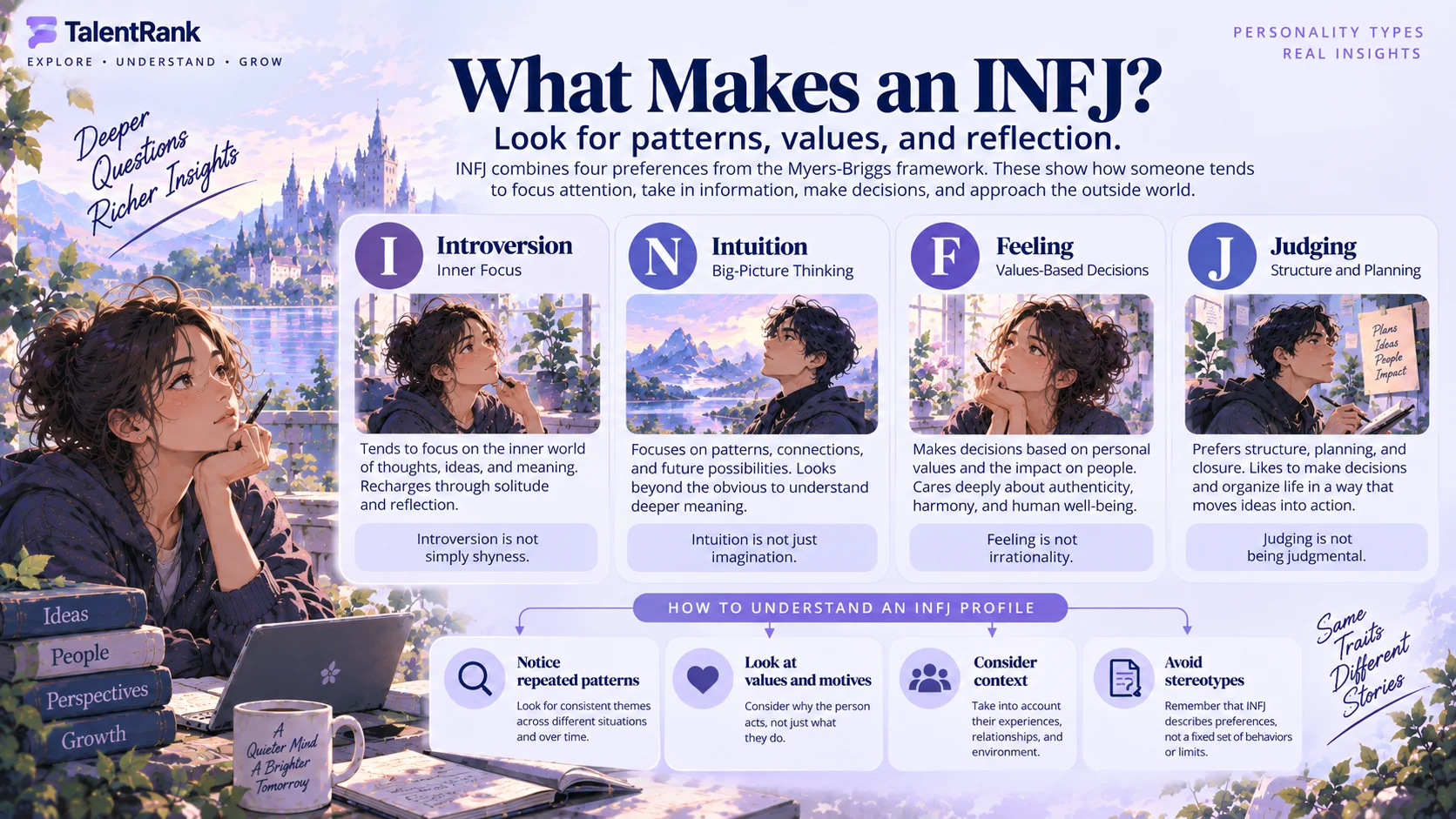
The model treats these as preferences, not exclusive abilities. Someone who prefers Introversion can still speak confidently to a large audience, and someone with a Feeling preference can make hard, data-heavy decisions.
INFJ Personality Type at a Glance
The INFJ personality type is often described as reflective, future-focused, values-aware, and organized. Treat those descriptions as themes to test against your own experience, not a checklist you must match.
Preference | May show up as | Does not automatically mean |
Introversion | Reflecting before speaking, needing quiet time | Shy or poor at teamwork |
Intuition | Looking for patterns and possibilities | Ignoring facts |
Feeling | Weighing values and people impact | Emotional or illogical |
Judging | Planning and wanting closure | Rigid or controlling |
Two people with the same INFJ personality type can still look quite different because skills, roles, culture, confidence, habits, and experience shape behavior.
Common INFJ Traits and How They May Show Up
Reflective and internally focused
Someone with an INFJ preference pattern may want time to think before giving a final answer. In a meeting, that might mean listening first and contributing after the discussion develops. In another setting, the same person may be highly talkative because the subject is familiar.
Introversion is about preference, not social competence. An employee can enjoy collaboration while still needing uninterrupted time for focused work.
Pattern-focused and future-oriented
The Intuition preference often directs attention toward connections and what could happen next. At work, that might mean spotting a repeated issue across customer feedback or seeing how several small project choices could affect a longer-term goal.
Big-picture thinking helps when strategy matters, but immediate details still need attention. Checklists and review habits can help balance the two.
Values-aware decision-making
Feeling in Myers-Briggs terminology refers to a decision preference, not the amount of emotion someone experiences. A person may consider how a decision affects coworkers or customers alongside practical constraints.
That can support thoughtful communication, but difficult decisions still need to be made. Empathy works best when it is paired with clear boundaries and direct feedback.
Preference for structure and closure
Judging preferences are commonly associated with planning and wanting decisions to move toward completion. For one INFJ, that may mean preparing well before a deadline. For another, it may simply mean wanting a clear goal before starting.
Structure can help. Flexibility still matters when circumstances change.
INFJ Traits Are Tendencies, Not Rules
A common mistake with the INFJ personality type is turning a preference into a fixed identity. Myers-Briggs theory itself does not require that interpretation. The Foundation states that type does not dictate behavior and that people can use the opposite preference when a situation calls for it. Environment and life experience also influence how type is expressed.
So an INFJ can enjoy public speaking, work in sales, lead a large team, prefer spreadsheets, or dislike counseling. Skills are learned, interests vary, and jobs create different demands.
A better question is not, "Would an INFJ do this?" It is, "Which way of working feels more natural to me, and when do I deliberately stretch beyond it?"
Want a broader view of your personality? TalentRank uses continuous Big Five traits rather than assigning one fixed four-letter type. Its current assessment also includes a brief ICAR-based cognitive screening and career-focused patterns. |
INFJ Strengths
INFJ strengths are more useful when connected to situations instead of treated as guaranteed talents.
Seeing connections and longer-term possibilities
A pattern-focused person may notice relationships between ideas that others initially treat as separate. That can help with strategy, research, writing, product thinking, or understanding why a problem keeps returning.
The strength is not having "better intuition" than everyone else. It is the tendency to search for meaning and connections, then test whether those connections hold up.
Listening and considering different perspectives
An INFJ may spend more time observing before responding, which can create space to understand several viewpoints. Listening is still a learned skill, though. The INFJ personality type cannot prove that someone is empathetic, emotionally intelligent, or good at reading people.
Working with purpose and personal standards
Some people who identify with the INFJ personality type care strongly about whether their work aligns with personal values. That can support persistence when a goal feels worthwhile.
High standards can also create friction if someone keeps revising work after it is already good enough or expects an organization to match every personal ideal.
Independent thought plus collaboration
Introversion does not equal poor teamwork. An INFJ may prefer to develop an idea privately and then bring it into a focused discussion. That can work well in roles that combine concentration with meaningful collaboration.
When an INFJ Strength Becomes a Limitation
The same tendency can help in one setting and create problems in another.
Possible tendency | Can help when... | Can become difficult when... |
Reflecting before responding | A decision benefits from depth | An urgent answer is needed |
Looking for patterns | Strategy matters | Immediate details are missed |
Considering people impact | Collaboration needs sensitivity | Difficult feedback is delayed |
Maintaining high standards | Quality matters | Perfection slows completion |
Preferring structure | Deadlines need organization | Priorities change frequently |
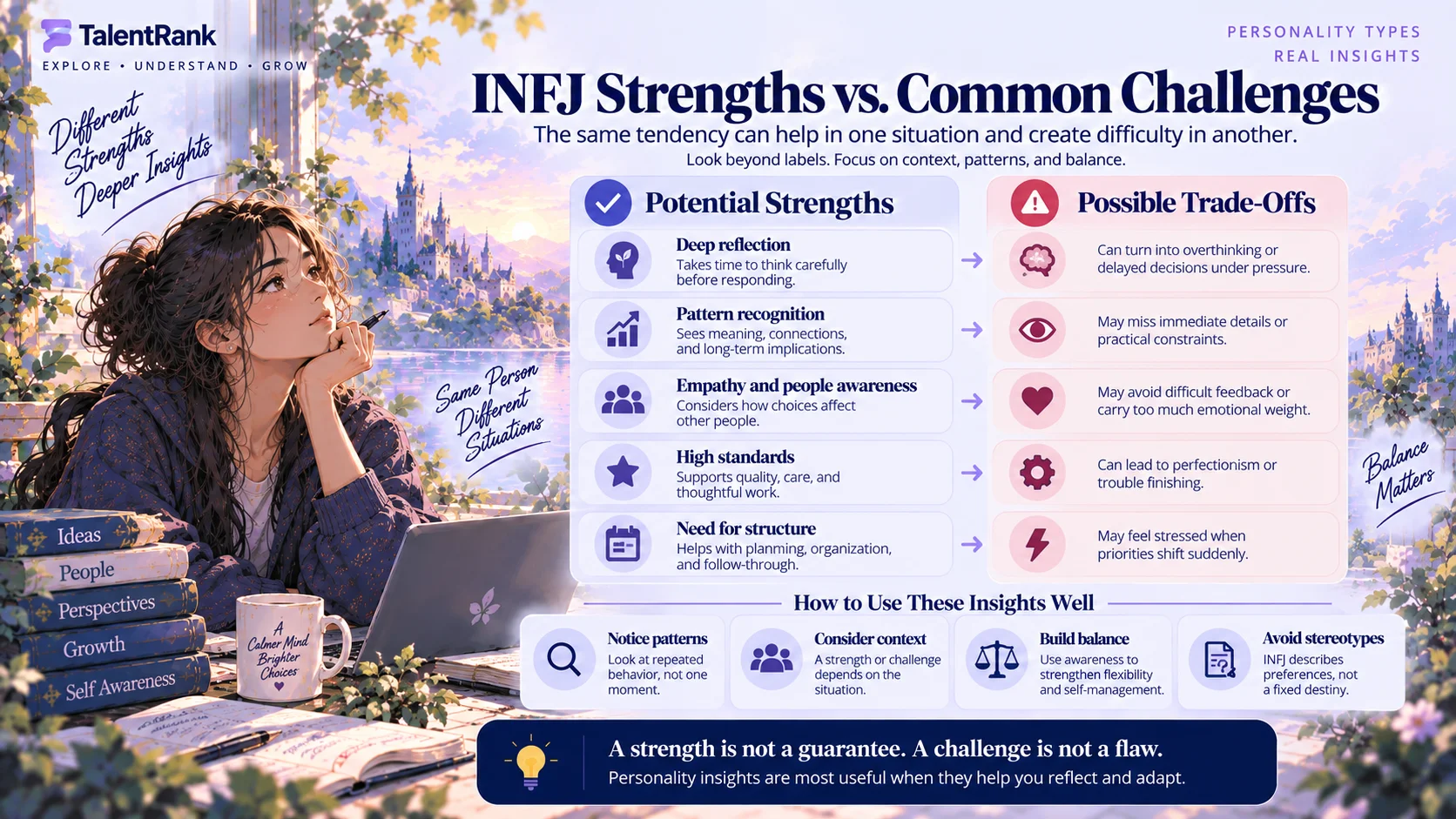
is a practical way to think about INFJ strengths and INFJ weaknesses. Instead of asking whether a trait is good or bad, ask whether it fits the situation.
INFJ Weaknesses and Common Blind Spots
Common INFJ weaknesses are often described as perfectionism, sensitivity to criticism, overthinking, conflict avoidance, or difficulty with sudden change. Those labels are prompts, not rules.
A reflective person may spend too long analyzing a decision. Someone who values harmony may postpone a difficult conversation. A future-focused person may miss a detail that needs attention now. High standards may make it hard to stop refining work.
Each pattern can be managed. Deadlines can limit over-analysis, checklists can catch details, and practicing direct conversations can reduce avoidance. A blind spot is useful only if it leads to a better response, not if it becomes an excuse.
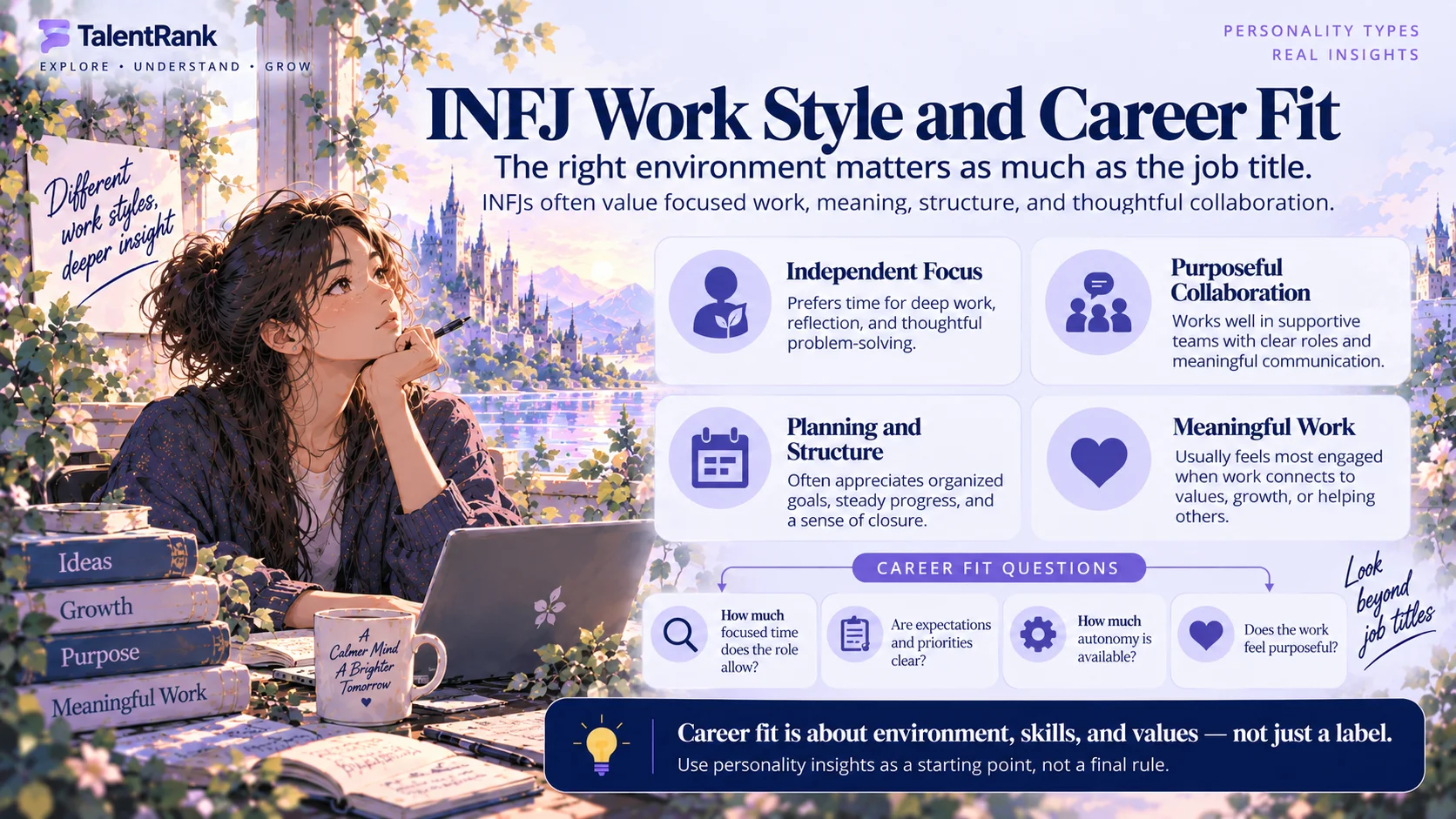
INFJ Work Style
The INFJ personality type may be associated with reflection, pattern-focused thinking, concern for people, and preference for structure, but workplace behavior is also shaped by the role and environment.
Independent work and teamwork
Some INFJs may appreciate uninterrupted time for research, writing, planning, analysis, or design. They may also enjoy collaboration when the discussion has a clear purpose. Too much isolation can be limiting in roles that depend on feedback, just as constant interaction can make focused work difficult.
Deadlines and structure
The Judging preference can make clear expectations, milestones, and closure appealing. Strong professionals still learn when to follow a plan and when new information justifies changing it.
Conflict and feedback
Someone who pays close attention to interpersonal consequences may find conflict uncomfortable. Delaying every difficult conversation, however, usually makes work harder. A useful INFJ work style includes learning to separate respectful disagreement from personal rejection.
Before choosing a role because it appears on an INFJ list, ask:
How much uninterrupted concentration does the job allow?
How much social interaction happens each day?
Are goals and expectations clear?
How often do priorities change?
How much autonomy does the role provide?
Does the work require frequent confrontation or negotiation?
Do the subject matter and outcomes matter to you?
Does the job fit your skills and qualifications?
Those questions reveal more about daily fit than a job title alone.
INFJ Careers: What Kind of Work May Feel Satisfying?
There is no single best career for the INFJ personality type. Some INFJs may be drawn to work that offers depth, autonomy, meaningful goals, thoughtful collaboration, or complex problem solving. Depending on interests and qualifications, possibilities include:
counseling and related helping professions
education and training
writing and editing
research
human resources
UX research or design
communications
healthcare
nonprofit or program work
strategy and advisory roles
These are examples to explore, not prescriptions. A highly social counseling role could exhaust one INFJ and energize another. A technical research role could suit someone who enjoys analytical depth. A sales role might work for a person who likes one-to-one problem solving.
Compare the daily tasks, qualifications, pay, work environment, growth path, and your interests instead of asking whether a job is "an INFJ career."
Look beyond the four-letter type. TalentRank currently reports Big Five traits on continuous dimensions, includes an ICAR-based cognitive screening, and presents career directions as starting points rather than guarantees. Its core Big Five profile can be viewed without paying, and the assessment typically takes about 15 minutes. |
INFJ Leadership Style
An INFJ leadership style may be reflective, values-aware, and interested in longer-term direction, but the INFJ personality type alone cannot tell you whether someone will lead well.
A preference for Intuition may make future possibilities especially interesting, which can support strategic thinking when paired with evidence and execution. A leader may also prefer to gather perspectives before deciding.
The risks matter too. Reflection can turn into indecision, concern for harmony can delay difficult feedback, and high personal standards can make delegation harder. Values-based leadership still requires accountability.
Introversion itself is not a leadership weakness. Communication, judgment, delegation, conflict management, and follow-through are skills that can be developed.
INFJs in Relationships
INFJ relationships are often described in terms of depth, privacy, loyalty, and meaningful conversation. Those themes may resonate with some people, but a relationship involves two individuals, not two type descriptions.
One INFJ may want time to process a disagreement before talking. Another may prefer to resolve it quickly. The INFJ personality type cannot tell you everything about communication habits, boundaries, expectations, or emotional maturity.
Type is more useful when it prompts better questions: How much alone time does each person need? How directly do you discuss conflict? How much planning feels comfortable? What makes each person feel heard?
INFJ Compatibility: Is There a Best Match?
There is no MBTI pairing that guarantees the best match for the INFJ personality type. Type can help partners discuss social energy, information processing, decisions, and planning, but it does not dictate behavior.
Instead of asking which type is "best," ask whether you communicate expectations clearly, respect each other's need for closeness and space, handle disagreement constructively, and share important values.
Two supposedly compatible types can still struggle. Two people with very different preferences can build a strong relationship. Four letters do not make the relationship for them.
INFJ vs Common INFJ Stereotypes
Common claim | Better interpretation |
INFJs are always shy | Introversion does not automatically mean low confidence |
INFJs can read people's minds | No personality type gives access to another person's thoughts |
INFJs are natural therapists | Interest in people is not a professional qualification |
INFJs dislike leadership | Introverts can lead; leadership depends on skills and context |
INFJs have one ideal career | Career fit depends on more than personality type |
INFJs have a perfect MBTI match | Type alone cannot determine relationship success |
The goal is not to make the framework useless. It is to separate useful reflection from flattering or limiting myths.
INFJ and the Big Five: Are They the Same Thing?
No. The INFJ personality type comes from the Myers-Briggs framework, which organizes preferences into four pairs and reports a four-letter type. The Big Five describes personality across five broad dimensions: Extraversion, Neuroticism, Agreeableness, Conscientiousness, and Openness to Experience.
A type label groups preferences into categories, while a Big Five profile can show where someone falls along continuous dimensions. The models can overlap in some of the behaviors they describe, but they are not interchangeable.
How Much Should You Rely on an INFJ Result?
Use an INFJ result as a reflection tool, not a verdict.
A 2025 review of 193 MBTI Form M studies published from 1999 through 2024 found internal consistency estimates of 0.845 to 0.921 and robust convergent evidence with similar constructs. Within the post-1998 literature that met the review's inclusion criteria, the authors found no test-retest or structural-validity studies, while noting that the MBTI manual reports earlier evidence on those questions.
The evidence supports using appropriate caution. The INFJ personality type may help you name preferences and start useful conversations. It should not by itself determine hiring, career choice, intelligence, relationship potential, or personal worth.
How to Use Your INFJ Result Practically
If the INFJ personality type feels accurate, treat it as a hypothesis you can test against real life.
Identify what genuinely fits. Look for repeated behavior rather than one memorable situation.
Look for exceptions. Notice when you comfortably use the opposite preference.
Compare contexts. Work, family, stress, and experience can bring out different behavior.
Add other information. Career decisions should also consider interests, abilities, qualifications, financial needs, opportunities, and circumstances.
If a four-letter description feels useful but incomplete, a trait-based model can offer another perspective. TalentRank currently reports Big Five personality dimensions, a brief ICAR-based cognitive estimate, and career-related patterns, while stating that career directions are starting points rather than guarantees.
Frequently Asked Questions
What does INFJ stand for?
INFJ stands for Introversion, Intuition, Feeling, and Judging. These preferences describe how a person tends to direct energy, take in information, make decisions, and approach the outside world. They are preferences rather than fixed abilities.
What are the main INFJ personality traits?
Common descriptions include reflection, attention to patterns and possibilities, concern for values and people, and preference for structure. Behavior still varies because type does not dictate behavior and experience influences how preferences are expressed.
What are common INFJ strengths and weaknesses?
Potential strengths include thoughtful reflection, pattern recognition, long-term thinking, and attention to human impact. The same tendencies can create blind spots if reflection becomes overthinking, future focus misses immediate details, or concern for harmony delays necessary feedback.
What careers are good for INFJs?
There is no single best INFJ career. Some people may enjoy roles offering depth, autonomy, meaningful goals, focused collaboration, or complex problem solving. Counseling, education, research, writing, HR, UX, healthcare, and strategy are possibilities, but skills, qualifications, and work environment should drive the decision.
Can INFJs be good leaders?
Yes. Introversion does not prevent leadership. An INFJ may prefer reflective decision-making or values-aware communication, but leadership depends on skills such as judgment, delegation, accountability, feedback, communication, and conflict management rather than a four-letter label.
Who is an INFJ most compatible with?
No MBTI type is guaranteed to be the best partner for an INFJ. Type can help people discuss social energy, communication, planning, and decisions, but relationship quality depends on what the people involved actually do.
Final Takeaway
The INFJ personality type can provide useful language for discussing reflection, patterns, values, decisions, and structure. It works best when you use those ideas to observe your own behavior rather than trying to fit every INFJ description.
Use the label as a starting point. Notice where it fits, where it does not, and what changes across situations. For career decisions, combine personality information with interests, skills, qualifications, constraints, and real-world experience. If you want to compare a four-letter framework with continuous traits, TalentRank's assessment provides a Big Five profile and additional career-focused information.