

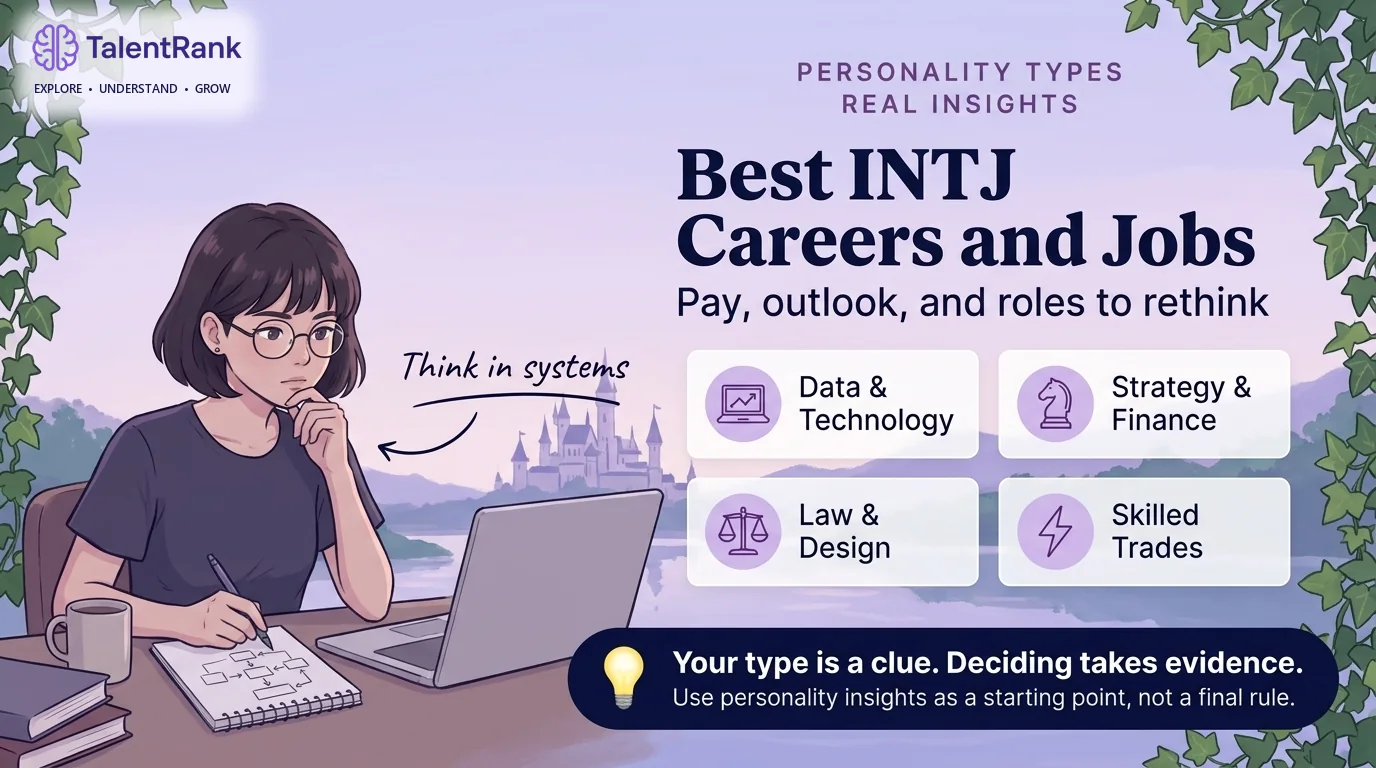
The best INTJ careers usually give you hard problems, room to work independently, and a clear way to see whether your ideas worked. Software development, data science, information security, operations research, management consulting, financial analysis, actuarial work, law, architecture, and urban planning all fit that description. So does a skilled trade like electrical work, if you like systems you can touch.
That list is a starting point, not a verdict. MBTI type describes preferences, not ability. The Myers-Briggs Company itself says the assessment shouldn't be used to select or place people in jobs, and that preferences "do not indicate skill or ability." (The Myers-Briggs Company) Nothing stops an INTJ from doing well in sales, nursing, or teaching. The label can point you toward work worth investigating. It can't tell you which job you'll be good at.
What follows is a practical guide: the careers people with INTJ preferences often explore, what they pay and how fast they're growing according to the U.S. Bureau of Labor Statistics, which conditions tend to wear INTJs down, and how to test a career before you commit years to it.
What Makes a Career a Good Fit for an INTJ?
INTJ stands for Introversion, Intuition, Thinking, and Judging. If those four preferences describe you, you probably like to understand how a system works, decide how it should work, and then build the plan to get there. You may prefer depth to variety, and a few good conversations to a day of back-to-back meetings. (If the letters themselves are fuzzy, our guide to the INTJ personality type covers them in more detail.)
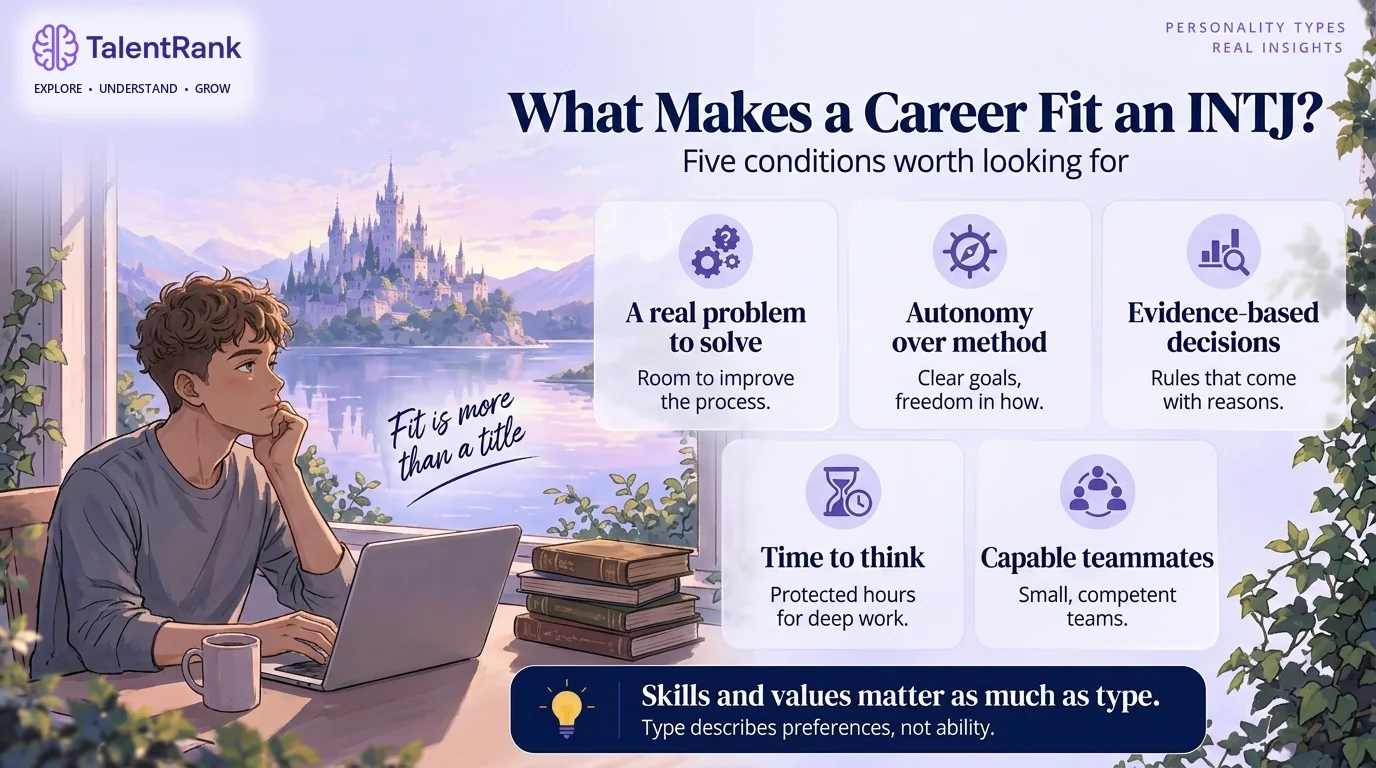
Those preferences show up at work as a few recurring needs:
A real problem to solve. Work that's mostly routine, with no room to improve the process, tends to feel pointless.
Autonomy over the method. Many INTJs are fine with a hard deadline. They're less fine with being told exactly how to hit it.
Decisions based on evidence. Rules that exist "because we've always done it this way" are a common source of friction.
Time to think. Long stretches of focused work matter more than a lively office.
Competent people nearby. Small, capable teams usually beat large, loosely organized ones.
None of this is unique to INTJs, and not every INTJ will recognize all five. Your interests and skills matter at least as much as your type, and so does what you can afford to train for. A career that fits your preferences but not your skills will still be a poor fit. If you haven't looked at your values directly, identifying your work values is a useful next step.
Best INTJ Careers to Explore
The careers below match the needs above: analysis, independent judgment, and long-range planning. Pay and outlook figures come from the Bureau of Labor Statistics Occupational Outlook Handbook (2025 median pay, projected growth 2025–35). BLS compares each occupation's growth with the average for all occupations, so a role marked "faster than average" is adding jobs more quickly than the job market as a whole.
Career | 2025 median pay | Projected growth, 2025–35 | Typical entry education |
Software developer | $134,040 | 10% | Bachelor's degree |
Data scientist | $120,230 | 35% | Bachelor's degree |
Information security analyst | $129,180 | 21% | Bachelor's degree |
Operations research analyst | $88,940 | 12% | Bachelor's degree |
Management analyst | $101,860 | 10% | Bachelor's degree |
Financial analyst | $103,570 | 7% | Bachelor's degree |
Actuary | $130,000 | 9% | Bachelor's degree plus exams |
Lawyer | $159,670 | 5% | Doctoral or professional degree |
Architect | $99,280 | 4% | Bachelor's degree plus licensure |
Urban and regional planner | $89,320 | 4% | Master's degree |
Technical writer | $90,390 | 1% | Bachelor's degree |
Electrician | $63,190 | 9% | High school diploma plus apprenticeship |
Source: BLS Occupational Outlook Handbook, pages updated August 2026.
Data, Analytics, and Technology
These are the most common INTJ career matches you'll see recommended, and the reasons hold up. Software developers design systems and live with the consequences of their design choices. Data scientists turn messy information into a decision, and BLS projects 35% growth for the role through 2035. Information security analysts think like an attacker and plan several moves ahead, which suits people who enjoy anticipating failure points.
Operations research analysts are less well known. They use math and modeling to answer questions like "how many trucks do we need?" or "where should this warehouse go?" If you like optimization problems more than code for its own sake, it's worth a look.
The catch: tech work is more collaborative than its reputation. Code reviews, stand-ups, and product meetings are normal. Look for teams that protect focus time.
Strategy, Finance, and Business
Management analysts, often called consultants, study how an organization works and recommend how to fix it. That's close to a job description for the INTJ habit of redesigning systems. Most people enter after several years of experience in another role, so it's a common second career rather than a first job.
Financial analysts and actuaries work with forecasts, risk, and long time horizons. Actuaries also pass a series of professional exams, which rewards the kind of structured, self-directed study many INTJs are comfortable with.
Keep in mind that both consulting and finance involve more client communication than people expect. You'll need to explain complex findings to people who don't want the full model.
Law, Architecture, and Planning
Lawyers build arguments, spot weak points in the other side's case, and plan strategy over months or years. The training is long: a law degree plus a bar exam. Litigation and transactional work feel very different day to day, so it helps to talk to people in both before choosing.
Architects combine design with technical constraints and long project timelines. Urban and regional planners do something similar at the scale of a city, weighing traffic, housing, and land use decades out. Planning usually requires a master's degree and a lot of public meetings, which some INTJs enjoy more than they'd guess, because the debates are about substance.
Writing and Research
Technical writers turn complicated systems into documentation people can actually use. The work is independent and precise. Be aware that BLS projects only 1% growth for the occupation through 2035, so it's worth pairing writing skill with a technical specialty.
Research roles in science, economics, or policy also come up often for INTJs. They reward curiosity and patience, though academic paths are long and competitive.
INTJ Jobs That Don't Require a Four-Year Degree
A degree isn't the only route to analytical, independent work.
Electricians typically start with a high school diploma and learn through a four- to five-year paid apprenticeship. The work is systems troubleshooting in physical form: reading a circuit, figuring out why it fails, and fixing it to code. BLS projects 9% growth, driven partly by grid upgrades and renewable energy work.
Web development is another option where a strong portfolio can matter as much as credentials, depending on the employer. BLS lists a 2025 median of $92,650 for web developers.
Other paths worth researching include IT support that grows into network or security work, drafting, and quality control. Check local training programs and job postings before committing, since entry requirements vary a lot by region.
Best Jobs for INTJ Women
There's no evidence that the best jobs for an INTJ differ by gender. The careers above apply to anyone with these preferences.
What can differ is how a direct, analytical style gets received. In a hiring experiment, Rudman and Glick found that female applicants who came across as highly agentic (confident, competitive, ambitious) were seen as less likable and were discriminated against for a management job described as needing interpersonal skills. (Rudman & Glick, 2001) That doesn't mean INTJ women should avoid any field. It does mean workplace culture is worth checking as closely as the job description. Ask how decisions get made, who gets credit, and what happened the last time someone disagreed with a manager.
INTJ-T Jobs: Does Assertive vs. Turbulent Change Anything?
The "-T" (Turbulent) and "-A" (Assertive) suffixes come from 16Personalities, not from the official MBTI. 16Personalities adds a fifth scale, which it calls Identity, and describes it as reflecting how confident people feel in their abilities and decisions. Its model is built on Big Five research rather than Myers-Briggs theory. (16Personalities)
So there isn't a separate list of INTJ-T jobs. The same careers apply. What the Turbulent label may flag is a tendency toward self-doubt or perfectionism, and that's more about work conditions than job titles. Someone who second-guesses their work may do better with clear feedback cycles and a manager who reviews drafts early, rather than a role where results appear only once a year.
INTJ Jobs to Avoid (or Conditions to Check First)
Most "jobs to avoid" lists name receptionists, sales associates, nurses, and social workers. The logic is that these jobs involve a lot of people, and INTJs are introverts. That reasoning is thin. Introversion describes where you get energy, not whether you can do people-facing work well. There's no rule that says an INTJ can't be an excellent nurse or a strong salesperson.
A more useful question is which working conditions tend to drain someone with INTJ preferences. Watch for:
Constant interruptions with no protected time for deep work.
Rules without reasons, and no path to question them.
Scripted work where you can't change the process even when it's clearly broken.
Performance judged on visibility rather than results.
Unclear goals that shift weekly without explanation.
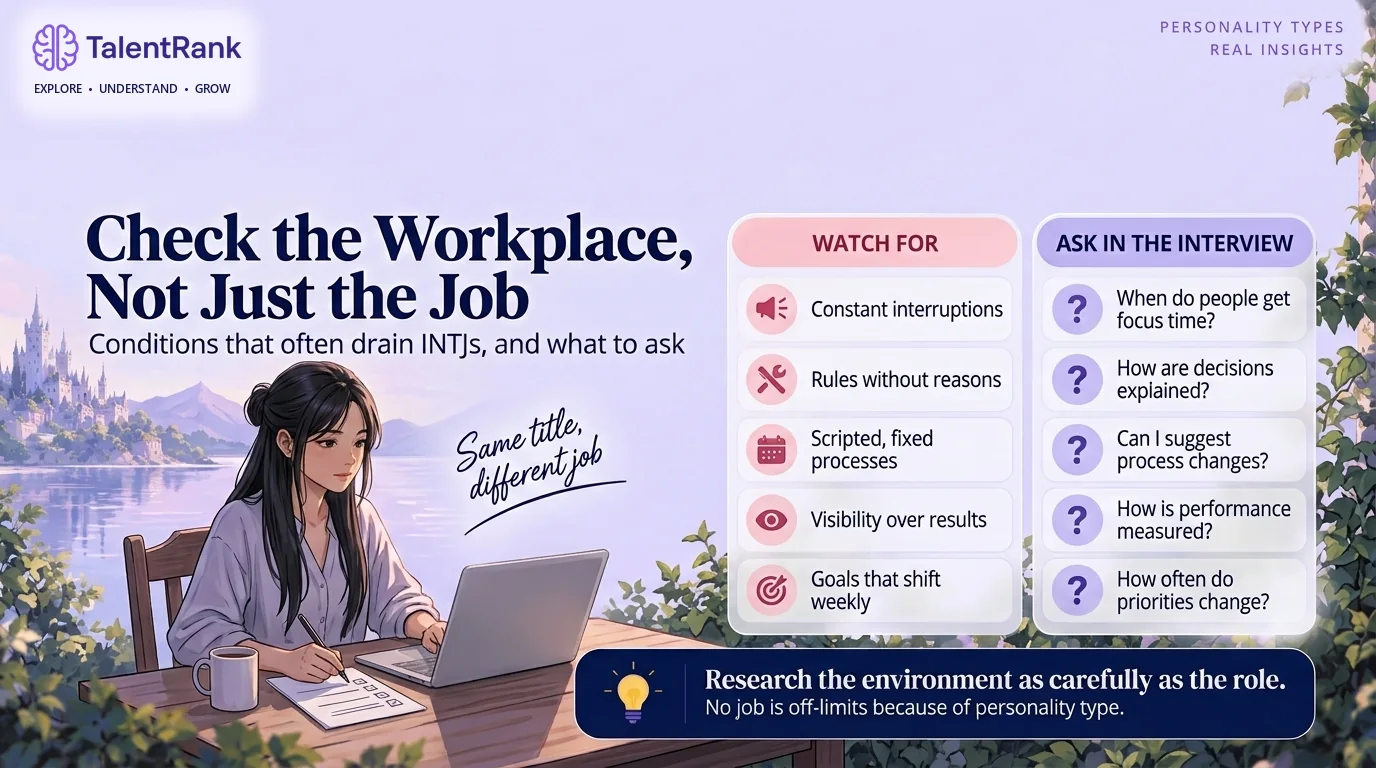
Hypothetical example: two INTJs take the same data analyst title. One joins a small team with a clear roadmap and a manager who asks for their recommendation. The other joins a company where priorities change in every meeting and the analysis is often ignored. Same job, very different experience. That's why it pays to research the workplace as carefully as the role.
How to Choose Between INTJ Career Options
A type-based list gets you a shortlist. Deciding takes more evidence. This process works for most people:
Pick three careers from the list above, or from career interest research, that genuinely interest you.
**Look each one up on O*NET OnLine**, which lists the daily tasks, skills, and work context for hundreds of occupations. Daily tasks tell you more than job titles.
Talk to two people who do the work. Ask what a normal Tuesday looks like and what they'd warn a newcomer about.
Run a small test. Take a short course, build a small project, or volunteer on something related. A month of real work beats a year of speculation.
Check the math. Compare training cost and time against the pay and outlook figures above.
If you want a broader framework than type, the Holland Code sorts careers by interest themes, and it's widely used by career counselors.
Checking Your Own Work Preferences
A four-letter type is a rough summary. Two INTJs can differ a lot in how much structure they want, how they handle stress, or how comfortable they are leading people. Trait-based measures capture those differences in more detail. (Our comparison of the Big Five and MBTI explains how the two approaches differ.)
The TalentRank assessment measures your Big Five personality traits and takes about 12 to 15 minutes. It won't confirm your MBTI type or pick a career for you, but it can show where you land on traits like conscientiousness and openness, which are useful inputs when you compare the options above. Take the TalentRank assessment and use the results alongside your own research.
Frequently Asked Questions About INTJ Careers
What is the best career for an INTJ?
There isn't one best career. INTJs often do well in work that involves analysis, independent judgment, and long-term planning, such as software development, data science, consulting, finance, law, or architecture. Which one suits you depends on your skills and on the specific workplace.
What jobs should INTJs avoid?
No job is off-limits because of personality type. It's more useful to avoid conditions that tend to drain INTJs: constant interruptions, rules with no rationale, scripted work that can't be improved, and goals that keep changing.
Are INTJs good leaders?
They can be. INTJs often bring long-range planning and clear standards. Leadership also requires communication and patience with people, which are skills anyone can develop regardless of type.
Can INTJs work in healthcare?
Yes. Personality type doesn't determine ability. Roles like physician, pharmacist, health data analyst, or medical researcher combine analysis with patient impact. Nursing and other hands-on roles are also possible if the work environment suits you.
What INTJ jobs pay the most?
Among the careers in this guide, lawyers, software developers, actuaries, and information security analysts had the highest 2025 median pay according to BLS, all above $129,000. Pay varies widely by location, experience, and employer.
Is there a difference between INTJ-A and INTJ-T jobs?
No. The A/T suffix comes from 16Personalities, not the official MBTI, and the same careers apply to both. The Turbulent label may matter more for work conditions, such as how often you get feedback.
Final Takeaway
INTJ career matches tend to share a pattern. The problems are complex, you get a say in how the work is done, and you can tell whether it worked. You'll find that in software and data work, in consulting and finance, in law and architecture, and in a well-run electrical apprenticeship.
Use the list to narrow things down. Then test your shortlist against real tasks and real workplaces before you commit. The type is a clue. Deciding still takes evidence.