


The best INTP careers give you a hard question and the freedom to chase it. Research science, computer science research, mathematics and statistics, economics, physics, data science, software development, information security, and university teaching all fit that description. They reward curiosity, logic, and a tolerance for problems nobody has solved yet.
Treat that list as a starting point. Personality type describes preferences, not talent. The Myers-Briggs Company notes that preferences "do not indicate skill or ability" and says the assessment shouldn't be used to select people for jobs. (The Myers-Briggs Company) INTPs work as nurses, lawyers, and chefs too.
This guide pairs the careers INTPs most often explore with 2025 pay and 2025–35 outlook figures from the U.S. Bureau of Labor Statistics. It also flags one popular INTP recommendation that the data doesn't support, covers routes without a four-year degree, and explains which working conditions tend to frustrate INTPs.
What INTPs Tend to Want From Work
INTP stands for Introversion, Intuition, Thinking, and Perceiving. In practice, that often means you'd rather understand why something works than just use it, you enjoy ideas for their own sake, and you prefer open-ended exploration to fixed plans. (For a closer look at the last letter, see judging vs. perceiving.)
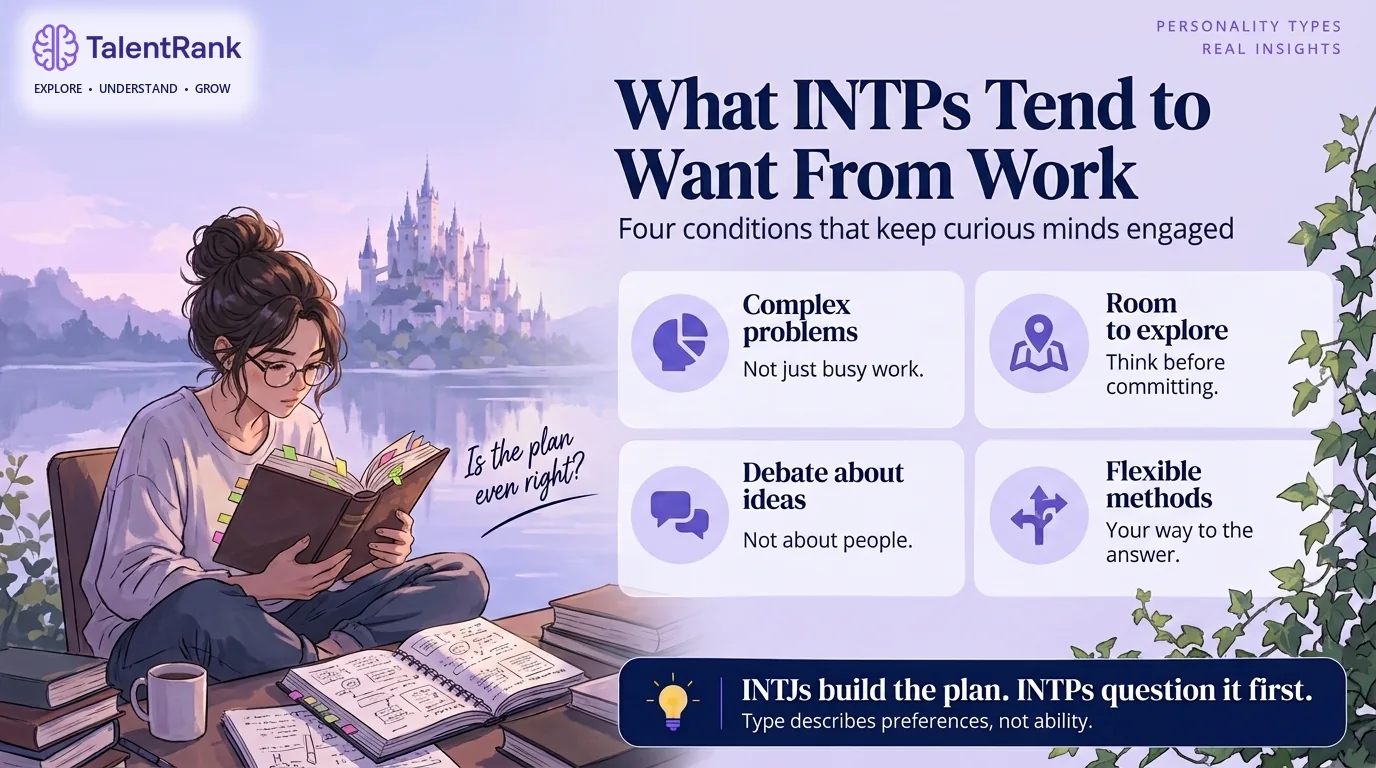
INTPs and INTJs are often lumped together, and many of their career matches overlap. The difference is usually in the P. INTJs tend to want to implement the plan. INTPs are often happiest figuring out whether the plan is right in the first place. That's why research, analysis, and early-stage design roles come up so often for INTPs.
If this describes you, look for work with:
Problems that are genuinely complex, not just busy.
Freedom to explore before committing to an answer.
Colleagues who argue with ideas, not with people.
Flexible schedules or at least flexible methods.
Best INTP Careers to Explore
The careers below all involve analysis, abstract thinking, or building systems. Figures come from the Bureau of Labor Statistics Occupational Outlook Handbook: median pay in May 2025 and projected employment change from 2025 to 2035.
Career | 2025 median pay | Projected growth, 2025–35 | Typical entry education |
Physicist or astronomer | $166,880 | 7% | Doctoral degree |
Computer and information research scientist | $140,300 | 22% | Master's degree |
Software developer | $134,040 | 10% | Bachelor's degree |
Information security analyst | $129,180 | 21% | Bachelor's degree |
Economist | $124,720 | 5% | Master's degree |
Data scientist | $120,230 | 35% | Bachelor's degree |
Mathematician or statistician | $105,720 | 10% | Master's degree |
Technical writer | $90,390 | 1% | Bachelor's degree |
Operations research analyst | $88,940 | 12% | Bachelor's degree |
Postsecondary teacher | $85,330 | 7% | Doctoral degree, often |
Drafter | $68,090 | 1% | Associate's degree |
Source: BLS Occupational Outlook Handbook, pages updated August 2026.
Research and Science
Computer and information research scientists invent new ways to use computing, including work on artificial intelligence. BLS projects 22% growth, and most roles ask for a master's degree. Physicists and astronomers have the highest median pay in this guide, though most research positions require a Ph.D. and a long training path.
Economists and mathematicians and statisticians build models of how the world behaves and test them against data. The federal government is a major employer of economists, which can mean stable hours and interesting policy questions.
Data and Technology
Data scientists get to ask open questions of messy data, and BLS expects 35% growth through 2035. Software developers design systems end to end. Information security analysts hunt for flaws in systems, which suits people who instinctively look for the hole in an argument. Operations research analysts apply math to real business problems like routing and scheduling.
Teaching and Explaining
Postsecondary teachers combine research with teaching, and many INTPs enjoy explaining a concept once they've untangled it themselves. The path usually runs through a doctorate, and tenure-track jobs are competitive. Technical writers do a different kind of explaining: turning complex systems into clear instructions. Growth there is slow, so pairing writing with a technical specialty helps.
A Popular INTP Career the Data Doesn't Back
"Computer programmer" appears on almost every INTP career list. The BLS numbers tell a different story. Computer programmers earned a solid median of $100,390 in 2025, but employment is projected to decline 7% by 2035. BLS attributes part of the drop to companies using AI to automate routine coding and shifting higher-level work to software developers.
That doesn't mean INTPs should avoid code. It means the safer bet is roles that involve design, judgment, and problem framing, like software development, research, or security, rather than writing code to someone else's specification.
INTP Jobs That Don't Require a Four-Year Degree
A bachelor's degree isn't the only door into analytical work:
Drafters turn engineering and architectural designs into technical drawings with CAD software. Most need an associate's degree, and the 2025 median was $68,090.
Computer support specialists can qualify with a high school diploma plus IT certifications. Network support specialists earned a median of $76,220. BLS projects the overall occupation to shrink 3%, so treat it as a stepping stone toward network, systems, or security work.
Electricians learn through a paid apprenticeship and spend their days diagnosing systems. The median was $63,190, with 9% projected growth.
Self-taught developers also get hired, though it's harder without a degree. A public portfolio of real projects does most of the convincing.
INTP-T Jobs: Does It Matter?
The -T (Turbulent) and -A (Assertive) suffixes come from 16Personalities, not the official MBTI. 16Personalities adds a fifth scale it calls Identity and bases its model on Big Five research. (16Personalities)
There's no separate list of INTP-T jobs. The careers above apply either way. If the Turbulent label fits you, it may be worth choosing environments with regular, low-stakes feedback, since long research projects with a single final judgment can amplify self-doubt.
INTP Jobs to Avoid (or Conditions to Watch)
Standard "INTP jobs to avoid" lists tend to include sales, customer service, and management. The reasoning is that INTPs are introverted and dislike routine. That's a generalization, and plenty of INTPs are effective managers and consultants.
What reliably frustrates INTPs is a set of conditions, not job titles:
Rigid procedures you're not allowed to question or improve.
Constant interruptions and back-to-back meetings.
Decisions made on politics or hierarchy rather than logic.
Repetitive tasks with nothing left to figure out.
Deadlines that leave no time to think a problem through.
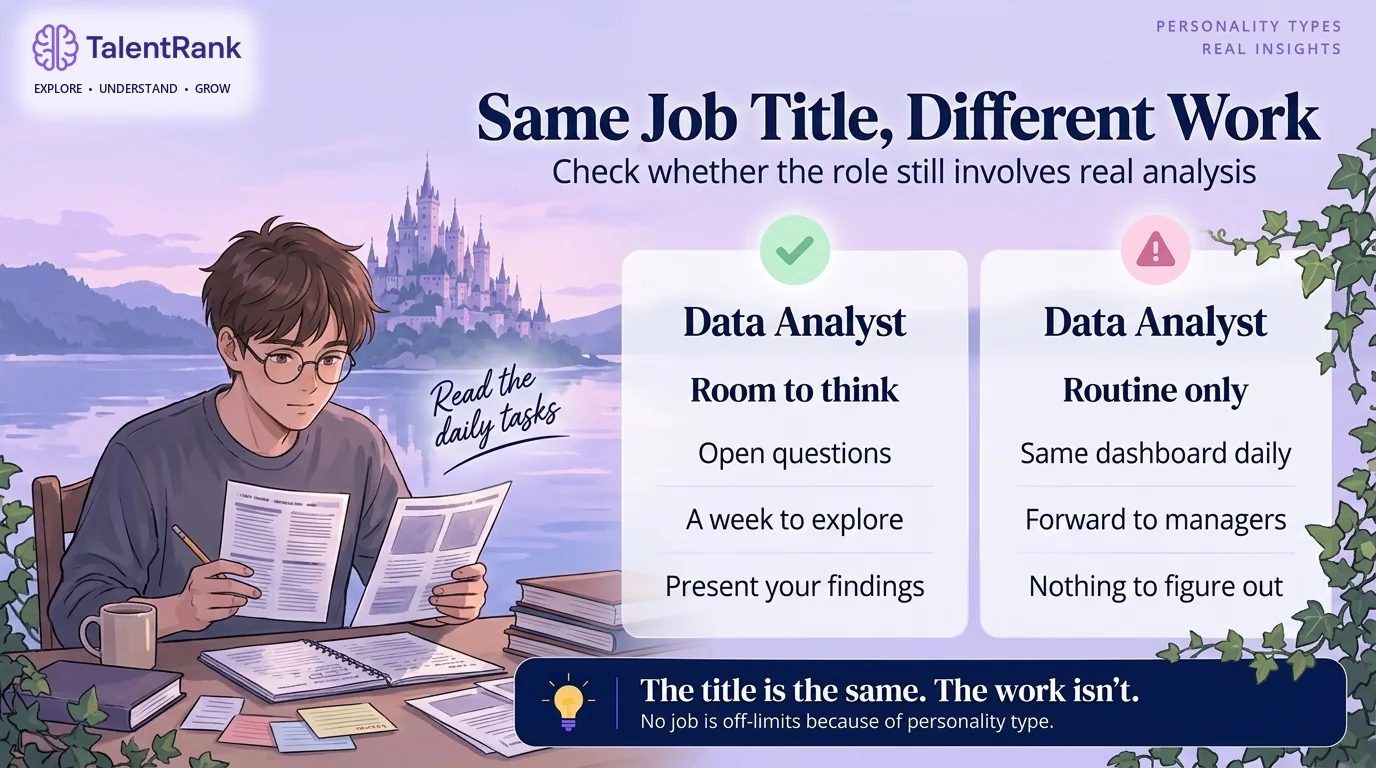
Hypothetical example: two INTPs are hired as data analysts. One is given open questions and a week to explore them before presenting findings. The other is asked to refresh the same dashboard every morning and forward it to five managers. On paper it's the same job. In practice, only one of them is doing analysis.
How to Pick Among INTP Career Options
INTPs can research a career forever without ever trying it. A shorter route:
Choose three careers that pull at your curiosity.
Read the daily tasks for each on O*NET OnLine. The tasks matter more than the title.
Ask one person in each role what they spend most of their time on. The answer is often "meetings" or "cleaning data."
Build something small: a data project, a proof, a program, a short paper. Notice whether you'd happily keep going.
Check the training cost and time against the pay and outlook figures above.
A second framework can help, too. The Holland Code sorts careers by interest themes. Its Investigative theme covers research and analysis work, which is where many of the careers above sit.
What Four Letters Can't Tell You
Two INTPs can differ a lot in how organized they are, how they handle stress, and how much novelty they need. Trait-based measures capture those differences. Openness to experience, for instance, is closely tied to intellectual curiosity. (Our guide to high openness covers what that can mean for careers.)
The TalentRank assessment measures your Big Five personality traits and takes about 12 to 15 minutes. It won't confirm an MBTI type or pick a job for you. It gives you a more detailed read on traits like openness and conscientiousness, which you can weigh alongside the options above. Take the TalentRank assessment and treat the results as one more piece of evidence.
Frequently Asked Questions About INTP Careers
What is the best career for an INTP?
There's no single best one. INTPs often do well in research, data science, software development, mathematics, economics, and information security, where complex problems and independent thinking are part of the job. Your skills and the specific workplace matter as much as your type.
What jobs should INTPs avoid?
No job is off-limits because of type. It's more useful to avoid conditions that frustrate many INTPs, such as rigid procedures, constant interruptions, decisions based on politics, and repetitive work with nothing left to figure out.
Are INTPs good programmers?
Many are, but type doesn't determine skill. Note that BLS projects employment of computer programmers to decline 7% by 2035, while software developer roles are projected to grow 10%. Design-heavy roles are the stronger long-term bet.
What INTP jobs pay the most?
In this guide, physicists and astronomers had the highest 2025 median pay at $166,880, followed by computer and information research scientists at $140,300 and software developers at $134,040, according to BLS. The top-paying research roles usually require graduate degrees.
Can an INTP be a manager?
Yes. INTPs can bring clear reasoning and fairness to management. The role involves more meetings and people decisions, so it helps to know whether you enjoy that before taking it on.
Is there a difference between INTP-A and INTP-T jobs?
No. The A/T suffix comes from 16Personalities, not the official MBTI, and the same careers apply to both.
Final Takeaway
INTP careers work best when there's something real to figure out and room to figure it out your way. Research, data, software design, security, economics, and teaching all offer that. Be wary of roles that have been reduced to routine execution, even when the title sounds technical. Pick a few options, build something small in each, and let the evidence decide.