

INTJ Personality Type: Traits, Strengths, and Work Style
The INTJ personality type is one of the 16 types in the Myers-Briggs framework. INTJ stands for Introversion, Intuition, Thinking, and Judging. Together, these preferences describe tendencies in where someone directs attention, what information they naturally notice, how they approach decisions, and how they deal with structure. They do not measure intelligence, empathy, professional ability, or a person's worth.
People with INTJ preferences are often described as independent, analytical, future-focused, and comfortable thinking through complex problems. Those descriptions can be useful, but they become misleading when they turn into a "mastermind" stereotype. An INTJ can be sociable, emotionally expressive, collaborative, uncertain, or flexible. This guide focuses on what the preferences actually mean, how common INTJ characteristics might appear in everyday situations, and how the same tendencies can create both strengths and tradeoffs.
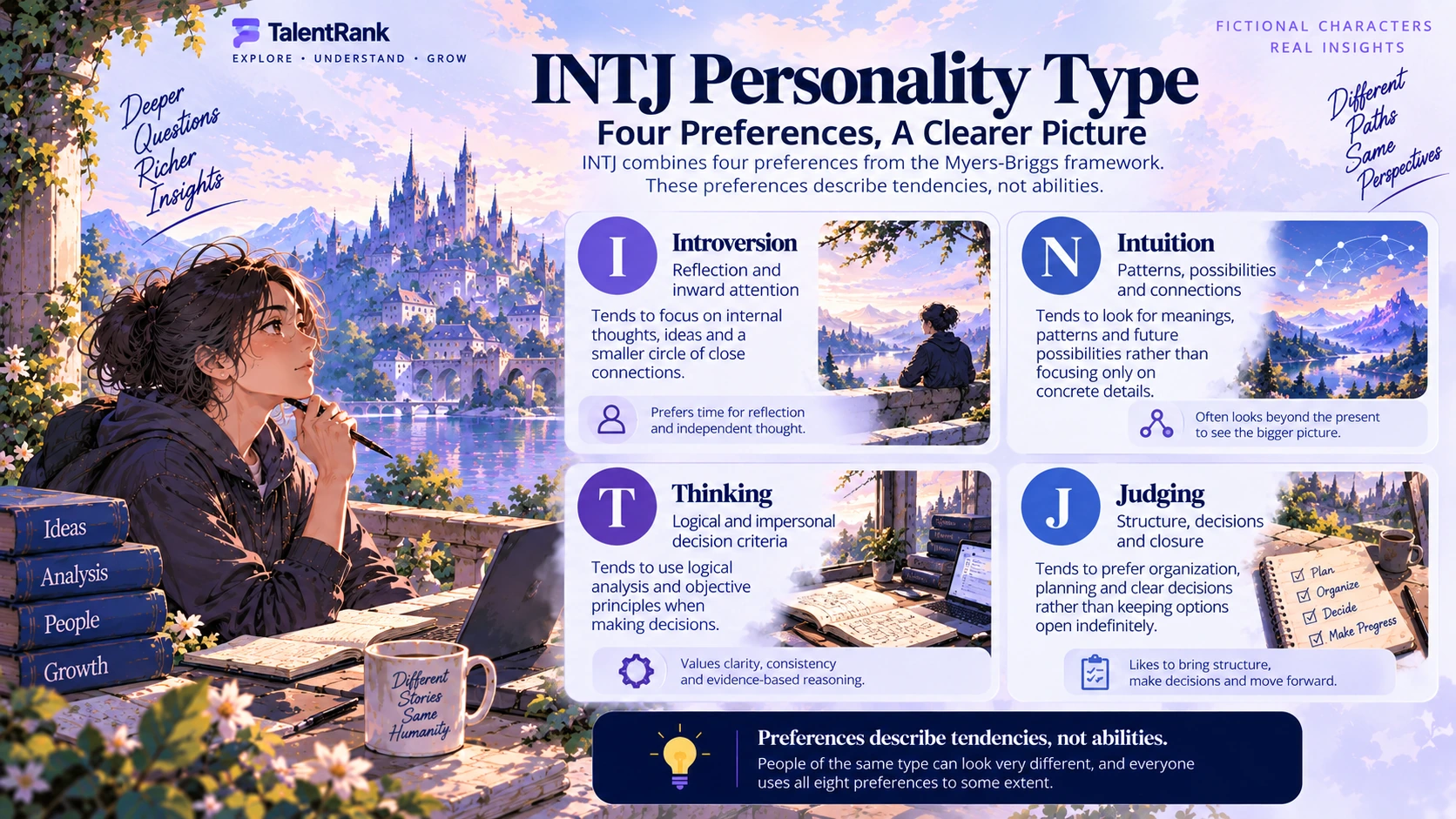
The INTJ personality type combines Introversion, Intuition, Thinking, and Judging. In the Myers-Briggs model, these preferences relate to attention and energy, how information is taken in, how decisions are made, and how someone approaches the outside world. They describe preferred tendencies rather than fixed abilities or rules for behavior.
The Myers & Briggs Foundation's MBTI preference guide explains that people use both sides of each preference pair even when one feels more natural. Someone with an INTJ result is not restricted to four ways of behaving.
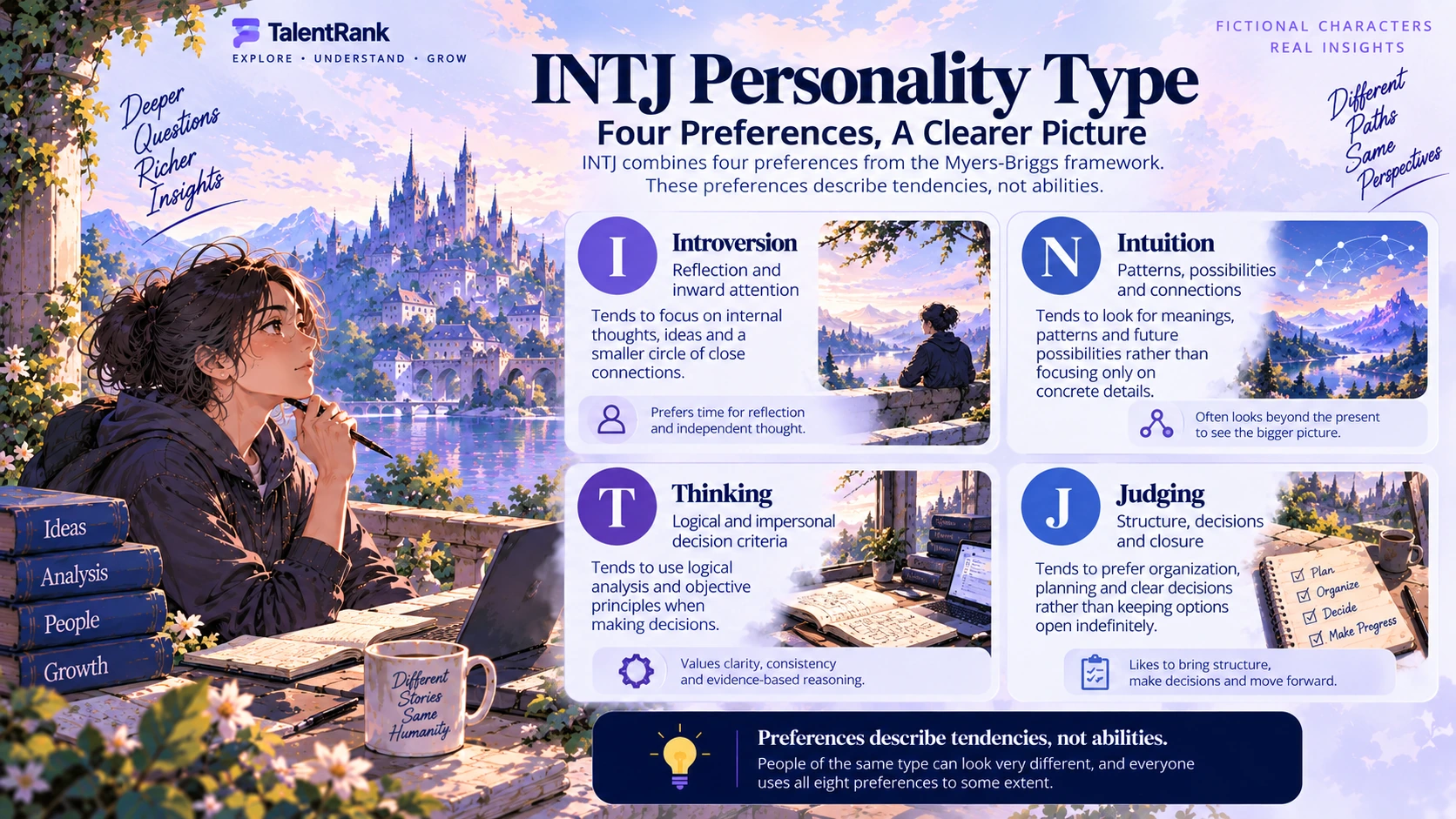
INTJ personality type: four preferences at a glance.
I: Introversion
Introversion in MBTI terminology concerns an inward orientation of attention and energy. People who prefer Introversion may find reflection on ideas, experiences, and concepts more natural and may prefer thinking something through before acting. It does not simply mean being shy, quiet, socially anxious, or uninterested in other people.
Consider a hypothetical employee preparing for a difficult planning meeting. They might prefer to read the proposal and develop their thoughts privately beforehand, then contribute actively during the discussion. Wanting preparation time does not mean they cannot present, lead, collaborate, or enjoy the meeting.
For a closer look at this distinction, TalentRank's E vs I guide separates Introversion and Extraversion preferences from common social stereotypes.
N: Intuition
Intuition describes a preference for noticing patterns, connections, meanings, and possibilities in information. The official MBTI explanation contrasts this with Sensing, which places more attention on concrete facts, specifics, and direct experience. People use both approaches even when one feels more natural.
At work, an Intuition preference might show up when someone receives a project brief and quickly starts asking how the project connects to a larger objective or what the current situation could become. That does not mean the person ignores facts or details. It also says nothing about intelligence.
TalentRank's S vs N guide explores how both preferences can contribute to solving the same problem.
T: Thinking
Thinking describes a decision-making preference. In the Myers-Briggs framework, people who prefer Thinking tend to give more weight to objective principles, logical analysis, and impersonal facts when reaching conclusions. Feeling gives more weight to values, relationships, personal concerns, and the people involved.
This is not a choice between logic and emotion. A person with a Thinking preference can care deeply about other people, just as someone with a Feeling preference can reason analytically.
TalentRank's T vs F guide examines the distinction in practical decision-making situations.
J: Judging
Judging describes a preference for structure, plans, decisions, and closure when dealing with the outside world. Perceiving is associated with keeping options open and adapting as additional information appears.
Judging does not mean judgmental. It also does not mean an INTJ must have every part of life scheduled. Someone can prefer clear priorities for an important project while being spontaneous on a weekend.
The practical distinction is covered further in TalentRank's J vs P guide.
Common INTJ Characteristics
Common descriptions of the INTJ personality type often point to independent thinking, pattern recognition, long-range planning, analytical decision-making, and a preference for structure. These are better understood as possible patterns than as requirements.
Common pattern | What it might look like | What it does not automatically mean |
Independent thinking | Forming a view before seeking consensus | Disliking teamwork |
Pattern-focused thinking | Looking for connections and implications | Always predicting correctly |
Long-range orientation | Considering downstream consequences | Having everything planned |
Analytical decisions | Testing ideas for consistency | Being unemotional |
Preference for structure | Wanting priorities and direction to be clear | Being unable to adapt |
High internal standards | Refining work until the reasoning feels sound | Being a perfectionist in every area |
The important phrase here is might look like. Behavior depends on context, experience, responsibilities, learned skills, culture, and the situation itself.
Why an INTJ may not look like the stereotype
A person can relate strongly to INTJ preferences and still enjoy parties, make people laugh, lead a team, express affection openly, procrastinate, change plans, or ask others for help. None of those behaviors automatically contradicts the type.
Consider Introversion again. A confident public speaker may still prefer inward reflection. A manager with a Judging preference can revise a project plan when new evidence appears. Someone with a Thinking preference can be highly attentive to how a decision affects colleagues.
The problem with stereotypes is that they turn preferences into predictions about an entire person.
What an INTJ label does not tell you
intelligence
empathy or emotional depth
professional competence
leadership ability
mental health
income or career success
morality
ideal occupation
compatibility with another person
That is why descriptions of an INTJ as automatically brilliant, cold, socially detached, or destined for certain careers go beyond what four preference letters can tell us.
INTJ Strengths and the Tradeoffs That Can Come With Them
Potential strengths of the INTJ personality type make more sense when considered alongside their possible tradeoffs. A tendency that helps in one setting may need adjustment in another.
Possible pattern | Potential advantage | Possible tradeoff | Useful question |
Long-range thinking | Anticipates downstream effects | May over-optimize for future possibilities | What decision needs to be made now? |
Independent judgment | Reduces dependence on immediate consensus | Useful input may arrive too late | Who has information I do not have? |
Analytical problem-solving | Spots inconsistencies and inefficient systems | Human effects may receive less attention initially | Who will experience this change? |
High standards | Supports quality and consistency | Can encourage unnecessary refinement | Is another revision worth the time? |
Persistence | Helps with difficult problems | Can prolong commitment to an outdated approach | What evidence would change my mind? |
Preference for structure | Creates clarity and direction | Unexplained change may create friction | Do I need the old plan or a coherent new one? |
These are reflection examples, not validated measures of INTJ behavior.
Strategic thinking
A focus on patterns and future implications can make long-range reasoning feel natural. Someone may instinctively ask how today's choice affects next quarter, what dependencies a decision creates, or whether the current solution will still work if circumstances change.
That can be valuable when downstream consequences matter. It can also become excessive if a decision is reversible and needs to be made quickly. A good question is not simply, "Am I strategic?" It is, "When does thinking further ahead improve this decision?"
Independent judgment
Developing a position without needing immediate approval can help someone examine an unpopular idea fairly or work through a difficult problem without constant reassurance.
The tradeoff appears when independence delays useful collaboration. Imagine a hypothetical analyst who spends two weeks perfecting a proposal before showing it to the operations team. The proposal may be carefully reasoned, but operations could have identified a practical constraint on day two. Independence and collaboration do not have to compete. Timing matters.
Analytical problem-solving
Someone who relates to INTJ preferences may enjoy identifying the underlying structure of a problem instead of treating each symptom separately. This can be particularly useful when a broken process keeps producing the same problem.
The risk is assuming that the technically cleanest solution is automatically the most useful one. Implementation also involves people, incentives, timing, cost, communication, and existing commitments.
High standards
High internal standards can support careful work. They can also make "better" difficult to distinguish from "good enough."
The practical question is whether another revision materially improves the outcome. Spending two extra hours checking a safety-critical calculation is different from spending two extra hours adjusting a low-impact presentation detail.
Persistence
Staying with a difficult problem can produce breakthroughs that would be missed by giving up early.
Persistence becomes less useful when it turns into attachment to a solution after the evidence has changed. A useful counterquestion is: What would convince me that my current approach is wrong?
What Does an INTJ Work Style Look Like?
There is no single INTJ work style. Someone who relates to the INTJ personality type may value autonomy, focused thinking, clear objectives, complex problems, and logical reasons behind decisions. But actual workplace behavior also depends on experience, expertise, role, colleagues, incentives, organizational culture, and the situation.
Personality preference should not be treated as a substitute for evaluating whether someone can perform a job.
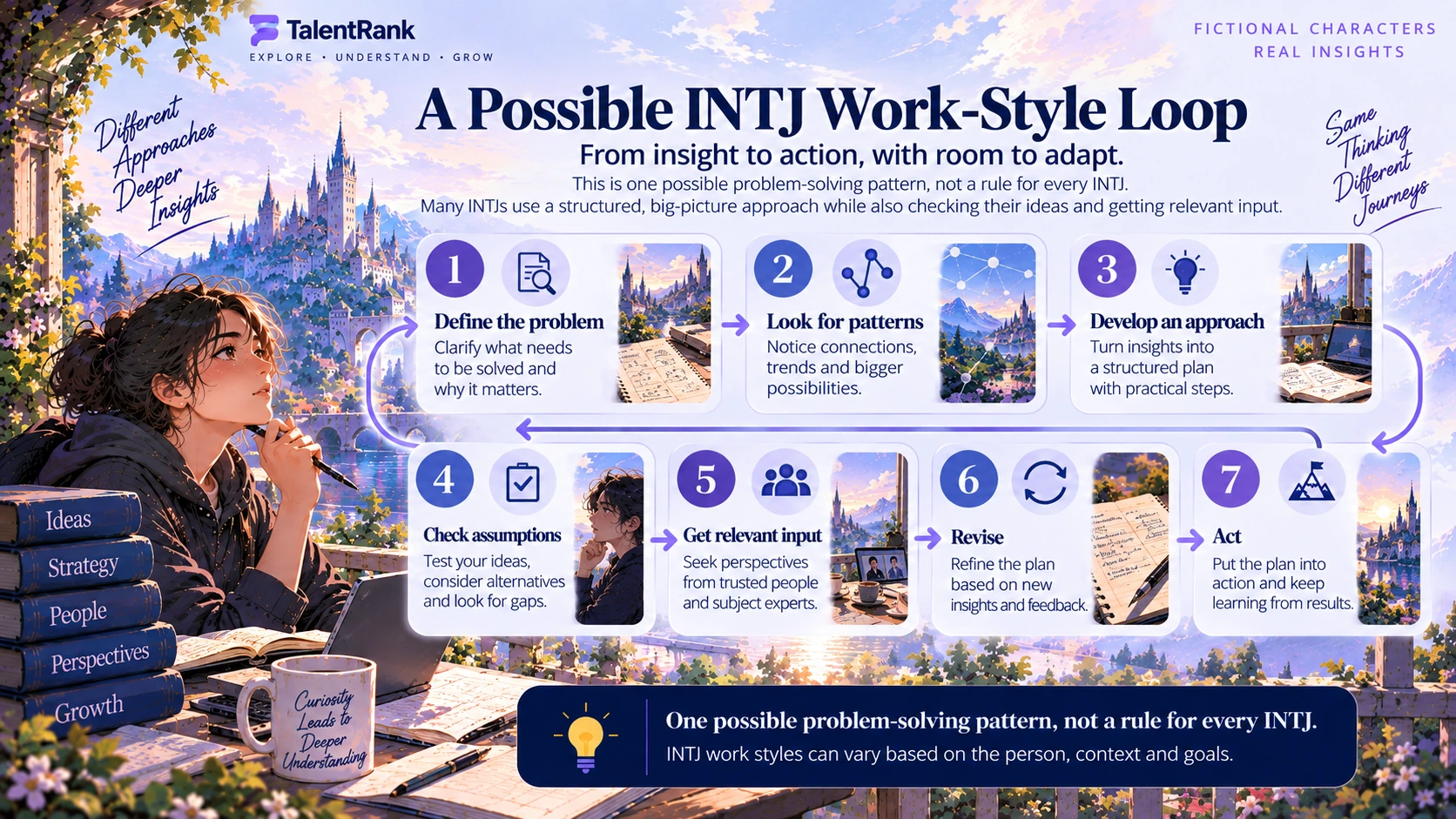
One possible INTJ work-style loop, shown as an illustrative process rather than a rule.
Planning and priorities
An INTJ preference pattern may make it appealing to understand the objective before committing to individual tasks.
Suppose a team receives a vague request to "improve customer onboarding." A person approaching the problem this way might first ask what improvement means, which customer problem matters most, how success will be measured, and which parts of the process depend on one another.
That can prevent wasted work. It can also delay action if every uncertainty has to be resolved before experimentation begins. Sometimes the fastest way to improve a plan is to test a reasonable first version.
Problem-solving and decisions
People who identify with INTJ preferences may be comfortable questioning an established process when its logic no longer seems convincing.
That does not necessarily mean rejecting authority. There is a difference between asking, "Why does this process exist?" and assuming, "This process is pointless." An existing rule may contain knowledge that is not immediately visible. Understanding why it exists can be part of analyzing whether it should change.
Independent work
Focused time can be valuable for tasks that require concentration, synthesis, writing, analysis, or building a detailed model. Preferring that time does not mean wanting to work completely alone.
A useful work arrangement might involve collaborative problem definition, independent analysis, and another collaborative checkpoint before implementation. The right balance depends on the work rather than a personality label.
Meetings and communication
The stereotype says INTJs hate meetings. A more useful distinction is between meetings that have a clear purpose and meetings that do not.
Someone who prefers time to think may appreciate receiving a difficult question before a meeting. They may also prefer discussion that results in a decision, clearer information, or a defined next step. Other INTJs may enjoy spontaneous debate. Personality preferences do not prescribe one meeting style.
Collaboration
An INTJ-style contribution to a team might involve identifying dependencies, challenging assumptions, organizing a complicated problem, or asking whether a proposed solution addresses the real issue.
Potential friction can appear when the reasoning is clear to the person presenting it but not to everyone else. For example, "This plan won't work" communicates a conclusion. Explaining which assumption fails, what evidence supports that view, and what alternative could work gives colleagues something they can evaluate. Directness becomes more useful when it carries enough context.
Feedback
Specific feedback is often easier to act on than a vague judgment, regardless of personality type.
Compare "Your presentation wasn't engaging" with "The recommendation appeared on slide 18. Moving it earlier would make the argument easier to follow." The second statement gives someone something concrete to examine.
A person who likes developing work independently may also benefit from deciding when to seek feedback. Waiting until everything feels finished can make revision unnecessarily expensive.
When priorities suddenly change
A preference for structure does not mean someone cannot adapt. The real source of frustration may be a change with no explanation, unclear ownership, or conflicting priorities rather than change itself.
Suppose a product launch moves forward by two weeks. "Everything has changed" offers little help. Explaining why the date changed, what is now most important, what can be dropped, and who owns each decision creates a new structure.
The relevant question may be: Do I need the original plan, or do I need a coherent plan?
INTJ Myths That Are Easy to Mistake for Personality Traits
Popular descriptions can make the INTJ personality type sound more dramatic than the underlying preferences.
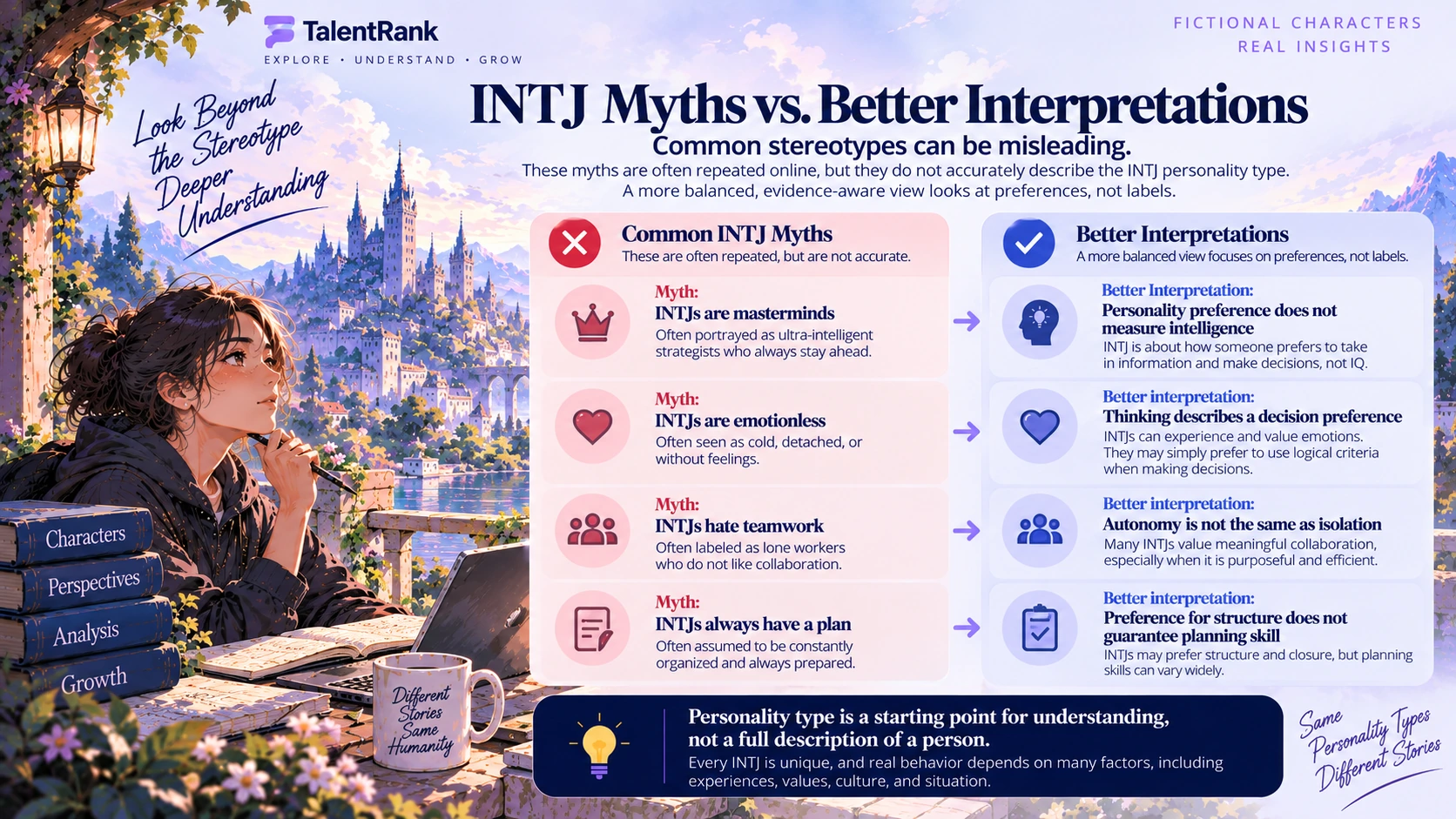
Common INTJ myths compared with more balanced preference-based interpretations.
Myth: INTJs are masterminds
"Mastermind" is a popular nickname, not a measure of cognitive ability. Being interested in patterns, systems, or long-range implications does not establish that someone is unusually intelligent. It certainly does not guarantee that their strategy is correct. An elaborate plan can still be based on a bad assumption.
Myth: INTJs are emotionless
Thinking is a decision-making preference in MBTI terminology, not a measure of how many emotions someone experiences or how deeply they experience them. Someone can care deeply about a colleague and still believe the fairest decision is the one based on consistent criteria.
Myth: INTJs always want to work alone
Autonomy and isolation are different things. Someone may want several uninterrupted hours to solve a difficult problem and still enjoy brainstorming, mentoring, presenting, or building something with a team. The more useful question is what kind of collaboration helps at each stage of the work.
Myth: INTJs always have a perfect plan
A preference for planning does not guarantee planning skill. INTJs can underestimate a task, procrastinate, miss information, abandon a plan, or make a poor prediction.
Myth: INTJs are naturally successful
No four-letter type guarantees career success, leadership ability, income, expertise, or good judgment. Success depends on far more than a personality description, including opportunity, knowledge, practice, resources, relationships, decisions, circumstances, and what "success" means to the person in the first place.
How INTJ Preferences Can Affect Collaboration
Good collaboration does not require everyone to think the same way.
For someone who likes developing ideas internally, one useful habit can be deciding when a problem has reached the point where outside information will improve it. That might mean asking a domain expert to challenge an assumption before a detailed solution is built.
It can also help to make reasoning visible. If you have mentally connected six pieces of information before reaching a conclusion, colleagues cannot evaluate that chain unless you explain enough of it.
The reverse matters too. A suggestion that initially seems inefficient may reflect a constraint or experience you do not have.
When disagreements happen, separate the proposal from the person proposing it. "I see a risk in this assumption" creates a different conversation from "You haven't thought this through."
Finally, recognize when optimization has diminishing returns. The best theoretical solution may not be the best practical solution if it requires resources, time, or organizational changes that are not available.
These are useful collaboration habits regardless of whether someone identifies as INTJ.
Practical Questions for Understanding Your Own Work Style
Instead of asking whether every INTJ description sounds like you, look at your actual behavior across different situations.
When I face a new problem, do I first look for concrete precedents or underlying patterns?
Do I prefer to form an opinion privately before discussing it?
What kind of evidence is most likely to change my mind?
When making a difficult decision, which criteria carry the most weight?
How much structure helps me focus, and when does it begin to feel restrictive?
Do I ask for feedback while developing a solution or mostly after I think it is finished?
When plans change, is the change itself frustrating, or is unclear reasoning the bigger problem?
Which parts of my work benefit from autonomy, and which improve when I involve other people earlier?
Do not score the answers or use them as an unofficial INTJ test. They are reflection prompts designed to make broad personality language more concrete.
Personality Type Is a Starting Point, Not a Verdict
The INTJ personality type can provide vocabulary for thinking about preferences, but four letters do not capture every meaningful difference between people.
Even within official MBTI interpretation, people use all of the preferences, and the Myers & Briggs Foundation describes a best-fit type process rather than treating a questionnaire result as an unquestionable verdict.
Other personality frameworks describe individual differences differently. The Big Five, for example, focuses on continuous trait dimensions rather than assigning one of 16 four-letter types. TalentRank's Big Five vs MBTI guide provides a fuller comparison.
The useful question is not whether you can make every habit fit an INTJ label. It is whether the framework helps you notice something about your preferences that you can examine in real situations.
Explore Your Own Personality Traits
Reading about the INTJ personality type can give you language for reflecting on your preferences, but your personality does not have to fit neatly into four letters.
TalentRank's assessment uses a Big Five-based approach and reports scores across Openness, Conscientiousness, Extraversion, Agreeableness, and Neuroticism. It is a separate personality framework, not a way to confirm whether you are an INTJ. Start the TalentRank Assessment
Frequently Asked Questions About the INTJ Personality Type
The INTJ personality type is one of the 16 types in the Myers-Briggs framework. INTJ stands for Introversion, Intuition, Thinking, and Judging. These preferences relate to attention and energy, information, decision-making, and approach to structure. They describe preferred tendencies rather than intelligence, ability, empathy, or someone's complete personality.
What does INTJ stand for?
INTJ stands for Introversion, Intuition, Thinking, and Judging. In MBTI terminology, Introversion concerns the orientation of attention and energy, Intuition concerns how information is perceived, Thinking concerns decision-making, and Judging concerns how someone approaches structure and the outside world.
What are common INTJ characteristics?
Common INTJ characteristics include independent thinking, attention to patterns and possibilities, analytical decision-making, long-range thinking, and a preference for structure. These are tendencies rather than requirements. An INTJ can also be warm, collaborative, expressive, spontaneous in some situations, and inconsistent with popular stereotypes.
What are common INTJ strengths?
Potential INTJ strengths include strategic thinking, independent judgment, analytical problem-solving, persistence, and high standards. Context matters because the same tendencies can create tradeoffs. Independence can delay useful input, for example, while high standards can lead to unnecessary refinement.
What is an INTJ like at work?
Someone with INTJ preferences may value autonomy, focused work, clear objectives, complex problems, and logical reasons behind decisions. They may prefer time to develop an idea before discussing it. Actual work style also depends on role, skills, experience, colleagues, culture, incentives, and the situation.
Do INTJs prefer working alone?
Not necessarily. Wanting autonomy or uninterrupted thinking time is different from disliking teamwork. Someone with INTJ preferences may enjoy collaboration while still wanting independent time to analyze a problem, prepare for a discussion, or develop part of a solution.
Are INTJs emotionless?
No. Thinking is a decision-making preference in the Myers-Briggs framework. It does not mean a person lacks feelings or empathy.
Does being INTJ mean you are highly intelligent?
No. The INTJ label describes personality preferences within the Myers-Briggs framework. It is not an intelligence score and should not be used to infer someone's cognitive ability, professional competence, or potential.
Understanding the Pattern Without Becoming the Label
The INTJ personality type is most useful when it gives you better questions rather than a rigid identity. Introversion, Intuition, Thinking, and Judging provide a vocabulary for examining attention, information, decisions, and structure, but they do not require someone to be a solitary strategist, an emotionless analyst, or a flawless planner.
Look instead at repeated behavior across different contexts. Notice when independent thinking improves your work and when earlier input would help. Ask when planning creates clarity and when flexibility matters more. Pay attention to the information you naturally seek and the evidence that changes your mind. A personality framework can organize that reflection, but your real habits, choices, skills, and circumstances contain more information than four letters ever could.