

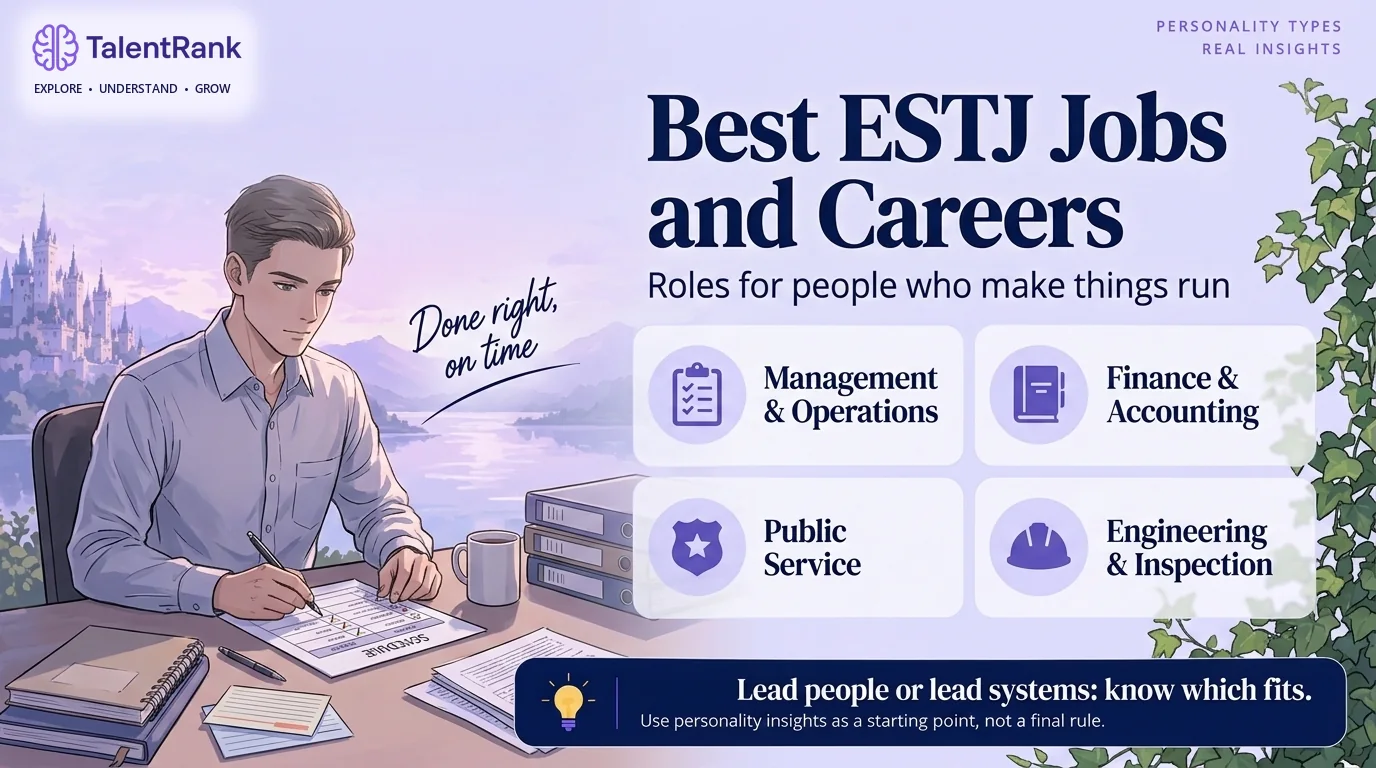
Good ESTJ jobs tend to put you in charge of making something run properly: a team, a budget, a building project, a supply chain, or a set of rules. Financial management, construction management, operations and production management, administrative services management, logistics, law enforcement, school administration, accounting, and civil engineering all come up often.
That's a tendency, not a guarantee. The Myers-Briggs Company says type preferences "do not indicate skill or ability" and warns against using the assessment to select people for jobs. (The Myers-Briggs Company) ESTJs can be artists, therapists, or researchers. Type shows what tends to feel natural.
This guide covers thirteen careers ESTJs often explore, with 2025 pay and 2025–35 growth figures from the U.S. Bureau of Labor Statistics. It also looks at the difference between managing people and managing systems, lists routes without a four-year degree, and covers the conditions that frustrate ESTJs most.
What ESTJs Tend to Want From Work
ESTJ stands for Extraversion, Sensing, Thinking, and Judging. You probably like to be around people, trust facts and proven methods, make decisions on logic, and prefer a clear plan with deadlines. (Our explainers on thinking vs. feeling and judging vs. perceiving cover those letters in more depth.)
At work, that often shows up as:
Clear rules, roles, and standards.
Responsibility for results.
Efficient processes that actually get followed.
A chain of command that makes sense.
Recognition for reliability and hard work.
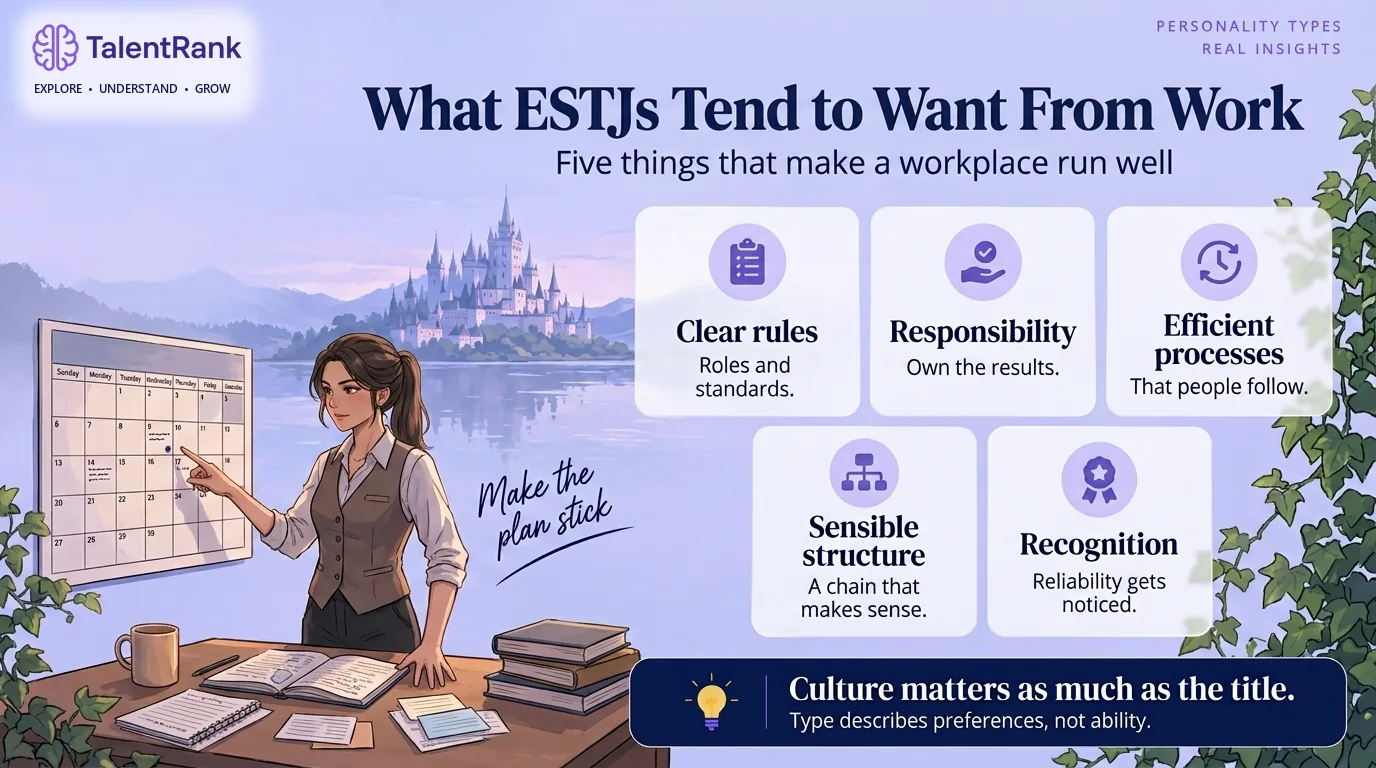
ESTJs are often described as natural administrators. That's a strength in the right place. In a fast-changing or loosely organized workplace, the same instinct for order can create friction, so the organization's culture matters as much as the job title.
Best ESTJ Jobs to Explore
These careers reward organization, accountability, and practical leadership. Figures come from the Bureau of Labor Statistics Occupational Outlook Handbook: median pay in May 2025 and projected employment change from 2025 to 2035.
Career | 2025 median pay | Projected growth, 2025–35 | Typical path in |
Financial manager | $166,570 | 10% | Bachelor's degree plus 5+ years' experience |
Industrial production manager | $126,060 | 3% | Bachelor's degree plus 5+ years' experience |
Construction manager | $114,990 | 9% | Bachelor's degree or years in a trade |
Administrative services and facilities manager | $110,500 | 5% | Bachelor's degree plus some experience |
School principal | $105,870 | 0% | Master's degree plus teaching experience |
Project management specialist | $102,320 | 7% | Bachelor's degree |
Civil engineer | $100,840 | 6% | Bachelor's degree |
Budget analyst | $91,640 | 2% | Bachelor's degree |
Accountant or auditor | $83,680 | 5% | Bachelor's degree |
Logistician | $82,320 | 18% | Bachelor's degree |
Police officer or detective | $77,310 | 3% | High school diploma to degree, plus academy |
Loan officer | $76,690 | 1% | Bachelor's degree |
Construction and building inspector | $74,690 | 0% | High school diploma |
Source: BLS Occupational Outlook Handbook, pages updated August 2026.
Management and Operations
Financial managers oversee an organization's money and reporting, and BLS projects 10% growth. Industrial production managers run manufacturing plants, and construction managers keep building projects on schedule and on budget. Administrative services and facilities managers make sure an organization's offices and support services work, and they typically need less experience than most managers on this list.
Logisticians run supply chains, and BLS projects 18% growth, the fastest in this guide. Project management specialists own schedules, budgets, and staffing, and it's one of the best entry points into management.
Finance and Accounting
Accountants and auditors make sure records are accurate and rules are followed. Budget analysts help organizations plan and control spending; the federal government is the largest employer. Loan officers evaluate applications against clear criteria.
Public Service and Education
Police officers and detectives enforce laws and protect communities. The work is physically demanding and stressful, and BLS notes it has one of the higher injury rates of any occupation, so it's worth talking to officers before applying. School principals run schools and usually come up through teaching.
Engineering and Inspection
Civil engineers plan and supervise roads, bridges, and water systems, splitting their time between the office and job sites. Construction and building inspectors make sure projects meet code, often starting with a high school diploma and trade experience.
Managing People vs. Managing Systems
Many ESTJ careers split into two kinds of leadership. Some roles mostly manage people: the principal, the production manager, the police sergeant. Others mostly manage systems: the budget analyst, the logistician, the auditor.
People leadership pays more at the top, but it also means handling emotions, conflict, and performance problems. Systems roles offer more control and fewer personnel headaches. Neither is better. It helps to know which one energizes you before you chase a title.
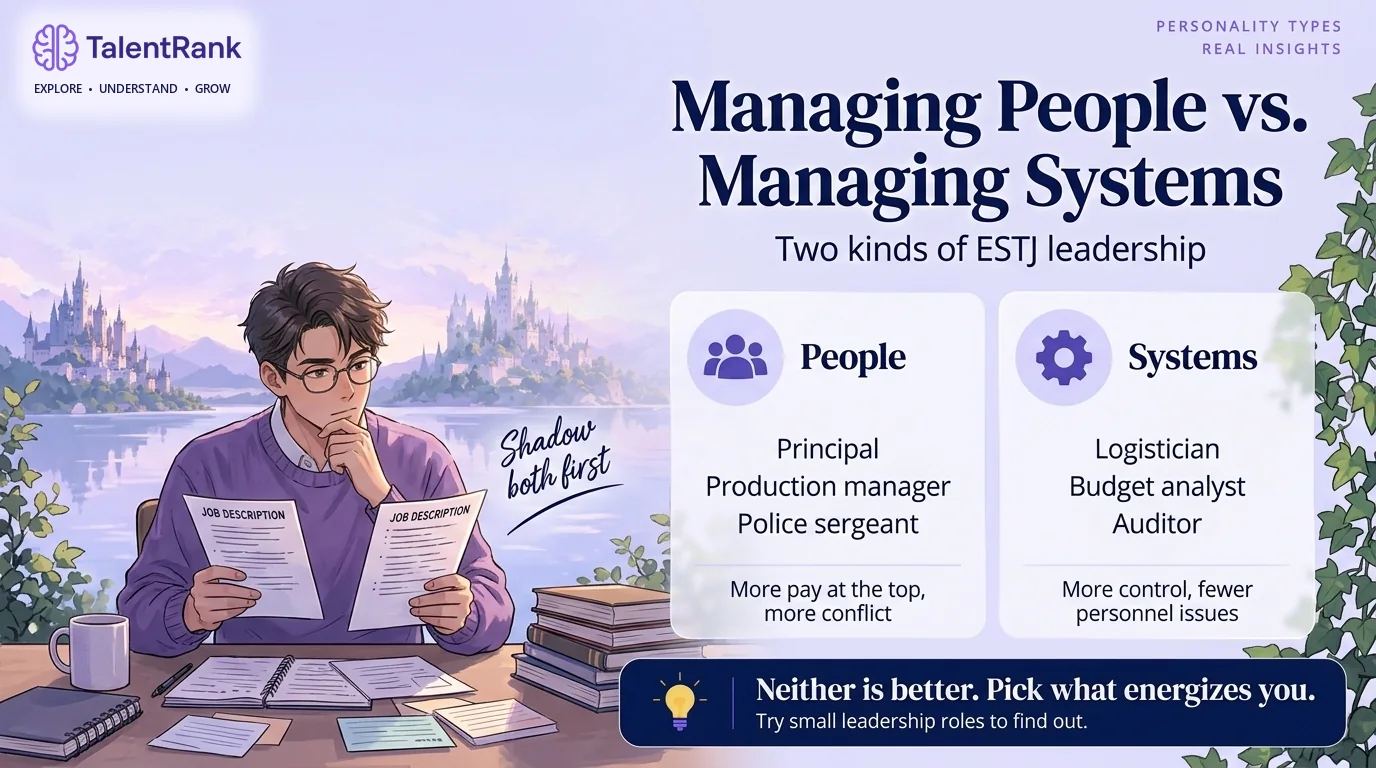
Hypothetical example: an ESTJ project coordinator gets offered two promotions. One is a team lead role supervising eight people. The other is a senior logistics analyst role owning the company's supplier data. She asks to shadow both for a week and realizes she enjoys fixing the process far more than coaching staff through it. That tells her more than any personality profile could.
ESTJ Jobs That Don't Require a Four-Year Degree
Construction manager: BLS notes some firms hire managers with a high school diploma and many years of trade experience.
Construction and building inspector: high school diploma plus experience, $74,690 median.
Police officer: high school diploma in many departments, plus academy training.
Food service manager: high school diploma plus experience, $69,390 median, 6% growth.
Quality control inspector: high school diploma, $48,570 median.
Supervisor roles in retail, warehousing, and manufacturing can also lead into management at employers that promote from within.
ESTJ-A and ESTJ-T Jobs
The -A (Assertive) and -T (Turbulent) suffixes come from 16Personalities, not the official MBTI. 16Personalities adds a fifth scale it calls Identity and bases its model on Big Five research. (16Personalities)
There's no separate list of ESTJ-T jobs. The same careers apply. If the Turbulent label fits, high personal standards may come with more self-criticism, which is worth managing in roles where you're responsible for others' mistakes.
ESTJ Jobs to Avoid (or Conditions to Watch)
"ESTJ jobs to avoid" lists usually include artistic careers, counseling, and loosely structured startup roles. The reasoning is that ESTJs prefer order and facts to ambiguity and emotion. That's a generalization. An ESTJ can run an excellent counseling practice or bring structure to a chaotic startup.
What tends to frustrate ESTJs is more specific:
No clear rules, roles, or accountability.
Constant change without a plan.
Colleagues who don't follow through.
Decisions made on feelings or politics rather than facts.
Responsibility without authority.
How to Choose Among ESTJ Careers
Pick three careers from this guide.
Read the daily tasks for each on O*NET OnLine.
Ask one person in each role how much of their week is people management versus process.
Take on a small leadership role now: run a project, a shift, or a volunteer event.
Compare the training path and experience requirements with the pay and outlook above.
Clarifying your work values can help you weigh pay against stability, and the Holland Code groups careers by interests such as Conventional and Enterprising.
Beyond the Four Letters
Two ESTJs can differ a lot in how they lead. One is patient and diplomatic. Another is blunt and fast. Trait measures pick up those differences. Conscientiousness, for example, relates to organization and follow-through. (Our guide to high conscientiousness covers its strengths and blind spots at work.)
The TalentRank assessment measures your Big Five personality traits and takes about 12 to 15 minutes. It won't confirm an MBTI type or choose a job for you. It can show where you land on traits like conscientiousness, extraversion, and agreeableness, which shape how you lead. Take the TalentRank assessment and use it as one input.
Frequently Asked Questions About ESTJ Jobs
What are the best jobs for an ESTJ?
ESTJs often do well in management, operations, logistics, finance, accounting, law enforcement, school administration, civil engineering, and inspection. Skills and the specific workplace matter as much as type.
What jobs should ESTJs avoid?
No job is off-limits because of type. It's more useful to avoid conditions that frustrate ESTJs, like unclear roles, constant unplanned change, and responsibility without authority.
What ESTJ jobs pay the most?
In this guide, financial managers had the highest 2025 median pay at $166,570, followed by industrial production managers at $126,060 and construction managers at $114,990, according to BLS.
Are ESTJs good managers?
They can be. ESTJs often bring structure, clear expectations, and follow-through. Good management also requires flexibility and listening, which anyone can build with practice.
What are good entry-level jobs for ESTJs?
Project management specialist, accountant, logistics analyst, and supervisor roles in retail or operations are common starting points that lead into management.
Is there a difference between ESTJ-A and ESTJ-T jobs?
No. The A/T suffix comes from 16Personalities, not the official MBTI, and the same careers apply to both.
Final Takeaway
ESTJ careers tend to share a theme: making things run properly. Management, finance, logistics, public service, and engineering all offer that. Decide early whether you'd rather lead people or systems, choose a workplace with clear standards, and take on small leadership roles now. That track record is what moves you up.