

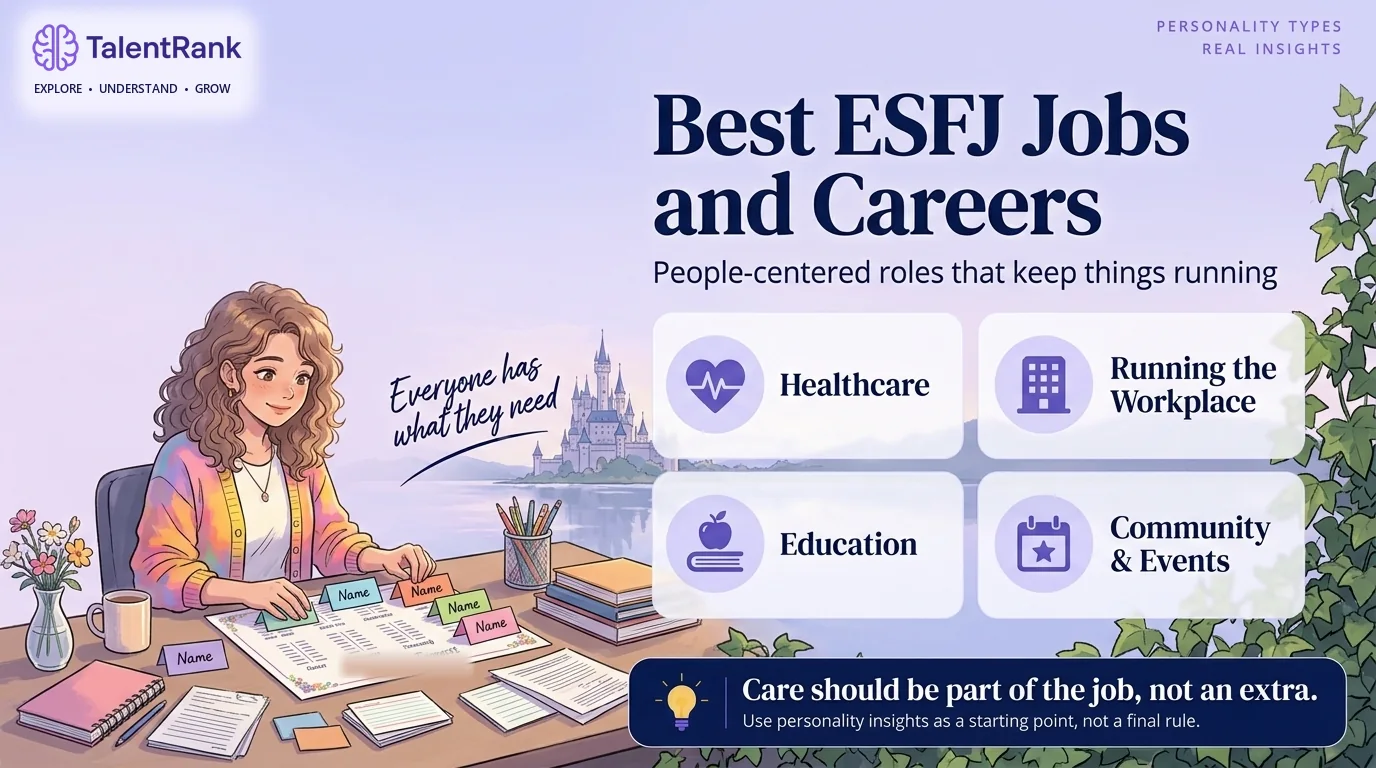
Good ESFJ jobs usually combine two talents: looking after people and keeping things organized. Healthcare, health services management, office and facilities management, human resources, teaching, school counseling, nonprofit program management, fundraising, event planning, and restaurant management all fit. They reward warmth, reliability, and a knack for making sure everyone has what they need.
That's a pattern, not a prescription. The Myers-Briggs Company says type preferences "do not indicate skill or ability" and warns against using the assessment to select people for jobs. (The Myers-Briggs Company) ESFJs work as engineers, analysts, and researchers too. Type suggests what may feel natural, not what you can do.
This guide covers twelve careers ESFJs often explore, with 2025 pay and 2025–35 growth figures from the U.S. Bureau of Labor Statistics. It also flags two popular ESFJ suggestions that the data doesn't favor, lists routes without a four-year degree, and covers the conditions that tend to wear ESFJs down.
What ESFJs Tend to Value at Work
ESFJ stands for Extraversion, Sensing, Feeling, and Judging. You probably get energy from people, trust practical experience, weigh how decisions affect others, and like a plan you can follow through. (For more on the S and J, see sensing vs. intuition and judging vs. perceiving.)
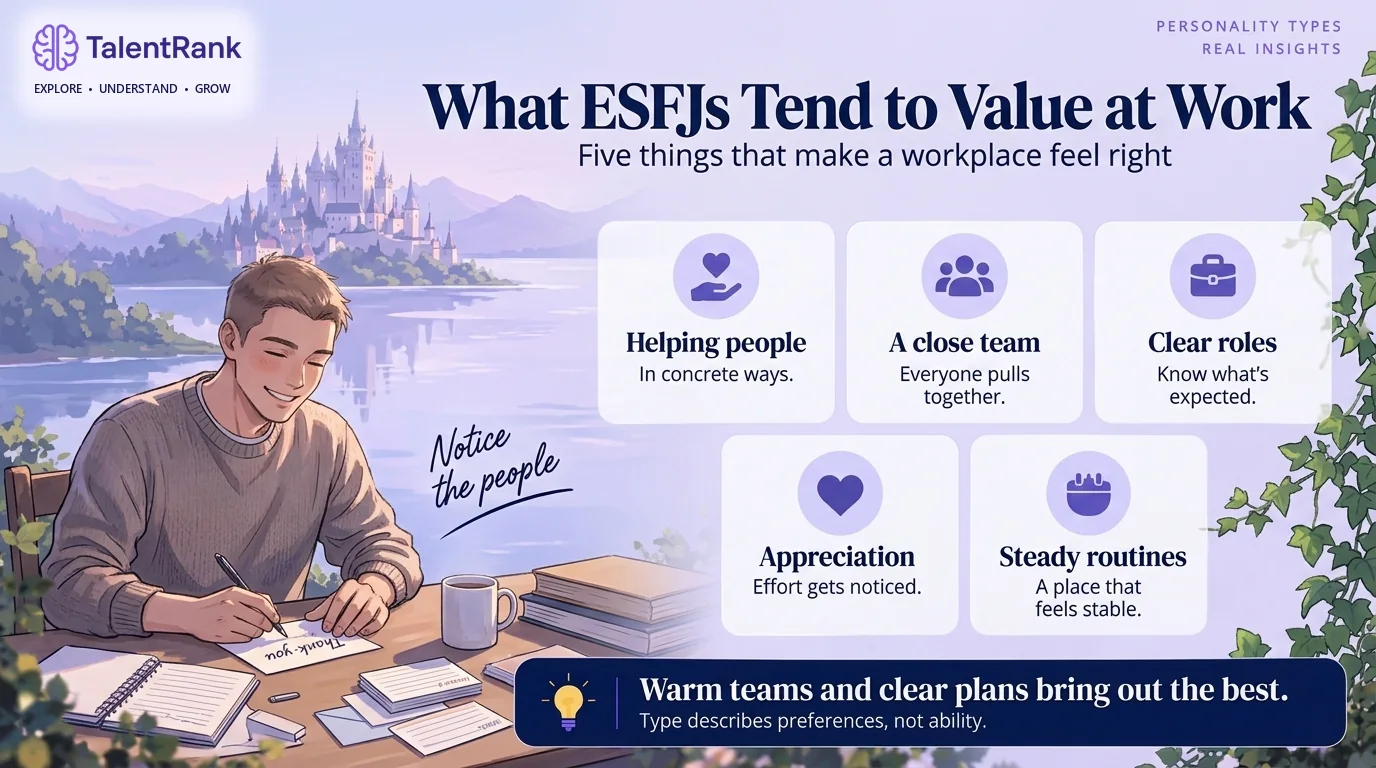
At work, that often shows up as a few needs:
Helping people in concrete ways.
A team that gets along and pulls together.
Clear roles and expectations.
Appreciation when you go the extra mile.
Traditions and routines that make a place feel steady.
ESFJs are often the people who remember birthdays, notice when a coworker is struggling, and quietly make sure the event actually happens. That's real value, and it's worth choosing roles where it's part of the job description rather than invisible extra work.
Best ESFJ Jobs to Explore
These careers combine people and organization. Figures come from the Bureau of Labor Statistics Occupational Outlook Handbook: median pay in May 2025 and projected employment change from 2025 to 2035.
Career | 2025 median pay | Projected growth, 2025–35 | Typical path in |
Medical and health services manager | $123,860 | 24% | Bachelor's degree |
Administrative services and facilities manager | $110,500 | 5% | Bachelor's degree plus some experience |
Dental hygienist | $98,100 | 8% | Associate's degree |
Registered nurse | $97,550 | 6% | Nursing degree or diploma plus license |
Social and community service manager | $80,390 | 7% | Bachelor's degree plus experience |
Human resources specialist | $75,940 | 6% | Bachelor's degree |
Fundraiser | $72,550 | 6% | Bachelor's degree |
Food service manager | $69,390 | 6% | High school diploma plus experience |
School or career counselor | $64,330 | 3% | Master's degree |
Elementary school teacher | $63,820 | 0% | Bachelor's degree |
Event planner | $61,160 | 6% | Bachelor's degree |
Dental assistant | $48,070 | 7% | Postsecondary certificate |
Source: BLS Occupational Outlook Handbook, pages updated August 2026.
Healthcare
Registered nurses combine patient care with coordination and teaching, and there are several ways in, including associate's degree programs. Dental hygienists earned close to $98,000 in 2025 with an associate's degree. Dental assistants keep patients comfortable and the office running, often after a certificate program.
For ESFJs who like organizing more than hands-on care, medical and health services managers run clinics and departments. BLS projects 24% growth, the fastest in this guide.
Running the Workplace
Administrative services and facilities managers make sure an organization's offices, records, and support services work. The median was $110,500, and BLS lists less than five years of related experience as typical, which is lower than most management roles. Human resources specialists handle hiring, onboarding, and employee questions, and it's a common path into HR management.
Education and Counseling
Elementary school teachers build a classroom community over a full year. School and career counselors help students plan and cope, usually with a master's degree.
Community, Events, and Hospitality
Social and community service managers run programs at nonprofits and agencies. Fundraisers build relationships with donors. Event planners coordinate every detail so guests have a good time, and food service managers run restaurants and cafeterias, often after working their way up from server or cook.
Two ESFJ Suggestions to Think Twice About
Some roles appear on almost every ESFJ list but look weaker in the data:
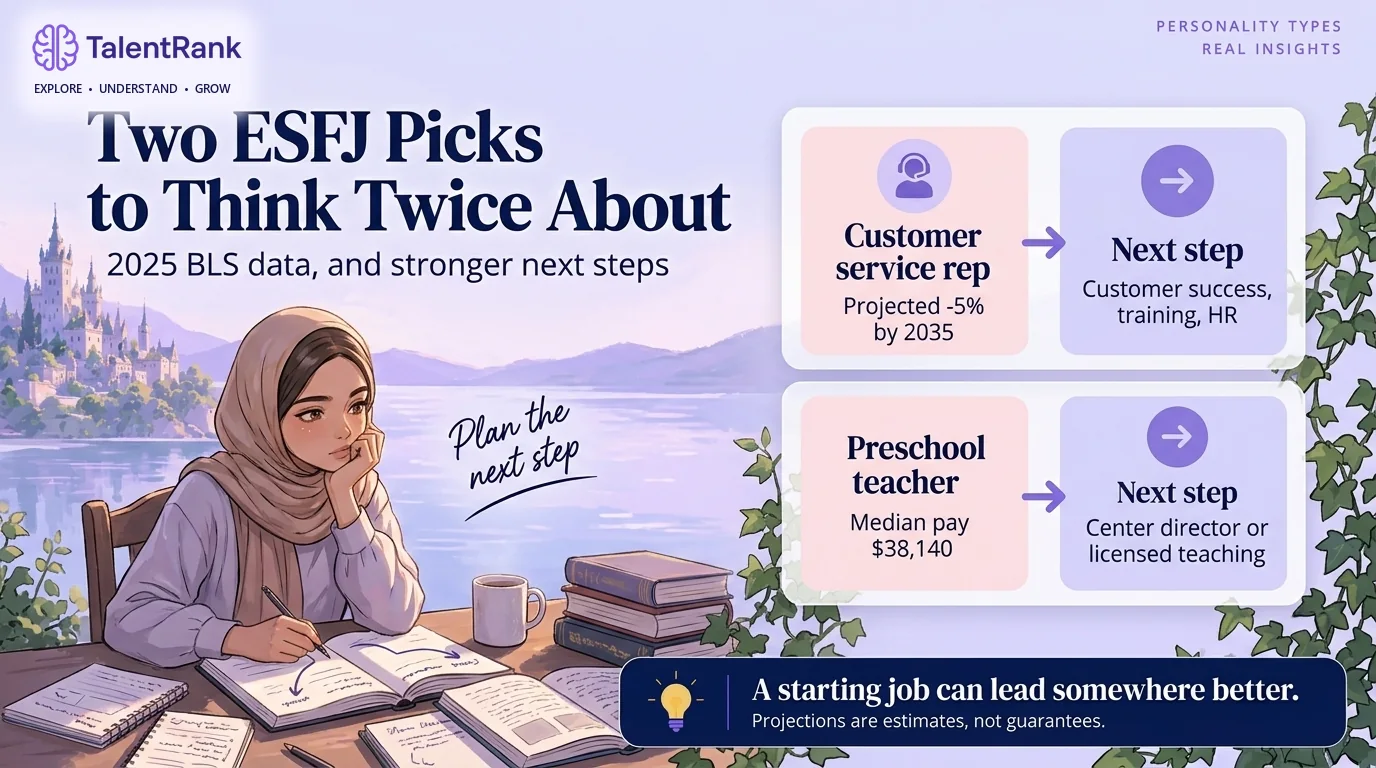
Customer service representatives earned a median of $44,770, and employment is projected to decline 5% as self-service systems and apps take over simple requests.
Preschool teachers do meaningful work, but the 2025 median was $38,140, far below the $63,820 median for elementary school teachers.
That doesn't rule them out. It means planning ahead: customer service can be a stepping stone into customer success, training, or HR, and early childhood educators can move toward center director roles or licensed public school teaching.
ESFJ Jobs That Don't Require a Four-Year Degree
Food service manager: high school diploma plus experience, $69,390 median, 6% growth.
Dental hygienist: associate's degree, $98,100 median.
Registered nurse: associate's degree routes are available.
Licensed practical nurse: about a year of training, $64,400 median.
Dental assistant: certificate, $48,070 median, 7% growth.
Medical assistant: certificate, $45,690 median, 13% growth.
Healthcare licensing varies by state, so check requirements before enrolling.
ESFJ-T and ESFJ-A Jobs
The -A (Assertive) and -T (Turbulent) suffixes come from 16Personalities, not the official MBTI. 16Personalities adds a fifth scale it calls Identity and builds its model on Big Five research. (16Personalities)
There's no separate list of ESFJ-T jobs. The same careers apply. If the Turbulent label fits you, you may take criticism or tension on a team especially hard, which makes workplace culture an important thing to check.
ESFJ Jobs to Avoid (or Conditions to Watch)
"ESFJ jobs to avoid" lists usually name isolated technical work, like lab research or programming, and highly competitive commission sales. That's a generalization. An ESFJ can do well in a technical field, especially in roles that connect people across a team.
What tends to wear ESFJs down is more useful to know:
Long stretches of solo work with little human contact.
Constant conflict or a cold, cutthroat culture.
Unclear expectations that keep changing.
Effort that nobody notices or thanks.
Being asked to treat people unfairly to hit a number.
Hypothetical example: two ESFJs work as HR specialists. One is at a company where managers value her read on how the team is doing. The other is at a company that uses HR mainly to process layoffs and paperwork. Same title, very different fit. Ask how the team actually uses the role before you accept.
How to Choose Among ESFJ Career Options
Pick three careers from this guide.
Read the daily tasks on O*NET OnLine for each one.
Talk to one person in each role about what a hard day looks like.
Volunteer or shadow for a day: at a clinic, a school, an event, or a nonprofit.
Compare training cost and time against the pay and outlook above.
Clarifying your work values can help if you're torn between, say, nursing and HR. The four temperaments offer another lens on how you tend to work with others.
Beyond the ESFJ Label
Two ESFJs can differ a lot in how they handle stress or conflict. Trait measures capture those differences. Agreeableness, for instance, relates to cooperation and trust, and it matters a lot in people-centered jobs. (Our guide to moderate agreeableness explains what a middle score can mean.)
The TalentRank assessment measures your Big Five personality traits and takes about 12 to 15 minutes. It won't confirm an MBTI type or choose a job for you. It can show where you fall on traits like agreeableness, extraversion, and conscientiousness, which are useful to weigh against the options above. Take the TalentRank assessment and use it as one input.
Frequently Asked Questions About ESFJ Jobs
What are the best jobs for an ESFJ?
ESFJs often do well in healthcare, health services management, office and facilities management, HR, teaching, counseling, nonprofit management, fundraising, event planning, and restaurant management. Skills and the specific workplace matter as much as type.
What jobs should ESFJs avoid?
No job is off-limits because of type. It's more useful to avoid conditions that drain ESFJs, like long isolation, cutthroat cultures, shifting expectations, and effort that goes unrecognized.
What ESFJ jobs pay the most?
In this guide, medical and health services managers had the highest 2025 median pay at $123,860, followed by administrative services and facilities managers at $110,500 and dental hygienists at $98,100, according to BLS.
Are ESFJs good managers?
They can be. ESFJs often build loyal, well-organized teams. Management also involves hard conversations, which get easier with practice and support.
Is customer service a good job for an ESFJ?
It can be a good starting point, but BLS projects a 5% decline for customer service representatives. Using it as a step toward customer success, training, or HR is a stronger long-term plan.
Is there a difference between ESFJ-A and ESFJ-T jobs?
No. The A/T suffix comes from 16Personalities, not the official MBTI, and the same careers apply to both.
Final Takeaway
ESFJ careers tend to share a theme: caring for people and keeping things organized so they can do well. Healthcare, workplace management, education, and community work all offer that. Look closely at pay and outlook, since some classic suggestions are shrinking, and choose a workplace where your care for people is part of the job, not an unpaid extra.