

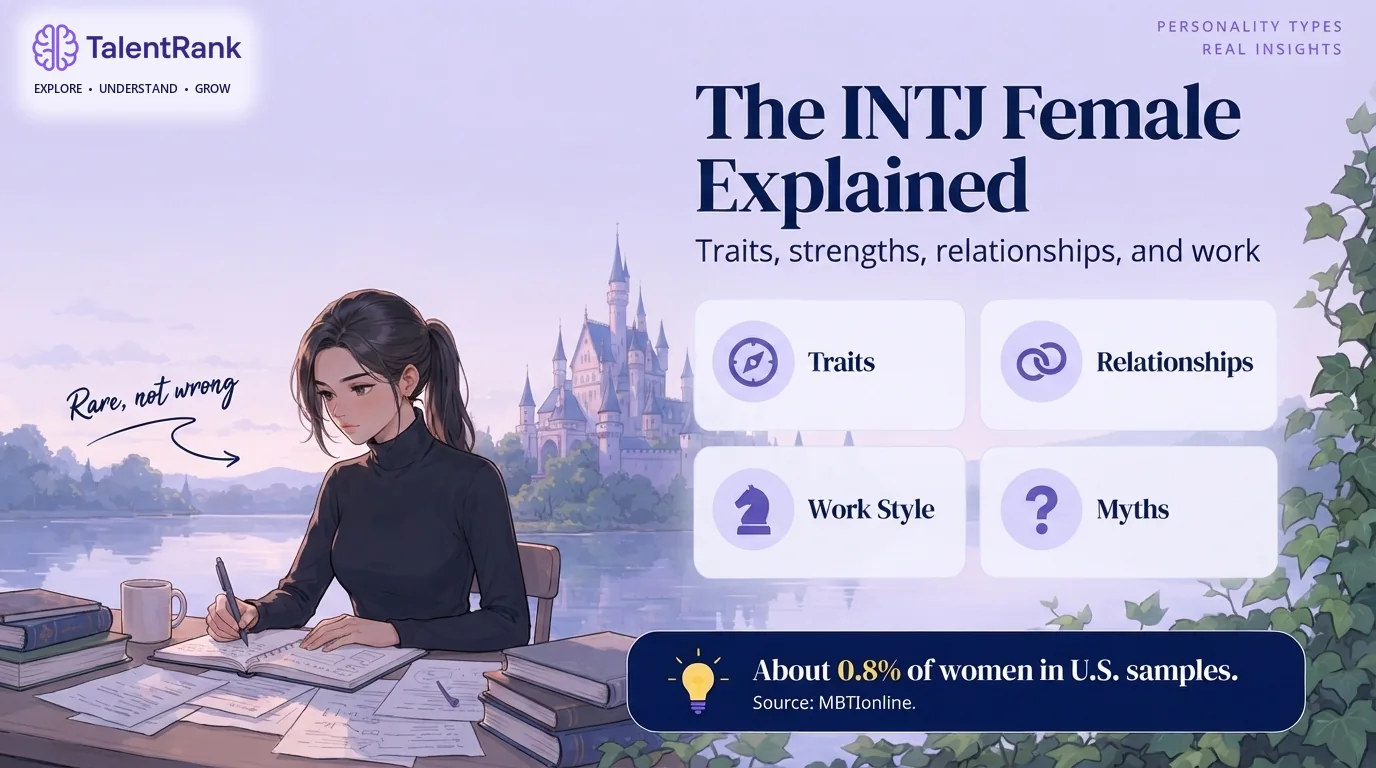
An INTJ female is a woman whose personality preferences match the INTJ pattern: Introversion, Intuition, Thinking, and Judging. In everyday terms, that often means an independent, strategic, and direct woman who plans ahead, values competence, and would rather have one deep conversation than ten polite ones.
It's also one of the least common type-and-gender combinations. According to the official MBTI site, INTJ makes up about 2.1% of the U.S. population, 3.3% of men, and only 0.8% of women, based on U.S. samples from the Center for Applications of Psychological Type, The Myers-Briggs Company, and the Stanford Research Institute. (MBTIonline) That rarity shapes a lot of what INTJ women describe: feeling misunderstood, being called "intimidating," and not seeing many people like themselves.
This guide covers common INTJ female traits, the tradeoffs that come with them, relationships, work, and the misconceptions worth letting go of.
What INTJ Means
The Myers-Briggs Foundation describes INTJs as having "original minds and great drive for implementing their ideas and achieving their goals," and as people who "quickly see patterns in external events and develop long-range explanatory perspectives." (Myers-Briggs Foundation) Nothing in that description is specific to men or women. The type is the same; what differs is often how people react to it. (For the full profile, see our INTJ personality type guide.)
Common INTJ Female Traits and Their Tradeoffs
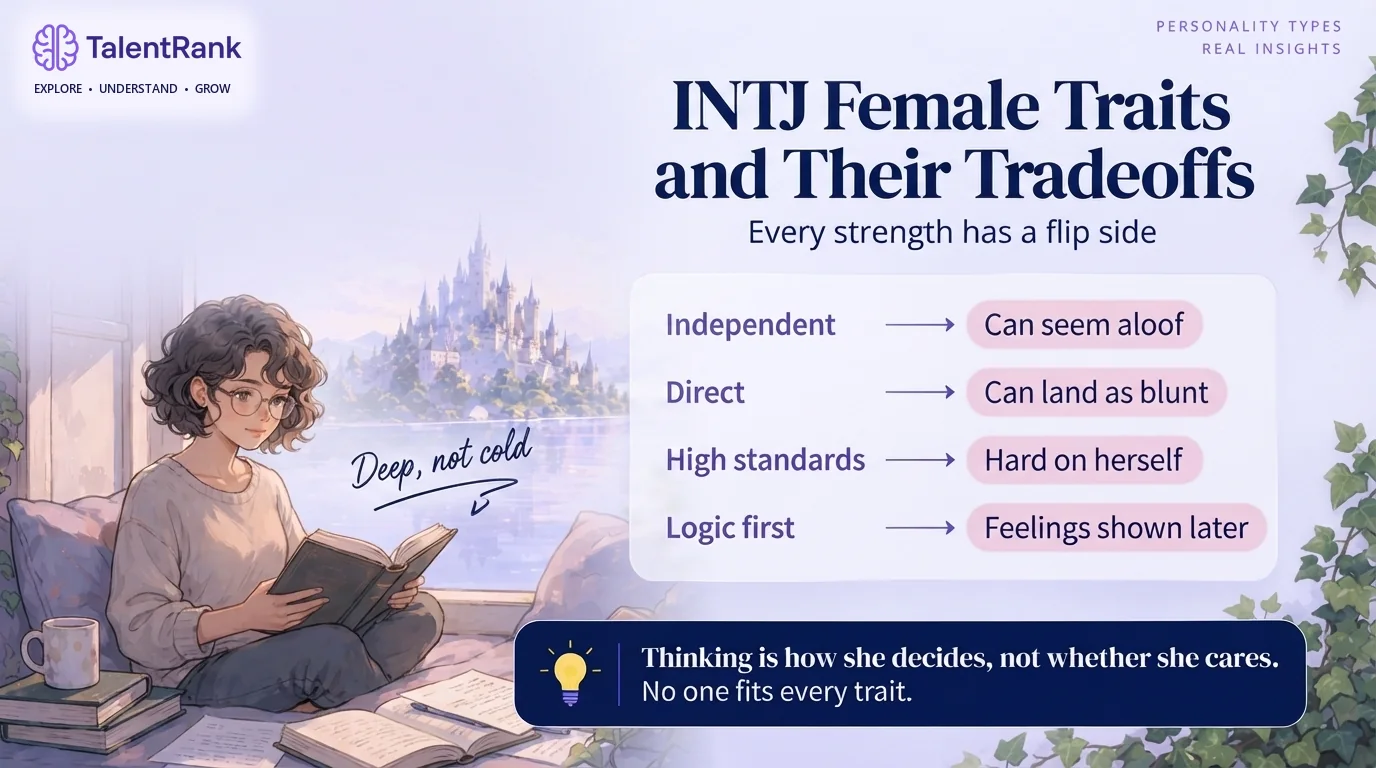
Every strength has a flip side. These patterns come up often in descriptions of INTJ women, though no one fits all of them:
Trait | How it helps | Possible tradeoff |
Independent thinking | Forms her own view instead of following the crowd | Can seem aloof or hard to persuade |
Long-range planning | Sees where things are heading and prepares | May get impatient with short-term thinking |
Directness | Says what she means, saves time | Can land as blunt, especially if others expect softness |
High standards | Produces careful, competent work | May be hard on herself and others |
Selective socializing | Invests deeply in a few relationships | May be seen as cold or uninterested |
Logic-first decisions | Stays calm and fair under pressure | Feelings may be expressed later or in private |
Note the last row. Thinking as a preference doesn't mean an absence of emotion. Many INTJ women feel things deeply; they just don't always lead with it. (Our thinking vs. feeling guide explains the difference.)
Why INTJ Women Often Feel Misunderstood
Rarity is part of it. At less than 1% of women in U.S. samples, many INTJ women grow up rarely meeting anyone who thinks the way they do.
Social expectations are another part. Research on gender stereotypes has found that women who come across as highly confident and competitive can be judged as less likable. In one hiring experiment, Rudman and Glick found that female applicants described as highly agentic were discriminated against for a management job framed as needing interpersonal skills. (Rudman & Glick, 2001) That study wasn't about MBTI types, but the traits it measured, directness and self-assurance, are the same ones often associated with INTJs.
The result is a common experience: an INTJ woman may be praised for competence and criticized for the same behavior in the same meeting.
INTJ Female Strengths
Strategic vision: she often spots long-term problems others miss.
Composure: she tends to stay steady in a crisis.
Honesty: people know where they stand with her.
Self-direction: she's comfortable working and learning on her own.
Loyalty: once she commits to a person or project, she usually stays.
INTJ Women in Relationships
INTJ women tend to be selective about who they let in, and they often show love through actions: solving a problem, planning a future, showing up reliably. Big public displays may matter less to them than consistency and trust.
What tends to help:
A partner who respects independence and alone time.
Honest, direct communication instead of hints.
Intellectual connection and shared long-term goals.
Patience while trust builds. Openness often grows slowly, then runs deep.
What tends to strain things: pressure to be more "bubbly," frequent social obligations, and conflicts that are never talked through logically.
Hypothetical example: an INTJ woman's partner feels she's distant because she rarely says "I love you." Then he notices she's quietly reorganized their finances, researched his health issue, and planned their next year together. Her care was there all along; it was just expressed as action.
INTJ Women at Work
INTJ women often enjoy work that offers complex problems, autonomy, and room to improve systems: strategy, research, engineering, analysis, law, and technology are common examples. (See our guide to INTJ careers, which includes pay and outlook data.)
At work, the biggest friction is often cultural rather than technical. A few things can help:
Look for workplaces that judge people on results, not on how warm they seem.
Explain the reasoning behind decisions; people accept directness more easily when they understand the why.
Find allies who value candor.
Pay attention to how disagreement is handled before accepting a role.
Common Misconceptions About INTJ Women
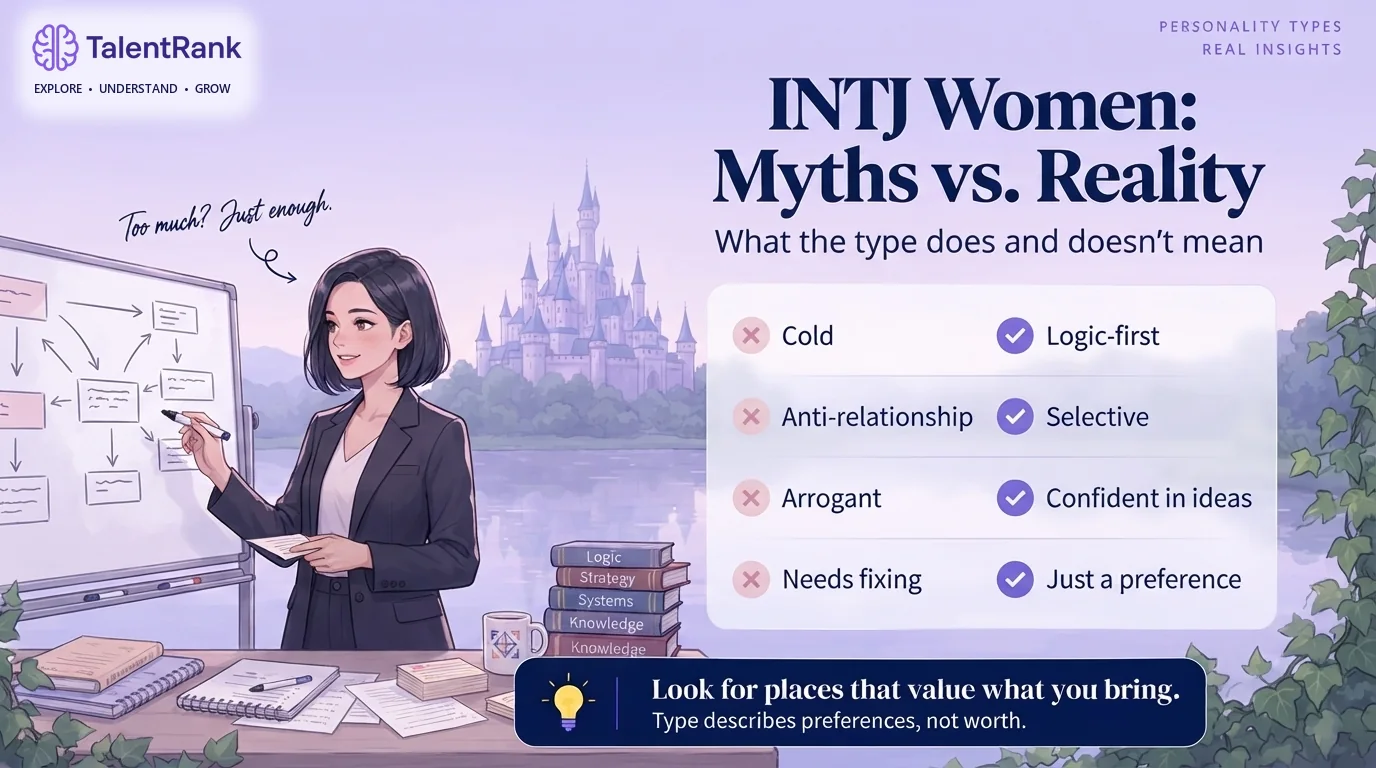
"INTJ women are cold." Thinking describes how decisions are made, not whether someone cares.
"INTJ women don't want relationships." Many do; they're just selective.
"INTJ women are arrogant." Confidence in an idea isn't the same as looking down on people.
"Being an INTJ woman is a problem to fix." The type is a set of preferences, not a flaw.
"All INTJ women are the same." Two INTJ women can differ a lot in warmth, stress level, and interests.
Famous INTJ Women
People often ask which well-known women are typed as INTJ. Personality sites commonly list figures like Jodie Foster and Ayn Rand, though none of those typings is confirmed. Our INTJ celebrities guide shows how many sources list each name and where they disagree.
Beyond the Four Letters
The INTJ label can be a useful mirror, but it's a broad category. Two INTJ women can differ in how outgoing, organized, or emotionally sensitive they are. The Big Five model captures those differences on a spectrum. (Our comparison of the Big Five and MBTI explains how.)
The TalentRank assessment measures your Big Five personality traits and takes about 12 to 15 minutes. It won't confirm an MBTI type, but it can show where you fall on traits like agreeableness, conscientiousness, and openness. Take the TalentRank assessment.
Frequently Asked Questions About INTJ Females
How rare is an INTJ female?
According to MBTIonline, INTJ women make up about 0.8% of women in U.S. samples, compared with 3.3% of men and 2.1% of the population overall.
What are INTJ female traits?
Common descriptions include independent thinking, long-range planning, directness, high standards, selective socializing, and logic-first decisions. No single woman will match all of them.
Are INTJ women emotional?
They can feel deeply. A Thinking preference means decisions tend to be made by logic first, not that emotions are absent.
What do INTJ women look for in a partner?
Often honesty, intellectual connection, respect for independence, and shared long-term goals.
Why are INTJ women called intimidating?
Directness and confidence can clash with social expectations for women. Research on gender stereotypes shows confident, competitive women are sometimes judged more harshly than men with similar traits.
Final Takeaway
INTJ women are rare, independent, and strategic, and they often spend years hearing that they're "too much" or "too cold" for traits that would be praised in someone else. Understanding the type can help explain that experience. Use the label as a starting point, pay attention to your own strengths and tradeoffs, and look for relationships and workplaces that value what you bring.