

You have probably been told that emotional intelligence beats raw intelligence at work. It is one of the most repeated claims in career advice, and it usually arrives with a confident statistic attached. If you are technically strong and watching less technical colleagues move ahead, it can also feel like an accusation.
The honest answer is more useful than the slogan. EQ and IQ measure different things, they matter at different points, and the question of which one wins is badly posed. This guide sets out what each actually covers, where cognitive ability is still the better predictor, how the answer shifts as your role changes, and which parts of the popular argument do not survive a close look.
Key Takeaways
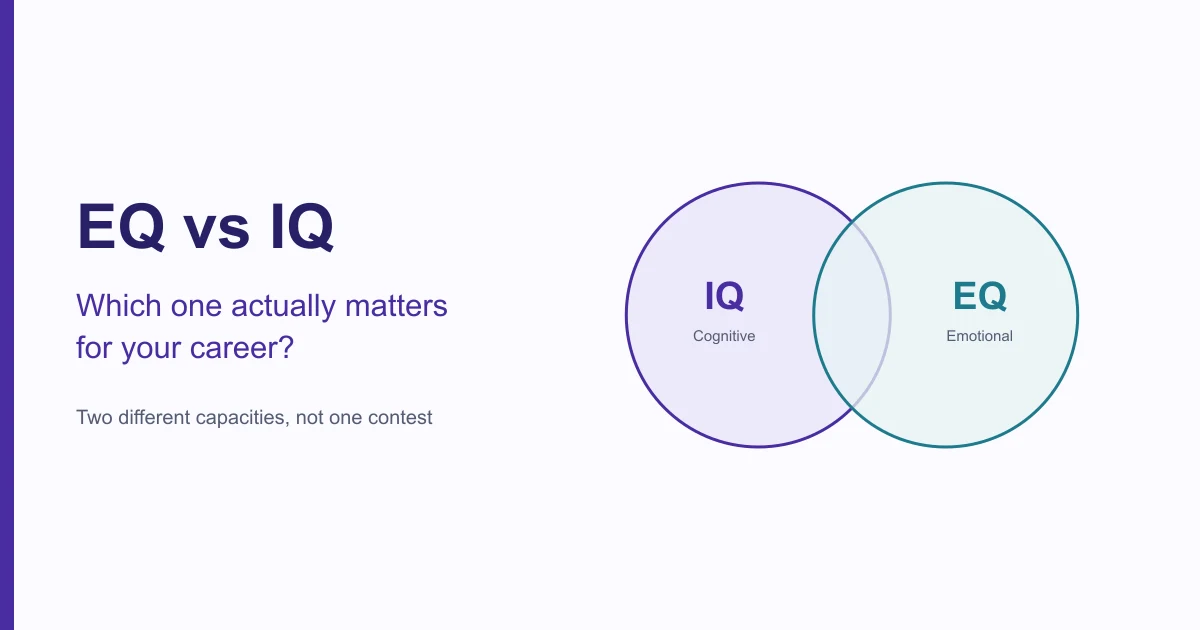
IQ describes cognitive ability. EQ describes how you recognise and handle emotions. They are separate capacities.
Which matters more depends on the role and the career stage, not on a fixed ranking.
Cognitive ability tends to matter most for entering and learning demanding work. Emotional skills matter more once the work is about people.
Emotional skills are generally more trainable than adult cognitive ability.
TalentRank measures cognitive ability and personality. It does not measure emotional intelligence.
What Is IQ?
IQ is a score describing general cognitive ability: reasoning, pattern recognition, working with information and solving unfamiliar problems. It is measured against a standardised population rather than as a raw count of correct answers. If you want the full picture of what an IQ score does and does not capture, read our guide to what IQ actually measures.
What Is EQ?
EQ, or emotional intelligence, describes how well you notice, understand and manage emotions, both your own and other people's. In practice that covers four recognisable behaviours: noticing your own reaction while it is happening rather than afterwards, managing that reaction instead of acting straight from it, reading what the other person is actually feeling rather than what they are saying, and using both to steer the interaction somewhere useful. Most people are stronger at some of these than others.
The academic construct was set out by Salovey and Mayer in 1990 and was defined narrowly, as a set of abilities for perceiving, using, understanding and regulating emotion. The term reached a much wider audience through Daniel Goleman's 1995 book, which framed it far more broadly. That gap between the narrow academic construct and the broad popular version is a large part of why claims about EQ vary so much in quality.
EQ vs IQ: The Core Differences
IQ measures cognitive ability: reasoning, pattern recognition, and problem solving. EQ describes how well you recognise and manage emotions, your own and other people's. IQ is about processing information. EQ is about processing people. They are separate capacities, and a strong score in one predicts very little about the other.
IQ and EQ describe different capacities. A strong score in one says very little about the other.
Dimension | What IQ covers | What EQ covers |
Core question | How well you reason and solve problems | How well you read and manage emotions |
Typical output | A standardised score against a population | A profile across emotional skill areas |
Stability in adults | Relatively stable | More changeable with practice |
Best predicts | Learning speed and handling complexity | Working with, leading and influencing people |
What it does not tell you | How you will behave with colleagues | Whether you can do technically demanding work |
That last row is the one people skip. A high score in either column is silent about the other.
Which One Matters More for Career Success?
It depends on the role and the stage. Cognitive ability tends to matter most for getting into and learning a demanding job. Emotional skills tend to matter more once the work involves leading, persuading or coordinating people. Neither replaces the other, and the honest answer is conditional.
This is less satisfying than a verdict, and it is closer to what people actually experience. Ask anyone who has watched a brilliant analyst struggle as a manager, or a warm and well liked candidate be turned down because they could not do the technical part. Both situations are common. Neither is explained by a ranking.
Where IQ Still Matters More
In work where the difficulty is in the problem rather than the people. Research, engineering, medicine, law and analysis all reward the ability to hold complexity and reason through it. Being well liked does not compensate for missing the technical threshold a role genuinely requires.
Kind of work | What predicts performance more | Why |
Deep technical or analytical work | Cognitive ability | The bottleneck is the problem, not the people |
Regulated or high-precision work | Cognitive ability | Errors are costly and rules are complex |
Client-facing and advisory work | Emotional skills | Trust and interpretation drive the outcome |
Team leadership | Emotional skills | Output comes through other people |
Founding or running a business | Both, at different moments | Judgement and persuasion sit together |
Illustrative example: the strong communicator below the threshold. Imagine someone genuinely excellent with people, being considered for a role that demands a level of technical skill they do not currently have. Their emotional skills are real and will help them enormously once they clear the bar. They do not remove the bar. Framing this as a failure of the hiring process, or as proof that credentials are overrated, misreads what the job requires.
The reason this section exists is that most writing on this topic argues in one direction. If you work in a field where the hard part is the problem, the standard advice can read as though your strengths do not count. They do.
How Does the Answer Change With Career Stage?
Early on, cognitive ability does more of the work, because you are learning fast and proving you can do the job. Later, the job changes shape. Progression starts depending on judgement, influence and how you handle people, which is where emotional skills carry more weight.
Early career
The task is to learn quickly, absorb an unfamiliar domain and demonstrate you can handle the work. That is largely a cognitive load. Emotional skills matter, but mostly for fitting into a team rather than for the core of the job.
Mid career and leadership
At some point the work stops being mainly about your own output. You are coordinating, deciding with incomplete information, persuading people who do not report to you, and absorbing pressure rather than passing it on. The technical foundation still matters, but it is no longer what distinguishes people.
Illustrative example: the capable specialist who stalls. Imagine someone technically strong who progresses quickly for several years, then plateaus. The work has not become harder in the way they are good at. It has become a different kind of work. This is not a deficiency, and it is not a sign they were overrated. It is a change in what the role rewards, and it is usually the first time anyone has told them the rules changed.
How Are EQ and IQ Measured?
Cognitive ability is measured with standardised reasoning tasks under controlled conditions. Emotional intelligence is measured either by self-report questionnaires or by ability-based tests, and the two approaches often disagree. Cognitive measurement is the more settled of the two, which is worth knowing before trusting any single EQ number.
How cognitive ability is measured
Through structured tasks with objectively correct answers: reasoning, sequences, verbal and spatial problems, scored against a reference population. The methodology is long established and its limitations are well documented. Our article on what IQ tests do and do not include covers where those limits sit.
How emotional intelligence is measured
Two broad approaches exist. Ability-based tests ask you to solve emotion-related problems that have better and worse answers. Self-report questionnaires, sometimes called mixed models, ask you to rate your own emotional skills with statements such as agreeing that you understand your emotions well.
That difference matters more than it sounds. Mayer, Salovey and Caruso, writing in American Psychologist, note that self-judgment items draw information that is filtered through the test taker's self-concept, and that respondents may never have received accurate feedback about how well they actually read emotions. In other words, a self-report EQ score partly measures how you see yourself, which is exactly the thing someone with weak emotional awareness is least equipped to judge.
So before you take any EQ number seriously, find out which kind of test produced it. A great deal of what circulates in workplaces comes from self-report instruments.
Can You Improve Either One?
Emotional skills are generally more trainable, because they involve behaviour you can practise: noticing reactions, listening, managing your own responses. Adult cognitive ability is far more stable. You can improve at specific tasks through practice, but that is not the same as raising general reasoning ability.
The difference is easier to see in practice than in theory. Deliberately changing how you respond in one difficult conversation, then doing it again next week, is a behaviour you can rehearse and it shows up in how the next conversation goes. Doing reasoning puzzles every morning, by contrast, mostly makes you better at those puzzles. The gain tends to stay attached to the task you practised rather than transferring to unfamiliar problems.
This asymmetry is the practical reason emotional skills get so much attention in professional development. It is not that they matter more in every situation. It is that they are the part you can most readily change.
What the Evidence Does Not Show
This topic carries some of the most confidently repeated statistics in career writing, and many of them are difficult to trace to a primary source. Rather than pass them along, here is what can and cannot reasonably be claimed.
Common claim | What can be said | What cannot |
"EQ accounts for most of career success" | Emotional skills matter more in people-centred work | No specific share of success can be attributed to EQ from the sources commonly cited |
"Most top performers have high EQ" | Senior roles tend to be people-heavy | The widely quoted percentages are rarely traceable to a primary study |
"Employers prefer EQ over IQ" | Employers value interpersonal skills | Survey figures repeated on this point are frequently reproduced without their original context |
"IQ stops mattering after a threshold" | Roles do have entry requirements, and above them other factors differentiate | Presenting this as a precise measured cutoff overstates it |
"EQ can be raised quickly" | Emotional skills respond to practice | Speed and durability of improvement are not well established |
The people who created the concept said this first. In their American Psychologist review, Mayer, Salovey and Caruso record that their own work never claimed emotional intelligence predicts huge proportions of success, and that they actively criticised those who said it did. They also note that Goleman later wrote that readers who took his 1995 book to mean EI predicts huge proportions of success had misunderstood it. The inflated version of the claim was never the research position. |
This article therefore contains no percentage claims about EQ or IQ. Every figure in wide circulation on this topic was checked against a primary source, and those that could not be traced were left out rather than softened. A number with no source is worse than no number.
How to Use Both in a Real Career Decision
Identify where the difficulty actually is in your work. Is the hard part the problem, or the people?
Be honest about the threshold. If a role has a genuine technical bar, no amount of interpersonal skill removes it.
Look at where you are stalling, not where you are strong. Progression problems usually sit at the boundary of your weaker capacity.
Pick the one you can move. Emotional skills are the more changeable of the two, so effort there generally returns more.
Get a measure rather than a guess for the cognitive side. Self-assessment is least reliable exactly where people most want reassurance.
What TalentRank Measures and What It Does Not
This article is written from experience building and interpreting cognitive and personality assessments. It is not written from experience administering emotional intelligence instruments.
TalentRank does not measure emotional intelligence and does not offer an EQ test. What it measures is cognitive ability, through a brief reasoning-based estimate, and Big Five personality. Those cover one side of this comparison honestly and say nothing about the other. If understanding your cognitive side is the part you want to stop guessing about, you can explore the TalentRank assessment.
Frequently Asked Questions
Can you have a high IQ and a low EQ?
Yes, and it is common enough to be unremarkable. The two describe different capacities, so a strong score in one says very little about the other. Someone can reason through difficult problems easily and still misread a room. Neither pattern is a character judgement.
Do IQ tests measure emotional intelligence?
No. IQ tests measure reasoning, pattern recognition and problem solving under standardised conditions. They contain nothing that assesses how you read or manage emotions. A cognitive score tells you about one capacity and is silent about the other.
Do employers test for EQ?
Some organisations use emotional intelligence questionnaires in development and coaching, more often than in hiring decisions. Where they appear in selection, they are usually one input among several. A score of this kind should not be used on its own to screen or reject candidates.
Is EQ a personality trait?
It depends which kind of test you mean. Mayer, Salovey and Caruso report that ability-based emotional intelligence correlates only weakly with Big Five traits, while self-report EQ questionnaires correlate strongly with them, in some cases above .5. Ability-based EQ looks distinct from personality. Self-report EQ overlaps heavily.
Sources
Two Different Questions, Not One Contest
The framing that pits emotional intelligence against cognitive ability makes for a satisfying headline and a poor guide to a career. IQ and EQ answer different questions: one is about how well you handle problems, the other about how well you handle people, and almost every job needs some of both in a mix that changes as you move through it. The useful move is not to decide which one wins, but to work out which one is currently limiting you, and then to be honest about whether it is the one you can change.