

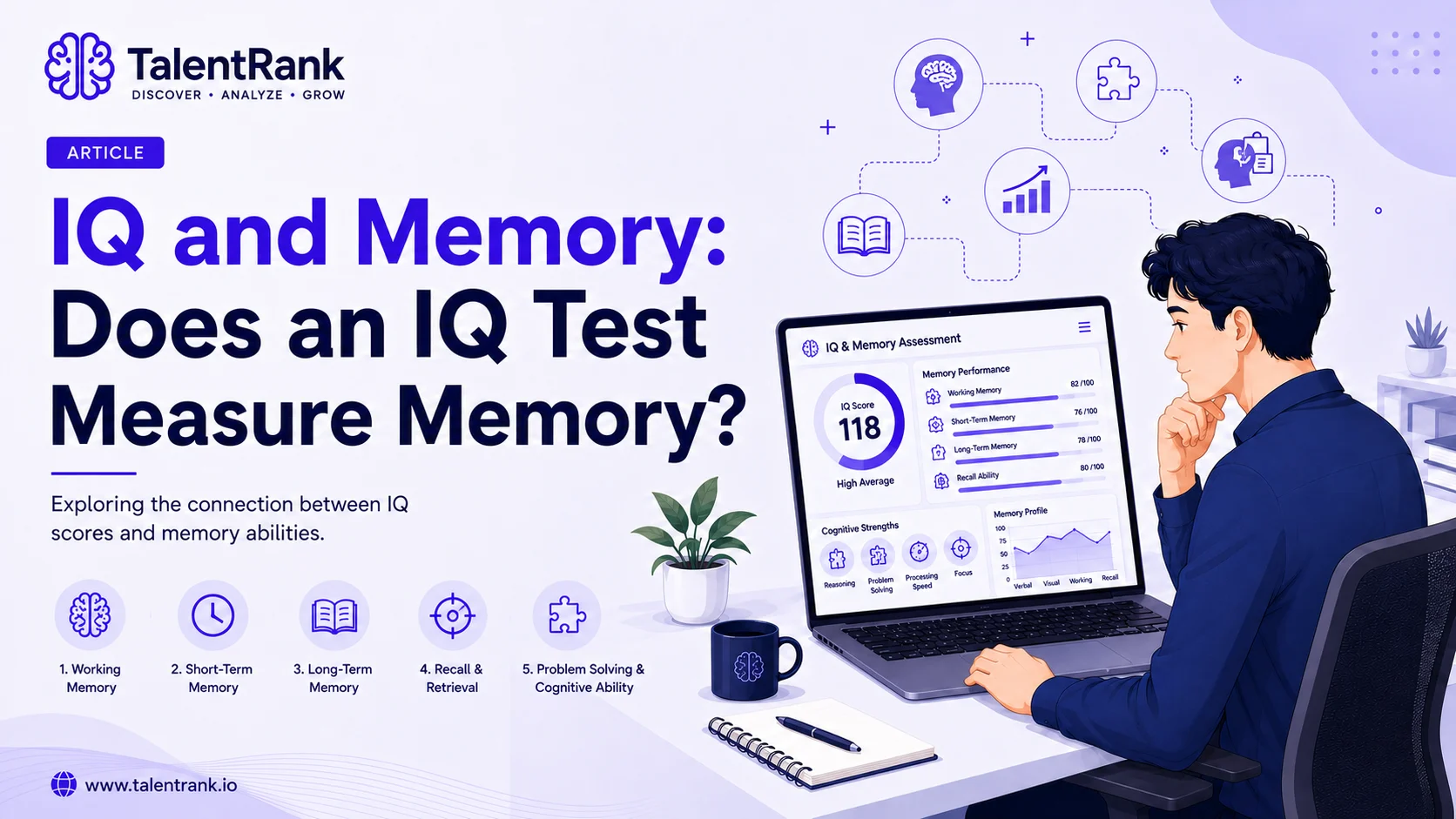
You can solve a difficult problem quickly and still forget the name of someone you met five minutes ago. That can feel contradictory, especially if you have taken an IQ test or received a cognitive ability score. It is natural to wonder whether a strong memory signals high intelligence, or whether everyday forgetfulness says something worrying about your IQ.
The useful answer is more precise than either assumption. IQ and memory overlap, but memory is not one single skill and an IQ score is not a complete memory score. Different tests measure different combinations of abilities. Understanding those differences makes a cognitive result more useful and stops one frustrating lapse from becoming a verdict about your intelligence.
Key Takeaways
Some comprehensive IQ batteries include working-memory tasks, but not every IQ-style test has a separate memory index.
Working memory supports reasoning, yet IQ and memory are not interchangeable.
Everyday forgetfulness does not reveal a person's overall intelligence.
Improving a practised memory task does not reliably prove that general intelligence increased.
TalentRank's ICAR16 result is a brief cognitive estimate, not a clinical IQ or memory assessment.
Does an IQ Test Measure Memory?
Some IQ tests include tasks that use working memory, such as holding and rearranging information for a few seconds. However, IQ is not simply a memory score. Comprehensive batteries combine several abilities, while brief online cognitive tests may focus on reasoning, patterns, verbal skills, or spatial thinking without a separate memory index.
The exact answer depends on the test. A comprehensive assessment may report several index scores alongside an overall score. Pearson's current WAIS-5 materials, for example, describe working memory as one of its primary index scales and list dedicated working-memory tasks. That structure belongs to the WAIS-5. It should not be treated as a template for every test that uses the term IQ or cognitive ability.
A shorter cognitive measure can have a different purpose. It may estimate reasoning ability through patterns, sequences, verbal problems, or spatial tasks without trying to measure memory as a separate clinical domain. Before interpreting any result, check the test's documentation rather than assuming that all IQ-style assessments measure the same things.
IQ and Memory Are Related, but They Are Not the Same
IQ and memory are related because solving a problem often requires you to keep relevant information available. They are not identical because memory also includes storing knowledge, recalling personal events, and retrieving details after different lengths of time. A person can be strong in one part of this system and less consistent in another.
Research supports a relationship without making the two constructs interchangeable. A 1997 study indexed by PubMed examined 64 adults and found that WAIS-R performance explained part, but not all, of the differences in later memory-test performance. The sample was small, the instruments were older versions, and the result cannot tell us one person's intelligence from one memory complaint. It is useful as evidence of overlap, not identity.
What the evidence does not prove: Group-level relationships between cognitive measures cannot reveal one person's IQ from a missed appointment, weak name recall, or one difficult memory task. The test design, sample, context, and quality of each measure all matter.
Why a Strong Memory Can Help With Reasoning
Reasoning becomes easier when you can keep several pieces of information active at once. Imagine comparing four project options while tracking cost, time, risk, and expected value. Losing one condition forces you to restart. Keeping the conditions available makes it easier to compare them and reach a sound conclusion.
Why Forgetfulness Does Not Automatically Mean Low IQ
Everyday recall depends on more than intellectual ability. You first have to notice information, encode it, store it, and retrieve it when needed. If your attention was elsewhere during an introduction, there may be very little name information available to retrieve later. That failure does not necessarily reflect your ability to solve a novel problem.
Is Working Memory the Same as IQ?
Working memory and IQ are related, but they are not the same ability. Working memory helps you keep information active while solving a problem, while IQ scores usually summarize performance across several cognitive tasks. Strong working memory can support reasoning, but it does not fully determine intelligence or everyday recall.
Psychologists often distinguish working memory from simple short-term storage. Short-term memory lets you hold information briefly. Working memory adds active use. Remembering a number for a few seconds is mostly storage. Holding the number, reversing it, and using it in a calculation requires manipulation as well.
The table below is a practical simplification, not a complete scientific taxonomy. Its purpose is to show why the everyday word memory can refer to several different processes.
Memory type | Plain-English function | Everyday example | Relationship to IQ-style testing |
Working memory | Holds and uses information briefly | Following several mental instructions in order | Directly tested in some comprehensive batteries |
Short-term memory | Briefly stores information | Holding a number long enough to write it | May support a task but is not identical to working memory |
Long-term memory | Stores knowledge and experience | Remembering facts learned earlier | Can support learned-knowledge tasks, depending on the test |
Everyday or autobiographical memory | Recalls personal events and routine details | Remembering a name, appointment, or conversation | Not equivalent to a general IQ score |
Working memory can support some IQ-style tasks, but IQ and memory are not the same construct.
How Different IQ Tests Use Memory Tasks
IQ tests do not use memory tasks in one universal way. Their purpose, theory, length, and scoring model determine which abilities appear in the final profile. A comprehensive clinical battery may include dedicated memory tasks, while a brief cognitive measure may concentrate on reasoning and produce no separate memory index.
Examples of Tasks That Use Working Memory
A working-memory task might ask someone to hold a short sequence and reorganize it according to a rule. Another task might require mental calculation while keeping intermediate information active. These examples describe general task demands only. They are not protected items from a particular assessment.
Why One Composite Score Can Hide Different Strengths
A composite score combines information. That makes a result easier to summarize, but the summary can hide uneven performance. Two people can receive similar overall scores even if one performs better on verbal tasks and the other performs better on visual or reasoning tasks.
Can You Have a High IQ and a Poor Memory?
Yes, someone can reason very well and still forget names, appointments, or personal details. IQ-style tasks and everyday memory place different demands on attention, storage, retrieval, and context. One frustrating memory weakness does not reveal a person's overall intelligence, and one strong IQ score does not guarantee perfect recall.
Illustrative Example: Strong Pattern Recognition, Weak Name Recall
Imagine a professional who quickly identifies patterns in unfamiliar data and solves new problems with little guidance. At networking events, the same person regularly forgets names soon after introductions. This illustration does not describe a client or clinical case. It shows that novel reasoning and everyday name recall depend on overlapping but different processes.
Illustrative Example: Strong Factual Recall, Average Novel Reasoning
Now imagine a learner who remembers detailed facts, procedures, and dates with little effort. When faced with a completely unfamiliar abstract problem, the learner needs more time to discover the rule. Strong stored knowledge is valuable, but it does not automatically produce exceptional fluid reasoning. Neither profile is better in every situation.
Does Improving Memory Increase IQ?
Improving performance on a practised memory task does not necessarily increase general intelligence. Meta-analyses often find near-transfer gains, meaning people improve on trained or similar tasks, while stronger evidence for far transfer to IQ and real-world abilities is limited. Claims that one memory exercise can reliably raise IQ should be treated cautiously.
Near transfer means improvement on the trained task or something similar. Far transfer would mean broader improvement in abilities such as general reasoning, reading, academic performance, or everyday problem-solving.
A 2016 meta-analytic review by Melby-Lervåg, Redick, and Hulme examined 87 publications with 145 experimental comparisons. It found short-term improvement on trained or related working-memory measures, but no convincing far-transfer improvement when stronger treated-control comparisons were considered. A 2020 meta-analysis of typically developing children similarly reported that far-transfer measures of cognitive ability and academic achievement were essentially unaffected under stronger controls.
Individual studies do not all produce identical results. Practice can improve a task and help develop strategies, but better performance on a memory exercise is not reliable proof that general intelligence has increased.
Do All IQ Tests Include a Memory Section?
No. IQ tests differ in purpose, length, theory, and design. Comprehensive clinical batteries may include dedicated working-memory subtests, while brief cognitive measures may emphasize reasoning, patterns, verbal ability, or spatial thinking. Readers should check the specific test's documentation instead of assuming that every IQ score includes the same memory components.
For a closer look at logic, pattern, verbal, numerical, spatial, memory, and attention formats, read TalentRank's guide to the different kinds of questions used on IQ tests.
What TalentRank's Cognitive Assessment Does and Does Not Measure
TalentRank describes its cognitive result as an estimate based on the ICAR16 reasoning battery. The current product interface also states that the estimated range is a brief screening measure, not a clinical IQ test. That boundary is especially important for an article about memory.
TalentRank should not be used to diagnose a memory disorder, learning disability, neurological condition, or another clinical issue. The result should not be described as a clinical memory index. Its value is in adding a brief view of cognitive reasoning to a broader profile that also considers personality and career context.
If you need an assessment for medical diagnosis, educational placement, disability documentation, or a legal decision, work with a qualified professional who can select and interpret an appropriate standardized battery. A brief online estimate cannot replace that process.
If the non-clinical boundaries above match what you need, you can explore the TalentRank assessment after reviewing what the result can and cannot show.
How to Interpret an IQ or Cognitive Score Without Overreading It
Treat a cognitive score as one structured sample of performance, not a complete portrait. Start by identifying the exact test, its purpose, and the domains documented by its publisher. Then look for profile differences before relying on the overall number alone.
Before drawing a conclusion:
Identify the exact assessment and its documented domains.
Separate the overall score from any available subtest or profile differences.
Consider the testing conditions without turning them into excuses or diagnoses.
Use the result alongside personality, interests, values, experience, and environment.
Seek a qualified professional when the purpose is clinical, legal, or educational diagnosis.
A cognitive result does not prove that your everyday memory is good or bad in every setting. It cannot guarantee career success, establish a fixed career ceiling, or show that memory practice will reliably raise general intelligence.
For a broader explanation of the abilities these scores can represent, read TalentRank's guide to what IQ measures. For the broader career context, see how personality and IQ work together. The more useful career question is rarely "What does this one number allow me to do?" It is "How do my abilities, personality, interests, values, experience, and environment work together?"
Frequently Asked Questions
No. Working memory helps you hold and manipulate information for a short time. IQ scores usually combine performance across several cognitive tasks. Working memory can support reasoning and may be measured in some batteries, but it does not independently represent a person's full intelligence or everyday memory.
Does a photographic memory mean a high IQ?
Exceptional recall does not establish a person's general IQ. Remembering visual details and solving unfamiliar reasoning problems are different abilities, even when they can support each other. The popular idea of a perfect photographic memory is also broader and less precise than the memory constructs used in cognitive research.
Can stress affect memory during an IQ test?
Stress can consume attention and make it harder to hold or retrieve information during a demanding task. That can influence performance on a particular day, but it does not explain every result and should not be used for self-diagnosis. A qualified examiner can consider testing conditions when formal interpretation matters.
No. Comprehensive batteries may report a dedicated working-memory index, while brief cognitive measures may focus on reasoning, verbal, numerical, or spatial tasks. Check the test publisher's documentation to learn what a particular score includes instead of assuming that every IQ-style assessment uses the same structure.
Sources
The Useful Takeaway: Treat Memory and IQ as Related Clues
IQ and memory are best understood as related clues rather than interchangeable labels. Some cognitive tests directly assess working memory, while others emphasize different reasoning abilities, and neither type captures every way you learn, remember, decide, or perform at work. Use the exact test documentation, respect the limits of one score, and combine cognitive information with personality, interests, values, experience, and context before making an important conclusion about yourself.