

An IQ test includes questions designed to measure specific cognitive abilities such as reasoning, pattern recognition, verbal understanding, numerical thinking, spatial awareness, and memory. Instead of testing only what you know, IQ questions usually focus on how you analyze information, recognize relationships, and solve unfamiliar problems.
Understanding what kind of questions are on an IQ test can help you know what to expect before taking an assessment. While IQ tests focus on cognitive abilities, personality assessments such as MBTI and Big Five explore different areas, including preferences, traits, and behavioral patterns. Ready to see your own results? Take a Talent Rank assessment to explore your cognitive strengths and personality profile.
What Does an IQ Test Measure?
An IQ test measures specific cognitive skills related to reasoning, problem-solving, and information processing. Different assessments may use different formats, but most evaluate how people identify patterns, understand relationships, and approach new challenges. For a deeper look at what IQ measures and what your score does and does not predict, see our honest guide.
- Logical reasoning
- Pattern recognition
- Verbal reasoning
- Numerical reasoning
- Spatial reasoning
- Memory and attention
IQ tests commonly include questions involving logic, numbers, words, patterns, and visual relationships. The exact format depends on the assessment, but most questions are designed to evaluate reasoning skills rather than memorized information.
| Question Type | What It Measures | Example |
|---|---|---|
| Logical reasoning | Problem solving and analysis | Finding the correct conclusion |
| Pattern recognition | Identifying relationships | Completing sequences |
| Numerical reasoning | Number relationships | Solving number patterns |
| Verbal reasoning | Understanding concepts and language | Word analogies |
| Spatial reasoning | Visual thinking ability | Shape rotation |
1. Logical Reasoning Questions
Logical reasoning questions test how well you analyze information and draw conclusions from available evidence.
Example: If all roses are flowers and some flowers fade quickly, can we conclude all roses fade quickly?
Answer: No.
The information does not prove that every rose fades quickly. The question tests whether you can avoid making assumptions beyond the available information.
2. Pattern Recognition Questions
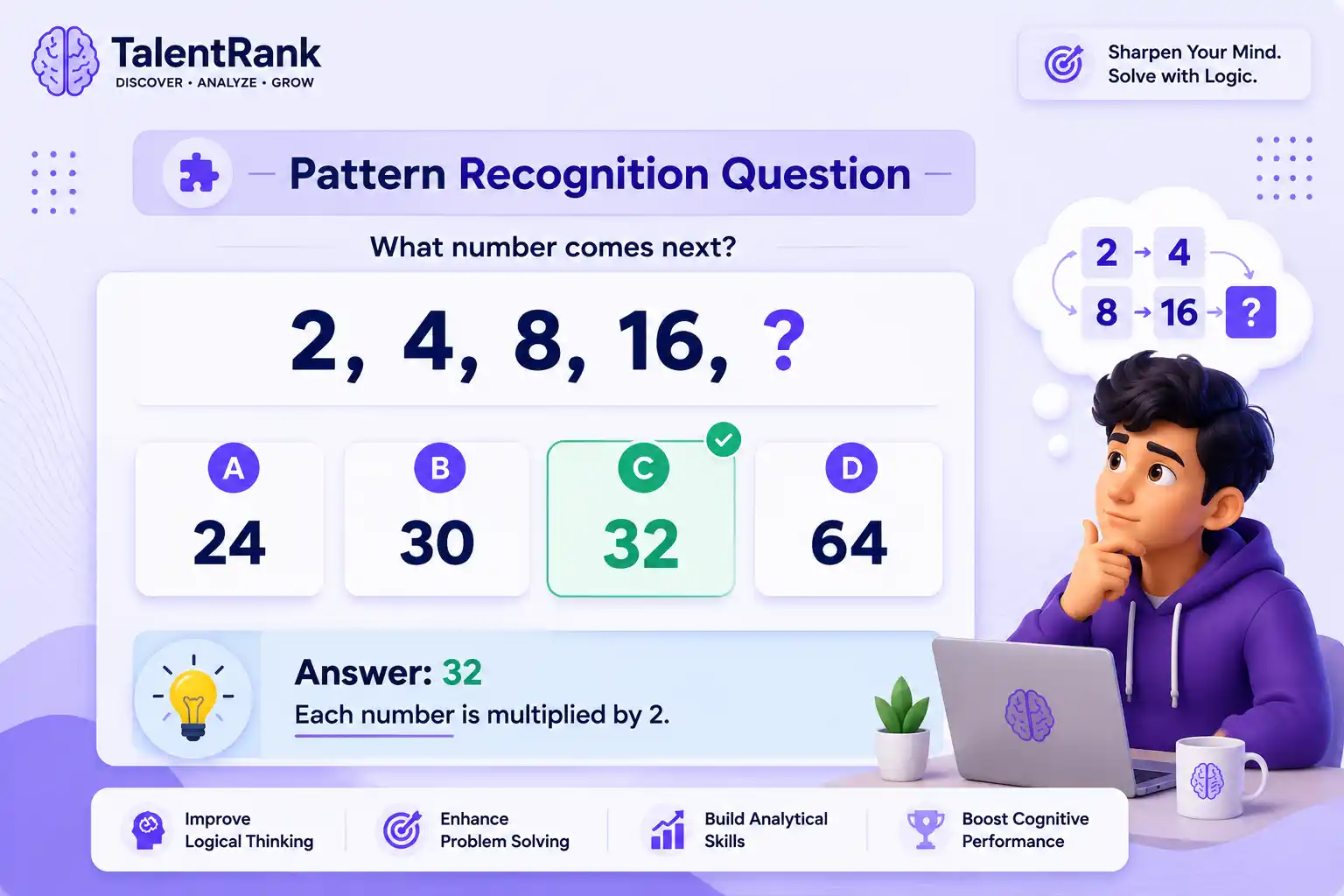
Pattern recognition is one of the most common IQ test question types. These questions measure your ability to identify rules and relationships.
Example: 2, 4, 8, 16, ?
Answer: 32
Each number doubles, following the same pattern.
3. Numerical Reasoning Questions
Numerical reasoning questions focus on understanding relationships between numbers rather than advanced mathematics.
- Number sequences
- Mathematical patterns
- Number comparisons
- Basic calculations
4. Verbal Reasoning Questions
Verbal reasoning questions test your ability to understand relationships between words and concepts.
Bird is to Fly as Fish is to ?
Answer: Swim
This type of question measures whether you can recognize relationships and apply them to new examples.
5. Spatial Reasoning Questions
Spatial reasoning questions evaluate how well you understand visual information, shapes, and object relationships.
- Rotating objects mentally
- Matching shapes from different angles
- Finding missing visual elements
6. Memory and Attention Questions
Some IQ assessments include tasks related to memory and attention. These may involve remembering sequences, recognizing information, or following multi-step patterns.
IQ Test Examples: What Questions Might You See?
| Question Type | Example | Skill Tested |
|---|---|---|
| Number sequence | 5, 10, 20, 40, ? | Pattern recognition |
| Analogy | Hand is to Glove as Foot is to ? | Verbal reasoning |
| Logic | Identify the correct conclusion | Analytical thinking |
How Do Online IQ Tests Work?
Online IQ tests usually present a series of questions designed to evaluate specific cognitive skills. The format, scoring method, and difficulty level can vary depending on the assessment provider and purpose of the test.
A quality assessment should clearly explain what it measures and how results should be interpreted.
Are IQ Tests the Same as Personality Tests?
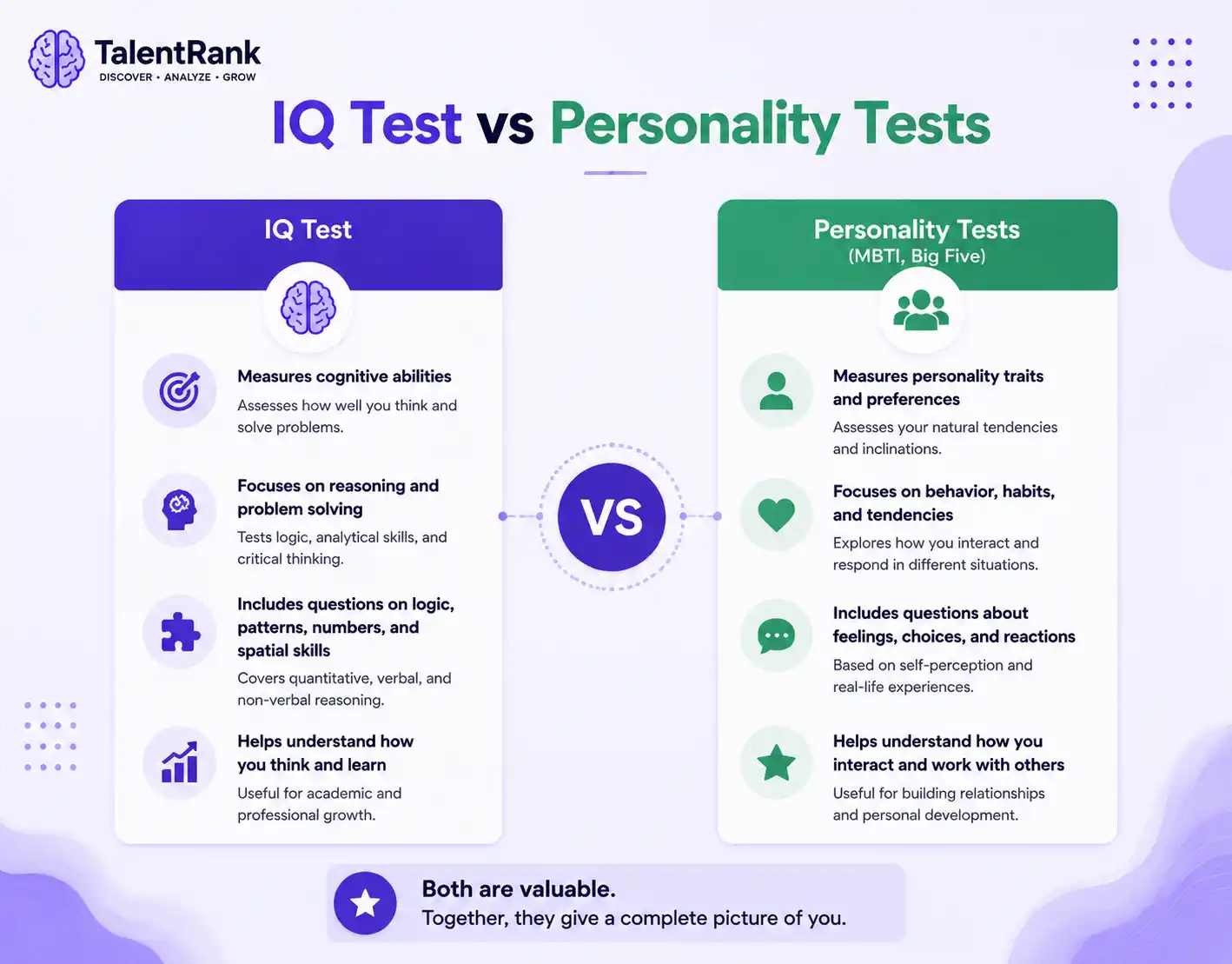
No. IQ tests and personality tests measure different aspects of a person. IQ tests focus on cognitive abilities, while personality assessments explore traits, preferences, and behavioral tendencies.
| Assessment | Measures |
|---|---|
| IQ Test | Reasoning and cognitive abilities |
| MBTI Test | Personality preferences |
| Big Five Test | Broad personality traits |
If you want to understand how the personality side compares, read our guide to Big Five vs MBTI personality frameworks.
How Can You Prepare for an IQ Test?
- Practice common reasoning formats
- Improve concentration
- Read instructions carefully
- Manage your time effectively
- Become familiar with different question types
IQ Test Questions: Common Questions
What are the most common IQ test questions?
The most common IQ test questions include logical reasoning, number sequences, pattern recognition, verbal analogies, and spatial reasoning tasks.
Are IQ test questions multiple choice?
Many IQ tests use multiple-choice formats, although the exact format depends on the assessment design.
Can IQ test questions be practiced?
Practicing question formats can help you understand the style of questions, but it does not guarantee a specific score.
What is the difference between an IQ test and a personality test?
IQ tests measure cognitive abilities, while personality tests measure traits, preferences, and behavioral patterns.
Conclusion
IQ tests usually include questions that measure reasoning, patterns, language, numbers, and visual thinking. Learning about these question types can help you understand how cognitive assessments work and what skills they evaluate. Talent Rank assessment tools can help you explore your cognitive strengths and personality characteristics through structured assessments.
Curious how you would do? Take the free Talent Rank assessment and see your cognitive and personality profile in one report.