

A person can have strong cognitive ability and weaker emotional skills at the same time. But having a high IQ does not automatically mean someone has low emotional intelligence. IQ, emotional intelligence, and personality describe different aspects of how people think, respond, and behave.
The phrase “high IQ, low EQ” is often used for someone who handles difficult analytical problems well but struggles with feedback, emotional cues, conflict, or communication. It can be useful shorthand, but it should not become a diagnosis. Introversion, autism, social anxiety, bluntness, or being quiet do not by themselves prove that someone has low emotional intelligence.
Can you have high IQ and low EQ?
Yes. Strong cognitive ability and weaker emotional skills can exist in the same person because IQ and emotional intelligence describe different characteristics. However, high IQ does not automatically cause low EQ, and social awkwardness or a reserved personality alone cannot tell you someone's level of emotional intelligence.
What Does “High IQ, Low EQ” Actually Mean?
High IQ and low EQ usually describes a person who shows strong reasoning or problem-solving ability while experiencing more difficulty with certain emotional or interpersonal skills.
High IQ
IQ is commonly used to describe performance on measures of cognitive abilities such as reasoning, learning, problem solving, spatial thinking, and working with information.
Emotional Intelligence
Emotional intelligence is a broad term covering abilities or self-perceived tendencies related to recognizing, understanding, using, and managing emotional information. Researchers do not all measure it in exactly the same way.
Personality
Personality describes relatively stable tendencies in how someone typically thinks, feels, and behaves. It is separate from both cognitive ability and emotional intelligence, although the concepts can sometimes overlap in how they appear in everyday life.
If you want a broader comparison, read TalentRank's guide to EQ vs IQ.
High IQ and Low EQ Are Not Opposite Ends of One Scale
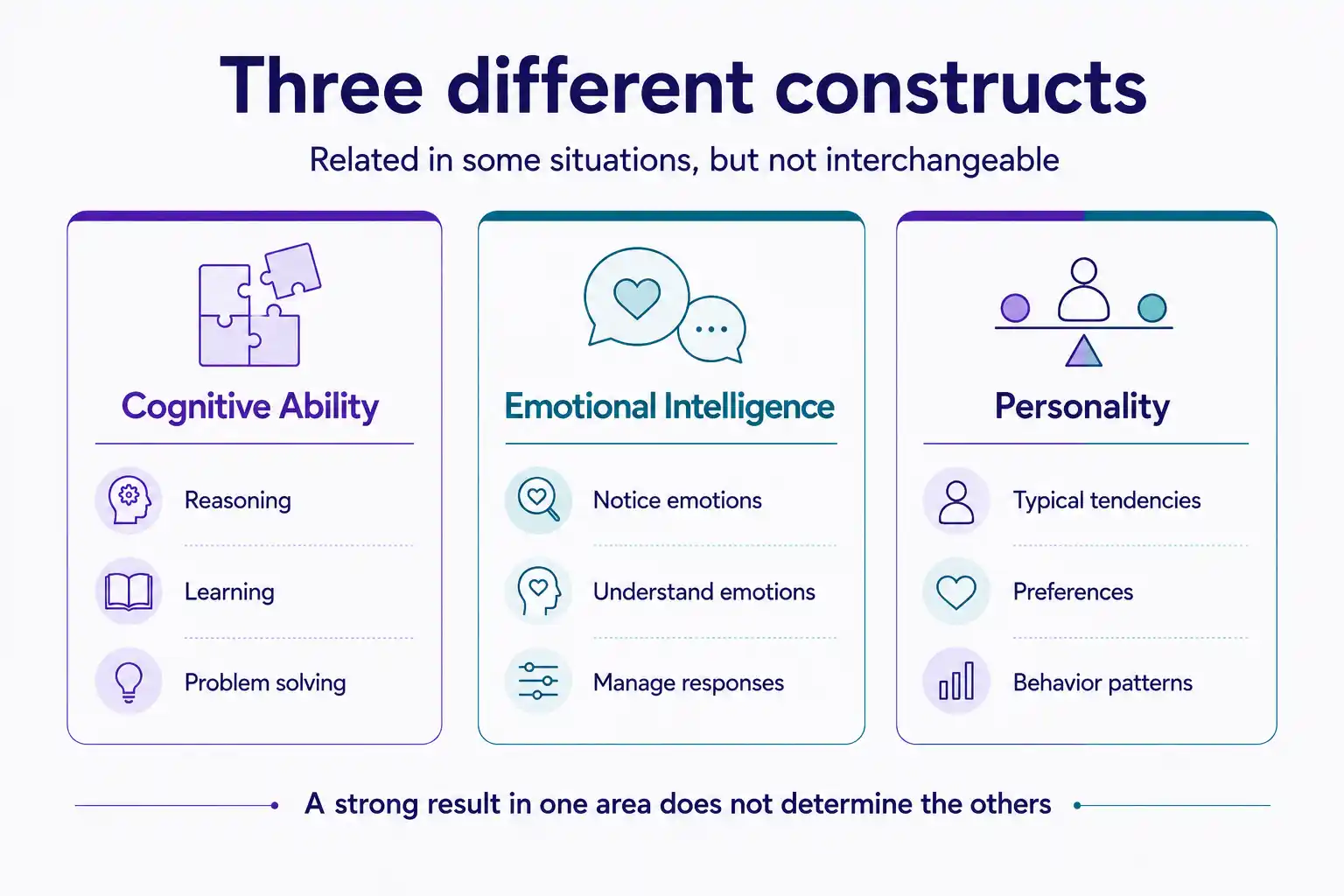
Cognitive ability, emotional intelligence and personality answer different questions and should not be treated as one scale.
It is tempting to imagine IQ and EQ as opposites, where having more of one means having less of the other. Research does not support such a simple relationship.
A 2023 study by Luke Treglown and Adrian Furnham examined more than 6,000 adults using measures of cognitive ability and trait emotional intelligence. The reported relationships were very small, with correlations generally around -.07 to -.12. These results suggest that cognitive ability and trait emotional intelligence should not be treated as simple opposites.
Treglown and Furnham research on IQ and trait emotional intelligence
Research note:
A small correlation does not establish a meaningful cause-and-effect relationship. This study does not show that becoming more intelligent lowers emotional intelligence.
TalentRank Does Not Measure Emotional Intelligence
TalentRank assesses cognitive ability and Big Five personality. It does not provide an emotional intelligence or EQ test. A TalentRank result should not be used to decide whether someone has high or low EQ.
Does a Higher IQ Mean a Lower EQ?
No. Current evidence does not support a general rule that higher IQ means lower emotional intelligence. A person's cognitive ability score does not reliably tell you how empathetic, emotionally self-aware, socially effective, or skilled at conflict management that person will be.
What the Research Actually Shows
In the Treglown and Furnham study, participants completed a multidimensional cognitive ability assessment and a trait emotional intelligence questionnaire. Most relationships between the measures were small.
Some individual dimensions were associated with one another, but the overall findings do not support the popular idea that highly intelligent people are generally emotionally weak.
The reverse is also true. Strong emotional skills do not tell you someone's IQ.
Trait EQ and Ability-Based Emotional Intelligence Are Different Approaches
Another reason to avoid oversimplification is that emotional intelligence is measured in different ways.
Ability-based approaches use performance tasks designed to assess how people work with emotional information. Self-report or trait approaches ask people about their own emotional tendencies and typical behavior. Mixed models can combine emotional skills with personality-like characteristics and other self-perceptions.
A 2022 meta-analysis of emotional intelligence and workplace outcomes analyzed ability EI, self-report EI, and mixed EI separately, highlighting the importance of distinguishing between these measurement approaches.
Meta-analysis of emotional intelligence and employee outcomes
Research on mixed emotional intelligence has also raised questions about overlap with personality, cognitive ability, self-efficacy, and related characteristics. This is another reason not to treat every EQ score as though it measures exactly the same thing.
Research on mixed emotional intelligence and job performance
Myth vs Reality: High IQ and Low EQ
Myth | More Accurate View |
|---|---|
Higher IQ means lower EQ | High cognitive ability does not automatically imply low emotional intelligence. |
IQ and EQ are opposites | They describe different characteristics and are measured differently. |
Social awkwardness proves low EQ | Social skill and emotional intelligence are not the same thing. |
Introverts usually have low EQ | Introversion is a personality tendency, not an emotional intelligence diagnosis. |
One EQ score explains emotional ability | Researchers use several models and measurement approaches. |
Smart people cannot have high EQ | Strong cognitive ability and strong emotional skills can coexist. |
Why Does the “Smart but Emotionally Unaware” Stereotype Exist?
The stereotype can feel believable because analytical ability and interpersonal skill become visible in different situations.
Someone may solve a technical problem quickly, understand a complex system faster than colleagues, or perform exceptionally well on analytical work. Those strengths are easy to notice.
The same person might interrupt during a tense discussion, communicate criticism poorly, or fail to notice that a colleague is frustrated. People may then assume intelligence caused the interpersonal difficulty.
That conclusion is not necessary. Communication can be influenced by personality, experience, culture, workplace norms, stress, training, and many other factors.
Popular culture also reinforces the image of the brilliant but socially awkward scientist, programmer, founder, or detective. Repetition can make a stereotype feel like a psychological rule when it is not.
These should not automatically be treated as signs of low EQ:
Introversion
Autism
Social anxiety
Quietness
Preference for working alone
Direct communication
Nervousness in social situations
Possible Signs of High IQ With Weaker Emotional Skills
These are possible patterns, not a diagnostic checklist.
A few difficult conversations or social mistakes are not enough to conclude that someone has low emotional intelligence. The patterns below are more useful as areas for reflection when they repeatedly cause problems.
1. You Solve the Problem Before Acknowledging the Emotion
Imagine a colleague tells you that a project has become overwhelming. Your first instinct may be to redesign the workflow and suggest a solution.
That may be useful, but your colleague might first need acknowledgment that the situation is difficult. The important question is whether moving immediately into problem solving regularly leaves people feeling unheard.
2. Your Message Is Accurate but Lands Badly
Correct information can still create unnecessary problems when the timing, tone, or delivery is poor.
For example, identifying an error may be necessary. Pointing it out publicly in a way that embarrasses a colleague may create a second problem that could have been avoided.
Emotional skill does not mean avoiding difficult truths. It includes communicating them effectively.
3. Feedback Becomes a Debate Over Details
A manager tells you that your communication in meetings can feel dismissive. Instead of focusing on the behavior, you analyze every example and explain why your statements were technically correct.
The factual details may matter, but the broader message may be about the effect your communication has on other people.
4. You Miss the Emotional Temperature of the Room
A meeting can be logically productive while still creating frustration, confusion, or resistance.
Someone who focuses heavily on the content of the discussion may overlook how other people are responding. This matters when missed emotional cues repeatedly affect teamwork or decision-making.
5. Conflict Becomes a Logic Contest
Some disagreements have a clear factual answer. Many workplace conflicts also involve priorities, trust, expectations, responsibilities, and relationships.
Instead of asking only, “Who is right?”, it can be useful to ask, “How can we solve the actual problem without making the working relationship worse?”
6. People Respect Your Expertise but Hesitate to Approach You
Colleagues may value your technical judgment but avoid asking questions because they expect impatience, criticism, or an uncomfortable conversation.
If similar feedback comes from several people, the pattern may be worth examining even if your intention is positive.
7. Difficult Conversations Feel Harder Than Difficult Problems
A complex technical problem may feel interesting, while an apology, performance discussion, conflict, or emotionally charged client conversation feels far more uncomfortable.
That difference may simply show that one type of skill has received much more practice than the other.
A more useful question is not “Do I have low EQ?” but “Which specific emotional or communication skill is creating problems for me?”
How High IQ and Low EQ Can Show Up at Work
Strong cognitive ability can support reasoning, learning, technical performance, and complex problem solving. Workplaces, however, also depend on communication, collaboration, feedback, conflict management, and trust.
Research has found positive associations between emotional intelligence measures and several workplace outcomes, including job performance and job satisfaction. The strength of those relationships varies according to the type of emotional intelligence measure used.
That does not mean EQ determines career success. Career outcomes depend on skills, experience, opportunity, job demands, personality, organizational culture, and many other factors.
Communication
Understanding an idea clearly does not guarantee that you will explain it clearly.
A highly analytical employee may skip context because the conclusion feels obvious. Better communication often requires adjusting the message to the listener instead of focusing only on the strength of the argument.
Teamwork
Individual problem solving and teamwork create different demands. A strong individual contributor may complete difficult work independently, while a team environment requires coordination, listening, shared expectations, compromise, and reliable handoffs.
Someone can therefore be technically excellent and still have collaboration skills worth developing.
Feedback
People with strong analytical habits may treat feedback as a claim that needs to be tested. That can be useful when feedback is vague or inaccurate, but it can also distract from the practical question of what behavior should change next time.
Workplace example
Manager: “Your communication sometimes feels dismissive.”
Logic-first response: “But what I said was factually correct.”
More useful response: “What part of my delivery made the conversation harder?”
Conflict
Intelligence can help someone construct a strong argument. It does not automatically tell them when an argument is worth winning.
Workplace disagreements may involve emotions, incentives, expectations, misunderstandings, status concerns, or previous experiences. Solving the factual issue may therefore be only part of the solution.
Leadership
The demands of a role often change when someone moves from individual contribution into management.
An individual contributor may be rewarded for solving difficult problems personally. A manager increasingly needs to help other people perform well.
Give useful feedback
Delegate effectively
Handle disagreements
Explain decisions
Build trust
Coach team members
Set expectations
Communicate with different stakeholders
This is one reason a technically excellent employee can find leadership more challenging than expected.
For a deeper discussion of cognitive ability in professional life, read what a high IQ may mean for your career.
Client and Stakeholder Relationships
Clients and stakeholders do not evaluate expertise in isolation. They also notice whether you understand their concerns, explain risks clearly, manage expectations, and make difficult information understandable.
The smartest technical answer is not always the most effective client response.
Performance Reviews and Career Progression
Weaker interpersonal skills do not automatically prevent promotion. But they may become more visible as a role requires more collaboration, leadership, persuasion, and stakeholder management.
A technically strong employee might receive feedback such as:
Needs to communicate more effectively
Should involve stakeholders earlier
Can come across as dismissive
Needs to handle disagreement more constructively
Should strengthen leadership communication
These comments do not establish a low EQ score. They identify behaviors that may affect performance or advancement.
Can High IQ Make Up for Weak Emotional Skills at Work?
Sometimes, particularly in roles where individual technical performance is heavily rewarded. Exceptional reasoning ability can create substantial value even when someone's communication is not equally strong.
The balance may change as responsibility grows. A senior specialist may need to explain technical decisions to non-specialists. A manager needs to coach employees. A founder may need to persuade customers, partners, or investors. A consultant needs clients to trust both the analysis and the person delivering it.
Strong cognitive ability remains valuable in all of these situations. It simply does not replace every other skill.
This is also why statements such as “EQ is more important than IQ” are too broad. The importance of each skill depends on the role, context, outcome, and way the skill is measured.
The more useful career question is not whether IQ or EQ wins. It is whether your current strengths match the demands of the role you want next.
High IQ and Poor Social Skills Are Not the Same Thing
A high IQ does not automatically mean poor social skills, and weak social confidence does not automatically mean low emotional intelligence.
Introversion Is Not Low EQ
An introvert may prefer smaller groups, spend more time alone, or speak less frequently in meetings. Those preferences do not tell you whether the person understands emotions or communicates with empathy.
Social Anxiety Is Not Low EQ
Someone can understand a social situation accurately while still feeling anxious in it. Anxiety and emotional intelligence are not interchangeable concepts.
Autism Is Not Low EQ
Autism should not be used as shorthand for poor emotional intelligence. Autistic people vary widely in emotional understanding, empathy, communication style, and social experience.
Blunt Communication Is Not Automatically Low EQ
Communication style can reflect culture, personality, professional norms, or individual preference. A direct communicator may still understand emotional impact and adapt when the situation requires it.
Being Quiet Is Not Low EQ
Someone who speaks less may still be paying close attention to emotional and social information. Social visibility and emotional skill are not the same thing.
Can Someone Have Both High IQ and High EQ?
Yes. There is no rule that strength in cognitive ability must come at the expense of emotional skill.
The research discussed earlier does not support treating cognitive ability and emotional intelligence as opposite ends of one spectrum. A person can be highly analytical while also being empathetic, emotionally aware, adaptable, and effective in relationships.
What Can You Actually Improve?
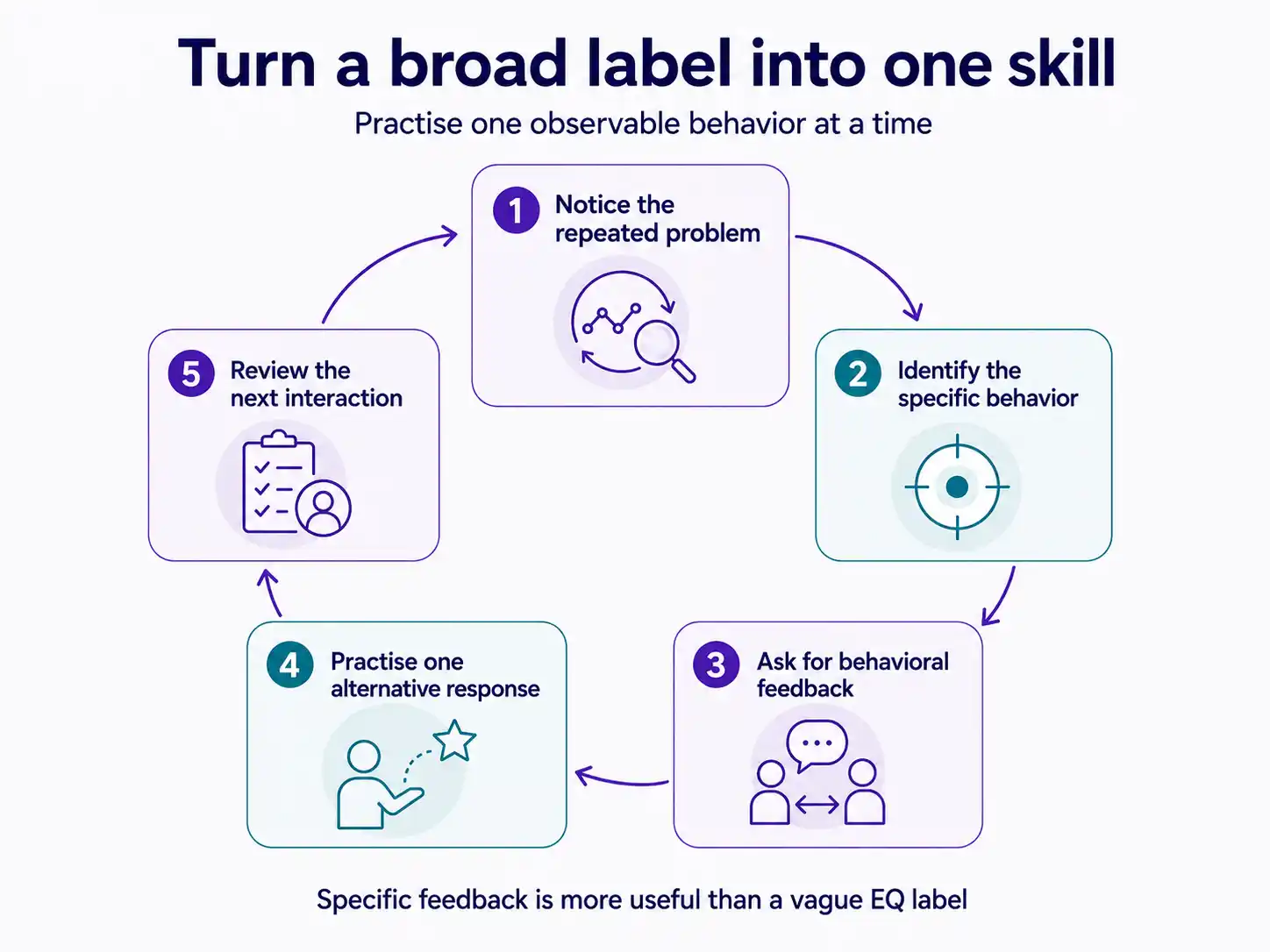
Improvement is easier when a broad EQ label is converted into one observable behavior.
The most useful goal is usually not simply “raise my EQ.” That is too vague. It is more practical to identify a specific behavior that repeatedly causes problems and work on that skill.
Instead of Asking “Do I Have Low EQ?”, Ask:
Do people often misunderstand my tone?
Do I become defensive when feedback is uncomfortable?
Do I start solving before I have listened fully?
Do similar conflicts happen with different people?
Do colleagues hesitate to approach me?
Do I understand the impact of my communication as well as my intention?
Notice Your Impact, Not Only Your Intention
You may not intend to sound dismissive, but intention and impact are different pieces of information. Consider what you wanted to communicate, how the other person experienced it, and whether a different approach could achieve the same goal more effectively.
Ask for Behavioral Feedback
Instead of asking, “Do I have low EQ?”, ask a specific question such as, “When I disagree in meetings, what do I do that makes the conversation harder?”
Specific feedback is easier to act on than a broad label.
Pause Before Solving Someone Else's Problem
When someone brings you a problem, consider asking whether they want help finding a solution or mainly need you to listen first. That short question can prevent a common communication mismatch.
Separate Disagreement From Disrespect
Someone disagreeing with your reasoning does not necessarily mean they doubt your intelligence or competence. Separating disagreement from personal threat can make difficult discussions more productive.
Use More Precise Emotional Language
Instead of describing every uncomfortable feeling as “bad” or “annoying,” try identifying whether you feel frustrated, disappointed, anxious, embarrassed, uncertain, irritated, pressured, or resentful.
More precise language can make it easier to decide what response is actually needed.
Review Difficult Conversations
What was I trying to achieve?
What was the other person trying to achieve?
What did I notice?
What might I have missed?
When did the conversation become more difficult?
What could I do differently next time?
You do not need to change your personality to improve a communication skill.
For more practical guidance, read how to improve emotional intelligence.
Where TalentRank Fits Into the Picture
TalentRank can help you explore cognitive ability and Big Five personality, two areas that can provide useful context for understanding how you approach reasoning, decisions, work, structure, and collaboration.
What TalentRank Measures | What TalentRank Does Not Measure |
|---|---|
Cognitive ability | Emotional intelligence or EQ |
Big Five personality | Mental health conditions |
Reasoning-related performance | Whether someone has “high IQ low EQ” |
TalentRank does not measure emotional intelligence. Its results should not be interpreted as evidence that someone has high or low EQ.
If you want to explore the areas TalentRank actually assesses, you can explore your cognitive ability and Big Five personality.
Frequently Asked Questions
Can you have a high IQ and low EQ?
Yes. Cognitive ability and emotional intelligence describe different characteristics, so someone can show strong reasoning ability while having weaker skills in areas such as emotional awareness, communication, or conflict management. High IQ does not automatically cause low EQ, and a few difficult social interactions are not enough to label someone.
Does high IQ mean low EQ?
No. Research does not support a simple rule that higher IQ means lower emotional intelligence. A study involving more than 6,000 adults found only very small relationships between cognitive ability and trait emotional intelligence, suggesting that the two should not be treated as simple opposites.
Do People With High IQ Usually Have Lower Emotional Intelligence?
There is not good evidence for that generalization. Cognitive ability and emotional intelligence should be considered separately. An IQ score does not reliably tell you whether someone is empathetic, emotionally self-aware, socially skilled, or effective at handling conflict.
Why Do Some Intelligent People Struggle With Communication?
Intelligence and communication depend on different skills. Someone may have spent years developing analytical or technical ability while receiving less practice with feedback, conflict, emotional cues, or adapting messages to different audiences. Personality, culture, anxiety, experience, and workplace environment can also influence communication.
How Common Is High IQ With Low EQ?
There is no reliable prevalence figure showing how common the high IQ low EQ combination is. Emotional intelligence is defined and measured in different ways, making a single meaningful percentage difficult to establish. A precise number would be misleading without stronger evidence.
Can Emotional Intelligence Improve?
Specific emotional and interpersonal skills can often be practiced. Useful targets may include listening, recognizing emotional cues, managing reactions, receiving feedback, communicating difficult information, and reflecting on conflict. Working on a specific behavior is usually more practical than focusing on raising one broad EQ score.
Yes. Strong cognitive ability and strong emotional skills can coexist. Research does not show that strength in one requires weakness in the other. Someone can be highly analytical while also being empathetic, emotionally aware, adaptable, and effective in relationships.
Does TalentRank Test Emotional Intelligence?
No. TalentRank measures cognitive ability and Big Five personality. It does not offer an emotional intelligence or EQ test, and its results should not be used to determine whether someone has high or low EQ.
High IQ and low EQ can exist in the same person, but intelligence itself is not a reliable explanation for weak emotional or interpersonal skills. Cognitive ability, personality, and emotional intelligence are more useful when understood separately. If communication, feedback, conflict, or relationship patterns are limiting your career, identifying the specific behavior that needs work is usually more useful than adopting a label such as “high IQ, low EQ.”