

Most advice on this subject tells you what emotional intelligence is, lists four skills, and leaves you exactly where you started. You already know that noticing your reactions matters. What is missing is what to do on Monday morning.
This guide is built around one instruction: pick the single skill you are weakest at and work on that, rather than all four at once. It sets out what practising each skill actually looks like, how to ask for feedback in a way that gets a real answer, a four-week way to start, and how to tell whether anything is changing. It also says what the evidence does not support, because there is less of it here than the confident tone of most articles suggests.
Key Takeaways
Emotional intelligence does respond to training, but not every part of it does.
Work on one skill at a time. Four at once is how people start everything and finish nothing.
Self-awareness is the hardest to improve alone, because you are the instrument doing the measuring.
Feedback only helps if you ask a narrow question about a specific occasion.
TalentRank measures cognitive ability and personality. It does not measure emotional intelligence or progress in it.
Can Emotional Intelligence Actually Be Improved?
Yes, with real effort. A randomised trial of senior managers found emotional intelligence improved after a 30-hour training programme, with gains still present a year later. Not everything improved, though. Interpersonal and adaptability scores did not shift, and the study covered 54 people in one company.
That study is worth knowing in a bit more detail, because it is one of the few places this question has been tested properly rather than asserted. Fifty-four senior managers were randomly split into a training group and a control group. The training ran for thirty hours over seven weeks. Scores were taken before, after, and again twelve months later, and the gains held. The full paper is published in PLOS ONE.
Two things about it should temper any enthusiasm. It is one company, so it tells us little about how this generalises. And the parts that did not move, interpersonal skills and adaptability, are exactly the parts most people are hoping to change. Improvement is real, but it is not uniform and it is not fast.
Which Skill Should You Work On First?
The one you are weakest at, not all four. Most guides list self-awareness, managing your reactions, reading others and handling interactions as a set, which is how people start everything and finish nothing. Pick the one your feedback keeps pointing at and leave the rest alone.
If you are not sure which one that is, do not rate yourself. Look instead at what actually goes wrong, because the failure is more informative than the self-assessment.
You are regularly surprised by your own reaction afterwards. That points at noticing.
You know what you felt but regret what you said. That points at managing the response.
People tell you that you misread them, or you are surprised by how someone took something. That points at reading others.
Conversations end worse than they started, even when you were calm. That points at handling the interaction.
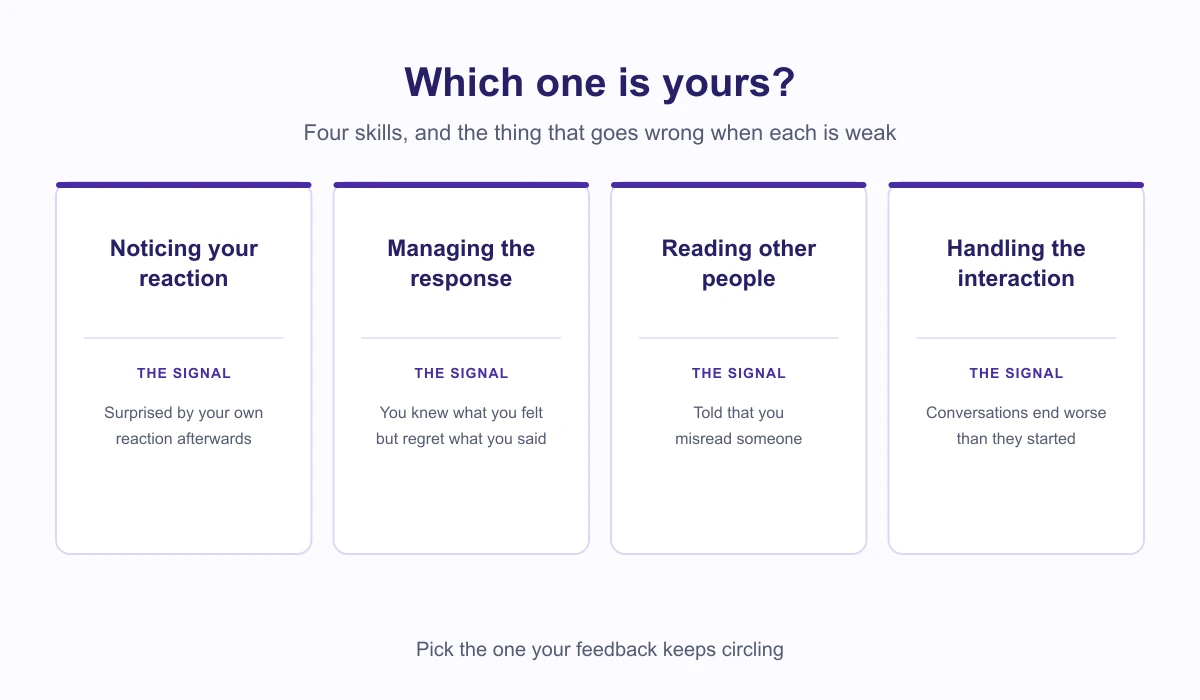
Pick the one your feedback keeps circling. Working on all four at once is how people finish none.
If more than one applies, take the one that has come up in feedback you already received and quietly discounted. The comment that stung is generally more diagnostic than the one that flattered.
Pick the one your feedback keeps circling. Working on all four at once is how people finish none.
The Four Skills, and What Practising Each Looks Like
Skill | What it is | What practising it looks like this week |
Noticing your own reaction | Registering what you feel while it is happening, not afterwards | Name the feeling silently, once, in a meeting where something annoys you |
Managing the response | Choosing what to do rather than acting straight from the reaction | Leave one deliberate pause before replying to something that irritates you |
Reading other people | Picking up what someone is feeling, including when it differs from what they say | In one conversation, ask a clarifying question instead of assuming you understood |
Handling the interaction | Steering the conversation somewhere useful given both | End one difficult exchange by summarising the other person's position first |
Noticing your own reaction as it happens
This is the foundation and the one most people skip, because it feels like doing nothing. The practice is small: catch the feeling while it is live and label it in one word. Irritated. Embarrassed. Rushed. That is all.
Managing the response instead of acting on it
Noticing buys you a gap. Managing is what you do with the gap. In practice it usually means one deliberate pause before you reply, which is unremarkable to watch and surprisingly hard to do.
Illustrative example: the pause. Imagine someone in a meeting where a deadline moves without warning. They feel the irritation rise, notice it, and instead of pushing back immediately they ask what changed. The meeting goes somewhere different. Nothing dramatic happened. That gap between feeling and acting is the entire skill.
Reading what other people are feeling
Less about intuition than about checking. The failure mode here is not missing a signal, it is confidently misreading one and never finding out. You decide someone is annoyed when they are distracted, or that silence means agreement, and you act on that reading without testing it.
So the practice is not becoming more perceptive. It is holding your interpretation loosely and asking one question that would disprove it. "You went quiet there, was that a concern or were you just thinking?" costs a sentence and prevents most of the damage.
Handling the interaction
This is the visible part, and it is downstream of the other three. If you notice, pause, and check what the other person means, most of this looks after itself. Practising it directly, without the others, tends to produce technique that reads as technique.
Where it does need practice is in endings. Most difficult conversations are judged on how they finish, not how they open. Summarising the other person's position before you state your own, out loud, is one concrete move that changes how the exchange is remembered.
One thing worth saying plainly: becoming more emotionally intelligent does not mean becoming more outgoing. An introvert who practises these skills is still an introvert. The skills are about accuracy and choice, not volume.
Why Is Self-Awareness the Hardest to Improve on Your Own?
Because you are the instrument doing the measuring. Judging how well you read a room requires the very skill you are trying to assess. This is why self-report emotional intelligence scores partly reflect how you see yourself, and why outside feedback matters more here than anywhere else.
Mayer, Salovey and Caruso make this point directly about self-report emotional intelligence questionnaires, writing in American Psychologist that such answers are filtered through the test taker's self-concept, and that people may never have received accurate feedback about how well they actually read emotions. If your only source of information is your own opinion of yourself, you are stuck.
How Do You Get Feedback That Is Actually Useful?
Ask a narrow question about a specific occasion, not a general one about yourself. "How did I come across in Tuesday's meeting when the deadline changed?" gets an answer. "Do you think I have good emotional intelligence?" gets reassurance. Ask someone who watched, and ask soon afterwards.
What people usually ask | What they get back | Ask this instead |
Do you think I have good emotional intelligence? | Reassurance | How did I come across in Tuesday's meeting? |
How am I doing generally? | A summary of your output | Was there a moment this week where I misread the room? |
Was that okay? | Yes | What would you have done differently in that conversation? |
Do people find me difficult? | An awkward denial | When I pushed back on the timeline, how did that land? |
Illustrative example: the same request, twice. Imagine someone asking a colleague whether they come across well. The colleague says yes, of course, and the conversation ends. A week later the same person asks how they came across in a specific meeting when they challenged a decision. This time the colleague pauses and says it felt abrupt to two people in the room. The second question produced something to work with. The first produced politeness.
A Four-Week Starting Plan
What this is, and what it is not. This is a way to begin practising, not a replication of a structured training programme. The research on how people develop emotional intelligence under supervision used thirty hours over seven weeks. Four weeks of self-directed practice is a start, not an equivalent, and it comes with no promised result.
Week one: notice only. Do not try to change anything. Once a day, catch a reaction while it is happening and name it in one word.
Week two: notice and record. Same practice, but write down one instance each day, with what triggered it. You are looking for a pattern, not a score.
Week three: add the pause. In one interaction a day, leave a deliberate gap before responding. Notice what you do with it.
Week four: ask. Request feedback once, using a narrow question about a specific occasion, from someone who was there.
If a week does not happen, repeat it rather than moving on. The sequence matters more than the timetable.
How Do You Tell If It Is Working?
Watch behaviour, not a score. Look for a gap opening between noticing a reaction and acting on it, for conversations that used to escalate and now do not, and for people bringing you problems earlier. No self-rated questionnaire will tell you this reliably.
The first signal is felt from the inside rather than observed. Early on, you notice the reaction just after you have already acted on it. Later, the noticing arrives fractionally earlier, and there is a moment where a choice exists. That moment is short and unglamorous, and it is the actual thing you are training.
The second is easier to see in hindsight. A conversation that would previously have escalated simply does not, and afterwards you cannot point to anything clever you did. That is usually the pause working rather than any technique.
The third is the most useful and the easiest to miss. When people start raising things with you sooner, it usually means they expect a better reaction than they used to.
What Does Not Work?
Reading about emotional intelligence without practising anything. Working on all four skills at once. Rating yourself and calling that a baseline. Expecting change in days. And assuming every skill responds equally, when the trial found interpersonal and adaptability scores did not move at all.
Two of these are worth expanding. Self-rating as a baseline fails for the reason in the self-awareness section: the rating is produced by the thing you are trying to measure. And the assumption that all four skills move together is contradicted by the only randomised evidence cited here, which found that some did and some did not.
Where This Fits With Cognitive Ability and Personality
Emotional skills are one part of a wider picture. Cognitive ability and personality are others, and they behave differently: cognitive ability is relatively stable in adults, while emotional skills respond to practice. If you want the comparison in full, read our guide to EQ vs IQ.
TalentRank measures cognitive ability and Big Five personality. It does not measure emotional intelligence, and it cannot track your progress in it. This guide is career development rather than mental health support; if what you are dealing with goes beyond ordinary workplace friction, that deserves proper support rather than a practice plan. If the cognitive and personality side is what you want measured, you can explore the TalentRank assessment.
Frequently Asked Questions
How long does it take to improve emotional intelligence?
There is no reliable answer, and anyone offering a number is guessing. The randomised trial cited here used thirty hours of training over seven weeks and measured gains that held at twelve months. Self-directed practice is slower and less structured than that.
Can you improve emotional intelligence if you are introverted?
Yes, and it does not require becoming more outgoing. These skills are about noticing accurately and choosing your response, neither of which depends on sociability. Quiet people are often better at the noticing half and simply get less credit for it.
Is emotional intelligence the same as being nice?
No. Being agreeable is a personality trait. Emotional skill includes reading a situation accurately and sometimes saying the uncomfortable thing well. Someone can be very pleasant and consistently misread people, or blunt and highly accurate.
Do emotional intelligence courses work?
One randomised trial found that a thirty-hour programme produced gains that held for a year, with some skills unchanged. That is a single study in one company. It is not a verdict on an industry, and TalentRank does not sell training.
Sources
Practise One Thing, Not Four
The reason most attempts at this fail is not lack of willingness, it is that the standard advice asks for four simultaneous changes and offers no order to do them in. Pick the skill your feedback keeps circling, practise it for a few weeks in the smallest way that counts as practice, and ask one narrow question of someone who watched. That is a smaller ambition than most articles on this subject will offer you, and it is considerably more likely to still be happening in a month.