


ENTJ Personality Type: Characteristics, Strengths, and Work Style
ENTJ is one of the 16 personality types in the Myers-Briggs framework. The letters stand for Extraversion, Intuition, Thinking, and Judging. Together, these preferences describe tendencies in where someone directs attention, how they take in information, how they approach decisions, and how they deal with structure. They do not measure intelligence, leadership ability, empathy, professional competence, or a person's likelihood of success.
People with ENTJ preferences are often described as direct, strategic, organized, decisive, and comfortable taking initiative. Those descriptions can be useful starting points, but they become misleading when they turn into the idea that every ENTJ is a confident "Commander" or natural leader. Type describes preferences, not a script for behavior.
An ENTJ is a personality type based on preferences for Extraversion, Intuition, Thinking, and Judging. In the Myers-Briggs model, these letters represent preferred ways of directing energy, taking in information, reaching conclusions, and approaching the outside world. People can use both sides of every preference pair, even when one feels more natural.
That last point matters. An ENTJ can need quiet time, pay close attention to concrete details, consider people's feelings, or change a plan. None of those behaviors automatically contradicts the personality profile ENTJ describes.
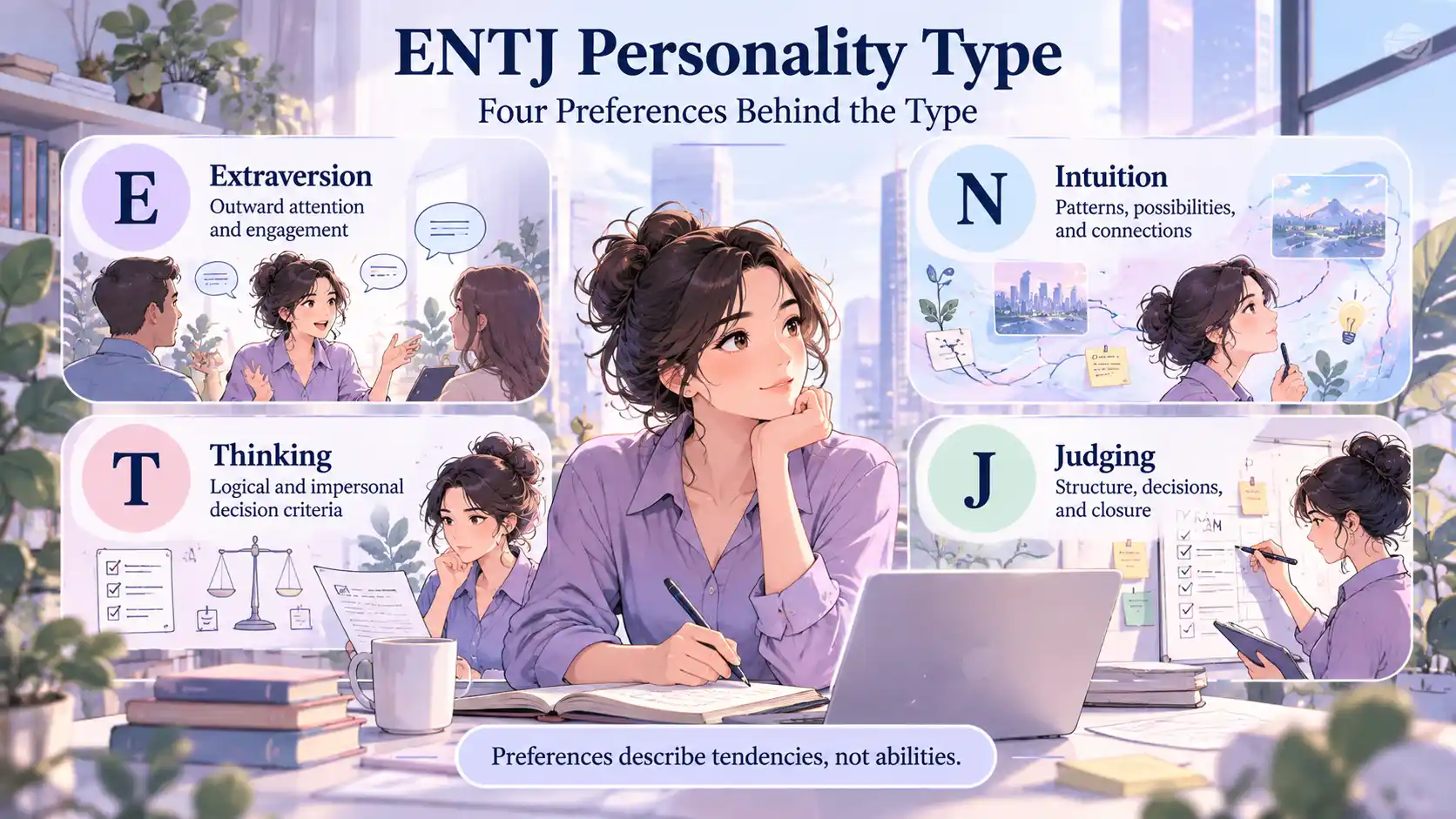
E: Extraversion
Extraversion concerns a preference for directing attention and energy toward the outer world of people and activity. It should not be reduced to being talkative, outgoing, or constantly social.
Imagine someone preparing a proposal. They might understand their own thinking better by discussing possibilities with colleagues, testing ideas aloud, and reacting to other people's questions. Another person might prefer to develop most of the proposal privately before discussing it. The difference is about a preferred orientation, not who has better social skills.
An ENTJ can enjoy active discussion and still want uninterrupted time to concentrate. Extraversion does not eliminate the need for privacy, reflection, or rest. For more detail, read Extraversion vs Introversion.
N: Intuition
Intuition describes a preference for patterns, possibilities, meanings, and connections when taking in information. Its opposite, Sensing, emphasizes concrete information and direct experience.
In a project discussion, an Intuition preference might show up as questions such as: Where could this lead? What larger problem are we actually trying to solve? Is there a pattern connecting these issues?
That does not mean someone with an Intuition preference ignores facts. People use both sides of each preference pair. For more detail, see Sensing vs Intuition.
T: Thinking
Thinking is a decision-making preference. Someone who prefers Thinking may naturally start with logical analysis, objective principles, consistency, or impersonal criteria when reaching a conclusion.
This does not mean the person has fewer emotions. Thinking and Feeling are decision preferences, not measures of intellect or emotion.
For example, an ENTJ manager might believe the fairest way to allocate a limited training budget is to use consistent criteria across the team. That decision can still be accompanied by genuine concern for employees who do not receive funding. For more detail, see Thinking vs Feeling.
J: Judging
Judging describes a preference for structure, decisions, and closure when approaching the outside world. It does not mean being judgmental.
Someone with this preference may appreciate knowing the objective, deadlines, ownership, and next steps. That can make it easier to organize work and move toward a decision.
It does not mean every ENTJ maintains a perfect calendar or dislikes spontaneity. Preference for structure is not the same thing as flawless organization, discipline, or planning skill. For more detail, see Judging vs Perceiving.
Common ENTJ Characteristics
Common ENTJ characteristics are often described in terms of initiative, strategic thinking, direct communication, logical decision-making, and a preference for organized action. These are better treated as possible patterns than fixed ENTJ personality traits.
Possible pattern | What it might look like | What it does not automatically mean |
Taking initiative | Proposing direction when a situation lacks one | Being a skilled leader |
Strategic thinking | Connecting current decisions with future consequences | Always predicting correctly |
Direct communication | Stating conclusions and expectations clearly | Being insensitive |
Logical decision-making | Looking for consistent criteria and evidence | Lacking emotion |
Preference for structure | Wanting objectives, ownership, and priorities defined | Being inflexible |
Challenging inefficiency | Questioning processes that no longer seem useful | Always having a better solution |
Context matters. Experience, responsibilities, skills, culture, incentives, relationships, and the situation itself can all influence how a person's preferences appear in practice.
Why an ENTJ May Not Look Like the "Commander" Stereotype
ENTJ profiles are frequently associated with command, ambition, authority, and leadership. An individual ENTJ may relate strongly to those descriptions, somewhat relate to them, or barely relate to them at all.
Type does not dictate behavior, and personality preferences do not measure skill or ability. That creates plenty of room for real people to look different from an online stereotype. For more detail, see ENTJ fictional characters.
Extraverted does not mean constantly social
An ENTJ can enjoy discussion, teamwork, or active environments and still want significant time alone. Someone might spend a lively afternoon challenging ideas in a workshop and then prefer several uninterrupted hours to develop the resulting plan.
Thinking does not mean emotionless
Thinking concerns a preferred starting point for decisions. It does not measure emotional depth, empathy, kindness, or the capacity to care about other people.
Judging does not mean rigid
A person may prefer plans and closure while remaining willing to change direction when the evidence changes. A structured response to new information can mean revising priorities quickly and creating a coherent new plan.
What an ENTJ Label Does Not Tell You
Knowing that someone identifies with the ENTJ personality type does not tell you their:
intelligence
emotional depth
empathy
leadership competence
confidence
productivity
professional expertise
income
career success
morality
mental health
ideal occupation
Four letters can provide vocabulary for preferences. They cannot summarize a whole person.
ENTJ Strengths and Their Possible Tradeoffs
Potential strengths become more useful when you consider the conditions under which they help and the conditions under which they can create friction.
Possible tendency | Potential advantage | Possible tradeoff | Useful question |
Taking initiative | Creates momentum when direction is unclear | Can move ahead before relevant input arrives | Who has information I need first? |
Strategic thinking | Connects decisions to longer-term consequences | Can overcomplicate a reversible decision | How far ahead does this decision require me to think? |
Decisiveness | Prevents unnecessary delay | Can create premature closure | What evidence would change this decision? |
Direct communication | Makes expectations and disagreement clear | Can create friction without enough context | Have I explained the reasoning, not just the conclusion? |
Preference for structure | Clarifies priorities and ownership | Can make poorly explained change frustrating | Do I need the old plan or a clear new one? |
Challenging inefficiency | Can reveal outdated processes | May overlook a hidden constraint | Why does this process exist? |
These are reflection examples, not validated measures of how every ENTJ behaves.
Taking initiative
Taking initiative can be valuable when everyone sees a problem but nobody has established what happens next. The tradeoff appears when initiative becomes direction-setting before the right people have contributed. Moving quickly is useful only if the decision includes the information that actually matters.
Strategic thinking
Looking for patterns and future consequences can help someone avoid solving today's problem in a way that creates new problems later. The same tendency can also make a simple decision unnecessarily elaborate. A reversible experiment may teach more than another round of planning.
Decisiveness
Decisiveness can reduce ambiguity and keep work moving. But speed is not automatically accuracy. A useful habit is to identify in advance what evidence would justify reopening the decision.
Direct communication
Direct communication can save time. Clear disagreement is often easier to work with than vague approval followed by resistance later. Directness becomes more useful when clarity includes context and reasoning.
Organization and structure
Clear goals, deadlines, ownership, and decision points can reduce confusion. The potential tradeoff is treating structure as valuable simply because it exists. Good structure should help the work.
Challenging inefficient systems
Questioning an inefficient process can lead to meaningful improvement. Some processes, however, contain constraints, regulatory requirements, historical lessons, or dependencies that are invisible at first. Understanding why the current process exists is part of evaluating whether it should change.
What Does an ENTJ Work Style Look Like?
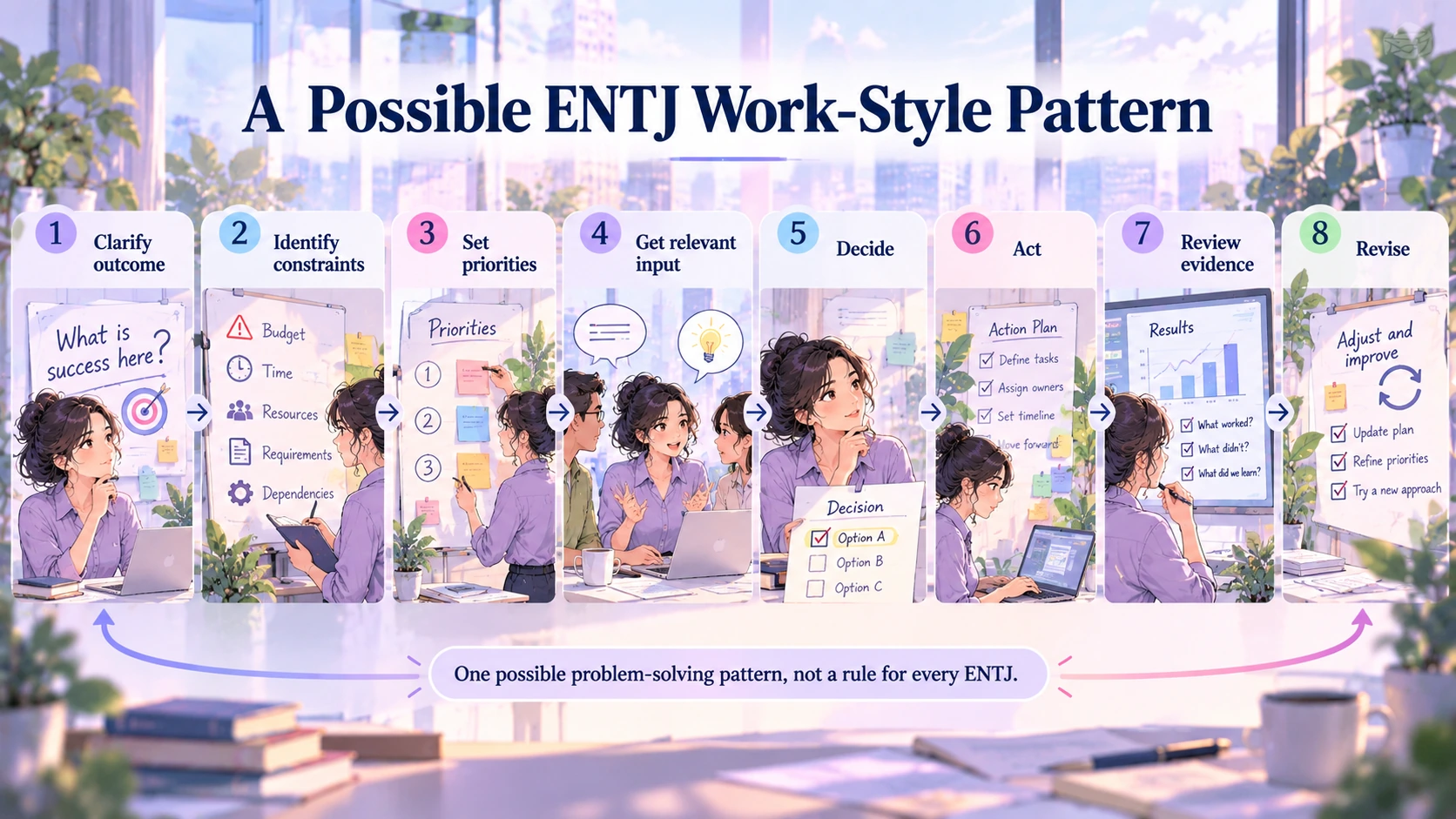
There is no single ENTJ work style. Someone with ENTJ preferences may appreciate clear objectives, active problem-solving, logical reasoning, future possibilities, and organized execution. Actual workplace behavior also depends on the person's role, skills, experience, authority, colleagues, incentives, organizational culture, and the problem in front of them.
Setting goals and priorities
An ENTJ-style approach may begin by clarifying the outcome before organizing individual tasks. Consider a hypothetical team told to "improve customer onboarding." Before building a detailed task list, someone might ask what customer problem is being reduced, what improvement would look like, which constraints cannot change, what needs to happen first, and who owns the final decision.
Making decisions
A Thinking preference may make consistent criteria and logical analysis feel like natural starting points. Good decision-making still requires recognizing incomplete information. Logical reasoning cannot compensate for missing facts.
Meetings and communication
An ENTJ may enjoy meetings where ideas are challenged, decisions are made, and next steps become clearer. Another ENTJ may prefer shorter discussions and more independent work. The more useful distinction is whether a meeting serves a purpose.
Independent work
Extraversion does not mean needing constant interaction. Complex analysis, writing, planning, design, and problem-solving can all benefit from uninterrupted concentration.
Collaboration
Taking initiative can be useful without being the formal leader. An ENTJ team member might help clarify the objective, identify a dependency, challenge an assumption, or push an unresolved discussion toward a decision. Collaboration becomes harder when confidence in a proposal turns into insufficient curiosity about other people's information.
Giving and receiving feedback
Direct feedback becomes more actionable when it is specific. The same principle applies when receiving feedback: before defending the reasoning, make sure you understand the objection.
When priorities suddenly change
Someone who values structure may find an unexplained change more frustrating than change itself. A clearer response to shifting priorities explains why the change happened, which work is now critical, what can be dropped, and who owns each decision.
ENTJ Myths That Are Easy to Mistake for Traits
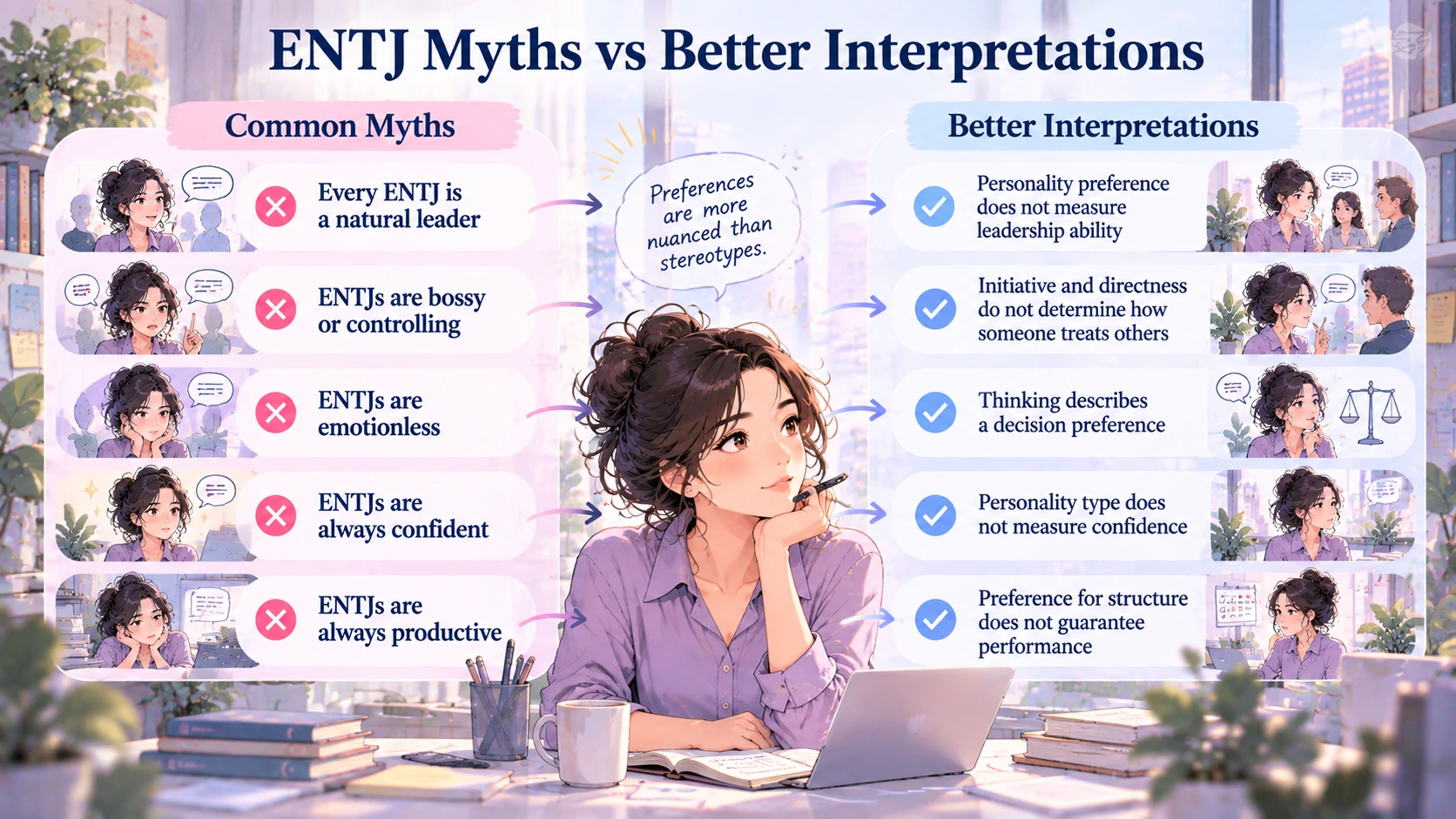
Popular personality descriptions can turn recognizable tendencies into claims that go far beyond what an ENTJ label establishes.
Myth: Every ENTJ is a natural leader
Some ENTJs may enjoy leadership. Others may not. Taking initiative, speaking directly, preferring decisions, or organizing work can be useful in leadership situations, but none of those preferences proves that someone can lead effectively.
Myth: ENTJs are bossy or controlling
Direct communication and willingness to propose a direction can sometimes be perceived as controlling, especially when other people have not had space to contribute. That does not make controlling behavior an ENTJ characteristic.
Myth: ENTJs are emotionless
Thinking is not the absence of emotion. It describes a decision-making preference within the MBTI framework. An ENTJ label cannot tell you how intensely someone experiences emotion.
Myth: ENTJs are always confident
Personality type does not measure confidence. Someone can communicate decisively while privately feeling uncertain, and confidence can vary by context and experience.
Myth: ENTJs are always productive
A preference for structure does not guarantee discipline, motivation, organization, or output. ENTJs can procrastinate, miss deadlines, lose focus, underestimate work, or abandon plans just like people of other types.
How ENTJ Preferences Can Affect Collaboration
Good collaboration does not require everyone to approach a problem in the same way. For someone who tends to reach conclusions quickly, one useful habit is separating having a preferred answer from having enough information to decide.
Making reasoning visible also helps. If you have mentally connected several facts before reaching a conclusion, colleagues cannot evaluate that chain unless you explain enough of it.
Tone can matter without requiring indirect communication. A statement can remain clear while distinguishing between an idea and the person who proposed it. Finally, recognize diminishing returns. Optimizing a solution indefinitely can consume time that would be better spent testing it.
Practical Questions for Understanding Your Own Work Style
Instead of asking whether every ENTJ personality trait sounds like you, examine your behavior across different situations.
When a situation lacks direction, do I naturally propose a next step or wait for more information?
Do I understand ideas better through active discussion, private reflection, or a mixture of both?
When making a difficult decision, which criteria receive the most weight?
What evidence is most likely to make me reconsider a decision?
When I disagree, do I explain my reasoning or mostly communicate my conclusion?
How much structure helps me work effectively, and when does it become unnecessary?
Do I involve people with relevant information early enough?
When priorities change, do I resist the change itself or the lack of a coherent new direction?
These questions are not an unofficial ENTJ test and should not be scored as one. They are prompts for turning broad personality language into reflection on actual behavior.
Personality Type Is a Starting Point, Not a Verdict
An ENTJ MBTI result can provide accessible language for thinking about preferences, but it should not become a rule for who you are allowed to be. People use all preferences and can stretch toward a nonpreferred approach when circumstances call for it.
Other personality frameworks organize individual differences differently. The Big Five, for example, describes personality using continuous trait dimensions rather than a four-letter type. Read TalentRank's Big Five vs MBTI guide.
Explore Your Own Personality Traits
Reading about ENTJ preferences can give you useful language for reflection, but your personality does not have to fit neatly into four letters. TalentRank uses a Big Five-based assessment that reports personality across continuous trait dimensions rather than confirming whether you are an ENTJ.
Start the TalentRank Assessment
Frequently Asked Questions About ENTJ
What does ENTJ stand for?
ENTJ stands for Extraversion, Intuition, Thinking, and Judging. In the Myers-Briggs framework, these preferences concern the direction of attention and energy, how information is taken in, how decisions are approached, and how someone relates to structure and the outside world.
What is an ENTJ personality type?
An ENTJ is one of the 16 personality types formed from the Myers-Briggs preference pairs. The letters describe preferred tendencies rather than a complete personality profile, and type does not determine someone's abilities, intelligence, or likelihood of success.
What are common ENTJ characteristics?
Commonly discussed ENTJ characteristics include taking initiative, strategic thinking, direct communication, logical decision-making, and preference for organized action. These should be treated as possible tendencies, not requirements.
What are common ENTJ strengths?
Possible ENTJ strengths include initiative, strategic thinking, decisiveness, direct communication, and organization. Each can also involve a tradeoff depending on context.
What is an ENTJ like at work?
Someone with ENTJ preferences may value clear objectives, logical decision-making, future possibilities, and organized execution. There is no universal ENTJ work style, however.
Are all ENTJs natural leaders?
No. Some ENTJs may enjoy taking initiative or organizing group decisions, but personality type does not establish leadership ability. Leadership depends on factors beyond four personality preferences.
Are ENTJs emotionless?
No. Thinking in MBTI terminology describes a decision-making preference, not a lack of emotion. An ENTJ label therefore cannot tell you how emotional, caring, or empathetic someone is.
Does being an ENTJ mean you are confident or successful?
No. An ENTJ result does not measure confidence, competence, intelligence, productivity, or likelihood of success. Those outcomes depend on many factors that a four-letter personality type does not capture.
Understanding ENTJ Without Becoming the Label
The ENTJ personality type can be useful when it gives you language for examining how you approach ideas, decisions, structure, and interaction. It becomes less useful when four preferences turn into a story that says you must be commanding, endlessly confident, emotionally detached, or naturally suited to leadership. Look instead at your behavior across situations: when initiative helps, when more input improves a decision, when directness creates clarity, and when a plan needs to change. Your preferences may describe part of the pattern, but your skills, choices, experiences, relationships, and circumstances tell much more of the story.