

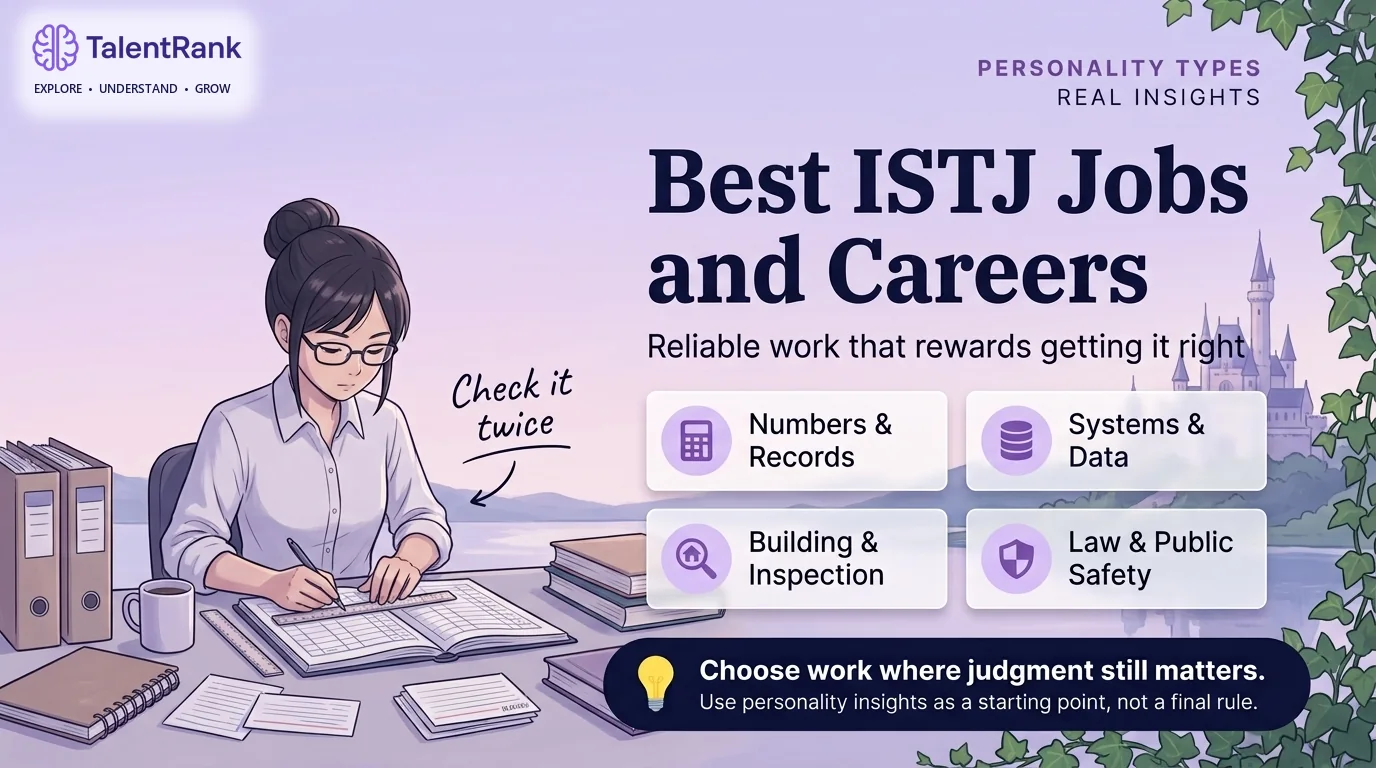
Good ISTJ jobs tend to reward accuracy, follow-through, and a steady hand. Accounting and auditing, budget analysis, database administration, civil engineering, logistics, actuarial work, building inspection, law enforcement, and the skilled trades all come up often. The common thread is work with clear standards, where doing it right matters more than doing it loudly.
That's a pattern, not a verdict. The Myers-Briggs Company says preferences "do not indicate skill or ability" and warns against using the assessment to select people for jobs. (The Myers-Briggs Company) ISTJs work as teachers, nurses, and designers too.
This guide covers thirteen careers ISTJs often explore, with 2025 pay and 2025–35 growth figures from the U.S. Bureau of Labor Statistics. It also flags something important for detail-focused careers: several classic ISTJ jobs are shrinking as software automates routine checking, so it pays to choose the versions of the work that still need judgment.
What ISTJs Tend to Want From Work
ISTJ stands for Introversion, Sensing, Thinking, and Judging. You probably recharge alone, trust facts and experience, make decisions on logic, and like a clear plan you can follow through. (For more on the S, see our guide to sensing vs. intuition.)
At work, that often shows up as:
Clear standards and procedures.
Work you can finish and check.
Quiet time to concentrate.
Stability and a predictable path.
Colleagues who keep their commitments.
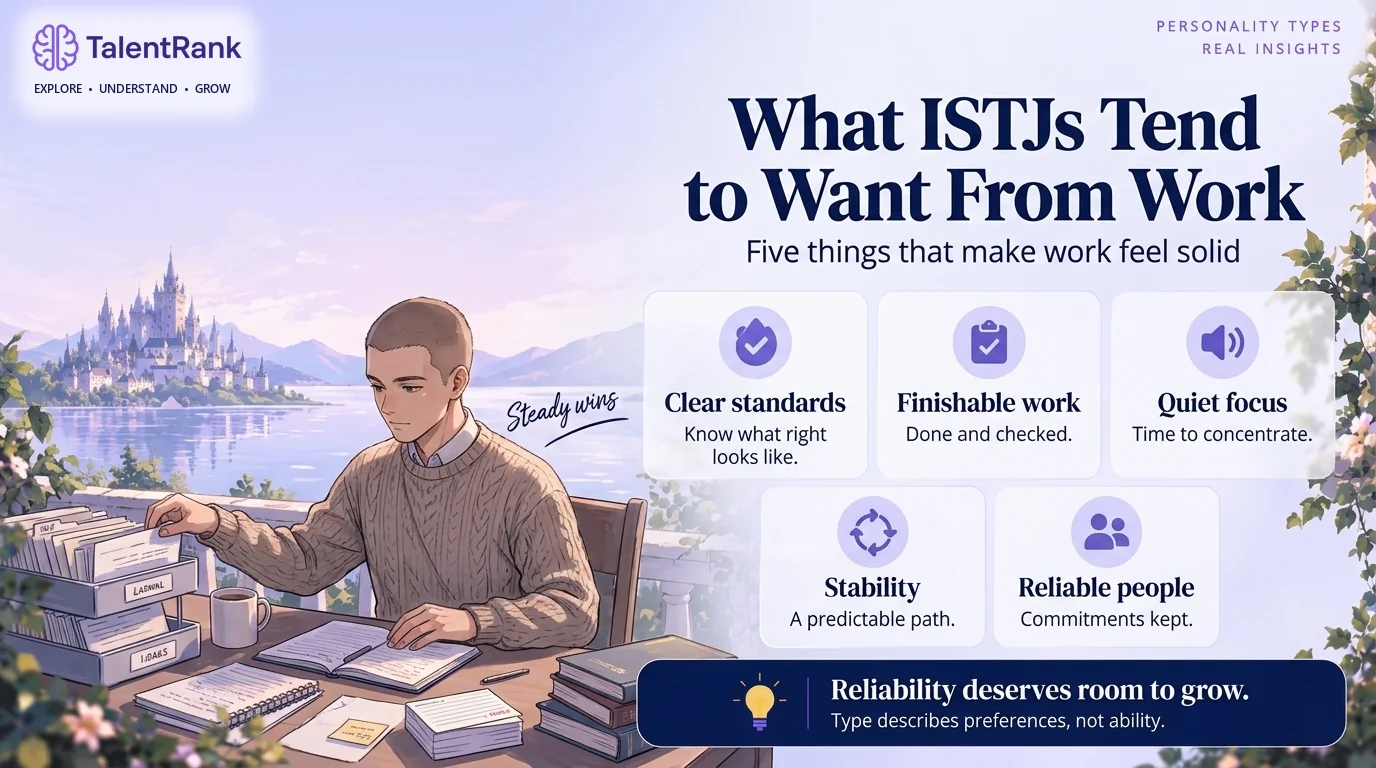
ISTJs are often the people an organization quietly relies on to catch errors. That's a real strength. The risk is being so reliable in a routine role that you never get stretched. It's worth choosing a job with room to grow into more responsibility.
Best ISTJ Jobs to Explore
These careers reward accuracy, structure, and reliability. Figures come from the Bureau of Labor Statistics Occupational Outlook Handbook: median pay in May 2025 and projected employment change from 2025 to 2035.
Career | 2025 median pay | Projected growth, 2025–35 | Typical entry education |
Actuary | $130,000 | 9% | Bachelor's degree plus exams |
Database administrator or architect | $126,760 | 4% | Bachelor's degree |
Civil engineer | $100,840 | 6% | Bachelor's degree |
Budget analyst | $91,640 | 2% | Bachelor's degree |
Accountant or auditor | $83,680 | 5% | Bachelor's degree |
Logistician | $82,320 | 18% | Bachelor's degree |
Police officer or detective | $77,310 | 3% | High school diploma to degree, plus academy |
Construction and building inspector | $74,690 | 0% | High school diploma |
Drafter | $68,090 | 1% | Associate's degree |
Electrician | $63,190 | 9% | High school diploma plus apprenticeship |
Paralegal | $62,890 | 0% | Associate's degree |
Medical records specialist | $51,140 | 8% | Postsecondary certificate |
Quality control inspector | $48,570 | 3% | High school diploma |
Source: BLS Occupational Outlook Handbook, pages updated August 2026.
Numbers and Records
Accountants and auditors keep financial records accurate and compliant, with 5% projected growth. Budget analysts plan and track spending, often for government agencies. Actuaries calculate risk and pass a series of professional exams, which rewards steady, disciplined study. They had the highest median pay in this guide.
Medical records specialists keep patient data accurate and coded correctly, usually after a certificate program, and BLS projects 8% growth.
Systems and Data
Database administrators and architects keep an organization's data organized, secure, and available. It's precise work where mistakes are costly, which suits careful ISTJs. Logisticians run supply chains and are projected to grow 18%, the fastest in this guide.
Building and Inspection
Civil engineers design and oversee roads, bridges, and water systems to strict codes. Construction and building inspectors check that projects meet those codes. Drafters turn designs into precise technical drawings, and electricians install and troubleshoot systems to code after a paid apprenticeship.
Law and Public Safety
Police officers and detectives enforce clear rules and procedures, though the job is stressful and physically demanding. Paralegals organize files, research, and prepare documents for attorneys, often with an associate's degree.
The Automation Question: Which ISTJ Jobs Are Shrinking?
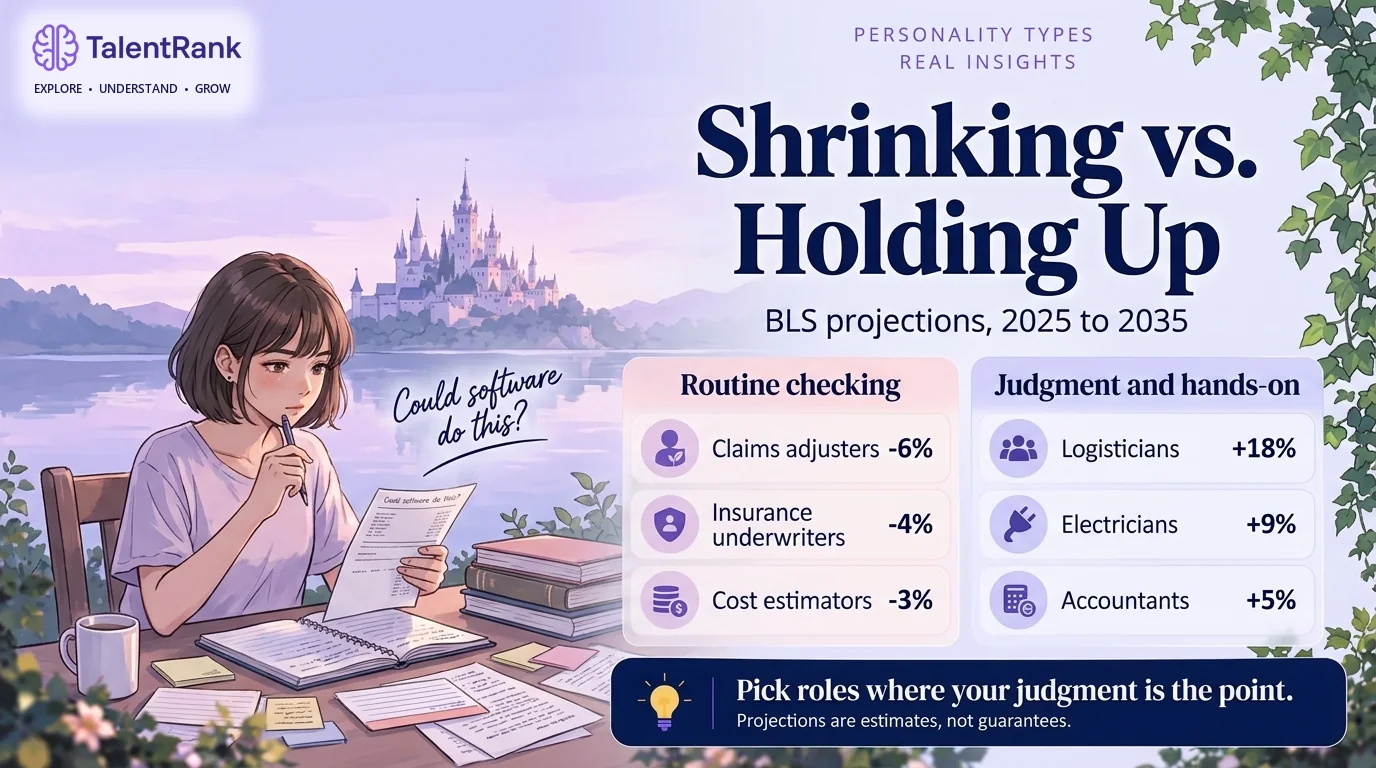
Several detail-focused jobs that appear on ISTJ lists are projected to decline, according to BLS:
Insurance underwriters: -4%, with BLS citing automated underwriting software.
Cost estimators: -3%, with estimation software raising productivity.
The pattern is clear: routine checking is increasingly done by software. The roles holding up best involve judgment, accountability, or physical work that can't be automated easily: auditing rather than data entry, inspecting a building rather than processing a form, fixing an electrical system rather than logging the fault.
Hypothetical example: an ISTJ works as an insurance claims examiner and sees more of her routine files handled by software each year. She uses her knowledge of policy and fraud patterns to move into an internal audit role, which still rewards her eye for detail but centers on judgment the software can't provide.
ISTJ Jobs That Don't Require a Four-Year Degree
Electrician: high school diploma plus a four- to five-year paid apprenticeship, $63,190 median, 9% growth.
Construction and building inspector: high school diploma plus experience, $74,690 median.
Drafter: associate's degree, $68,090 median.
Paralegal: associate's degree, $62,890 median.
Medical records specialist: certificate, $51,140 median, 8% growth.
Police officer: high school diploma in many departments, plus academy training.
ISTJ-A and ISTJ-T Jobs
The -A (Assertive) and -T (Turbulent) suffixes come from 16Personalities, not the official MBTI. 16Personalities adds a fifth scale it calls Identity and bases its model on Big Five research. (16Personalities)
There's no separate list of ISTJ-T jobs. The same careers apply. If the Turbulent label fits, high standards may come with more worry about mistakes, which makes clear procedures and good supervision especially helpful.
ISTJ Jobs to Avoid (or Conditions to Watch)
"ISTJ jobs to avoid" lists usually include sales, acting, and fast-changing creative roles. The reasoning is that ISTJs prefer structure to improvisation. That's a generalization. ISTJs can do well in sales roles with clear products and processes, and in creative fields that require technical precision.
What tends to frustrate ISTJs is more specific:
Constant change with no clear plan.
Vague goals and shifting priorities.
Noisy, interruption-heavy workplaces.
Colleagues who cut corners or miss deadlines.
Being asked to improvise without enough information.
How to Choose Among ISTJ Careers
Pick three careers from this guide.
Read the daily tasks for each on O*NET OnLine.
Check the growth figure, and ask whether the core tasks could be automated.
Talk to one person in each role about what a normal week looks like.
Compare training time and cost against the pay and outlook above.
Clarifying your work values can help you weigh stability against pay, and the Holland Code groups careers by interests such as Conventional and Realistic.
Beyond the Four Letters
Two ISTJs can differ a lot in how they handle change or how much people contact they're comfortable with. Trait measures pick up those differences. Conscientiousness, for example, relates to organization and dependability. (Our guide on what your conscientiousness score means explains the trait.)
The TalentRank assessment measures your Big Five personality traits and takes about 12 to 15 minutes. It won't confirm an MBTI type or choose a job for you. It can show where you land on traits like conscientiousness, openness, and emotional stability, which are useful to weigh against the options above. Take the TalentRank assessment and use it as one input.
Frequently Asked Questions About ISTJ Jobs
What are the best jobs for an ISTJ?
ISTJs often do well in accounting, auditing, budget analysis, database administration, civil engineering, logistics, actuarial work, inspection, law enforcement, and skilled trades. Skills and the specific workplace matter as much as type.
What jobs should ISTJs avoid?
No job is off-limits because of type. It's more useful to avoid conditions that frustrate ISTJs, like constant unplanned change, vague goals, and noisy workplaces.
What ISTJ jobs pay the most?
In this guide, actuaries had the highest 2025 median pay at $130,000, followed by database administrators and architects at $126,760 and civil engineers at $100,840, according to BLS.
Are ISTJ jobs at risk from automation?
Some are. BLS projects declines for claims adjusters, insurance underwriters, and cost estimators, partly due to software. Roles that involve judgment, accountability, or hands-on work are more resilient.
Can ISTJs be good leaders?
Yes. ISTJs often lead by example, with clear expectations and reliable follow-through. Leadership also involves handling change and people's emotions, which anyone can learn.
Is there a difference between ISTJ-A and ISTJ-T jobs?
No. The A/T suffix comes from 16Personalities, not the official MBTI, and the same careers apply to both.
Final Takeaway
ISTJ careers tend to share a theme: clear standards and work you can do right. Finance, data, engineering, inspection, public safety, and the trades all offer that. Pay attention to automation, since routine checking is shrinking, and choose roles where your judgment and reliability are the point, not a task a program can take over.