

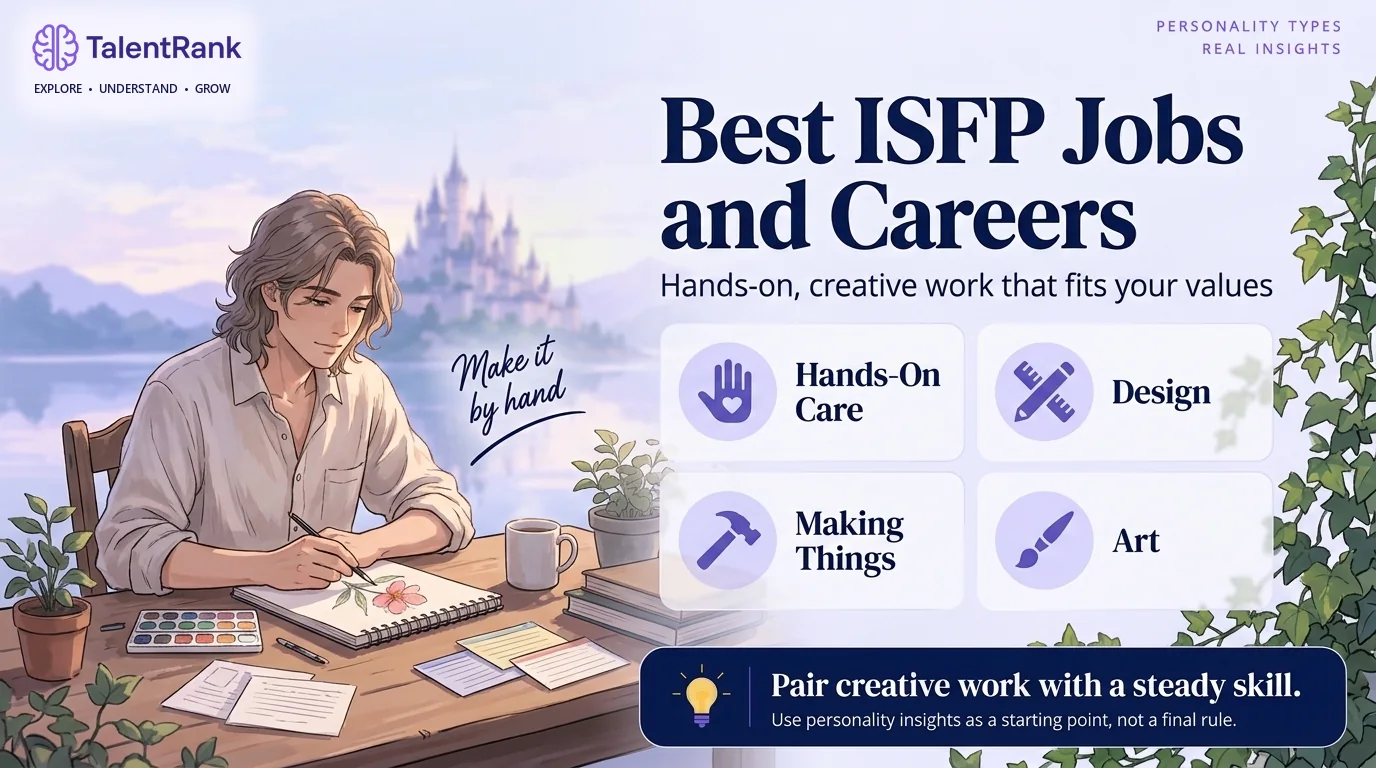
Good ISFP jobs usually let you make something, fix something, or care for someone with your hands, at your own pace, in a way that feels true to you. Physical therapy, dental hygiene, massage therapy, interior and landscape design, digital design, cooking, carpentry, veterinary care, and art all come up often. The common thread is concrete, sensory work with a personal touch.
That's a tendency, not a rule. The Myers-Briggs Company says type preferences "do not indicate skill or ability" and shouldn't be used to select people for jobs. (The Myers-Briggs Company) An ISFP can be a great accountant or engineer. Type points to what may feel natural.
This guide covers thirteen careers ISFPs often explore, with 2025 pay and 2025–35 growth figures from the U.S. Bureau of Labor Statistics. It also looks honestly at a problem most ISFP career lists skip: several of the classic "artist" jobs are shrinking or pay modestly, while hands-on care careers are growing fast.
What ISFPs Tend to Want From Work
ISFP stands for Introversion, Sensing, Feeling, and Perceiving. You probably recharge alone, notice physical details others miss, make decisions by what feels right, and prefer flexibility to rigid plans. (More on the S in our guide to sensing vs. intuition.)
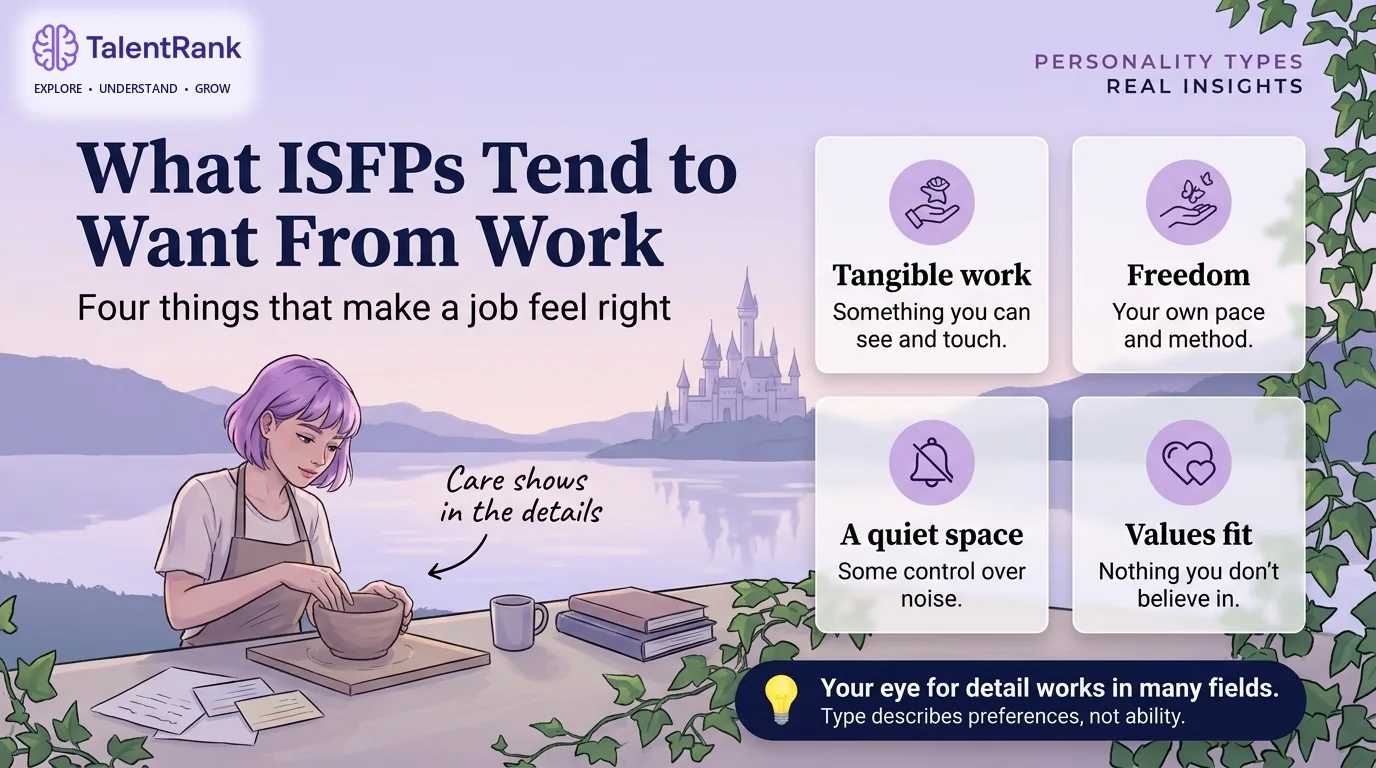
At work, that often means you want:
Work you can see and touch, not just talk about.
Freedom in how and when you do it.
A quiet space, or at least some control over noise and people.
Work that doesn't clash with your values.
ISFPs are sometimes described as the artists of the type system. That's partly true, and it can also box people in. Many people with ISFP preferences express the same eye for detail and care through healthcare, trades, or cooking, and get steadier income in the process.
Best ISFP Jobs to Explore
These careers reward hands-on skill, aesthetics, or one-on-one care. Figures come from the Bureau of Labor Statistics Occupational Outlook Handbook: median pay in May 2025 and projected employment change from 2025 to 2035.
Career | 2025 median pay | Projected growth, 2025–35 | Typical entry education |
Web and digital interface designer | $104,000 | 5% | Bachelor's degree |
Physical therapist | $102,760 | 12% | Doctoral degree |
Dental hygienist | $98,100 | 8% | Associate's degree |
Landscape architect | $79,870 | 4% | Bachelor's degree |
Physical therapist assistant | $68,380 | 23% | Associate's degree |
Interior designer | $67,190 | 3% | Bachelor's degree |
Graphic designer | $62,960 | -2% | Bachelor's degree |
Chef or head cook | $62,470 | 7% | High school diploma plus experience |
Carpenter | $60,580 | 4% | High school diploma plus apprenticeship |
Massage therapist | $58,450 | 15% | Postsecondary certificate |
Craft or fine artist | $55,290 | -1% | Bachelor's degree is common |
Veterinary technician | $47,380 | 9% | Associate's degree |
Photographer | $44,660 | -1% | High school diploma |
Source: BLS Occupational Outlook Handbook, pages updated August 2026.
Hands-On Care
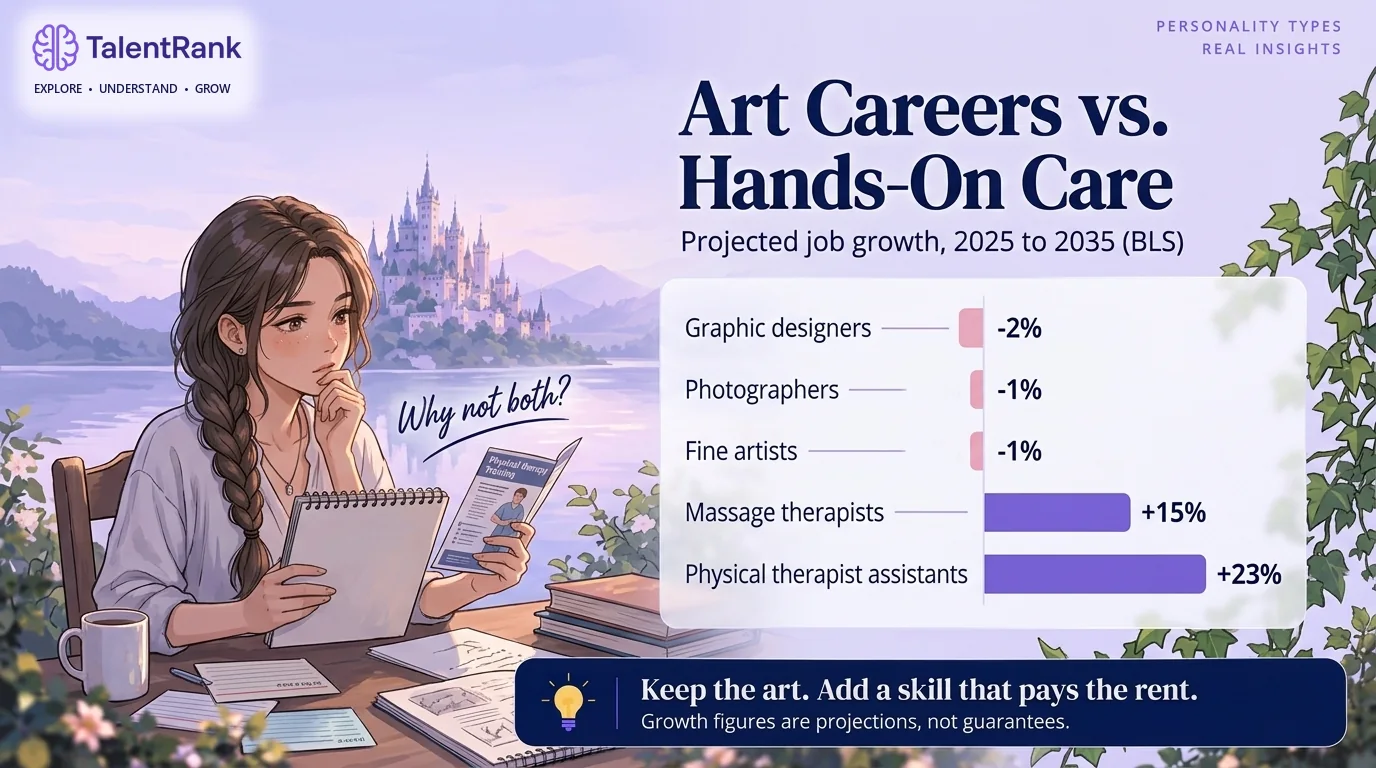
Physical therapist assistants help patients rebuild movement through exercise and practical care, with an associate's degree. BLS projects 23% growth, the fastest in this guide. Physical therapists lead that care and earn more, but need a doctorate. Massage therapists train through a certificate program and are projected to grow 15%. Some run their own practice.
Dental hygienists do precise, one-on-one work with an associate's degree and earned close to $98,000 in 2025. Veterinary technicians suit ISFPs who'd rather care for animals than people.
Design
Interior designers and landscape architects shape real spaces that people live and work in. Both usually need a bachelor's degree, and some states require a license. Web and digital interface designers had the highest median pay in this guide, and the work combines visual taste with understanding how people use a screen.
Making Things
Chefs and head cooks turn taste and presentation into a craft. Most reach the role after years in kitchens, and BLS projects 7% growth. Carpenters learn through a paid apprenticeship, and about a quarter are self-employed, which appeals to ISFPs who want to set their own pace.
The Honest Truth About ISFP Art Careers
Artist, photographer, and graphic designer appear on almost every ISFP list. The BLS data show why it helps to plan carefully:
Graphic designers earned a median of $62,960, and employment is projected to decline 2%. BLS points to AI design tools as one reason.
Photographers earned a median of $44,660, with a 1% projected decline.
Craft and fine artists earned a median of $55,290, also with a 1% projected decline.
That doesn't mean creative work is a bad idea. It means creative income often works best alongside a steady skill. One common approach is to pair art with teaching, commercial design, a trade, or a part-time healthcare role, so the steady job pays the bills while the art grows.
Hypothetical example: an ISFP painter works three days a week as a massage therapist and spends the other two in her studio. The steady income means she can turn down commissions she doesn't believe in. That kind of setup can be more sustainable than trying to live on art sales alone.
ISFP Jobs That Don't Require a Four-Year Degree
Many of the options above start without a bachelor's degree:
Physical therapist assistant: associate's degree, $68,380 median, 23% projected growth.
Dental hygienist: associate's degree, $98,100 median.
Massage therapist: certificate program, $58,450 median, 15% growth.
Carpenter: high school diploma plus apprenticeship, $60,580 median.
Chef or head cook: high school diploma plus kitchen experience, $62,470 median.
Veterinary technician: associate's degree, $47,380 median.
Licensing rules vary by state, especially in healthcare, so check your state board before you enroll.
ISFP-T and ISFP-A Jobs
The -A (Assertive) and -T (Turbulent) suffixes come from 16Personalities, not the official MBTI. 16Personalities adds a fifth scale it calls Identity and bases its model on Big Five research. (16Personalities)
There's no separate list of ISFP-T jobs. The same careers apply. If the Turbulent label fits, you may find public criticism of your work especially draining, which is worth considering in client-facing creative roles where feedback can be blunt.
ISFP Jobs to Avoid (or Conditions to Watch)
Standard "ISFP jobs to avoid" lists usually include sales, management, and corporate finance. The idea is that ISFPs dislike pressure and abstract work. That's a generalization. An ISFP can do well in those fields, especially when the role involves real products or real people.
The conditions that tend to drain ISFPs are more useful to know:
Rigid schedules and micromanagement.
Loud, crowded, or high-conflict workplaces.
Work that feels abstract, with nothing tangible to show for it.
Pressure to act against your values, like pushing a product you don't believe in.
Constant public performance, such as daily presentations.
How to Choose Among ISFP Career Options
Pick three careers from this guide.
Read the daily tasks on O*NET OnLine for each one.
Spend a day shadowing someone in each role, or take a short hands-on class.
Ask working people how much of their week is the part you'd love, and how much is admin.
Compare training cost and time with the pay and outlook above.
Clarifying your work values can help you weigh freedom against stability, and the Holland Code groups careers by interest themes such as Artistic and Realistic.
Seeing Yourself Beyond the Type
Two ISFPs can differ a lot. One is highly organized and runs a busy studio. Another needs lots of quiet and flexibility. Trait measures pick up those differences. Openness and extraversion, for example, shape how much novelty and people contact you'll enjoy. (Our guide to introvert personality traits looks at what lower extraversion can mean at work.)
The TalentRank assessment measures your Big Five personality traits and takes about 12 to 15 minutes. It won't confirm an MBTI type or pick a career for you. It can show where you land on traits like openness, extraversion, and conscientiousness, which help when you're comparing creative and hands-on paths. Take the TalentRank assessment and use the results as one input.
Frequently Asked Questions About ISFP Jobs
What are the best jobs for an ISFP?
ISFPs often enjoy hands-on and creative work, such as physical therapy, dental hygiene, massage therapy, interior and landscape design, digital design, cooking, carpentry, veterinary care, and art. Skills and the specific workplace matter as much as type.
What jobs should ISFPs avoid?
No job is off-limits because of type. It's more useful to avoid conditions that drain many ISFPs, like micromanagement, loud high-conflict workplaces, abstract work with nothing tangible, and pressure to act against their values.
Can an ISFP make a living as an artist?
Some do, but BLS data show modest median pay and small projected declines for graphic designers, photographers, and fine artists. Many ISFPs combine art with a steady skill, such as design, teaching, a trade, or healthcare.
What ISFP jobs pay well?
In this guide, web and digital interface designers had a 2025 median of $104,000, physical therapists $102,760, and dental hygienists $98,100, according to BLS. Dental hygiene requires only an associate's degree.
Is there a difference between ISFP-A and ISFP-T jobs?
No. The A/T suffix comes from 16Personalities, not the official MBTI, and the same careers apply to both.
Are ISFPs good in healthcare?
They can be. Hands-on roles like physical therapist assistant, massage therapist, and dental hygienist combine care with practical skill, and several are growing quickly.
Final Takeaway
ISFP careers tend to work best when there's something real to make, fix, or care for, with some freedom in how you do it. Healthcare, design, trades, and cooking all offer that, and many start with two years of training or less. If art is your calling, keep it, and consider pairing it with a skill that keeps the rent paid.